Sandipan Dhar
sandipandhar@gmail.com
DEFINITION SCIENCE
The word science comes from the
Latin      "scientia,"    meaning
knowledge. According to Webster's
New Collegiate Dictionary, the
definition of science is "knowledge
attained through study or practice,"
ASPECT OF SCIENCE
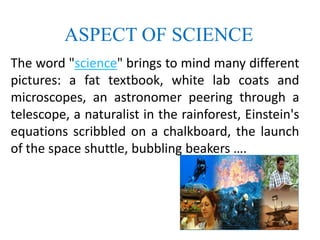
The word "science" brings to mind many different
pictures: a fat textbook, white lab coats and
microscopes, an astronomer peering through a
telescope, a naturalist in the rainforest, Einstein's
equations scribbled on a chalkboard, the launch
of the space shuttle, bubbling beakers ….
CHARACTERISTICS OF SCIENCE
Science is both a body of knowledge and a
process
Science is exciting.
Science is useful
Science is ongoing
Science is a global human endeavor
Discovery: The spark for science
Science has limits
SCIENCE ASKS QUESTIONS ABOUT
Science studies the natural world. This
includes the components of the physical
universe around us like atoms, plants,
ecosystems, people, societies and
galaxies, as well as the natural forces at
work on those things
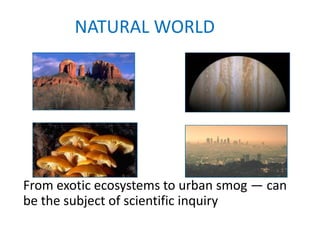
NATURAL WORLD


From exotic ecosystems to urban smog — can
be the subject of scientific inquiry
SCIENCE CAN INVESTIGATE ALL
    SORTS OF QUESTIONS
When did the oldest rocks on earth
form?
Through what chemical reactions do
fungi get energy from the nutrients they
absorb?
What causes Jupiter's red spot?
How does smog move through the
atmosphere?
SCIENTIST
Scientists strive to test their ideas with
evidence from the natural world
 Science depends on interactions within the
scientific community.
 Scientists often work collaboratively.
 Scientific ideas lead to ongoing research.
Answering       one      scientific  question
frequently leads to additional questions to
be investigated.
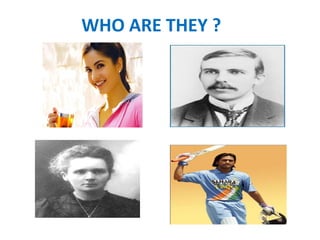
WHO ARE THEY ?
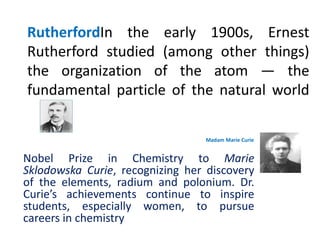
RutherfordIn the early 1900s, Ernest
Rutherford studied (among other things)
the organization of the atom — the
fundamental particle of the natural world

                                 Madam Marie Curie


Nobel Prize in Chemistry to Marie
Sklodowska Curie, recognizing her discovery
of the elements, radium and polonium. Dr.
Curie’s achievements continue to inspire
students, especially women, to pursue
careers in chemistry
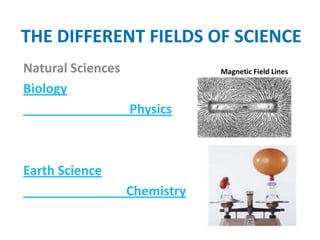
THE DIFFERENT FIELDS OF SCIENCE
Natural Sciences               Magnetic Field Lines

Biology
                   Physics


Earth Science
                   Chemistry
Chemistry

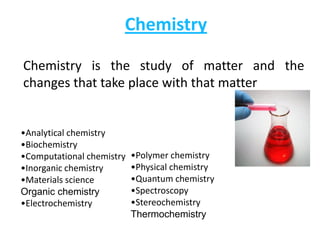
Chemistry is the study of matter and the
changes that take place with that matter


•Analytical chemistry
•Biochemistry
•Computational chemistry   •Polymer chemistry
•Inorganic chemistry       •Physical chemistry
•Materials science         •Quantum chemistry
Organic chemistry          •Spectroscopy
•Electrochemistry          •Stereochemistry
                           Thermochemistry
International Year of Chemistry,
     abbreviated IYC 2011.


   The official slogan of the IYC 2011 is
    "Chemistry—our life, our future".
SIGNIFICANCE OF THE IYC 2011
For the first time in the 100-year history of the
International Union of Pure and Applied Chemistry
(IUPAC), the worldwide chemistry community is
celebrated throughout 2011 the achievements of
chemistry and its contributions to the well-being
of humankind. At its 44th General Assembly in
August 2007 in Torino, Italy, IUPAC unanimously
approved a resolution in favor of the proclamation
of 2011 as the International Year of Chemistry (IYC
2011: www.chemistry2011.org).
ACTIVITIES OF IYC,2011
1.Increase the public’s appreciation of chemistry in
meeting world needs: Chemistry, which is appropriately
called the Central Science, is both a philosophical inquiry
and an applied scientific endeavor. Molecular
transformations are central to the production of
foodstuffs, medicines, fuels, and metals, that is, virtually
all manufactured and extracted products.
2. Increase young people’s interest in chemistry
3.Generate enthusiasm for the creative future of
chemistry
4.Celebrate the 100th anniversary of the Mme. Curie
Nobel Prize and the 100th anniversary of the founding of
the International Association of Chemical SocietieS
MEGA EVENTS OF IYC,2011
An official launch with UNESCO in Paris on
January 27–28, 2011
The 43rd IUPAC Congress and 46th General
Assembly in San Juan, Puerto Rico on July 30–
August 7, 2011.
A closing event in Brussels in November 30–
December 1, 2011
AGRICULTURAL CHEMISTRY
Modern agriculture depends quite heavily
on the advances that have been made in
science, and chemistry in particular, to
maximize the yield of crops and animal
products.Fertilizers,  pesticides,   and
antibiotics play ever increasing roles in
this field
POLLUTION IN SOIL IS ASSOCIATED WITH
Indiscriminate use of fertilizers
Indiscriminate use of pesticides,
insecticides and herbicides
Dumping of large quantities of solid
waste
Deforestation and soil erosion
INDISCRIMINATE USE OF FERTILIZERS
Soil nutrients are important for plant
growth and development. Plants obtain
carbon( C), hydrogen(H) and oxygen(O)
from air and water. But other necessary
nutrients like nitrogen(N), phosphorus(P),
potassium(K),                  calcium(Ca),
magnesium(Mg), sulphur(S) and more
must be obtained from the soil
CONTAMINATION FROM FERTILIZERS
Fertilizers contaminate the soil with
impurities, which come from the raw
materials used for their manufacture.
Mixed fertilizers often contain ammonium
nitrate (NH4NO3), phosphorus as P2O5, and
potassium as K2O. For instance, As, Pb and Cd
present in traces in rock phosphate
Metals are not degradable,
The over use of NPK fertilizers reduce
quantity of vegetables and crops
The carbohydrate quality of such crops also
gets degraded.
 Excess potassium content in soil decreases
Vitamin C and carotene content in
vegetables and fruits.
The vegetables and fruits grown on over-
fertilized soil are more prone to attacks by
insects and disease.
PESTICIDE USE
Pesticides are defined as the substance or
mixture of substances used to prevent, destroy,
repel, attract, sterilise, stupefy or mitigate any
insects.
Generally pesticides are used in three sectors
viz. agriculture, public health and consumer
use. The consumption of pesticide in India is
about 600 gms. / hectare, where as that of
developed countries is touching 3000 gms. /
hectare
INDISCRIMINATE USE OF PESTICIDES,
   INSECTICIDES AND HERBICIDES
The first widespread insecticide use began at
the end of World War II and included DDT
(dichlorodiphenyltrichloroethane)        and
gammaxene. Insects soon became resistant
to DDT and as the chemical did not
decompose readily, it persisted in the
environment.
COND.
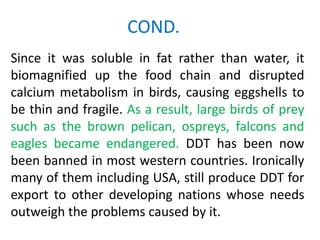
Since it was soluble in fat rather than water, it
biomagnified up the food chain and disrupted
calcium metabolism in birds, causing eggshells to
be thin and fragile. As a result, large birds of prey
such as the brown pelican, ospreys, falcons and
eagles became endangered. DDT has been now
been banned in most western countries. Ironically
many of them including USA, still produce DDT for
export to other developing nations whose needs
outweigh the problems caused by it.
COND.
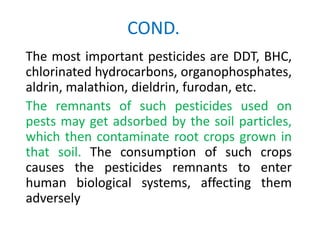
The most important pesticides are DDT, BHC,
chlorinated hydrocarbons, organophosphates,
aldrin, malathion, dieldrin, furodan, etc.
The remnants of such pesticides used on
pests may get adsorbed by the soil particles,
which then contaminate root crops grown in
that soil. The consumption of such crops
causes the pesticides remnants to enter
human biological systems, affecting them
adversely
CONTROL OF SOIL POLLUTION
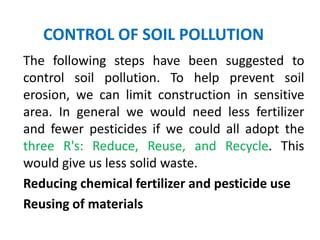
The following steps have been suggested to
control soil pollution. To help prevent soil
erosion, we can limit construction in sensitive
area. In general we would need less fertilizer
and fewer pesticides if we could all adopt the
three R's: Reduce, Reuse, and Recycle. This
would give us less solid waste.
Reducing chemical fertilizer and pesticide use
Reusing of materials
FUN AND INTERESTING CHEMISTRY FACTS

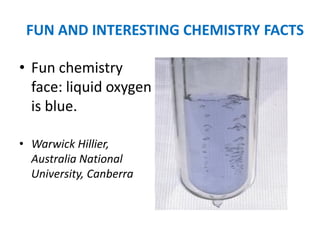
• Fun chemistry
  face: liquid oxygen
  is blue.

• Warwick Hillier,
  Australia National
  University, Canberra
CHEMISTRY IS A FASCINATING SCIENCE
•Unlike many substances, water expands as
it freezes.

•The only elements that are liquid at room
temperature are bromine and mercury.

•However, you can melt gallium by holding
a lump in the warmth of your hand.
CHEMISTRY IS A FASCINATING SCIENCE

• An ice cube takes up about 9% more
  volume than the water used to make it.
• If you pour a handful of salt into a full
  glass of water, the water level will
  actually go down rather than overflowing
  the glass.
• There is about 1/2 lb or 250 g of salt
  (NaCl) in the average adult human body
CHEMISTRY IS A FASCINATING SCIENCE
• A pure element can take many forms. For
  example, diamond and graphite both are
  forms of pure carbon.
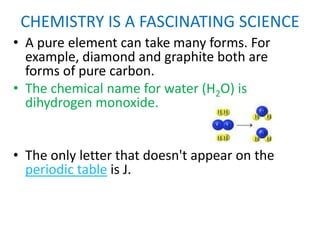
• The chemical name for water (H2O) is
  dihydrogen monoxide.


• The only letter that doesn't appear on the
  periodic table is J.
CHEMISTRY IS A FASCINATING SCIENCE

• Lightning strikes produce O3, which is ozone,
  and strengthen the ozone layer of the
  atmosphere.
• The only two non-silvery metals are gold and
  copper.
• Although oxygen gas is colorless, the liquid
  and solid forms of oxygen are blUE
CHEMISTRY IS A FASCINATING SCIENCE
• The human body contains enough carbon to
  provide 'lead' (which is really graphite) for about
  9,000 pencils.
• Hydrogen is the most abundant element in the
  universe, while oxygen is the most abundant
  element in the earth's atmosphere, crust, and
  oceans (about 49.5%).
• The rarest naturally-occurring element in the
  earth's crust may be astatine. The entire crust
  appears to contain about 28 g of the element
CHEMISTRY IS A FASCINATING SCIENCE

• Hydrofluoric acid is so corrosive that it will
  dissolve glass. Although it is corrosive,
  hydrofluoric acid is considered to be a 'weak
  acid'.
• One bucket full of water contains more atoms
  than there are bucketfuls of water in the
  Atlantic ocean
CHEMISTRY IS A FASCINATING SCIENCE
• Approximately 20% of the oxygen in the
  atmosphere was produced by the Amazon
  rainforest.
• Helium balloons float because helium is
  lighter than air.
• Bee stings are acidic while wasp stings are
  alkaline
CHEMISTRY IS A FASCINATING SCIENCE

• Hot peppers get their heat from a molecule
  called capsaicin. While the molecule acts as an
  irritant to mammals, including humans, birds
  lack the receptor responsible for the effect
  and are immune to the burning sensation
  from exposure.
• Dry ice is the solid form of carbon dioxide,
  CO2.
• Liquid air has a bluish tint, similar to water
KETCHUP & BAKING SODA VOLCANO
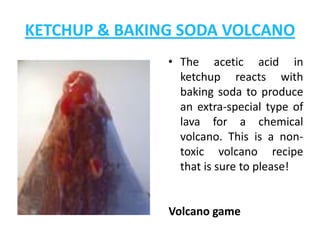
               • The acetic acid in
                 ketchup reacts with
                 baking soda to produce
                 an extra-special type of
                 lava for a chemical
                 volcano. This is a non-
                 toxic volcano recipe
                 that is sure to please!


               Volcano game
SOME PHOTOGRAPHS


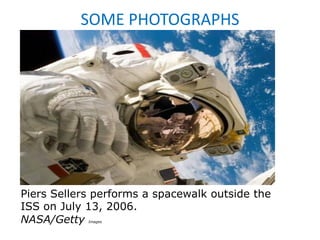
Piers Sellers performs a spacewalk outside the
ISS on July 13, 2006.
NASA/Getty  Images
SOME IMPORTANT PHOTO


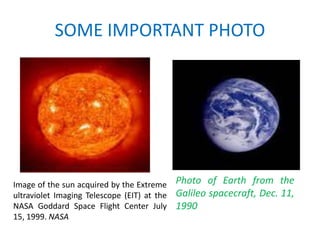
Image of the sun acquired by the Extreme     Photo of Earth from the
ultraviolet Imaging Telescope (EIT) at the   Galileo spacecraft, Dec. 11,
NASA Goddard Space Flight Center July        1990
15, 1999. NASA
Mad Scientist

Presentation iyc

  • 1.
  • 2.
    DEFINITION SCIENCE The wordscience comes from the Latin "scientia," meaning knowledge. According to Webster's New Collegiate Dictionary, the definition of science is "knowledge attained through study or practice,"
  • 3.
    ASPECT OF SCIENCE Theword "science" brings to mind many different pictures: a fat textbook, white lab coats and microscopes, an astronomer peering through a telescope, a naturalist in the rainforest, Einstein's equations scribbled on a chalkboard, the launch of the space shuttle, bubbling beakers ….
  • 4.
    CHARACTERISTICS OF SCIENCE Scienceis both a body of knowledge and a process Science is exciting. Science is useful Science is ongoing Science is a global human endeavor Discovery: The spark for science Science has limits
  • 5.
    SCIENCE ASKS QUESTIONSABOUT Science studies the natural world. This includes the components of the physical universe around us like atoms, plants, ecosystems, people, societies and galaxies, as well as the natural forces at work on those things
  • 6.
    NATURAL WORLD From exoticecosystems to urban smog — can be the subject of scientific inquiry
  • 7.
    SCIENCE CAN INVESTIGATEALL SORTS OF QUESTIONS When did the oldest rocks on earth form? Through what chemical reactions do fungi get energy from the nutrients they absorb? What causes Jupiter's red spot? How does smog move through the atmosphere?
  • 8.
    SCIENTIST Scientists strive totest their ideas with evidence from the natural world Science depends on interactions within the scientific community. Scientists often work collaboratively. Scientific ideas lead to ongoing research. Answering one scientific question frequently leads to additional questions to be investigated.
  • 9.
  • 10.
    RutherfordIn the early1900s, Ernest Rutherford studied (among other things) the organization of the atom — the fundamental particle of the natural world Madam Marie Curie Nobel Prize in Chemistry to Marie Sklodowska Curie, recognizing her discovery of the elements, radium and polonium. Dr. Curie’s achievements continue to inspire students, especially women, to pursue careers in chemistry
  • 11.
    THE DIFFERENT FIELDSOF SCIENCE Natural Sciences Magnetic Field Lines Biology Physics Earth Science Chemistry
  • 12.
    Chemistry Chemistry is thestudy of matter and the changes that take place with that matter •Analytical chemistry •Biochemistry •Computational chemistry •Polymer chemistry •Inorganic chemistry •Physical chemistry •Materials science •Quantum chemistry Organic chemistry •Spectroscopy •Electrochemistry •Stereochemistry Thermochemistry
  • 13.
    International Year ofChemistry, abbreviated IYC 2011. The official slogan of the IYC 2011 is "Chemistry—our life, our future".
  • 14.
    SIGNIFICANCE OF THEIYC 2011 For the first time in the 100-year history of the International Union of Pure and Applied Chemistry (IUPAC), the worldwide chemistry community is celebrated throughout 2011 the achievements of chemistry and its contributions to the well-being of humankind. At its 44th General Assembly in August 2007 in Torino, Italy, IUPAC unanimously approved a resolution in favor of the proclamation of 2011 as the International Year of Chemistry (IYC 2011: www.chemistry2011.org).
  • 15.
    ACTIVITIES OF IYC,2011 1.Increasethe public’s appreciation of chemistry in meeting world needs: Chemistry, which is appropriately called the Central Science, is both a philosophical inquiry and an applied scientific endeavor. Molecular transformations are central to the production of foodstuffs, medicines, fuels, and metals, that is, virtually all manufactured and extracted products. 2. Increase young people’s interest in chemistry 3.Generate enthusiasm for the creative future of chemistry 4.Celebrate the 100th anniversary of the Mme. Curie Nobel Prize and the 100th anniversary of the founding of the International Association of Chemical SocietieS
  • 16.
    MEGA EVENTS OFIYC,2011 An official launch with UNESCO in Paris on January 27–28, 2011 The 43rd IUPAC Congress and 46th General Assembly in San Juan, Puerto Rico on July 30– August 7, 2011. A closing event in Brussels in November 30– December 1, 2011
  • 17.
    AGRICULTURAL CHEMISTRY Modern agriculturedepends quite heavily on the advances that have been made in science, and chemistry in particular, to maximize the yield of crops and animal products.Fertilizers, pesticides, and antibiotics play ever increasing roles in this field
  • 18.
    POLLUTION IN SOILIS ASSOCIATED WITH Indiscriminate use of fertilizers Indiscriminate use of pesticides, insecticides and herbicides Dumping of large quantities of solid waste Deforestation and soil erosion
  • 19.
    INDISCRIMINATE USE OFFERTILIZERS Soil nutrients are important for plant growth and development. Plants obtain carbon( C), hydrogen(H) and oxygen(O) from air and water. But other necessary nutrients like nitrogen(N), phosphorus(P), potassium(K), calcium(Ca), magnesium(Mg), sulphur(S) and more must be obtained from the soil
  • 20.
    CONTAMINATION FROM FERTILIZERS Fertilizerscontaminate the soil with impurities, which come from the raw materials used for their manufacture. Mixed fertilizers often contain ammonium nitrate (NH4NO3), phosphorus as P2O5, and potassium as K2O. For instance, As, Pb and Cd present in traces in rock phosphate Metals are not degradable,
  • 21.
    The over useof NPK fertilizers reduce quantity of vegetables and crops The carbohydrate quality of such crops also gets degraded. Excess potassium content in soil decreases Vitamin C and carotene content in vegetables and fruits. The vegetables and fruits grown on over- fertilized soil are more prone to attacks by insects and disease.
  • 22.
    PESTICIDE USE Pesticides aredefined as the substance or mixture of substances used to prevent, destroy, repel, attract, sterilise, stupefy or mitigate any insects. Generally pesticides are used in three sectors viz. agriculture, public health and consumer use. The consumption of pesticide in India is about 600 gms. / hectare, where as that of developed countries is touching 3000 gms. / hectare
  • 23.
    INDISCRIMINATE USE OFPESTICIDES, INSECTICIDES AND HERBICIDES The first widespread insecticide use began at the end of World War II and included DDT (dichlorodiphenyltrichloroethane) and gammaxene. Insects soon became resistant to DDT and as the chemical did not decompose readily, it persisted in the environment.
  • 24.
    COND. Since it wassoluble in fat rather than water, it biomagnified up the food chain and disrupted calcium metabolism in birds, causing eggshells to be thin and fragile. As a result, large birds of prey such as the brown pelican, ospreys, falcons and eagles became endangered. DDT has been now been banned in most western countries. Ironically many of them including USA, still produce DDT for export to other developing nations whose needs outweigh the problems caused by it.
  • 25.
    COND. The most importantpesticides are DDT, BHC, chlorinated hydrocarbons, organophosphates, aldrin, malathion, dieldrin, furodan, etc. The remnants of such pesticides used on pests may get adsorbed by the soil particles, which then contaminate root crops grown in that soil. The consumption of such crops causes the pesticides remnants to enter human biological systems, affecting them adversely
  • 27.
    CONTROL OF SOILPOLLUTION The following steps have been suggested to control soil pollution. To help prevent soil erosion, we can limit construction in sensitive area. In general we would need less fertilizer and fewer pesticides if we could all adopt the three R's: Reduce, Reuse, and Recycle. This would give us less solid waste. Reducing chemical fertilizer and pesticide use Reusing of materials
  • 28.
    FUN AND INTERESTINGCHEMISTRY FACTS • Fun chemistry face: liquid oxygen is blue. • Warwick Hillier, Australia National University, Canberra
  • 29.
    CHEMISTRY IS AFASCINATING SCIENCE •Unlike many substances, water expands as it freezes. •The only elements that are liquid at room temperature are bromine and mercury. •However, you can melt gallium by holding a lump in the warmth of your hand.
  • 30.
    CHEMISTRY IS AFASCINATING SCIENCE • An ice cube takes up about 9% more volume than the water used to make it. • If you pour a handful of salt into a full glass of water, the water level will actually go down rather than overflowing the glass. • There is about 1/2 lb or 250 g of salt (NaCl) in the average adult human body
  • 31.
    CHEMISTRY IS AFASCINATING SCIENCE • A pure element can take many forms. For example, diamond and graphite both are forms of pure carbon. • The chemical name for water (H2O) is dihydrogen monoxide. • The only letter that doesn't appear on the periodic table is J.
  • 32.
    CHEMISTRY IS AFASCINATING SCIENCE • Lightning strikes produce O3, which is ozone, and strengthen the ozone layer of the atmosphere. • The only two non-silvery metals are gold and copper. • Although oxygen gas is colorless, the liquid and solid forms of oxygen are blUE
  • 33.
    CHEMISTRY IS AFASCINATING SCIENCE • The human body contains enough carbon to provide 'lead' (which is really graphite) for about 9,000 pencils. • Hydrogen is the most abundant element in the universe, while oxygen is the most abundant element in the earth's atmosphere, crust, and oceans (about 49.5%). • The rarest naturally-occurring element in the earth's crust may be astatine. The entire crust appears to contain about 28 g of the element
  • 34.
    CHEMISTRY IS AFASCINATING SCIENCE • Hydrofluoric acid is so corrosive that it will dissolve glass. Although it is corrosive, hydrofluoric acid is considered to be a 'weak acid'. • One bucket full of water contains more atoms than there are bucketfuls of water in the Atlantic ocean
  • 35.
    CHEMISTRY IS AFASCINATING SCIENCE • Approximately 20% of the oxygen in the atmosphere was produced by the Amazon rainforest. • Helium balloons float because helium is lighter than air. • Bee stings are acidic while wasp stings are alkaline
  • 36.
    CHEMISTRY IS AFASCINATING SCIENCE • Hot peppers get their heat from a molecule called capsaicin. While the molecule acts as an irritant to mammals, including humans, birds lack the receptor responsible for the effect and are immune to the burning sensation from exposure. • Dry ice is the solid form of carbon dioxide, CO2. • Liquid air has a bluish tint, similar to water
  • 37.
    KETCHUP & BAKINGSODA VOLCANO • The acetic acid in ketchup reacts with baking soda to produce an extra-special type of lava for a chemical volcano. This is a non- toxic volcano recipe that is sure to please! Volcano game
  • 38.
    SOME PHOTOGRAPHS Piers Sellersperforms a spacewalk outside the ISS on July 13, 2006. NASA/Getty Images
  • 39.
    SOME IMPORTANT PHOTO Imageof the sun acquired by the Extreme Photo of Earth from the ultraviolet Imaging Telescope (EIT) at the Galileo spacecraft, Dec. 11, NASA Goddard Space Flight Center July 1990 15, 1999. NASA
  • 40.