Energy and Comfort in
Buildings
Practical assessment
University of Minho
Master of Sustainable Rehabilitation And Construction
18-Dec-2015
Group 4:
Ahmad Alshaghel
Chadi Charles
NisreenArdda
Rita Correia
Energy and Comfort in Buildings
• Introduction
• Orientation
• Window area
• Air change rate
• HVAC systems
• Shading system
• DHW systems
• Insulation
• NZEB
• Thermal Comfort
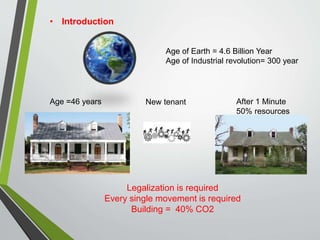
• Introduction
Age of Earth = 4.6 Billion Year
Age of Industrial revolution= 300 year
Age =46 years After 1 Minute
50% resources
New tenant
Legalization is required
Every single movement is required
Building = 40% CO2
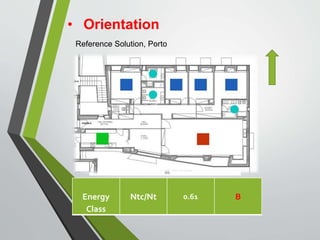
• Orientation
B0.61Ntc/NtEnergy
Class
Reference Solution, Porto
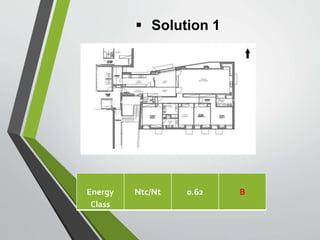
Heating gains decrease 2%
total energy increase 0.4%
 Solution 1
B0.62Ntc/NtEnergy
Class
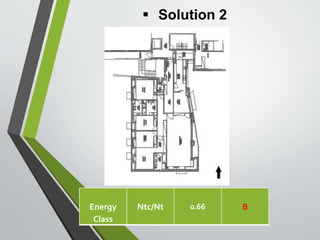
 Solution 2
energy for cooling increases around 13%.
the total energy increase 6% B0.66Ntc/NtEnergy
Class
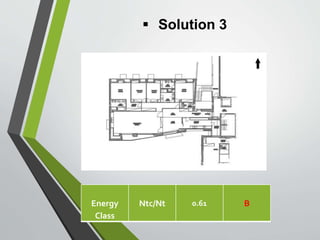
 Solution 3
energy for cooling and cooling about 1%.
the total energy increase 1%
B0.61Ntc/NtEnergy
Class
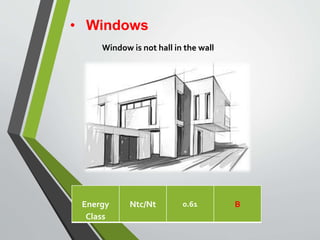
• Windows
Window is not hall in the wall
B0.61Ntc/NtEnergy
Class
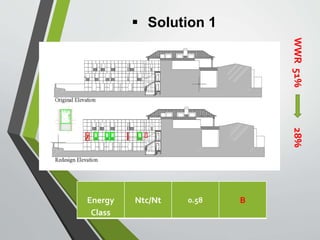
 Solution 1
Transmission /cooling decrease about 10%
WWR51%28%
energy for heating decrease about 5%
energy for cooling decrease about 13%
global energy decrease 6%
B0.58Ntc/NtEnergy
Class
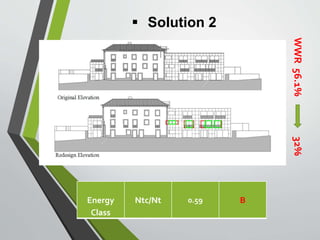
 Solution 2
Transmission /cooling decrease about 10%
WWR56.1%32%
energy for heating decrease about 4%
energy for cooling decrease about 9%
global energy decrease 4.5%
B0.59Ntc/NtEnergy
Class
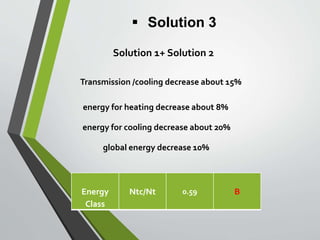
 Solution 3
Transmission /cooling decrease about 15%
energy for heating decrease about 8%
energy for cooling decrease about 20%
global energy decrease 10%
B0.59Ntc/NtEnergy
Class
Solution 1+ Solution 2
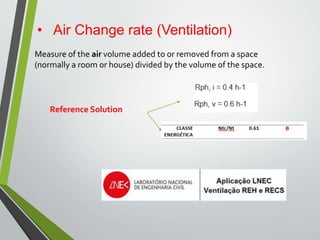
• Air Change rate (Ventilation)
Measure of the air volume added to or removed from a space
(normally a room or house) divided by the volume of the space.
Reference Solution
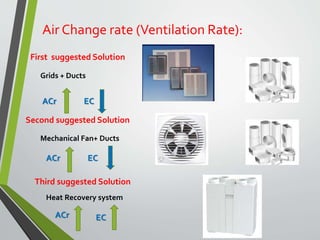
First suggested Solution
Air Change rate (Ventilation Rate):
Second suggested Solution
Third suggested Solution
Grids + Ducts
ACr EC
ACr EC
ACr EC
Mechanical Fan+ Ducts
Heat Recovery system
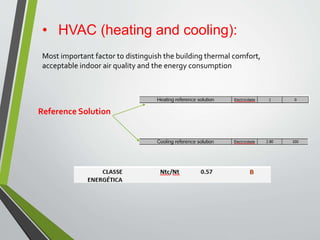
• HVAC (heating and cooling):
Most important factor to distinguish the building thermal comfort,
acceptable indoor air quality and the energy consumption
Reference Solution
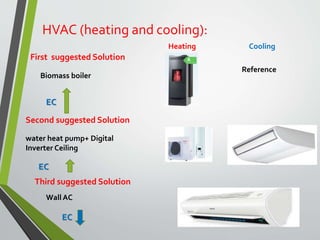
First suggested Solution
Second suggested Solution
Third suggested Solution
Biomass boiler
EC
EC
EC
water heat pump+ Digital
Inverter Ceiling
Wall AC
HVAC (heating and cooling):
Reference
CoolingHeating
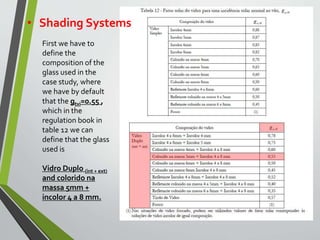
First we have to
define the
composition of the
glass used in the
case study, where
we have by default
that the gtvi=0.55 ,
which in the
regulation book in
table 12 we can
define that the glass
used is
Vidro Duplo (int + ext)
and colorido na
massa 5mm +
incolor 4 a 8 mm.
• Shading Systems
1. Lona MuitoTransparente. (0.64 B) [ Reference case study ]
2. the Portada De Madeira. (0.59 B)
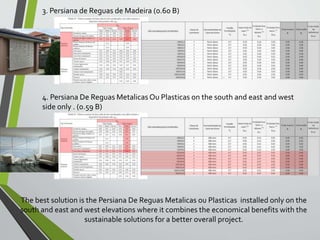
3. Persiana de Reguas de Madeira (0.60 B)
4. Persiana De Reguas Metalicas Ou Plasticas on the south and east and west
side only . (0.59 B)
The best solution is the Persiana De Reguas Metalicas ou Plasticas installed only on the
south and east and west elevations where it combines the economical benefits with the
sustainable solutions for a better overall project.
• AQS or DHW Domestic Hot Water.
Water used, in any type of building, for domestic purposes, principally
drinking, food preparation, sanitation and personal hygiene.
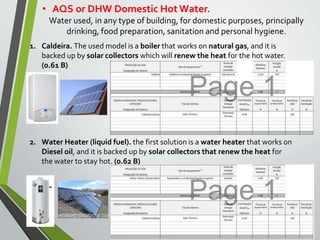
1. Caldeira. The used model is a boiler that works on natural gas, and it is
backed up by solar collectors which will renew the heat for the hot water.
(0.61 B)
2. Water Heater (liquid fuel). the first solution is a water heater that works on
Diesel oil, and it is backed up by solar collectors that renew the heat for
the water to stay hot. (0.62 B)
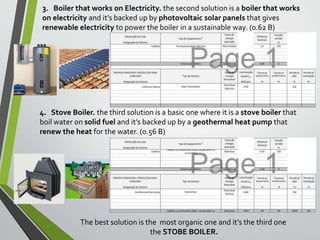
3. Boiler that works on Electricity. the second solution is a boiler that works
on electricity and it’s backed up by photovoltaic solar panels that gives
renewable electricity to power the boiler in a sustainable way. (0.62 B)
4. Stove Boiler. the third solution is a basic one where it is a stove boiler that
boil water on solid fuel and it’s backed up by a geothermal heat pump that
renew the heat for the water. (0.56 B)
The best solution is the most organic one and it’s the third one
the STOBE BOILER.
Insulation
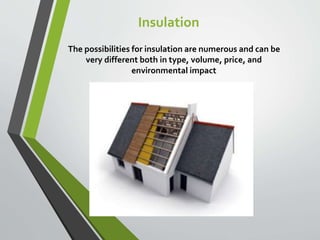
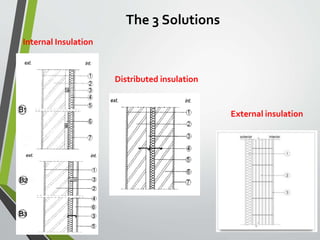
The possibilities for insulation are numerous and can be
very different both in type, volume, price, and
environmental impact
The 3 Solutions
Internal Insulation
Distributed insulation
External insulation
BuildingThermal inertia
ASSUMED CONTRIBUTION from
Pavements and Separation Walls:
maximum allowed superficial mass (150Kg/m2)
reduction factor equal to 1.
Sseparationwalls = 130m2
It = [2 x (150 x 1 x 130) + (150 x 189,12)] / 189,12 = 356 Kg/m2
PlaneThermal bridges
ASSUMED
Concrete Intermediate Pillars (0,25m thick)
R = 0,25/2,3 = 0,11 [(m2.ºC)/W]
Internal Insulation Distributed insulation
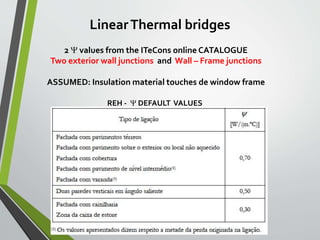
LinearThermal bridges
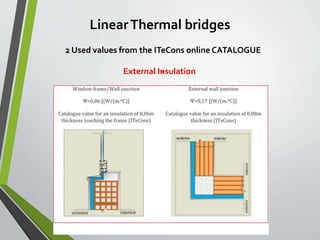
2  values from the ITeCons online CATALOGUE
Two exterior wall junctions and Wall – Frame junctions
ASSUMED: Insulation material touches de window frame
REH -  DEFAULT VALUES
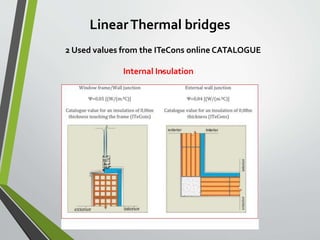
LinearThermal bridges
2 Used values from the ITeCons online CATALOGUE
-Internal Insulation
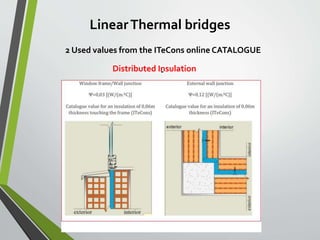
LinearThermal bridges
2 Used values from the ITeCons online CATALOGUE
-Distributed Insulation
LinearThermal bridges
2 Used values from the ITeCons online CATALOGUE
-External Insulation
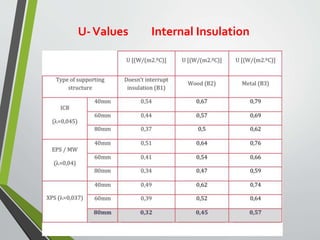
U-Values Internal Insulation
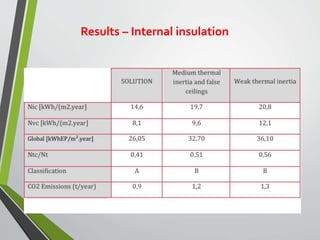
Results – Internal insulation
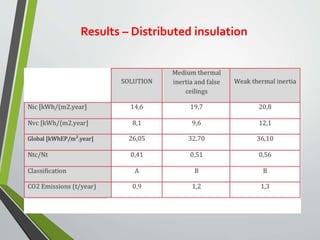
Results – Distributed insulation
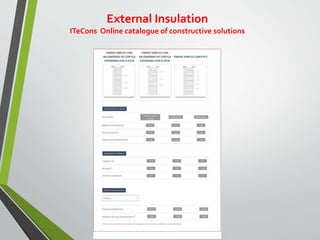
External Insulation
ITeCons Online catalogue of constructive solutions
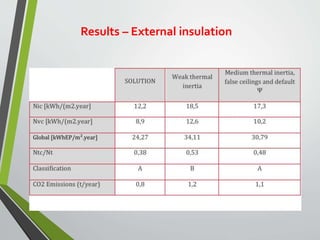
Results – External insulation
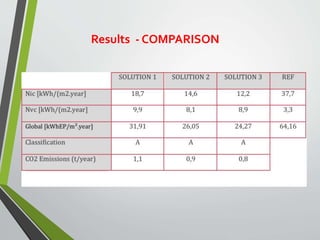
Results - COMPARISON
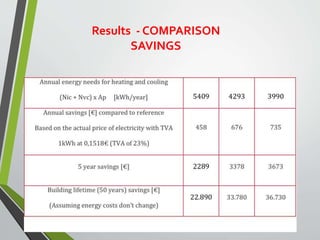
SAVINGS
Results - COMPARISON
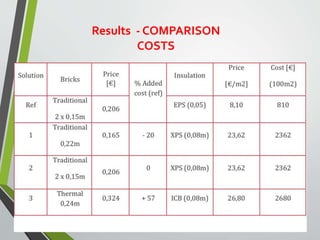
COSTS
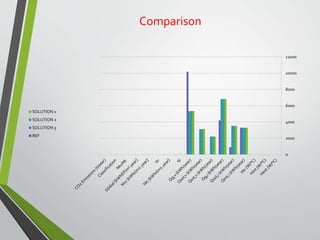
Comparison
0
2000
4000
6000
8000
10000
12000
SOLUTION 1
SOLUTION 2
SOLUTION 3
REF
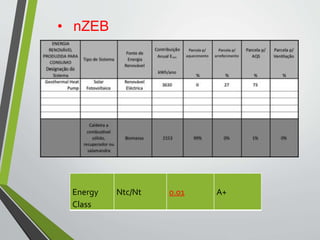
nZEB
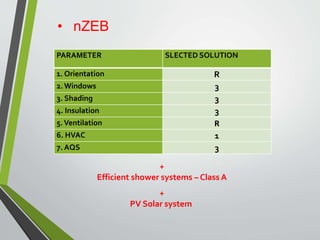
• nZEB
PARAMETER SLECTED SOLUTION
1. Orientation R
2. Windows 3
3. Shading 3
4. Insulation 3
5.Ventilation R
6. HVAC 1
7. AQS 3
+
Efficient shower systems – Class A
+
PV Solar system
• nZEB
A+0.01Ntc/NtEnergy
Class
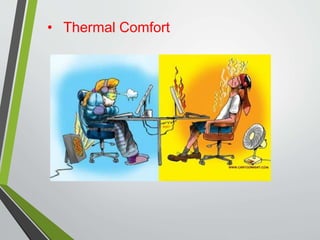
• Thermal Comfort
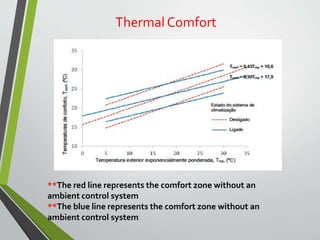
Thermal Comfort
**The red line represents the comfort zone without an
ambient control system
**The blue line represents the comfort zone without an
ambient control system
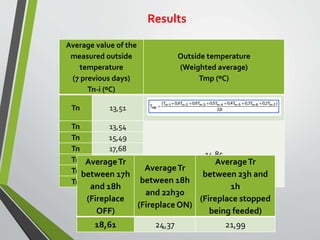
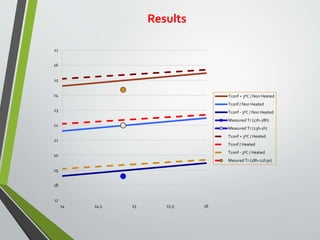
Results
Average value of the
measured outside
temperature
(7 previous days)
Tn-i (ºC)
Outside temperature
(Weighted average)
Tmp (ºC)
Tn 13,51
Tn 13,54
14,85
Tn 15,49
Tn 17,68
Tn 16,07
Tn 15,58
Tn 14,18
AverageTr
between 17h
and 18h
(Fireplace
OFF)
AverageTr
between 18h
and 22h30
(Fireplace ON)
AverageTr
between 23h and
1h
(Fireplace stopped
being feeded)
18,61 24,37 21,99
Results
17
18
19
20
21
22
23
24
25
26
27
14 14.5 15 15.5 16
Tconf + 3ºC / Non Heated
Tconf / Non Heated
Tconf - 3ºC / Non Heated
Measured Tr (17h-18h)
Measured Tr (23h-1h)
Tconf + 3ºC / Heated
Tconf / Heated
Tconf - 3ºC / Heated
Mesured Tr (18h-22h30)
ThankYou

Presentation energy and comfort

  • 1.
    Energy and Comfortin Buildings Practical assessment University of Minho Master of Sustainable Rehabilitation And Construction 18-Dec-2015 Group 4: Ahmad Alshaghel Chadi Charles NisreenArdda Rita Correia
  • 2.
    Energy and Comfortin Buildings • Introduction • Orientation • Window area • Air change rate • HVAC systems • Shading system • DHW systems • Insulation • NZEB • Thermal Comfort
  • 3.
    • Introduction Age ofEarth = 4.6 Billion Year Age of Industrial revolution= 300 year Age =46 years After 1 Minute 50% resources New tenant Legalization is required Every single movement is required Building = 40% CO2
  • 4.
  • 5.
    Heating gains decrease2% total energy increase 0.4%  Solution 1 B0.62Ntc/NtEnergy Class
  • 6.
     Solution 2 energyfor cooling increases around 13%. the total energy increase 6% B0.66Ntc/NtEnergy Class
  • 7.
     Solution 3 energyfor cooling and cooling about 1%. the total energy increase 1% B0.61Ntc/NtEnergy Class
  • 8.
    • Windows Window isnot hall in the wall B0.61Ntc/NtEnergy Class
  • 9.
     Solution 1 Transmission/cooling decrease about 10% WWR51%28% energy for heating decrease about 5% energy for cooling decrease about 13% global energy decrease 6% B0.58Ntc/NtEnergy Class
  • 10.
     Solution 2 Transmission/cooling decrease about 10% WWR56.1%32% energy for heating decrease about 4% energy for cooling decrease about 9% global energy decrease 4.5% B0.59Ntc/NtEnergy Class
  • 11.
     Solution 3 Transmission/cooling decrease about 15% energy for heating decrease about 8% energy for cooling decrease about 20% global energy decrease 10% B0.59Ntc/NtEnergy Class Solution 1+ Solution 2
  • 12.
    • Air Changerate (Ventilation) Measure of the air volume added to or removed from a space (normally a room or house) divided by the volume of the space. Reference Solution
  • 13.
    First suggested Solution AirChange rate (Ventilation Rate): Second suggested Solution Third suggested Solution Grids + Ducts ACr EC ACr EC ACr EC Mechanical Fan+ Ducts Heat Recovery system
  • 14.
    • HVAC (heatingand cooling): Most important factor to distinguish the building thermal comfort, acceptable indoor air quality and the energy consumption Reference Solution
  • 15.
    First suggested Solution Secondsuggested Solution Third suggested Solution Biomass boiler EC EC EC water heat pump+ Digital Inverter Ceiling Wall AC HVAC (heating and cooling): Reference CoolingHeating
  • 16.
    First we haveto define the composition of the glass used in the case study, where we have by default that the gtvi=0.55 , which in the regulation book in table 12 we can define that the glass used is Vidro Duplo (int + ext) and colorido na massa 5mm + incolor 4 a 8 mm. • Shading Systems
  • 17.
    1. Lona MuitoTransparente.(0.64 B) [ Reference case study ] 2. the Portada De Madeira. (0.59 B)
  • 18.
    3. Persiana deReguas de Madeira (0.60 B) 4. Persiana De Reguas Metalicas Ou Plasticas on the south and east and west side only . (0.59 B) The best solution is the Persiana De Reguas Metalicas ou Plasticas installed only on the south and east and west elevations where it combines the economical benefits with the sustainable solutions for a better overall project.
  • 19.
    • AQS orDHW Domestic Hot Water. Water used, in any type of building, for domestic purposes, principally drinking, food preparation, sanitation and personal hygiene. 1. Caldeira. The used model is a boiler that works on natural gas, and it is backed up by solar collectors which will renew the heat for the hot water. (0.61 B) 2. Water Heater (liquid fuel). the first solution is a water heater that works on Diesel oil, and it is backed up by solar collectors that renew the heat for the water to stay hot. (0.62 B)
  • 20.
    3. Boiler thatworks on Electricity. the second solution is a boiler that works on electricity and it’s backed up by photovoltaic solar panels that gives renewable electricity to power the boiler in a sustainable way. (0.62 B) 4. Stove Boiler. the third solution is a basic one where it is a stove boiler that boil water on solid fuel and it’s backed up by a geothermal heat pump that renew the heat for the water. (0.56 B) The best solution is the most organic one and it’s the third one the STOBE BOILER.
  • 21.
    Insulation The possibilities forinsulation are numerous and can be very different both in type, volume, price, and environmental impact
  • 22.
    The 3 Solutions InternalInsulation Distributed insulation External insulation
  • 23.
    BuildingThermal inertia ASSUMED CONTRIBUTIONfrom Pavements and Separation Walls: maximum allowed superficial mass (150Kg/m2) reduction factor equal to 1. Sseparationwalls = 130m2 It = [2 x (150 x 1 x 130) + (150 x 189,12)] / 189,12 = 356 Kg/m2
  • 24.
    PlaneThermal bridges ASSUMED Concrete IntermediatePillars (0,25m thick) R = 0,25/2,3 = 0,11 [(m2.ºC)/W] Internal Insulation Distributed insulation
  • 25.
    LinearThermal bridges 2 values from the ITeCons online CATALOGUE Two exterior wall junctions and Wall – Frame junctions ASSUMED: Insulation material touches de window frame REH -  DEFAULT VALUES
  • 26.
    LinearThermal bridges 2 Usedvalues from the ITeCons online CATALOGUE -Internal Insulation
  • 27.
    LinearThermal bridges 2 Usedvalues from the ITeCons online CATALOGUE -Distributed Insulation
  • 28.
    LinearThermal bridges 2 Usedvalues from the ITeCons online CATALOGUE -External Insulation
  • 29.
  • 30.
  • 31.
  • 32.
    External Insulation ITeCons Onlinecatalogue of constructive solutions
  • 33.
  • 34.
  • 35.
  • 36.
  • 37.
  • 38.
  • 39.
    • nZEB PARAMETER SLECTEDSOLUTION 1. Orientation R 2. Windows 3 3. Shading 3 4. Insulation 3 5.Ventilation R 6. HVAC 1 7. AQS 3 + Efficient shower systems – Class A + PV Solar system
  • 40.
  • 41.
  • 42.
    Thermal Comfort **The redline represents the comfort zone without an ambient control system **The blue line represents the comfort zone without an ambient control system
  • 43.
    Results Average value ofthe measured outside temperature (7 previous days) Tn-i (ºC) Outside temperature (Weighted average) Tmp (ºC) Tn 13,51 Tn 13,54 14,85 Tn 15,49 Tn 17,68 Tn 16,07 Tn 15,58 Tn 14,18 AverageTr between 17h and 18h (Fireplace OFF) AverageTr between 18h and 22h30 (Fireplace ON) AverageTr between 23h and 1h (Fireplace stopped being feeded) 18,61 24,37 21,99
  • 44.
    Results 17 18 19 20 21 22 23 24 25 26 27 14 14.5 1515.5 16 Tconf + 3ºC / Non Heated Tconf / Non Heated Tconf - 3ºC / Non Heated Measured Tr (17h-18h) Measured Tr (23h-1h) Tconf + 3ºC / Heated Tconf / Heated Tconf - 3ºC / Heated Mesured Tr (18h-22h30)
  • 45.