MOHSIN AZIZ FA19-BSM-033 HEAD
JAHANZAIB FA19-BSM-027
MUHAMMAD ABDULLAH SP19-BSM-027
RAMZAN ALI SP19-BSM-038
KASHIF RASHID SP19-BSM-030
MUHAMMAD USMAN SP19-BSM-031
Table of contents:
Background
History
Introduction
Formula
Criteria of Binomial distribution
Conclusion
Background
In probability theory and statistics, the binomial distribution is
the discrete probability distribution that gives only two possible
results in an experiment, either Success or Failure. For
example, if we toss a coin, there could be only two possible
outcomes: heads or tails, and if any test is taken, then there
could be only two results:pass or fail.
This distribution is also called a binomial probability distribution.
History of the Binomial Distribution
This historical study allowed us to discuss five periods in the
development of the binomial distribution:
The First Approach to Binomial Phenomena:
 Early Combinatorics and Number Patterns from Ancient India and
Greece to Dante’s Divine Comedy (600 BCE—14th Century).
 The first approaches by former experts to the study of probabilistic
phenomena, which can also be associated with binomial situations.
 The combinatorial problems was presented in the oral compilations of
the encyclopedic work called the Bhagavati Sutra(Exposition of
Explanations) (5th century BC).
Development and Formalization of Numerical
Patterns for Counting Cases:
 From Stifel’s and Pascal’s Triangles to Probability as a Numerical
Notion by Arnauld and Nicole (15th Century–16th Century).
 The mathematical patterns identified in the previous period and their
relationships were formalized and presented in works such as Stifel’s
triangle and Pascal’s triangle.
Third period:
 Use of Mathematical Constructs to Model Probability Situations from
the Beginnings of Probability Theory with the Problem of Points to the
Incomplete Binomial Distribution by Pascal and Fermat (15th–17th
Centuries).
 The deductive use of constructs such as combinatorics was presented
and allowing the direct calculation of the probability of concrete
situations.
Fourth period:
 The Informal Binomial Distribution, from Its First Appearance in the
Works of Pascal and Fermat to Its Iterations in the Works of Huygens and
Arbuthnot (17th Century–18th Century).
 the generalization of expressions to model binomial situations involving
some unknown variable, such as the number of trials needed or particular
cases, was identified.
Fifth period:
 The Big Leap in Probability Theory: The Formal Binomial Distribution
by Bernoulli and Its Consolidation as Part of Mathematical and
Probability Theory (18th Century Onwards).
 This period was started by Pierre Rémond and followed by persons such
as Nicholas, James Bernoulli and Arbuthnot.
Introduction
 Binomial distribution is a common probability distribution that
models the probability of obtaining one of two outcomes under
a given number of parameters.
 The binomial distribution model allows us to compute the
probability of observing a specified number of "successes"
when the process is repeated a specific number of times.
 It summarizes the number of trials when each trials has the
same chance of attaining one specific outcome.
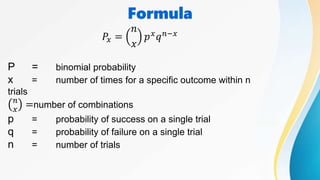
Formula
𝑃𝑥 =
𝑛
𝑥
𝑝𝑥
𝑞𝑛−𝑥
P = binomial probability
x = number of times for a specific outcome within n
trials
𝑛
𝑥
=number of combinations
p = probability of success on a single trial
q = probability of failure on a single trial
n = number of trials
Criteria of binomial distribution
Binomial distribution models the probability of occurrence of an
event when specific criteria are met. Binomial distribution
involves the following rules that must be present in the process
in order to use the binomial probability formula.
1. Fixed trials
 The process under investigation must have a fixed number of trials
that cannot be altered in the course of the analysis. During the
analysis, each trial must be performed in a uniform manner,
although each trial may yield a different outcome.
Example:
An example of a fixed trial may be coin flips, free throws, wheel
spins, etc. The number of times that each trial is conducted is
known from the start. If a coin is flipped 10 times, each flip of the
coin is a trial.
2. Independent trials
The other condition of a binomial probability is that the trials are
independent of each other. In simple terms, the outcome of one
trial should not affect the outcome of the subsequent trials. When
using certain sampling methods, there is a possibility of having
trials that are not completely independent of each other, and
binomial distribution may only be used when the size of the
population is large vis-a-vis the sample size.
Example
 An example of independent trials may be tossing a coin or
rolling a dice. When tossing a coin, the first event is
independent of the subsequent events.
3. Fixed probability of success
In a binomial distribution, the probability of getting a success
must remain the same for the trials we are investigating. For
example, when tossing a coin, the probability of flipping a coin
is ½ or 0.5 for every trial we conduct, since there are only two
possible outcomes. In some sampling techniques, such as
sampling without replacement, the probability of success from
each trial may vary from one trial to the other.
Example
 For example, assume that there are 50 boys in a population of
1,000 students. The probability of picking a boy from that
population is 0.05.
 In the next trial, there will be 49 boys out of 999 students. The
probability of picking a boy in the next trial is 0.049. It shows
that in subsequent trials, the probability from one trial to the
next will vary slightly from the prior trial.
4. Two mutually exqclusive outcomes
In binomial probability, there are only two mutually exclusive
outcomes, i.e., success or failure. While success is generally a
positive term, it can be used to mean that the outcome of the
trial agrees with what you have defined as a success, whether
it is a positive or negative outcome.
Example
When a business receives a consignment of lamps with a lot of
breakages, the business can define success for the trial to be
every lamp that has broken glass. A failure can be defined as
when the lamps have zero broken glasses. In our example, the
instances of broken lamps may be used to denote success as a
way of showing that a high proportion of the lamps in the
consignment is broken. and that there is a low probability of
getting a consignment of lamps with zero breakages.
Conclusion
 The binomial distribution is a discrete probability.
 distribution used when there are only two possible
outcomes for a random variable: success and failure.
 Success and failure are mutually exclusive; they cannot
occur at the same time.
 The binomial distribution assumes a finite number
of trials n.
 For the binomial distribution to be applied, each successive
trial must be independent of the last; that is, the outcome of
a previous trial has no bearing on the probabilities of
success onsubsequent trials.
Thanks
Thanks

presentation itc.pptx

  • 2.
    MOHSIN AZIZ FA19-BSM-033HEAD JAHANZAIB FA19-BSM-027 MUHAMMAD ABDULLAH SP19-BSM-027 RAMZAN ALI SP19-BSM-038 KASHIF RASHID SP19-BSM-030 MUHAMMAD USMAN SP19-BSM-031
  • 3.
  • 4.
    Background In probability theoryand statistics, the binomial distribution is the discrete probability distribution that gives only two possible results in an experiment, either Success or Failure. For example, if we toss a coin, there could be only two possible outcomes: heads or tails, and if any test is taken, then there could be only two results:pass or fail. This distribution is also called a binomial probability distribution.
  • 5.
    History of theBinomial Distribution This historical study allowed us to discuss five periods in the development of the binomial distribution: The First Approach to Binomial Phenomena:  Early Combinatorics and Number Patterns from Ancient India and Greece to Dante’s Divine Comedy (600 BCE—14th Century).  The first approaches by former experts to the study of probabilistic phenomena, which can also be associated with binomial situations.  The combinatorial problems was presented in the oral compilations of the encyclopedic work called the Bhagavati Sutra(Exposition of Explanations) (5th century BC).
  • 6.
    Development and Formalizationof Numerical Patterns for Counting Cases:  From Stifel’s and Pascal’s Triangles to Probability as a Numerical Notion by Arnauld and Nicole (15th Century–16th Century).  The mathematical patterns identified in the previous period and their relationships were formalized and presented in works such as Stifel’s triangle and Pascal’s triangle. Third period:  Use of Mathematical Constructs to Model Probability Situations from the Beginnings of Probability Theory with the Problem of Points to the Incomplete Binomial Distribution by Pascal and Fermat (15th–17th Centuries).  The deductive use of constructs such as combinatorics was presented and allowing the direct calculation of the probability of concrete situations.
  • 7.
    Fourth period:  TheInformal Binomial Distribution, from Its First Appearance in the Works of Pascal and Fermat to Its Iterations in the Works of Huygens and Arbuthnot (17th Century–18th Century).  the generalization of expressions to model binomial situations involving some unknown variable, such as the number of trials needed or particular cases, was identified. Fifth period:  The Big Leap in Probability Theory: The Formal Binomial Distribution by Bernoulli and Its Consolidation as Part of Mathematical and Probability Theory (18th Century Onwards).  This period was started by Pierre Rémond and followed by persons such as Nicholas, James Bernoulli and Arbuthnot.
  • 8.
    Introduction  Binomial distributionis a common probability distribution that models the probability of obtaining one of two outcomes under a given number of parameters.  The binomial distribution model allows us to compute the probability of observing a specified number of "successes" when the process is repeated a specific number of times.  It summarizes the number of trials when each trials has the same chance of attaining one specific outcome.
  • 9.
    Formula 𝑃𝑥 = 𝑛 𝑥 𝑝𝑥 𝑞𝑛−𝑥 P =binomial probability x = number of times for a specific outcome within n trials 𝑛 𝑥 =number of combinations p = probability of success on a single trial q = probability of failure on a single trial n = number of trials
  • 10.
    Criteria of binomialdistribution Binomial distribution models the probability of occurrence of an event when specific criteria are met. Binomial distribution involves the following rules that must be present in the process in order to use the binomial probability formula. 1. Fixed trials  The process under investigation must have a fixed number of trials that cannot be altered in the course of the analysis. During the analysis, each trial must be performed in a uniform manner, although each trial may yield a different outcome.
  • 11.
    Example: An example ofa fixed trial may be coin flips, free throws, wheel spins, etc. The number of times that each trial is conducted is known from the start. If a coin is flipped 10 times, each flip of the coin is a trial.
  • 12.
    2. Independent trials Theother condition of a binomial probability is that the trials are independent of each other. In simple terms, the outcome of one trial should not affect the outcome of the subsequent trials. When using certain sampling methods, there is a possibility of having trials that are not completely independent of each other, and binomial distribution may only be used when the size of the population is large vis-a-vis the sample size.
  • 13.
    Example  An exampleof independent trials may be tossing a coin or rolling a dice. When tossing a coin, the first event is independent of the subsequent events.
  • 14.
    3. Fixed probabilityof success In a binomial distribution, the probability of getting a success must remain the same for the trials we are investigating. For example, when tossing a coin, the probability of flipping a coin is ½ or 0.5 for every trial we conduct, since there are only two possible outcomes. In some sampling techniques, such as sampling without replacement, the probability of success from each trial may vary from one trial to the other.
  • 15.
    Example  For example,assume that there are 50 boys in a population of 1,000 students. The probability of picking a boy from that population is 0.05.  In the next trial, there will be 49 boys out of 999 students. The probability of picking a boy in the next trial is 0.049. It shows that in subsequent trials, the probability from one trial to the next will vary slightly from the prior trial.
  • 16.
    4. Two mutuallyexqclusive outcomes In binomial probability, there are only two mutually exclusive outcomes, i.e., success or failure. While success is generally a positive term, it can be used to mean that the outcome of the trial agrees with what you have defined as a success, whether it is a positive or negative outcome.
  • 17.
    Example When a businessreceives a consignment of lamps with a lot of breakages, the business can define success for the trial to be every lamp that has broken glass. A failure can be defined as when the lamps have zero broken glasses. In our example, the instances of broken lamps may be used to denote success as a way of showing that a high proportion of the lamps in the consignment is broken. and that there is a low probability of getting a consignment of lamps with zero breakages.
  • 18.
    Conclusion  The binomialdistribution is a discrete probability.  distribution used when there are only two possible outcomes for a random variable: success and failure.  Success and failure are mutually exclusive; they cannot occur at the same time.  The binomial distribution assumes a finite number of trials n.  For the binomial distribution to be applied, each successive trial must be independent of the last; that is, the outcome of a previous trial has no bearing on the probabilities of success onsubsequent trials.
  • 19.