Mathematical Foundation for
Computer Science
Random Variable
Types of Random Variable
• Discrete Random Variable
• Continuous Random Variable
Types of Probability
Distributions
Discrete Probability
Distributions
Continuous Probability
Distributions
Probability Distributions
• Discrete Probability Distributions
– Poisson distribution,
– Bernoulli distribution,
– Binomial distribution,
– Geometric distribution,
– Negative binomial distribution,
– Multinomial binomial distribution,
– Categorical distribution
• Continuous Probability Distributions
– Normal distribution,
– Gaussian distribution,
– Exponential distribution
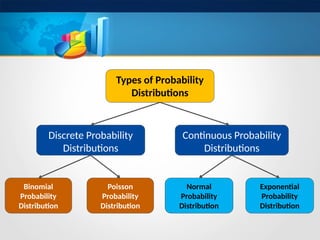
Types of Probability
Distributions
Discrete Probability
Distributions
Continuous Probability
Distributions
Binomial
Probability
Distribution
Normal
Probability
Distribution
Poisson
Probability
Distribution
Exponential
Probability
Distribution
BINOMIAL DISTRIBUTION
Jacob Bernoulli (also known as James or Jacques) (1654 – 1705)
Binomial Distribution
• Bi means two. When only two outcomes are possible, binomial
distribution is prepared – example – throw of coins – (Head or
tail) trials are independent
p= probability of success
q= probability of failure
• Binomial distribution was discovered by James Bernoulli in 1738.
• It is also known as Bernoulli Distribution or Bernoulli Theorem.
• This theorem was published eight years after the death of James
Bernoulli in 1713.
• Finite number of trials – with exclusive and exhaustive outcomes
• This is a discrete probability distribution.
Bernoulli
distributio
n
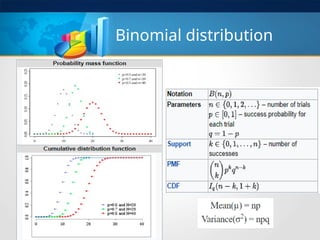
Binomial distribution
Binomial Distribution
• A discrete probability distribution (applicable to the
scenarios where the set of possible outcomes is discrete,
such as a coin toss or a roll of dice) can be encoded by a
discrete list of the probabilities of the outcomes, known as a
probability mass function.
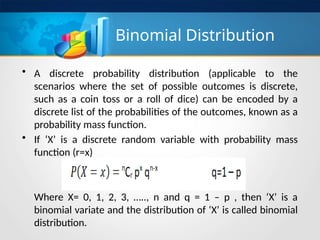
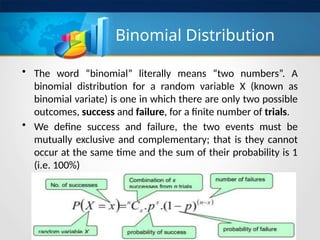
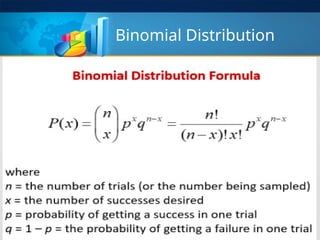
• If ‘X’ is a discrete random variable with probability mass
function (r=x)
Where X= 0, 1, 2, 3, ….., n and q = 1 – p , then ‘X’ is a
binomial variate and the distribution of ‘X’ is called binomial
distribution.
N=0 1
N=1 1 1
N=2 1 2 1
N=3 1 3 3 1
N=0 0C0 =1
N=1 1C0 = 1 1C1=1
N=2 nCr 2
C0 = 1 2
C1 =2 2
C2 =1
N=3 3C0 =1 3C1 = 3 3C2 = 3 3C3 = 1
N=4 4C0 = 1 4C1= 4 4C2= 6 4C3 = 4 4C4 =1
Binomial Distribution
• The word “binomial” literally means “two numbers”. A
binomial distribution for a random variable X (known as
binomial variate) is one in which there are only two possible
outcomes, success and failure, for a finite number of trials.
• We define success and failure, the two events must be
mutually exclusive and complementary; that is they cannot
occur at the same time and the sum of their probability is 1
(i.e. 100%)
Binomial Distribution
Examples
• If you are purchasing a lottery then either you are going to
win money or you are not. In other words, anywhere the
outcome could be a success or a failure that can be proved
through binomial distribution.
• If someone tosses the coin then there is an equal chance of
outcome it can be heads or tails. There is a 50% chance of the
outcomes.
• Examples of election polls; whether the party ‘A’ will win or
the party ‘B’ will win in the upcoming election. Whether by
implementing a certain policy the government will get the
expected results within a specific period or not.
• If you are appearing in an exam then there is also an equal
possibility of getting passed or fail.
Binomial Distribution
Examples
Example- 5.1
Example- 5.2
Example- 5.3
Example- 5.4
THANK YOU

Binomial distribution_mfcs module 5ppt.pptx

  • 1.
  • 2.
    Random Variable Types ofRandom Variable • Discrete Random Variable • Continuous Random Variable Types of Probability Distributions Discrete Probability Distributions Continuous Probability Distributions
  • 3.
    Probability Distributions • DiscreteProbability Distributions – Poisson distribution, – Bernoulli distribution, – Binomial distribution, – Geometric distribution, – Negative binomial distribution, – Multinomial binomial distribution, – Categorical distribution • Continuous Probability Distributions – Normal distribution, – Gaussian distribution, – Exponential distribution
  • 4.
    Types of Probability Distributions DiscreteProbability Distributions Continuous Probability Distributions Binomial Probability Distribution Normal Probability Distribution Poisson Probability Distribution Exponential Probability Distribution
  • 5.
    BINOMIAL DISTRIBUTION Jacob Bernoulli(also known as James or Jacques) (1654 – 1705)
  • 6.
    Binomial Distribution • Bimeans two. When only two outcomes are possible, binomial distribution is prepared – example – throw of coins – (Head or tail) trials are independent p= probability of success q= probability of failure • Binomial distribution was discovered by James Bernoulli in 1738. • It is also known as Bernoulli Distribution or Bernoulli Theorem. • This theorem was published eight years after the death of James Bernoulli in 1713. • Finite number of trials – with exclusive and exhaustive outcomes • This is a discrete probability distribution.
  • 7.
  • 8.
  • 9.
    Binomial Distribution • Adiscrete probability distribution (applicable to the scenarios where the set of possible outcomes is discrete, such as a coin toss or a roll of dice) can be encoded by a discrete list of the probabilities of the outcomes, known as a probability mass function. • If ‘X’ is a discrete random variable with probability mass function (r=x) Where X= 0, 1, 2, 3, ….., n and q = 1 – p , then ‘X’ is a binomial variate and the distribution of ‘X’ is called binomial distribution.
  • 10.
    N=0 1 N=1 11 N=2 1 2 1 N=3 1 3 3 1 N=0 0C0 =1 N=1 1C0 = 1 1C1=1 N=2 nCr 2 C0 = 1 2 C1 =2 2 C2 =1 N=3 3C0 =1 3C1 = 3 3C2 = 3 3C3 = 1 N=4 4C0 = 1 4C1= 4 4C2= 6 4C3 = 4 4C4 =1
  • 11.
    Binomial Distribution • Theword “binomial” literally means “two numbers”. A binomial distribution for a random variable X (known as binomial variate) is one in which there are only two possible outcomes, success and failure, for a finite number of trials. • We define success and failure, the two events must be mutually exclusive and complementary; that is they cannot occur at the same time and the sum of their probability is 1 (i.e. 100%)
  • 12.
    Binomial Distribution Examples • Ifyou are purchasing a lottery then either you are going to win money or you are not. In other words, anywhere the outcome could be a success or a failure that can be proved through binomial distribution. • If someone tosses the coin then there is an equal chance of outcome it can be heads or tails. There is a 50% chance of the outcomes. • Examples of election polls; whether the party ‘A’ will win or the party ‘B’ will win in the upcoming election. Whether by implementing a certain policy the government will get the expected results within a specific period or not. • If you are appearing in an exam then there is also an equal possibility of getting passed or fail.
  • 13.
  • 14.
  • 15.