
Thesis Defense
CHEMALY Chantal
UNIVERSITE LIBANAISE - FACULTE DE GENIE
&
UNIVERSITE SAINT-JOSEPH
FACULTE D’INGENIERIE– DEPARTEMENT DES
ETUDES DOCTORALES
STUDY OF THE POSSIBILITIES OF A TRI-
GENERATION PRODUCTION: HEAT, COLD AND
ELECTRICITY, FROM BIOMASS
Committee Members:
Dr. BECHRA Rami (Advisor)
Dr. MOURTADA Adel
Dr. YOUNES Rafic October 18, 2016
1
Outline
 Introduction - Scope of thesis
 Methodology
 Results
 Sensibility Study
 Application
 Conclusion & Future Work
2
Outline
 Introduction - Scope of thesis
 Methodology
 Results
 Sensibility Study
 Application
 Conclusion & Future Work
3
Introduction 4
A Solution Tri-generation
High efficiency
Environmental protection
Economic benefits
F= Biomass
Outline
 Introduction - Scope of thesis
 Methodology
 Results
 Sensibility Study
 Application
 Conclusion & Future Work
5
Methodology 6
Biomass flow rate = 57 t/h
Biomass moisture content = 0.49%
Methodology 7
HHV=17.919MJ/Kg
Efficiency = 70%
Energy produced = (biomass flow x HHV) x burner efficiency
Methodology 8
Operating Pressure = 90 bar*
Superheating Temperature = 553.31°C*
Total steam produced = 149 t/h
* Bechara, R. (2015). Methodology for the designof optimal processes: application to sugarcane conversion processes (Doctoral dissertation,
Université Claude Bernard-Lyon I).
Methodology 9
Input Steam Pressure = 90 bar
Output Steam Pressure = 3 bar*
Output Steam temperature = 150 °C*
Total Power produced = 25 MW (Steam turbine calculator)
* Bechara, R. (2015). Methodology for the designof optimal processes: application to sugarcane conversion processes (Doctoral dissertation,
Université Claude Bernard-Lyon I).
Methodology 10
Output Pressure = 0.7 bar Output Temperature = 150°C Reheat = 220°C
Output water temperature = 50°C Efficiency of exchange = 0.8
Power produced = 8MW (for VHvsLP=1)
Hot water Produced = 2517.5 t/h (for VHvsLP=0)
VHvsLP between 0 & 1
Methodology 11
Input Temperature= 90°C*
COP=1.4*
Cold produced=Heat at the input of the chiller x Cooling Efficiency
VCool between 0 & 1
* Maraver, D., Sin, A., Royo, J., & Sebastián, F. (2013). Assessment of CCHP systems based on biomass combustion for small-scale applications
through a review of the technology and analysis of energy efficiency parameters. Applied energy, 102, 1303-1313.
Methodology 12
Heat transfer efficiency = 0.8*
Cold produced with flue gas recovery = 54.966 MW
VFGR between 0 & 1
* Bechara, R. (2015). Methodology for the designof optimal processes: application to sugarcane conversion processes (Doctoral dissertation,
Université Claude Bernard-Lyon I).
Outline
 Introduction - Scope of thesis
 Methodology
 Results
 Sensibility Study
 Application
 Conclusion & Future Work
13
Results 14
0
10
20
30
40
50
60
0 0.2 0.4 0.6 0.8 1 1.2
EnergyProduced(MW)
VH vs LP
Total Energy Produced for Diferent Values of VHvsLP
Vcool=1 Vrecovery=1
Vcool=0 Vrecovery=1
Vcool=1 VRecovery=0
Vcool=0 Vrecovery=0
Outline
 Introduction - Scope of thesis
 Methodology
 Results
 Sensibility Study
 Application
 Conclusion & Future Work
15
Results 16
0
20
40
60
80
100
120
MP Turbine Power LP Turbine Power Hot Water Cold Total Energy Produced
EnergyProduced(MW)
0
20
40
60
80
100
120
MP Turbine Power LP Turbine Power Hot Water Cold Total Energy Produced
EnergyProduced(MW)
Case1: without cold production and without flue gas recovery (VCool=0 & VFGR=0)
Case2: with cold production and without flue gas recovery (VCool=1 & VFGR=0)
Case3: with cold production and with flue gas recovery (VCool=1 & VFGR=1)
VHvsLP=0
VHvsLP=1
Outline
 Introduction - Scope of thesis
 Methodology
 Results
 Sensibility Study
 Application
 Conclusion & Future Work
17
Results 18
Energy type Energy sales
Electric power 87 $/MW
Heating 8.4 $/MW
Cold 24.9 $/MW
Results 18
VHvsLP=0
VHvsLP=1
0
1000
2000
3000
4000
5000
MP Turbine Power LP Turbine Power Hot Water Cold Total Energy
Produced
EnergySales($)
0
1000
2000
3000
4000
5000
MP Turbine Power LP Turbine Power Hot Water Cold Total Energy Produced
EnergySales($)
Case1: without cold production and without flue gas recovery (VCool=0 & VFGR=0)
Case2: with cold production and without flue gas recovery (VCool=1 & VFGR=0)
Case3: with cold production and with flue gas recovery (VCool=1 & VFGR=1)
Outline
 Introduction - Scope of thesis
 Methodology
 Results
 Sensibility Study
 Application
 Conclusion & Future Work
19
Results 20
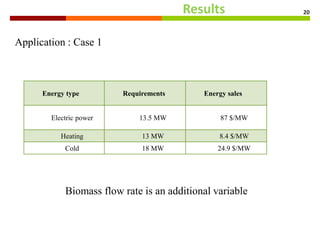
Application : Case 1
Biomass flow rate is an additional variable
Energy type Requirements Energy sales
Electric power 13.5 MW 87 $/MW
Heating 13 MW 8.4 $/MW
Cold 18 MW 24.9 $/MW
Results 21
Type of
energy
Energy
required
Energy
produced
Delta
E
Price of energy
supplemented
from market*
Total
electric
power
13.5 MW 13.5 MW 0 $0
Heating 13 MW 12.7 MW 0.308 $2.6
Cold 18 MW 18. MW 0 $0
Total
energy
58 MW 44.2 MW
Variables Values taken
VHvsLP 0.554
VCool 1
VFGR 1
Biomass flow 26.576 t/h
Application : Case 1
Results 22
Energy type Requirements Energy sales
Electricity 13.5 MW 87 $/MW
Heating 13 MW 30 $/MW
Cold 18 MW 23 $/MW
Application : Case 2
Results 23
Application : Case 2
Energy
type
Energy
required
Energy
produced
Delta E
Price of
energy
supplemen
ted from
market*
Total
electric
power
13.5 MW
13.500
MW
0 $0
Heating 13 MW
13.000
MW
0 $0
Cold 18 MW
17.786
MW
0.214 $4.912
Total
energy
58 MW
44.286
MW
Variables Values taken
VHvsLP 0.5442
VCool 1
VFGR 1
Biomass flow 26.647 t/h
Outline
 Introduction - Scope of thesis
 Methodology
 Results
 Sensibility Study
 Application
 Conclusion & Future Work
24
Conclusion & Future Work 25
Further
Studies
Greenhouse
gas
emissions
Running
Cost
Installation
cost
CCHP system with large potential of economical efficiency and energy savings
Questions 26

Presentation finale

  • 1.
     Thesis Defense CHEMALY Chantal UNIVERSITELIBANAISE - FACULTE DE GENIE & UNIVERSITE SAINT-JOSEPH FACULTE D’INGENIERIE– DEPARTEMENT DES ETUDES DOCTORALES STUDY OF THE POSSIBILITIES OF A TRI- GENERATION PRODUCTION: HEAT, COLD AND ELECTRICITY, FROM BIOMASS Committee Members: Dr. BECHRA Rami (Advisor) Dr. MOURTADA Adel Dr. YOUNES Rafic October 18, 2016 1
  • 2.
    Outline  Introduction -Scope of thesis  Methodology  Results  Sensibility Study  Application  Conclusion & Future Work 2
  • 3.
    Outline  Introduction -Scope of thesis  Methodology  Results  Sensibility Study  Application  Conclusion & Future Work 3
  • 4.
    Introduction 4 A SolutionTri-generation High efficiency Environmental protection Economic benefits F= Biomass
  • 5.
    Outline  Introduction -Scope of thesis  Methodology  Results  Sensibility Study  Application  Conclusion & Future Work 5
  • 6.
    Methodology 6 Biomass flowrate = 57 t/h Biomass moisture content = 0.49%
  • 7.
    Methodology 7 HHV=17.919MJ/Kg Efficiency =70% Energy produced = (biomass flow x HHV) x burner efficiency
  • 8.
    Methodology 8 Operating Pressure= 90 bar* Superheating Temperature = 553.31°C* Total steam produced = 149 t/h * Bechara, R. (2015). Methodology for the designof optimal processes: application to sugarcane conversion processes (Doctoral dissertation, Université Claude Bernard-Lyon I).
  • 9.
    Methodology 9 Input SteamPressure = 90 bar Output Steam Pressure = 3 bar* Output Steam temperature = 150 °C* Total Power produced = 25 MW (Steam turbine calculator) * Bechara, R. (2015). Methodology for the designof optimal processes: application to sugarcane conversion processes (Doctoral dissertation, Université Claude Bernard-Lyon I).
  • 10.
    Methodology 10 Output Pressure= 0.7 bar Output Temperature = 150°C Reheat = 220°C Output water temperature = 50°C Efficiency of exchange = 0.8 Power produced = 8MW (for VHvsLP=1) Hot water Produced = 2517.5 t/h (for VHvsLP=0) VHvsLP between 0 & 1
  • 11.
    Methodology 11 Input Temperature=90°C* COP=1.4* Cold produced=Heat at the input of the chiller x Cooling Efficiency VCool between 0 & 1 * Maraver, D., Sin, A., Royo, J., & Sebastián, F. (2013). Assessment of CCHP systems based on biomass combustion for small-scale applications through a review of the technology and analysis of energy efficiency parameters. Applied energy, 102, 1303-1313.
  • 12.
    Methodology 12 Heat transferefficiency = 0.8* Cold produced with flue gas recovery = 54.966 MW VFGR between 0 & 1 * Bechara, R. (2015). Methodology for the designof optimal processes: application to sugarcane conversion processes (Doctoral dissertation, Université Claude Bernard-Lyon I).
  • 13.
    Outline  Introduction -Scope of thesis  Methodology  Results  Sensibility Study  Application  Conclusion & Future Work 13
  • 14.
    Results 14 0 10 20 30 40 50 60 0 0.20.4 0.6 0.8 1 1.2 EnergyProduced(MW) VH vs LP Total Energy Produced for Diferent Values of VHvsLP Vcool=1 Vrecovery=1 Vcool=0 Vrecovery=1 Vcool=1 VRecovery=0 Vcool=0 Vrecovery=0
  • 15.
    Outline  Introduction -Scope of thesis  Methodology  Results  Sensibility Study  Application  Conclusion & Future Work 15
  • 16.
    Results 16 0 20 40 60 80 100 120 MP TurbinePower LP Turbine Power Hot Water Cold Total Energy Produced EnergyProduced(MW) 0 20 40 60 80 100 120 MP Turbine Power LP Turbine Power Hot Water Cold Total Energy Produced EnergyProduced(MW) Case1: without cold production and without flue gas recovery (VCool=0 & VFGR=0) Case2: with cold production and without flue gas recovery (VCool=1 & VFGR=0) Case3: with cold production and with flue gas recovery (VCool=1 & VFGR=1) VHvsLP=0 VHvsLP=1
  • 17.
    Outline  Introduction -Scope of thesis  Methodology  Results  Sensibility Study  Application  Conclusion & Future Work 17
  • 18.
    Results 18 Energy typeEnergy sales Electric power 87 $/MW Heating 8.4 $/MW Cold 24.9 $/MW
  • 19.
    Results 18 VHvsLP=0 VHvsLP=1 0 1000 2000 3000 4000 5000 MP TurbinePower LP Turbine Power Hot Water Cold Total Energy Produced EnergySales($) 0 1000 2000 3000 4000 5000 MP Turbine Power LP Turbine Power Hot Water Cold Total Energy Produced EnergySales($) Case1: without cold production and without flue gas recovery (VCool=0 & VFGR=0) Case2: with cold production and without flue gas recovery (VCool=1 & VFGR=0) Case3: with cold production and with flue gas recovery (VCool=1 & VFGR=1)
  • 20.
    Outline  Introduction -Scope of thesis  Methodology  Results  Sensibility Study  Application  Conclusion & Future Work 19
  • 21.
    Results 20 Application :Case 1 Biomass flow rate is an additional variable Energy type Requirements Energy sales Electric power 13.5 MW 87 $/MW Heating 13 MW 8.4 $/MW Cold 18 MW 24.9 $/MW
  • 22.
    Results 21 Type of energy Energy required Energy produced Delta E Priceof energy supplemented from market* Total electric power 13.5 MW 13.5 MW 0 $0 Heating 13 MW 12.7 MW 0.308 $2.6 Cold 18 MW 18. MW 0 $0 Total energy 58 MW 44.2 MW Variables Values taken VHvsLP 0.554 VCool 1 VFGR 1 Biomass flow 26.576 t/h Application : Case 1
  • 23.
    Results 22 Energy typeRequirements Energy sales Electricity 13.5 MW 87 $/MW Heating 13 MW 30 $/MW Cold 18 MW 23 $/MW Application : Case 2
  • 24.
    Results 23 Application :Case 2 Energy type Energy required Energy produced Delta E Price of energy supplemen ted from market* Total electric power 13.5 MW 13.500 MW 0 $0 Heating 13 MW 13.000 MW 0 $0 Cold 18 MW 17.786 MW 0.214 $4.912 Total energy 58 MW 44.286 MW Variables Values taken VHvsLP 0.5442 VCool 1 VFGR 1 Biomass flow 26.647 t/h
  • 25.
    Outline  Introduction -Scope of thesis  Methodology  Results  Sensibility Study  Application  Conclusion & Future Work 24
  • 26.
    Conclusion & FutureWork 25 Further Studies Greenhouse gas emissions Running Cost Installation cost CCHP system with large potential of economical efficiency and energy savings
  • 27.

Editor's Notes

  • #9 The angles between a1 , a2 and a3 are equally 120º, while the angles between i a (i=1,2,3) and c are equally 90º. - The 4-axis system is based on the vectors a1, a2, a3 and c as shown in Figure 2.1; a3 is redundant since a3= - (a1+a2).