EB-5 IMMIGRANT
INVESTMENT CATEGORY
EB-5 Program Overview
• Two types of EB-5 cases: Individual and Regional
Center (RC)
• Approximately 90-95% of EB-5 cases are filed
through Regional Center Program.
• 10,000 “EB-5” immigrant visas per year
• $500,000 or $1 million investment
• Conditional green card – after 2 years investor
needs to remove conditions if investment is
sustained and jobs are created
Family Immigration
• Who can immigrate with the investor
Spouse
Unmarried children under 21
• “Aging out” children
EB-5 Structure
There are four steps to becoming a Lawful Permanent
Resident (LPR) through the EB-5 program
1. Form I-526 immigrant petition approval (9 months
adjudication)
2. Adjustment of Status (4-6 months) or Immigrant Visa
Consular Processing (6-10 months)
3. Receive 2-year conditional permanent resident (CPR)
status
4. Between 21-24 months of receiving CPR status, file
Form I-829 petition to remove the conditions (6-8
months)
5. In about 2.5 years, eligible to apply for citizenship
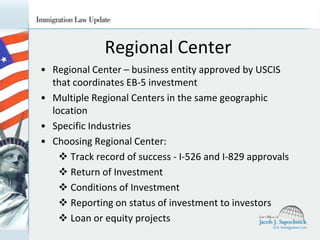
Regional Center
• Regional Center – business entity approved by USCIS
that coordinates EB-5 investment
• Multiple Regional Centers in the same geographic
location
• Specific Industries
• Choosing Regional Center:
 Track record of success - I-526 and I-829 approvals
 Return of Investment
 Conditions of Investment
 Reporting on status of investment to investors
 Loan or equity projects
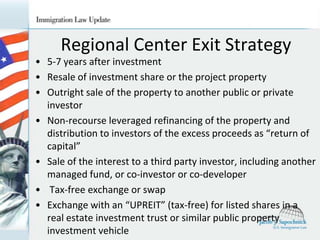
Regional Center Exit Strategy
• 5-7 years after investment
• Resale of investment share or the project property
• Outright sale of the property to another public or private
investor
• Non-recourse leveraged refinancing of the property and
distribution to investors of the excess proceeds as “return of
capital”
• Sale of the interest to a third party investor, including another
managed fund, or co-investor or co-developer
• Tax-free exchange or swap
• Exchange with an “UPREIT” (tax-free) for listed shares in a
real estate investment trust or similar public property
investment vehicle
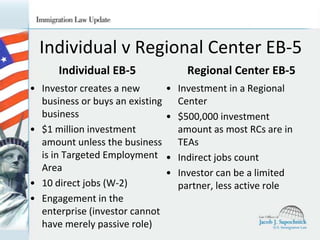
Individual v Regional Center EB-5
Individual EB-5
• Investor creates a new
business or buys an existing
business
• $1 million investment
amount unless the business
is in Targeted Employment
Area
• 10 direct jobs (W-2)
• Engagement in the
enterprise (investor cannot
have merely passive role)

Regional Center EB-5
• Investment in a Regional
Center
• $500,000 investment
amount as most RCs are in
TEAs
• Indirect jobs count
• Investor can be a limited
partner, less active role
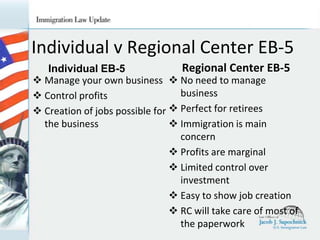
Individual v Regional Center EB-5
Regional Center EB-5
Individual EB-5
 Manage your own business  No need to manage
business
 Control profits
 Creation of jobs possible for  Perfect for retirees
the business
 Immigration is main
concern
 Profits are marginal
 Limited control over
investment
 Easy to show job creation
 RC will take care of most of
the paperwork
General Requirements
• Invest capital - $500,000 or $1 million obtained from lawful
source
• In a New Commercial Enterprise:
Created after 11/29/1990; or
Restructured or Reorganized; or
Expand business resulting in 40% increase in net worth or
number of employees
• At risk investment
• Engage in Management or Policy Formulation
• Create or Save 10 full-time jobs for USC, LPR
Investment of Capital
• Invested or in the process of investment
• Investment must be maintained throughout conditional
resident period
• Reduced capital threshold of $500,000 if Targeted
Employment Area (TEA)
 “High unemployment area” – at least 150% of
national average, OR
 “Rural area” – not within an MSA and not within
boundary of any city or town having a population of
20,000 or more
Lawful Source of Capital
• 5 years of income tax return required (business and personal)
• If foreign country does not have tax return filing requirement
– must prove it
• Evidence of lawful acquisition of capital
 Business earnings
 Salary
 Gifts
 Loans
 Sale of Real Estate
• Tracing of Funds from Investor to Enterprise
New Commercial Enterprise
• Any for-profit business
• “New” – means formed after 11/29/1990
• New Commercial Enterprise may be a preexisting business if
was created after 1990
• If formed before, have to show substantial reorganization or
restructuring - complete transformation of nature of business
• Expansion of existing business resulting in 40% increase in net
worth or number of employees
“At risk” Investment
• Capital can include cash, equipment, inventory or tangible
property
• Equity interest is required (stock, LLC/LP interest, etc.)
• Commitment of capital without guaranteed return
• Loans to enterprise will not work
• No guaranteed distributions or redemption provisions
• May use escrow, conditioning release of funds to enterprise
upon approval of I-526
Engage in the Enterprise
• Day-to-day managerial control, or
• Policy formulation
• Corporate officer, board member, limited partner with rights
and responsibilities of ULPA
• Passive investor will not qualify
Job Creation
• Investment must create 10 full-time jobs for 10 workers
(USC, LPR, asylee or refugee)
• Prove employment with W-2, I-9, payroll records
• Independent contractors do not count
• Business Plan should detail the timeline for job creation
Job Creation
• At Removal of Conditions stage, must show jobs were
created or can be expected to be created within a reasonable
period of time
• Direct vs Indirect Jobs (RC)
Direct – employees of the enterprise
Indirect – jobs created collaterally or as a result of capital
invested in a commercial enterprise affiliated with a
regional center by an EB-5 investor.
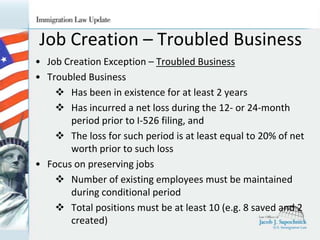
Job Creation – Troubled Business
• Job Creation Exception – Troubled Business
• Troubled Business
 Has been in existence for at least 2 years
 Has incurred a net loss during the 12- or 24-month
period prior to I-526 filing, and
 The loss for such period is at least equal to 20% of net
worth prior to such loss
• Focus on preserving jobs
 Number of existing employees must be maintained
during conditional period
 Total positions must be at least 10 (e.g. 8 saved and 2
created)
EB-5 Considerations
•

Removal of Conditions in 2 years: Capital
invested/sustained, jobs created/preserved
• Trends in Adjudication
• Statistics – over 90% RC EB-5
Other Visa Options
• E-2 Investment Visa – Investment can later be used for
EB-5
• L-1A Intra-Company Transferee Visa
• H-1B Work Visa
QUESTIONS AND ANSWERS
Jacob J. Sapochnick, Esq.
619-819-9204
jacob@h1b.biz

Imigration Law Update

  • 2.
  • 3.
    EB-5 Program Overview •Two types of EB-5 cases: Individual and Regional Center (RC) • Approximately 90-95% of EB-5 cases are filed through Regional Center Program. • 10,000 “EB-5” immigrant visas per year • $500,000 or $1 million investment • Conditional green card – after 2 years investor needs to remove conditions if investment is sustained and jobs are created
  • 4.
    Family Immigration • Whocan immigrate with the investor Spouse Unmarried children under 21 • “Aging out” children
  • 5.
    EB-5 Structure There arefour steps to becoming a Lawful Permanent Resident (LPR) through the EB-5 program 1. Form I-526 immigrant petition approval (9 months adjudication) 2. Adjustment of Status (4-6 months) or Immigrant Visa Consular Processing (6-10 months) 3. Receive 2-year conditional permanent resident (CPR) status 4. Between 21-24 months of receiving CPR status, file Form I-829 petition to remove the conditions (6-8 months) 5. In about 2.5 years, eligible to apply for citizenship
  • 6.
    Regional Center • RegionalCenter – business entity approved by USCIS that coordinates EB-5 investment • Multiple Regional Centers in the same geographic location • Specific Industries • Choosing Regional Center:  Track record of success - I-526 and I-829 approvals  Return of Investment  Conditions of Investment  Reporting on status of investment to investors  Loan or equity projects
  • 7.
    Regional Center ExitStrategy • 5-7 years after investment • Resale of investment share or the project property • Outright sale of the property to another public or private investor • Non-recourse leveraged refinancing of the property and distribution to investors of the excess proceeds as “return of capital” • Sale of the interest to a third party investor, including another managed fund, or co-investor or co-developer • Tax-free exchange or swap • Exchange with an “UPREIT” (tax-free) for listed shares in a real estate investment trust or similar public property investment vehicle
  • 8.
    Individual v RegionalCenter EB-5 Individual EB-5 • Investor creates a new business or buys an existing business • $1 million investment amount unless the business is in Targeted Employment Area • 10 direct jobs (W-2) • Engagement in the enterprise (investor cannot have merely passive role) Regional Center EB-5 • Investment in a Regional Center • $500,000 investment amount as most RCs are in TEAs • Indirect jobs count • Investor can be a limited partner, less active role
  • 9.
    Individual v RegionalCenter EB-5 Regional Center EB-5 Individual EB-5  Manage your own business  No need to manage business  Control profits  Creation of jobs possible for  Perfect for retirees the business  Immigration is main concern  Profits are marginal  Limited control over investment  Easy to show job creation  RC will take care of most of the paperwork
  • 10.
    General Requirements • Investcapital - $500,000 or $1 million obtained from lawful source • In a New Commercial Enterprise: Created after 11/29/1990; or Restructured or Reorganized; or Expand business resulting in 40% increase in net worth or number of employees • At risk investment • Engage in Management or Policy Formulation • Create or Save 10 full-time jobs for USC, LPR
  • 11.
    Investment of Capital •Invested or in the process of investment • Investment must be maintained throughout conditional resident period • Reduced capital threshold of $500,000 if Targeted Employment Area (TEA)  “High unemployment area” – at least 150% of national average, OR  “Rural area” – not within an MSA and not within boundary of any city or town having a population of 20,000 or more
  • 12.
    Lawful Source ofCapital • 5 years of income tax return required (business and personal) • If foreign country does not have tax return filing requirement – must prove it • Evidence of lawful acquisition of capital  Business earnings  Salary  Gifts  Loans  Sale of Real Estate • Tracing of Funds from Investor to Enterprise
  • 13.
    New Commercial Enterprise •Any for-profit business • “New” – means formed after 11/29/1990 • New Commercial Enterprise may be a preexisting business if was created after 1990 • If formed before, have to show substantial reorganization or restructuring - complete transformation of nature of business • Expansion of existing business resulting in 40% increase in net worth or number of employees
  • 14.
    “At risk” Investment •Capital can include cash, equipment, inventory or tangible property • Equity interest is required (stock, LLC/LP interest, etc.) • Commitment of capital without guaranteed return • Loans to enterprise will not work • No guaranteed distributions or redemption provisions • May use escrow, conditioning release of funds to enterprise upon approval of I-526
  • 15.
    Engage in theEnterprise • Day-to-day managerial control, or • Policy formulation • Corporate officer, board member, limited partner with rights and responsibilities of ULPA • Passive investor will not qualify
  • 16.
    Job Creation • Investmentmust create 10 full-time jobs for 10 workers (USC, LPR, asylee or refugee) • Prove employment with W-2, I-9, payroll records • Independent contractors do not count • Business Plan should detail the timeline for job creation
  • 17.
    Job Creation • AtRemoval of Conditions stage, must show jobs were created or can be expected to be created within a reasonable period of time • Direct vs Indirect Jobs (RC) Direct – employees of the enterprise Indirect – jobs created collaterally or as a result of capital invested in a commercial enterprise affiliated with a regional center by an EB-5 investor.
  • 18.
    Job Creation –Troubled Business • Job Creation Exception – Troubled Business • Troubled Business  Has been in existence for at least 2 years  Has incurred a net loss during the 12- or 24-month period prior to I-526 filing, and  The loss for such period is at least equal to 20% of net worth prior to such loss • Focus on preserving jobs  Number of existing employees must be maintained during conditional period  Total positions must be at least 10 (e.g. 8 saved and 2 created)
  • 19.
    EB-5 Considerations • Removal ofConditions in 2 years: Capital invested/sustained, jobs created/preserved • Trends in Adjudication • Statistics – over 90% RC EB-5
  • 20.
    Other Visa Options •E-2 Investment Visa – Investment can later be used for EB-5 • L-1A Intra-Company Transferee Visa • H-1B Work Visa
  • 21.
  • 22.
    Jacob J. Sapochnick,Esq. 619-819-9204 jacob@h1b.biz