EB-5 Financing - IMN's 15th Annual US Real Estate
Opportunity & Private Fund Investing Forum
Thursday June 12, 2014
New York City
Agenda
• Introductions
• Background On EB-5
• Discussion
• Questions
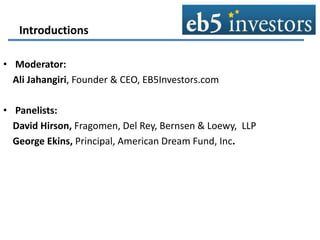
• Moderator:
Ali Jahangiri, Founder & CEO, EB5Investors.com
• Panelists:
David Hirson, Fragomen, Del Rey, Bernsen & Loewy, LLP
George Ekins, Principal, American Dream Fund, Inc.
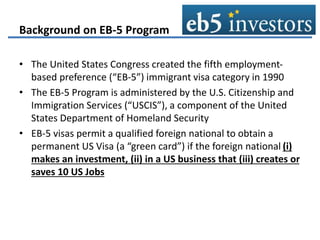
Background on EB-5 Program
• The United States Congress created the fifth employment-
based preference (“EB-5”) immigrant visa category in 1990
• The EB-5 Program is administered by the U.S. Citizenship and
Immigration Services (“USCIS”), a component of the United
States Department of Homeland Security
• EB-5 visas permit a qualified foreign national to obtain a
permanent US Visa (a “green card”) if the foreign national (i)
makes an investment, (ii) in a US business that (iii) creates or
saves 10 US Jobs
Background on EB-5 Program
Investment Requirements
EB-5 Investments must:
- Create at least 10 US Jobs
- Be equal to at least $1M
If the investment is made in an area where the
unemployment level is at least 150% above the national average
(a “target employment area” or “TEA”), the investment may be
$500k
- Be actively managed by the foreign national. Ownership of a
limited partnership interest satisfies this requirement.
- Be made in a new or substantially reorgianized commercial
enterprise
- Be at risk (no guaranteed repayment or job creation)
- Be made from lawfully obtained funds
Typical Deal
• Typically arranged by “regional center”
- Allows a larger number of jobs to be counted through
economic modeling
• “Migration Brokers” market interest to EB-5 investors
• Debt or preferred equity
- Typically fixed rate – 4% - 8%
• Generally 5 years, interest only, balloon payment
• Funds must be “at risk” until Green Card (I-829 Approval)
Typical Deal
Sizing
• Project Budget Determines # of jobs through economic model
- Budget applied to model (e.g., $x construction budget =
1,000 jobs)
- Typically, a “job cushion” is applied (e.g., 10% reduction =
900 jobs)
- Max Investors (900/10 = 90)
- Max size (90 x $500k = $45M; 90 x $1M = $90M)
• Economic model prepared based on projections and prepared
by third party economist
Typical Deal
Funding
• EB-5 Investor subscribes and pays fees ($50K) and EB-5
investor submits “I-526 Application” to USCIS
• Investor’s subscription funds ($500k/$1M) deposited in
escrow
• Funds released from escrow to lender and available for
advance under two primary models:
1. “Hold until Approval” – An investor’s funds released from
escrow when USCIS grants “I-526 Approval”
2. “Early Release” – All or a portion of an investor’s funds
released from escrow when I-526 Application submitted;
if any “holdback”, released when investor (or certain
number of other investors) obtain I-526 Approval
Typical Deal
Cash Flow – The Principal Challenge
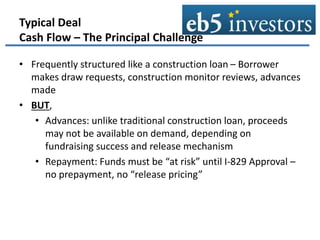
• Frequently structured like a construction loan – Borrower
makes draw requests, construction monitor reviews, advances
made
• BUT,
• Advances: unlike traditional construction loan, proceeds
may not be available on demand, depending on
fundraising success and release mechanism
• Repayment: Funds must be “at risk” until I-829 Approval –
no prepayment, no “release pricing”
Typical Deal
Other Unique Features
• Job generation – Covenant to “create” jobs – spend more!
• Reimbursements – Frequently permit EB-5 funds to be used
to reimburse prior costs
• Interest – Some EB-5 loans charge interest once funds
available for advance, not once drawn
• Advance Early – Advance to Borrower as soon as released
from escrow, regardless of whether current required for
construction
• Fallow Money Solutions ($ Too early and prepayment
lockouts) – Distribute, defease
• Securities risks
EB-5 Financing
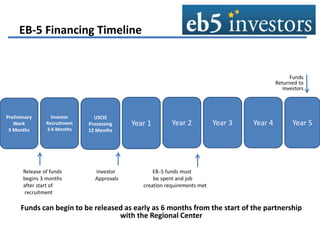
EB-5 Financing Timeline
Funds
Returned to
Investors
Release of funds Investor EB-5 funds must
begins 3 months Approvals be spent and job
after start of creation requirements met
recruitment
Funds can begin to be released as early as 6 months from the start of the partnership
with the Regional Center
Year 4 Year 5Year 2
Preliminary
Work
3 Months
Investor
Recruitment
3-6 Months
USCIS
Processing
12 Months
Year 1 Year 3
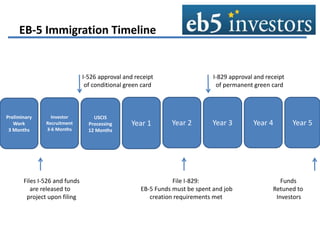
EB-5 Immigration Timeline
I-526 approval and receipt I-829 approval and receipt
of conditional green card of permanent green card
Files I-526 and funds File I-829: Funds
are released to EB-5 Funds must be spent and job Retuned to
project upon filing creation requirements met Investors
Year 4 Year 5Year 2
Preliminary
Work
3 Months
Investor
Recruitment
3-6 Months
USCIS
Processing
12 Months
Year 1 Year 3
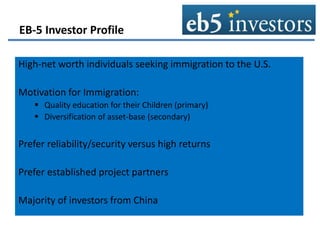
EB-5 Investor Profile
High-net worth individuals seeking immigration to the U.S.
Motivation for Immigration:
 Quality education for their Children (primary)
 Diversification of asset-base (secondary)
Prefer reliability/security versus high returns
Prefer established project partners
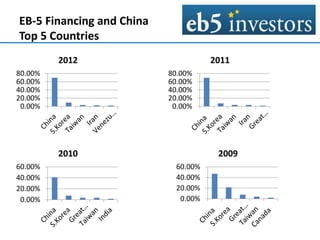
Majority of investors from China
EB-5 Financing and China
Top 5 Countries
0.00%
20.00%
40.00%
60.00%
80.00%
2012
0.00%
20.00%
40.00%
60.00%
80.00%
2011
0.00%
20.00%
40.00%
60.00%
2009
0.00%
20.00%
40.00%
60.00%
2010
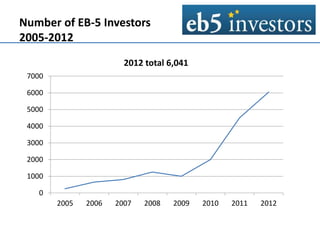
Number of EB-5 Investors
2005-2012
0
1000
2000
3000
4000
5000
6000
7000
2005 2006 2007 2008 2009 2010 2011 2012
2012 total 6,041
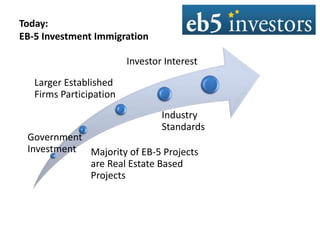
Today:
EB-5 Investment Immigration
Majority of EB-5 Projects
are Real Estate Based
Projects
Industry
Standards
Investor Interest
Larger Established
Firms Participation
Government
Investment
Roles
Regional Center Role
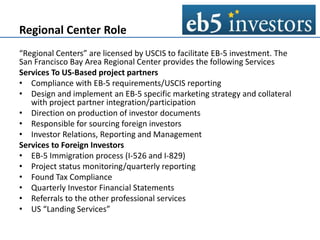
“Regional Centers” are licensed by USCIS to facilitate EB-5 investment. The
San Francisco Bay Area Regional Center provides the following Services
Services To US-Based project partners
• Compliance with EB-5 requirements/USCIS reporting
• Design and implement an EB-5 specific marketing strategy and collateral
with project partner integration/participation
• Direction on production of investor documents
• Responsible for sourcing foreign investors
• Investor Relations, Reporting and Management
Services to Foreign Investors
• EB-5 Immigration process (I-526 and I-829)
• Project status monitoring/quarterly reporting
• Found Tax Compliance
• Quarterly Investor Financial Statements
• Referrals to the other professional services
• US “Landing Services”
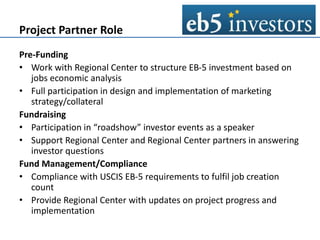
Project Partner Role
Pre-Funding
• Work with Regional Center to structure EB-5 investment based on
jobs economic analysis
• Full participation in design and implementation of marketing
strategy/collateral
Fundraising
• Participation in “roadshow” investor events as a speaker
• Support Regional Center and Regional Center partners in answering
investor questions
Fund Management/Compliance
• Compliance with USCIS EB-5 requirements to fulfil job creation
count
• Provide Regional Center with updates on project progress and
implementation
Thank You

Power point presentation for ali

  • 1.
    EB-5 Financing -IMN's 15th Annual US Real Estate Opportunity & Private Fund Investing Forum Thursday June 12, 2014 New York City
  • 2.
    Agenda • Introductions • BackgroundOn EB-5 • Discussion • Questions
  • 3.
    • Moderator: Ali Jahangiri,Founder & CEO, EB5Investors.com • Panelists: David Hirson, Fragomen, Del Rey, Bernsen & Loewy, LLP George Ekins, Principal, American Dream Fund, Inc.
  • 4.
    Background on EB-5Program • The United States Congress created the fifth employment- based preference (“EB-5”) immigrant visa category in 1990 • The EB-5 Program is administered by the U.S. Citizenship and Immigration Services (“USCIS”), a component of the United States Department of Homeland Security • EB-5 visas permit a qualified foreign national to obtain a permanent US Visa (a “green card”) if the foreign national (i) makes an investment, (ii) in a US business that (iii) creates or saves 10 US Jobs
  • 5.
    Background on EB-5Program Investment Requirements EB-5 Investments must: - Create at least 10 US Jobs - Be equal to at least $1M If the investment is made in an area where the unemployment level is at least 150% above the national average (a “target employment area” or “TEA”), the investment may be $500k - Be actively managed by the foreign national. Ownership of a limited partnership interest satisfies this requirement. - Be made in a new or substantially reorgianized commercial enterprise - Be at risk (no guaranteed repayment or job creation) - Be made from lawfully obtained funds
  • 6.
    Typical Deal • Typicallyarranged by “regional center” - Allows a larger number of jobs to be counted through economic modeling • “Migration Brokers” market interest to EB-5 investors • Debt or preferred equity - Typically fixed rate – 4% - 8% • Generally 5 years, interest only, balloon payment • Funds must be “at risk” until Green Card (I-829 Approval)
  • 7.
    Typical Deal Sizing • ProjectBudget Determines # of jobs through economic model - Budget applied to model (e.g., $x construction budget = 1,000 jobs) - Typically, a “job cushion” is applied (e.g., 10% reduction = 900 jobs) - Max Investors (900/10 = 90) - Max size (90 x $500k = $45M; 90 x $1M = $90M) • Economic model prepared based on projections and prepared by third party economist
  • 8.
    Typical Deal Funding • EB-5Investor subscribes and pays fees ($50K) and EB-5 investor submits “I-526 Application” to USCIS • Investor’s subscription funds ($500k/$1M) deposited in escrow • Funds released from escrow to lender and available for advance under two primary models: 1. “Hold until Approval” – An investor’s funds released from escrow when USCIS grants “I-526 Approval” 2. “Early Release” – All or a portion of an investor’s funds released from escrow when I-526 Application submitted; if any “holdback”, released when investor (or certain number of other investors) obtain I-526 Approval
  • 9.
    Typical Deal Cash Flow– The Principal Challenge • Frequently structured like a construction loan – Borrower makes draw requests, construction monitor reviews, advances made • BUT, • Advances: unlike traditional construction loan, proceeds may not be available on demand, depending on fundraising success and release mechanism • Repayment: Funds must be “at risk” until I-829 Approval – no prepayment, no “release pricing”
  • 10.
    Typical Deal Other UniqueFeatures • Job generation – Covenant to “create” jobs – spend more! • Reimbursements – Frequently permit EB-5 funds to be used to reimburse prior costs • Interest – Some EB-5 loans charge interest once funds available for advance, not once drawn • Advance Early – Advance to Borrower as soon as released from escrow, regardless of whether current required for construction • Fallow Money Solutions ($ Too early and prepayment lockouts) – Distribute, defease • Securities risks
  • 11.
  • 12.
    EB-5 Financing Timeline Funds Returnedto Investors Release of funds Investor EB-5 funds must begins 3 months Approvals be spent and job after start of creation requirements met recruitment Funds can begin to be released as early as 6 months from the start of the partnership with the Regional Center Year 4 Year 5Year 2 Preliminary Work 3 Months Investor Recruitment 3-6 Months USCIS Processing 12 Months Year 1 Year 3
  • 13.
    EB-5 Immigration Timeline I-526approval and receipt I-829 approval and receipt of conditional green card of permanent green card Files I-526 and funds File I-829: Funds are released to EB-5 Funds must be spent and job Retuned to project upon filing creation requirements met Investors Year 4 Year 5Year 2 Preliminary Work 3 Months Investor Recruitment 3-6 Months USCIS Processing 12 Months Year 1 Year 3
  • 14.
    EB-5 Investor Profile High-networth individuals seeking immigration to the U.S. Motivation for Immigration:  Quality education for their Children (primary)  Diversification of asset-base (secondary) Prefer reliability/security versus high returns Prefer established project partners Majority of investors from China
  • 15.
    EB-5 Financing andChina Top 5 Countries 0.00% 20.00% 40.00% 60.00% 80.00% 2012 0.00% 20.00% 40.00% 60.00% 80.00% 2011 0.00% 20.00% 40.00% 60.00% 2009 0.00% 20.00% 40.00% 60.00% 2010
  • 16.
    Number of EB-5Investors 2005-2012 0 1000 2000 3000 4000 5000 6000 7000 2005 2006 2007 2008 2009 2010 2011 2012 2012 total 6,041
  • 17.
    Today: EB-5 Investment Immigration Majorityof EB-5 Projects are Real Estate Based Projects Industry Standards Investor Interest Larger Established Firms Participation Government Investment
  • 18.
  • 19.
    Regional Center Role “RegionalCenters” are licensed by USCIS to facilitate EB-5 investment. The San Francisco Bay Area Regional Center provides the following Services Services To US-Based project partners • Compliance with EB-5 requirements/USCIS reporting • Design and implement an EB-5 specific marketing strategy and collateral with project partner integration/participation • Direction on production of investor documents • Responsible for sourcing foreign investors • Investor Relations, Reporting and Management Services to Foreign Investors • EB-5 Immigration process (I-526 and I-829) • Project status monitoring/quarterly reporting • Found Tax Compliance • Quarterly Investor Financial Statements • Referrals to the other professional services • US “Landing Services”
  • 20.
    Project Partner Role Pre-Funding •Work with Regional Center to structure EB-5 investment based on jobs economic analysis • Full participation in design and implementation of marketing strategy/collateral Fundraising • Participation in “roadshow” investor events as a speaker • Support Regional Center and Regional Center partners in answering investor questions Fund Management/Compliance • Compliance with USCIS EB-5 requirements to fulfil job creation count • Provide Regional Center with updates on project progress and implementation
  • 21.