


EB-5 IMMIGRANT INVESTORS
     Permanent Residence
          in the U.S.
Ask Questions at Any Time
 Go to your Question and Answer panel
  at the bottom of the page.
 Type and send your question.
 We will answer questions during the
  Q&A session at the end of the
  presentation.
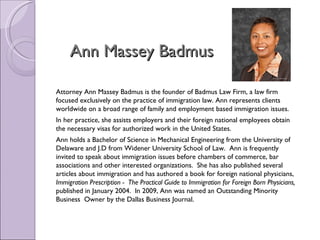
Ann Massey Badmus

Attorney Ann Massey Badmus is the founder of Badmus Law Firm, a law firm
focused exclusively on the practice of immigration law. Ann represents clients
worldwide on a broad range of family and employment based immigration issues.
In her practice, she assists employers and their foreign national employees obtain
the necessary visas for authorized work in the United States.
Ann holds a Bachelor of Science in Mechanical Engineering from the University of
Delaware and J.D from Widener University School of Law. Ann is frequently
invited to speak about immigration issues before chambers of commerce, bar
associations and other interested organizations. She has also published several
articles about immigration and has authored a book for foreign national physicians,
Immigration Prescription - The Practical Guide to Immigration for Foreign Born Physicians,
published in January 2004. In 2009, Ann was named an Outstanding Minority
Business Owner by the Dallas Business Journal.
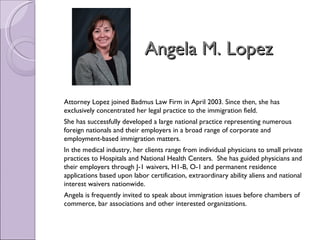
Angela M. Lopez

Attorney Lopez joined Badmus Law Firm in April 2003. Since then, she has
exclusively concentrated her legal practice to the immigration field.
She has successfully developed a large national practice representing numerous
foreign nationals and their employers in a broad range of corporate and
employment-based immigration matters.
In the medical industry, her clients range from individual physicians to small private
practices to Hospitals and National Health Centers.  She has guided physicians and
their employers through J-1 waivers, H1-B, O-1 and permanent residence
applications based upon labor certification, extraordinary ability aliens and national
interest waivers nationwide.
Angela is frequently invited to speak about immigration issues before chambers of
commerce, bar associations and other interested organizations.
EB-5 – Visa for Investors

   Employment- Based fifth preference
    category (EB-5)

   Foreign investors seeking permanent
    residence in the U. S.
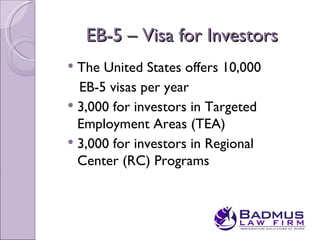
EB-5 – Visa for Investors
 The United States offers 10,000
  EB-5 visas per year
 3,000 for investors in Targeted
  Employment Areas (TEA)
 3,000 for investors in Regional
  Center (RC) Programs
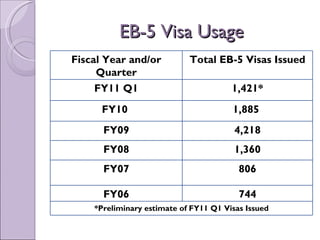
EB-5 Visa Usage
Fiscal Year and/or          Total EB-5 Visas Issued
     Quarter
     FY11 Q1                           1,421*
      FY10                             1,885
      FY09                              4,218
      FY08                              1,360
      FY07                               806

      FY06                               744
    *Preliminary estimate of FY11 Q1 Visas Issued
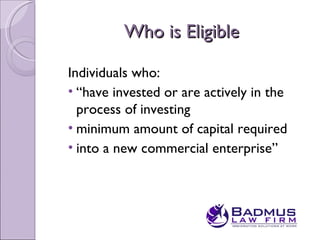
Who is Eligible

Individuals who:
• “have invested or are actively in the
  process of investing
• minimum amount of capital required
• into a new commercial enterprise”
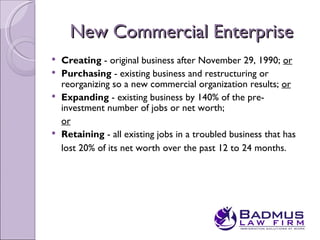
New Commercial Enterprise
 Creating - original business after November 29, 1990; or
 Purchasing - existing business and restructuring or
  reorganizing so a new commercial organization results; or
 Expanding - existing business by 140% of the pre-
  investment number of jobs or net worth;
  or
 Retaining - all existing jobs in a troubled business that has
  lost 20% of its net worth over the past 12 to 24 months.
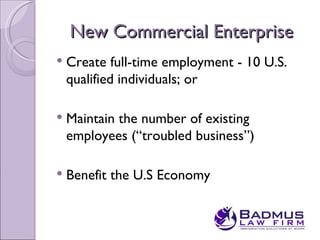
New Commercial Enterprise
   Create full-time employment - 10 U.S.
    qualified individuals; or

   Maintain the number of existing
    employees (“troubled business”)

   Benefit the U.S Economy
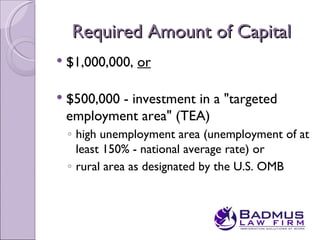
Required Amount of Capital
   $1,000,000, or

   $500,000 - investment in a "targeted
    employment area" (TEA)
    ◦ high unemployment area (unemployment of at
      least 150% - national average rate) or
    ◦ rural area as designated by the U.S. OMB
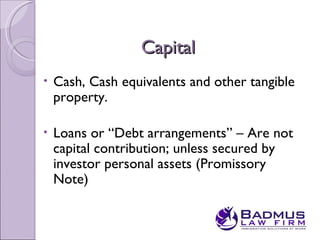
Capital
•   Cash, Cash equivalents and other tangible
    property.

•   Loans or “Debt arrangements” – Are not
    capital contribution; unless secured by
    investor personal assets (Promissory
    Note)
Capital Source
•   Legitimate/lawful source

•   At Risk
    • Actual capital commitment
    • Expended directly towards job creation
Benefit the U.S Economy
No guidance - “subjective” determination.

“Enterprise, in the conduct of its
business, will benefit the U.S economy.”
(e.g. enterprise will provide good and
services).
EB-5 Investment Options
           “Programs”

Traditional Program – Immigration Act of
1990

Regional Center (RC) Program – Public
Law – 2002. Extended to September 30,
2012.
Traditional Program


 Private investment and
 Investor directly involved in the
  management of the business.
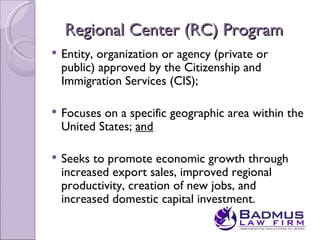
Regional Center (RC) Program
   Entity, organization or agency (private or
    public) approved by the Citizenship and
    Immigration Services (CIS);

   Focuses on a specific geographic area within the
    United States; and

   Seeks to promote economic growth through
    increased export sales, improved regional
    productivity, creation of new jobs, and
    increased domestic capital investment.
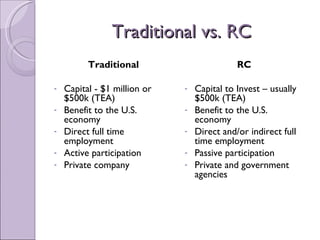
Traditional vs. RC
          Traditional                        RC

-   Capital - $1 million or   -   Capital to Invest – usually
    $500k (TEA)                   $500k (TEA)
-   Benefit to the U.S.       -   Benefit to the U.S.
    economy                       economy
-   Direct full time          -   Direct and/or indirect full
    employment                    time employment
-   Active participation      -   Passive participation
-   Private company           -   Private and government
                                  agencies
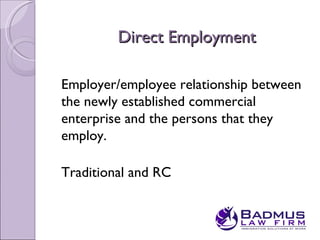
Direct Employment

Employer/employee relationship between
the newly established commercial
enterprise and the persons that they
employ.

Traditional and RC
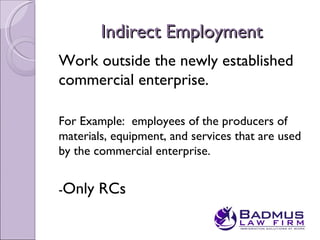
Indirect Employment
Work outside the newly established
commercial enterprise.

For Example: employees of the producers of
materials, equipment, and services that are used
by the commercial enterprise.


-Only   RCs
Investor Participation
   Active Participation - Investor is involved
    in the “day-to-day management of the
    business.” (Traditional)

   Passive Participation (RC)
RC Statistics
   There are currently 125 Regional Centers approved.
    Complete list of approved RCs is available at
    http://www.uscis.gov/eb-5centers
   Approx. 90-95% EB-5 petitions filed each year, are filed
    by Investors in RC-affiliated commercial enterprises.
   There are 156 initial RC Proposals, as well as 34 RC
    proposals seeking to amend approved RCs, pending
    initial review with USCIS.
Permanent Residence
Three (3) steps:
   Immigrant petition - Form I-526
   Immigrant visa (“green card”) petition -
    Form I-485 or DS 230
   Removal of Condition - Form I-829
Immigrant petition
              I-526 Form

• Basis for EB-5 Investor to become
  Permanent Resident of the United States
• File with the USCIS
• Processing time – 5 months (in practicality,
  taking 2-4 months)
• Filing fees - $1500
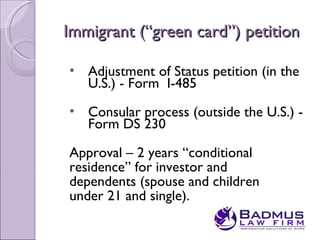
Immigrant (“green card”) petition

• Adjustment of Status petition (in the
  U.S.) - Form I-485
• Consular process (outside the U.S.) -
  Form DS 230

Approval – 2 years “conditional
residence” for investor and
dependents (spouse and children
under 21 and single).
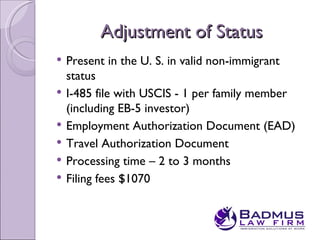
Adjustment of Status
   Present in the U. S. in valid non-immigrant
    status
   I-485 file with USCIS - 1 per family member
    (including EB-5 investor)
   Employment Authorization Document (EAD)
   Travel Authorization Document
   Processing time – 2 to 3 months
   Filing fees $1070
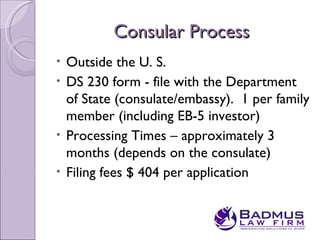
Consular Process
• Outside the U. S.
• DS 230 form - file with the Department
  of State (consulate/embassy). 1 per family
  member (including EB-5 investor)
• Processing Times – approximately 3
  months (depends on the consulate)
• Filing fees $ 404 per application
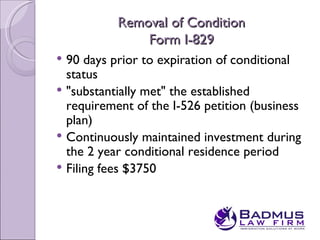
Removal of Condition
               Form I-829
 90 days prior to expiration of conditional
  status
 "substantially met" the established
  requirement of the I-526 petition (business
  plan)
 Continuously maintained investment during
  the 2 year conditional residence period
 Filing fees $3750
Termination of Conditional Residence

   At the end of the 2-year period - If I-526
    (business plan) conditions not met
   Before the 2 years
    ◦ Enterprise not established,
    ◦ Established solely to evade immigration laws,
    ◦ Requirements were otherwise violated.
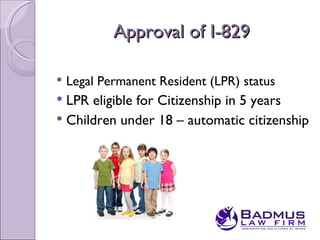
Approval of I-829

   Legal Permanent Resident (LPR) status
 LPR eligible for Citizenship in 5 years
 Children under 18 – automatic citizenship
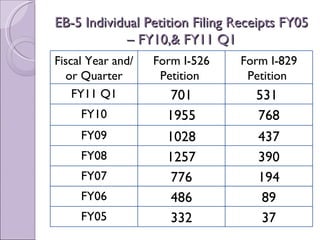
EB-5 Individual Petition Filing Receipts FY05
             – FY10,& FY11 Q1
Fiscal Year and/   Form I-526   Form I-829
  or Quarter        Petition     Petition
    FY11 Q1           701          531
     FY10            1955          768
     FY09            1028          437
     FY08            1257          390
     FY07             776          194
     FY06             486           89
     FY05             332           37
The Road to Permanent Residence

 Consider all possible options to obtaining
  LPR
 Chose EB-5, if most appropriate
 Regional Center - Due diligence
Question & Answer Session
Legal Notice
Facts of each case are different. The
information provided here is general in
nature and should not be relied upon for
your specific situation and is not legal
advice.
Consult with an experienced immigration
attorney to get the right advice to secure
your future in the United States.
Thank you
In appreciation of your participation in
this webinar, we will waive our $200
consultation fee if you schedule a
telephone consultation by July 15, 2011
to discuss your immigration options.

Call 469-916-7900 or email
pcuervo@badmuslaw.com
We value your feedback!
 So we may serve you better, please
 complete the brief survey that you will
 receive at the conclusion of this
 program.

 Give us your feedback and you could
 win a $50 gift card!
Thank You!
    Badmus Law Firm, PLLC
 Immigration Solutions at Work
11325 Pegasus Street, Suite S-215
        P.O. Box 551209
        Dallas, TX 75355
    469-916-7900 Telephone
     469-916-7901 Facsimile
  immigration@badmuslaw.com
      www.badmuslaw.com

EB-5 Webinar

  • 1.
    EB-5 IMMIGRANT INVESTORS Permanent Residence in the U.S.
  • 2.
    Ask Questions atAny Time  Go to your Question and Answer panel at the bottom of the page.  Type and send your question.  We will answer questions during the Q&A session at the end of the presentation.
  • 3.
    Ann Massey Badmus AttorneyAnn Massey Badmus is the founder of Badmus Law Firm, a law firm focused exclusively on the practice of immigration law. Ann represents clients worldwide on a broad range of family and employment based immigration issues. In her practice, she assists employers and their foreign national employees obtain the necessary visas for authorized work in the United States. Ann holds a Bachelor of Science in Mechanical Engineering from the University of Delaware and J.D from Widener University School of Law. Ann is frequently invited to speak about immigration issues before chambers of commerce, bar associations and other interested organizations. She has also published several articles about immigration and has authored a book for foreign national physicians, Immigration Prescription - The Practical Guide to Immigration for Foreign Born Physicians, published in January 2004. In 2009, Ann was named an Outstanding Minority Business Owner by the Dallas Business Journal.
  • 4.
    Angela M. Lopez AttorneyLopez joined Badmus Law Firm in April 2003. Since then, she has exclusively concentrated her legal practice to the immigration field. She has successfully developed a large national practice representing numerous foreign nationals and their employers in a broad range of corporate and employment-based immigration matters. In the medical industry, her clients range from individual physicians to small private practices to Hospitals and National Health Centers.  She has guided physicians and their employers through J-1 waivers, H1-B, O-1 and permanent residence applications based upon labor certification, extraordinary ability aliens and national interest waivers nationwide. Angela is frequently invited to speak about immigration issues before chambers of commerce, bar associations and other interested organizations.
  • 5.
    EB-5 – Visafor Investors  Employment- Based fifth preference category (EB-5)  Foreign investors seeking permanent residence in the U. S.
  • 6.
    EB-5 – Visafor Investors  The United States offers 10,000 EB-5 visas per year  3,000 for investors in Targeted Employment Areas (TEA)  3,000 for investors in Regional Center (RC) Programs
  • 7.
    EB-5 Visa Usage FiscalYear and/or Total EB-5 Visas Issued Quarter FY11 Q1 1,421* FY10 1,885 FY09 4,218 FY08 1,360 FY07 806 FY06 744 *Preliminary estimate of FY11 Q1 Visas Issued
  • 8.
    Who is Eligible Individualswho: • “have invested or are actively in the process of investing • minimum amount of capital required • into a new commercial enterprise”
  • 9.
    New Commercial Enterprise Creating - original business after November 29, 1990; or  Purchasing - existing business and restructuring or reorganizing so a new commercial organization results; or  Expanding - existing business by 140% of the pre- investment number of jobs or net worth; or  Retaining - all existing jobs in a troubled business that has lost 20% of its net worth over the past 12 to 24 months.
  • 10.
    New Commercial Enterprise  Create full-time employment - 10 U.S. qualified individuals; or  Maintain the number of existing employees (“troubled business”)  Benefit the U.S Economy
  • 11.
    Required Amount ofCapital  $1,000,000, or  $500,000 - investment in a "targeted employment area" (TEA) ◦ high unemployment area (unemployment of at least 150% - national average rate) or ◦ rural area as designated by the U.S. OMB
  • 12.
    Capital • Cash, Cash equivalents and other tangible property. • Loans or “Debt arrangements” – Are not capital contribution; unless secured by investor personal assets (Promissory Note)
  • 13.
    Capital Source • Legitimate/lawful source • At Risk • Actual capital commitment • Expended directly towards job creation
  • 14.
    Benefit the U.SEconomy No guidance - “subjective” determination. “Enterprise, in the conduct of its business, will benefit the U.S economy.” (e.g. enterprise will provide good and services).
  • 15.
    EB-5 Investment Options “Programs” Traditional Program – Immigration Act of 1990 Regional Center (RC) Program – Public Law – 2002. Extended to September 30, 2012.
  • 16.
    Traditional Program  Privateinvestment and  Investor directly involved in the management of the business.
  • 17.
    Regional Center (RC)Program  Entity, organization or agency (private or public) approved by the Citizenship and Immigration Services (CIS);  Focuses on a specific geographic area within the United States; and  Seeks to promote economic growth through increased export sales, improved regional productivity, creation of new jobs, and increased domestic capital investment.
  • 18.
    Traditional vs. RC Traditional RC - Capital - $1 million or - Capital to Invest – usually $500k (TEA) $500k (TEA) - Benefit to the U.S. - Benefit to the U.S. economy economy - Direct full time - Direct and/or indirect full employment time employment - Active participation - Passive participation - Private company - Private and government agencies
  • 19.
    Direct Employment Employer/employee relationshipbetween the newly established commercial enterprise and the persons that they employ. Traditional and RC
  • 20.
    Indirect Employment Work outsidethe newly established commercial enterprise. For Example: employees of the producers of materials, equipment, and services that are used by the commercial enterprise. -Only RCs
  • 21.
    Investor Participation  Active Participation - Investor is involved in the “day-to-day management of the business.” (Traditional)  Passive Participation (RC)
  • 22.
    RC Statistics  There are currently 125 Regional Centers approved. Complete list of approved RCs is available at http://www.uscis.gov/eb-5centers  Approx. 90-95% EB-5 petitions filed each year, are filed by Investors in RC-affiliated commercial enterprises.  There are 156 initial RC Proposals, as well as 34 RC proposals seeking to amend approved RCs, pending initial review with USCIS.
  • 23.
    Permanent Residence Three (3)steps:  Immigrant petition - Form I-526  Immigrant visa (“green card”) petition - Form I-485 or DS 230  Removal of Condition - Form I-829
  • 24.
    Immigrant petition I-526 Form • Basis for EB-5 Investor to become Permanent Resident of the United States • File with the USCIS • Processing time – 5 months (in practicality, taking 2-4 months) • Filing fees - $1500
  • 25.
    Immigrant (“green card”)petition • Adjustment of Status petition (in the U.S.) - Form I-485 • Consular process (outside the U.S.) - Form DS 230 Approval – 2 years “conditional residence” for investor and dependents (spouse and children under 21 and single).
  • 26.
    Adjustment of Status  Present in the U. S. in valid non-immigrant status  I-485 file with USCIS - 1 per family member (including EB-5 investor)  Employment Authorization Document (EAD)  Travel Authorization Document  Processing time – 2 to 3 months  Filing fees $1070
  • 27.
    Consular Process • Outsidethe U. S. • DS 230 form - file with the Department of State (consulate/embassy). 1 per family member (including EB-5 investor) • Processing Times – approximately 3 months (depends on the consulate) • Filing fees $ 404 per application
  • 28.
    Removal of Condition Form I-829  90 days prior to expiration of conditional status  "substantially met" the established requirement of the I-526 petition (business plan)  Continuously maintained investment during the 2 year conditional residence period  Filing fees $3750
  • 29.
    Termination of ConditionalResidence  At the end of the 2-year period - If I-526 (business plan) conditions not met  Before the 2 years ◦ Enterprise not established, ◦ Established solely to evade immigration laws, ◦ Requirements were otherwise violated.
  • 30.
    Approval of I-829  Legal Permanent Resident (LPR) status  LPR eligible for Citizenship in 5 years  Children under 18 – automatic citizenship
  • 31.
    EB-5 Individual PetitionFiling Receipts FY05 – FY10,& FY11 Q1 Fiscal Year and/ Form I-526 Form I-829 or Quarter Petition Petition FY11 Q1 701 531 FY10 1955 768 FY09 1028 437 FY08 1257 390 FY07 776 194 FY06 486 89 FY05 332 37
  • 32.
    The Road toPermanent Residence  Consider all possible options to obtaining LPR  Chose EB-5, if most appropriate  Regional Center - Due diligence
  • 33.
  • 34.
    Legal Notice Facts ofeach case are different. The information provided here is general in nature and should not be relied upon for your specific situation and is not legal advice. Consult with an experienced immigration attorney to get the right advice to secure your future in the United States.
  • 35.
    Thank you In appreciationof your participation in this webinar, we will waive our $200 consultation fee if you schedule a telephone consultation by July 15, 2011 to discuss your immigration options. Call 469-916-7900 or email pcuervo@badmuslaw.com
  • 36.
    We value yourfeedback! So we may serve you better, please complete the brief survey that you will receive at the conclusion of this program. Give us your feedback and you could win a $50 gift card!
  • 37.
    Thank You! Badmus Law Firm, PLLC Immigration Solutions at Work 11325 Pegasus Street, Suite S-215 P.O. Box 551209 Dallas, TX 75355 469-916-7900 Telephone 469-916-7901 Facsimile immigration@badmuslaw.com www.badmuslaw.com