THE OECD INCLUSIVE GROWTH
INITIATIVE
Identifying the policy drivers of multidimensional well-being
4 OCTOBER 2019
Romina Boarini
OECD, Senior Advisor to the Secretary-General and OECD Inclusive Growth Initiative Co-ordinator
© OECD |
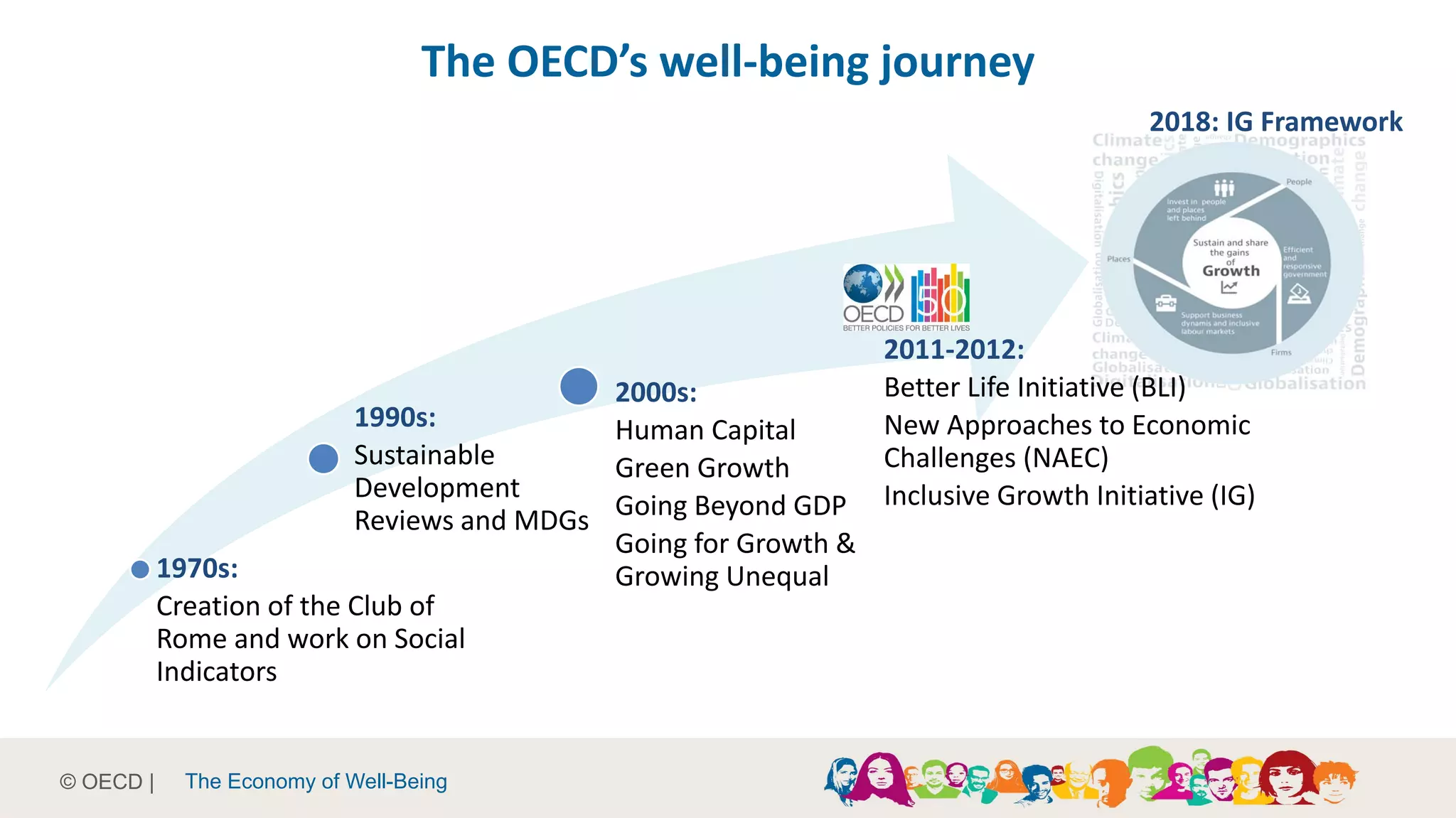
The OECD’s well-being journey
1970s:
Creation of the Club of
Rome and work on Social
Indicators
1990s:
Sustainable
Development
Reviews and MDGs
2000s:
Human Capital
Green Growth
Going Beyond GDP
Going for Growth &
Growing Unequal
2011-2012:
Better Life Initiative (BLI)
New Approaches to Economic
Challenges (NAEC)
Inclusive Growth Initiative (IG)
The Economy of Well-Being
2018: IG Framework
Since 2011: the OECD Well-Being Framework
• Studied the policy drivers of 9 dimensions (with
the exception of social connections and personal
security) across countries, over time, place-based
etc [Formal quantification for many of them]
• Studied the intersections (e.g. how health has an
impact of income; how access to green space
affects subjective well-being, etc)
• Mainstreaming of well-being within OECD
successful:
• Focus on multidimensionality
• Focus on distribution
• Focus on outcomes (including subjective)
© OECD |
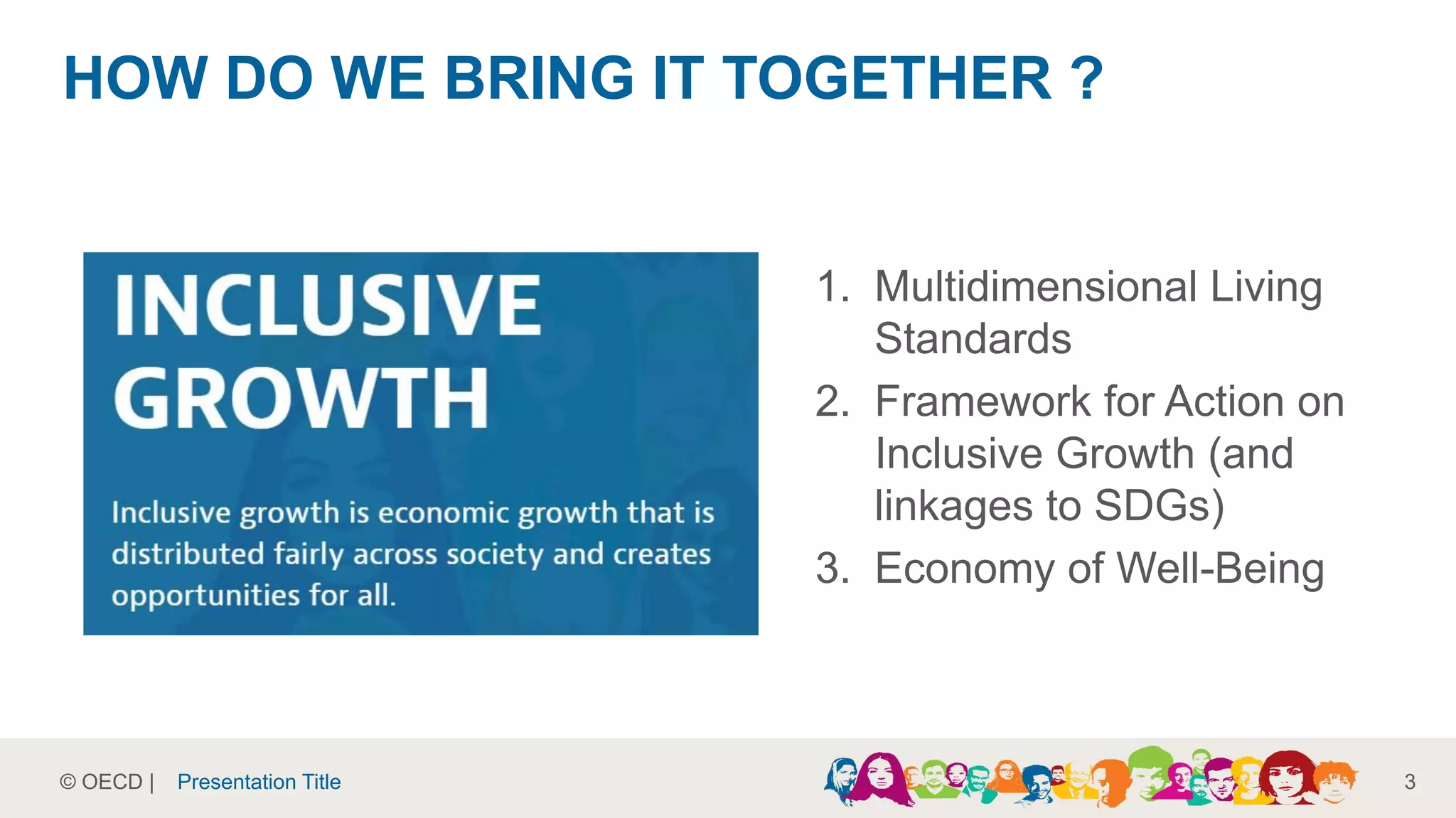
HOW DO WE BRING IT TOGETHER ?
1. Multidimensional Living
Standards
2. Framework for Action on
Inclusive Growth (and
linkages to SDGs)
3. Economy of Well-Being
3Presentation Title
© OECD |
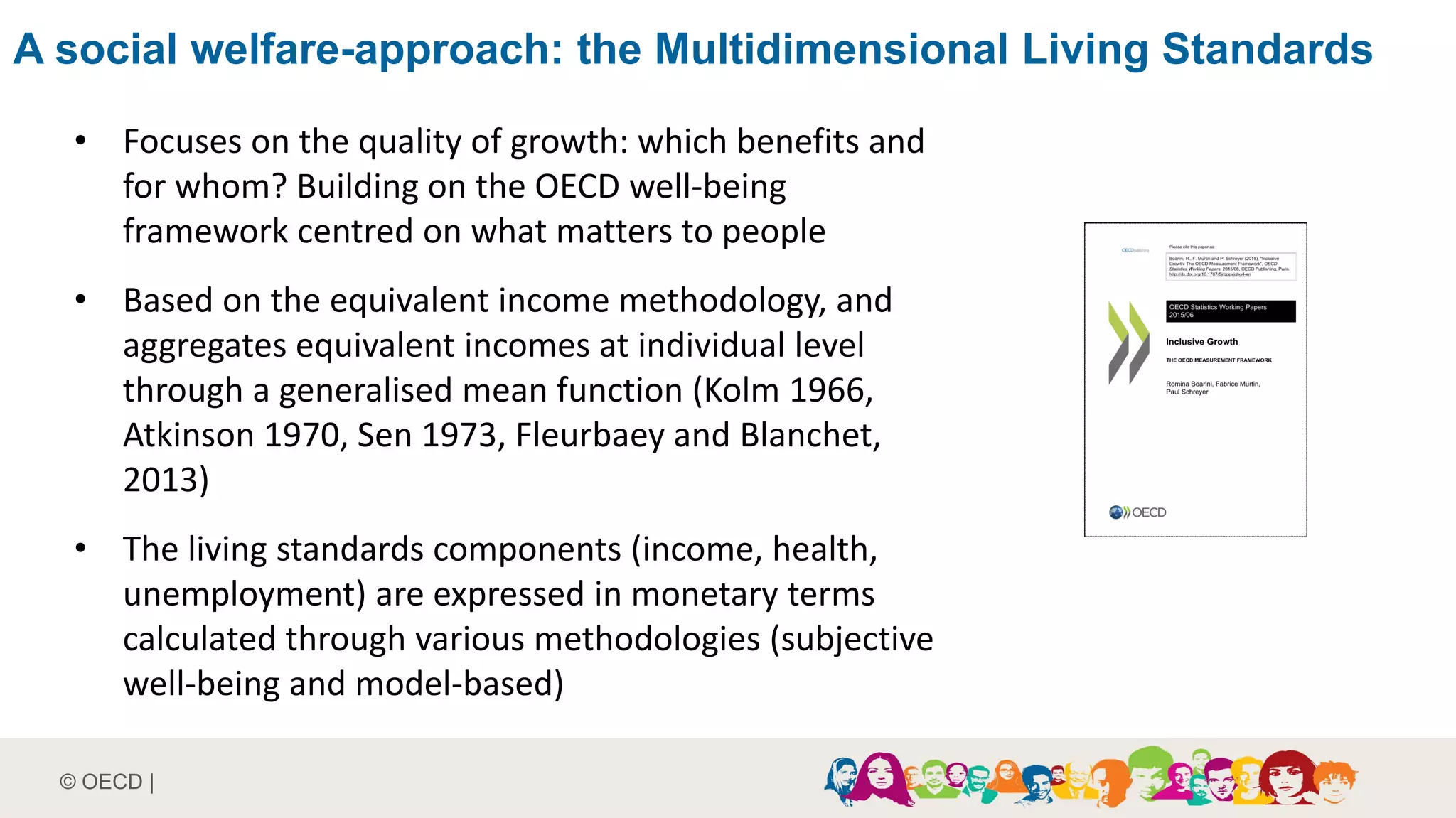
• Focuses on the quality of growth: which benefits and
for whom? Building on the OECD well-being
framework centred on what matters to people
• Based on the equivalent income methodology, and
aggregates equivalent incomes at individual level
through a generalised mean function (Kolm 1966,
Atkinson 1970, Sen 1973, Fleurbaey and Blanchet,
2013)
• The living standards components (income, health,
unemployment) are expressed in monetary terms
calculated through various methodologies (subjective
well-being and model-based)
A social welfare-approach: the Multidimensional Living Standards
© OECD |
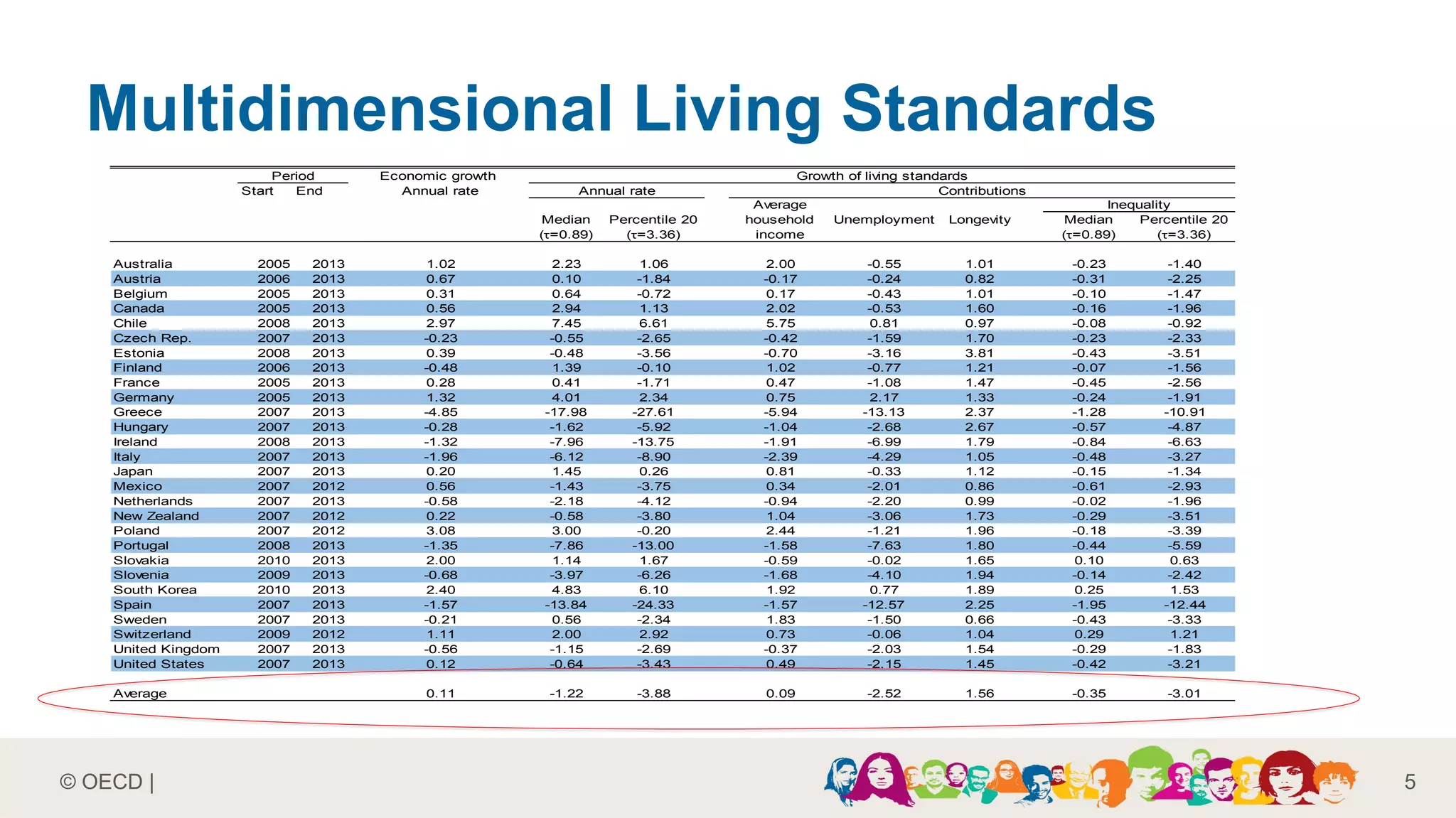
Multidimensional Living Standards
5
Economic growth
Start End Annual rate
Median
(τ=0.89)
Percentile 20
(τ=3.36)
Median
(τ=0.89)
Percentile 20
(τ=3.36)
Australia 2005 2013 1.02 2.23 1.06 2.00 -0.55 1.01 -0.23 -1.40
Austria 2006 2013 0.67 0.10 -1.84 -0.17 -0.24 0.82 -0.31 -2.25
Belgium 2005 2013 0.31 0.64 -0.72 0.17 -0.43 1.01 -0.10 -1.47
Canada 2005 2013 0.56 2.94 1.13 2.02 -0.53 1.60 -0.16 -1.96
Chile 2008 2013 2.97 7.45 6.61 5.75 0.81 0.97 -0.08 -0.92
Czech Rep. 2007 2013 -0.23 -0.55 -2.65 -0.42 -1.59 1.70 -0.23 -2.33
Estonia 2008 2013 0.39 -0.48 -3.56 -0.70 -3.16 3.81 -0.43 -3.51
Finland 2006 2013 -0.48 1.39 -0.10 1.02 -0.77 1.21 -0.07 -1.56
France 2005 2013 0.28 0.41 -1.71 0.47 -1.08 1.47 -0.45 -2.56
Germany 2005 2013 1.32 4.01 2.34 0.75 2.17 1.33 -0.24 -1.91
Greece 2007 2013 -4.85 -17.98 -27.61 -5.94 -13.13 2.37 -1.28 -10.91
Hungary 2007 2013 -0.28 -1.62 -5.92 -1.04 -2.68 2.67 -0.57 -4.87
Ireland 2008 2013 -1.32 -7.96 -13.75 -1.91 -6.99 1.79 -0.84 -6.63
Italy 2007 2013 -1.96 -6.12 -8.90 -2.39 -4.29 1.05 -0.48 -3.27
Japan 2007 2013 0.20 1.45 0.26 0.81 -0.33 1.12 -0.15 -1.34
Mexico 2007 2012 0.56 -1.43 -3.75 0.34 -2.01 0.86 -0.61 -2.93
Netherlands 2007 2013 -0.58 -2.18 -4.12 -0.94 -2.20 0.99 -0.02 -1.96
New Zealand 2007 2012 0.22 -0.58 -3.80 1.04 -3.06 1.73 -0.29 -3.51
Poland 2007 2012 3.08 3.00 -0.20 2.44 -1.21 1.96 -0.18 -3.39
Portugal 2008 2013 -1.35 -7.86 -13.00 -1.58 -7.63 1.80 -0.44 -5.59
Slovakia 2010 2013 2.00 1.14 1.67 -0.59 -0.02 1.65 0.10 0.63
Slovenia 2009 2013 -0.68 -3.97 -6.26 -1.68 -4.10 1.94 -0.14 -2.42
South Korea 2010 2013 2.40 4.83 6.10 1.92 0.77 1.89 0.25 1.53
Spain 2007 2013 -1.57 -13.84 -24.33 -1.57 -12.57 2.25 -1.95 -12.44
Sweden 2007 2013 -0.21 0.56 -2.34 1.83 -1.50 0.66 -0.43 -3.33
Switzerland 2009 2012 1.11 2.00 2.92 0.73 -0.06 1.04 0.29 1.21
United Kingdom 2007 2013 -0.56 -1.15 -2.69 -0.37 -2.03 1.54 -0.29 -1.83
United States 2007 2013 0.12 -0.64 -3.43 0.49 -2.15 1.45 -0.42 -3.21
Average 0.11 -1.22 -3.88 0.09 -2.52 1.56 -0.35 -3.01
Period Growth of living standards
Annual rate Contributions
InequalityAverage
household
income
Unemployment Longevity
© OECD | 6
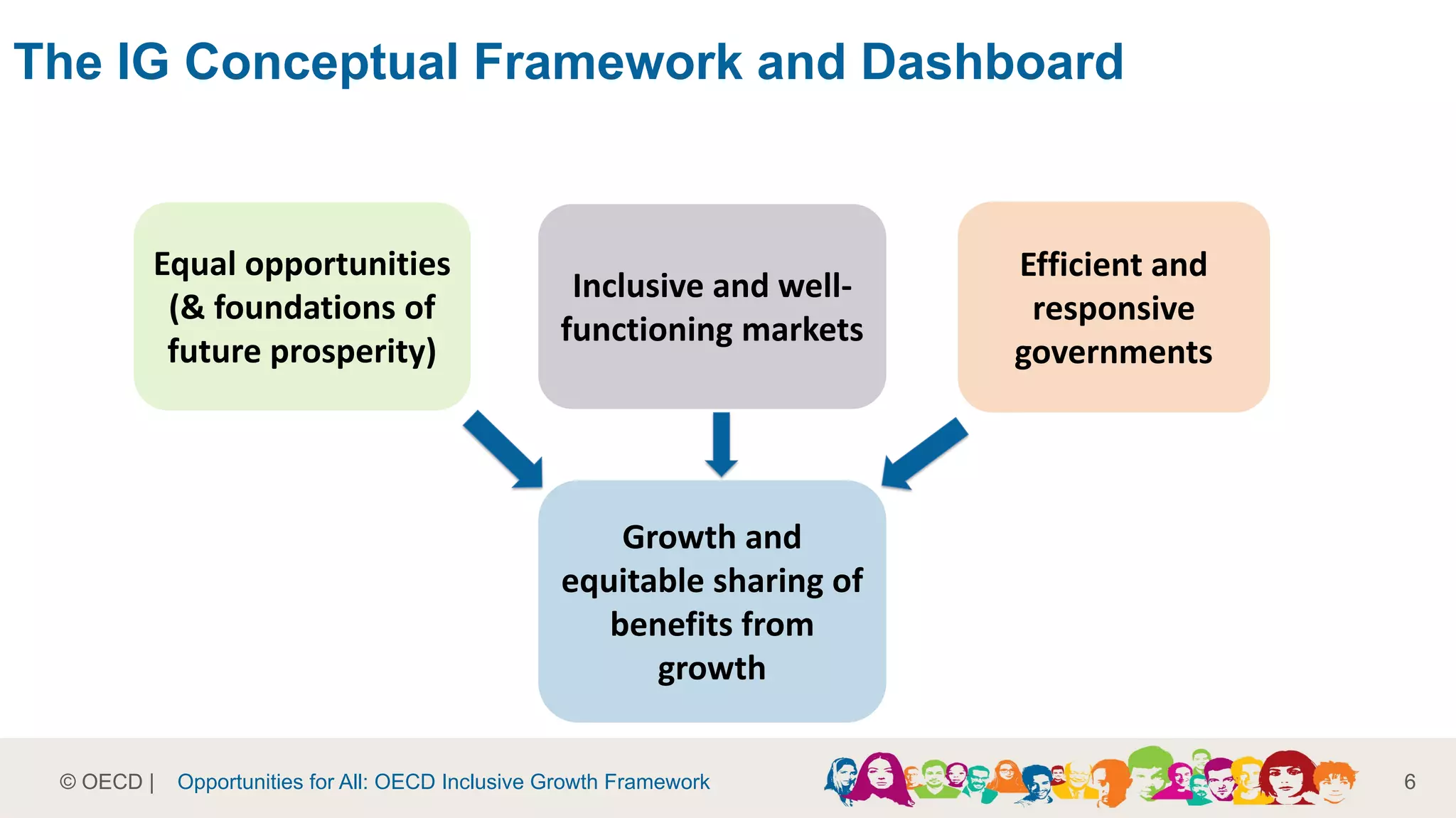
Inclusive and well-
functioning markets
Equal opportunities
(& foundations of
future prosperity)
Efficient and
responsive
governments
Growth and
equitable sharing of
benefits from
growth
The IG Conceptual Framework and Dashboard
Opportunities for All: OECD Inclusive Growth Framework
© OECD |
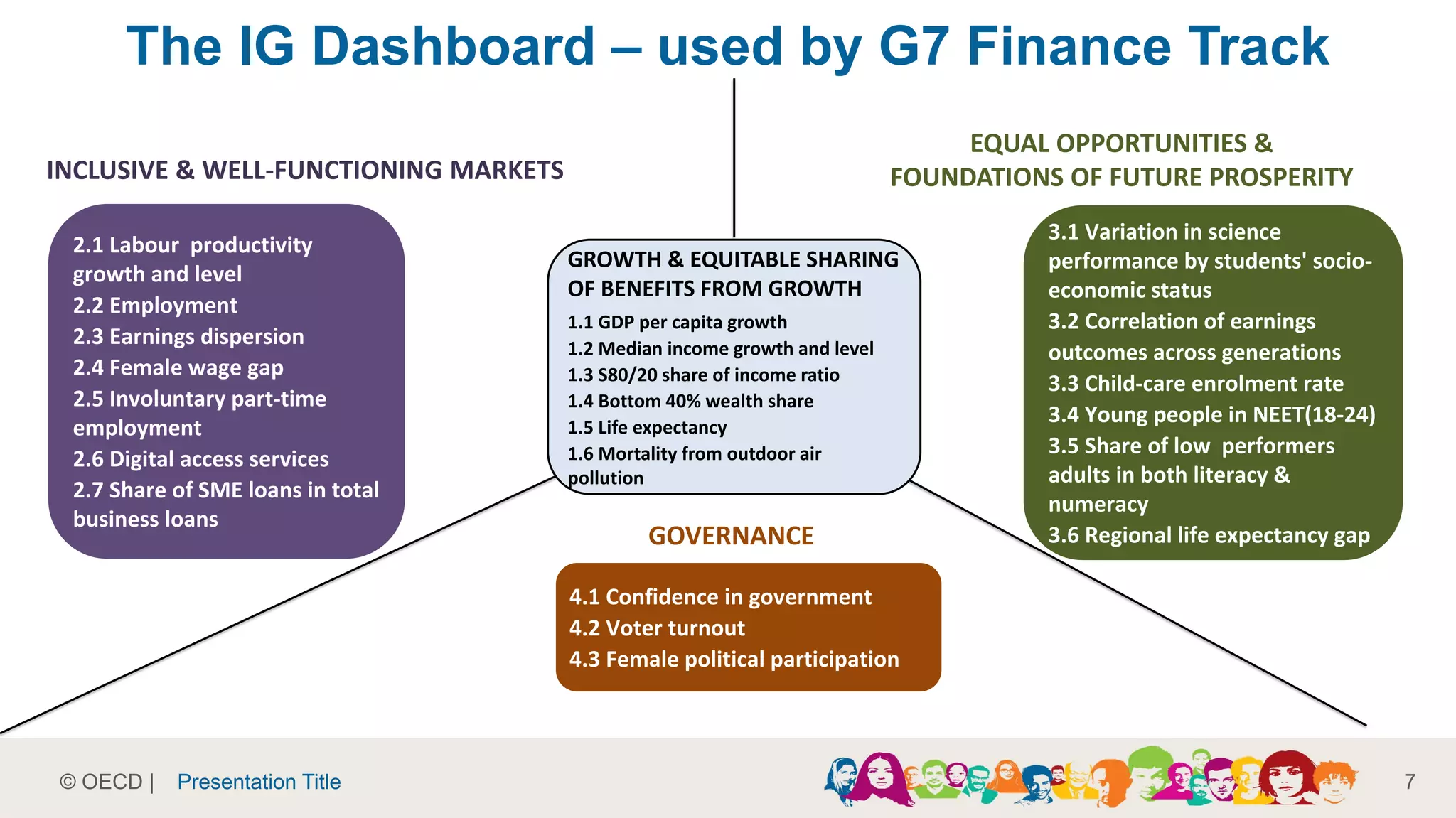
The IG Dashboard – used by G7 Finance Track
7Presentation Title
GROWTH & EQUITABLE SHARING
OF BENEFITS FROM GROWTH
1.1 GDP per capita growth
1.2 Median income growth and level
1.3 S80/20 share of income ratio
1.4 Bottom 40% wealth share
1.5 Life expectancy
1.6 Mortality from outdoor air
pollution
INCLUSIVE & WELL-FUNCTIONING MARKETS
EQUAL OPPORTUNITIES &
FOUNDATIONS OF FUTURE PROSPERITY
GOVERNANCE
4.1 Confidence in government
4.2 Voter turnout
4.3 Female political participation
2.1 Labour productivity
growth and level
2.2 Employment
2.3 Earnings dispersion
2.4 Female wage gap
2.5 Involuntary part-time
employment
2.6 Digital access services
2.7 Share of SME loans in total
business loans
3.1 Variation in science
performance by students' socio-
economic status
3.2 Correlation of earnings
outcomes across generations
3.3 Child-care enrolment rate
3.4 Young people in NEET(18-24)
3.5 Share of low performers
adults in both literacy &
numeracy
3.6 Regional life expectancy gap
© OECD | 8
The Framework for Policy Action: an integrated
approach to growth that works for all
From the dashboard an analysis of policy drivers across the board, synthetized in
three sets of dynamics that policies can catalyse:
1. Investing in people and places that have been
left behind [“Pre-Distribution”];
2. Supporting business dynamism and inclusive
labour markets [“Ïn-market Distribution”]; and
3. Building efficient and responsive governments
[“Redistribution”+ “Inclusive Policy-Making”+
“Fair institutions”].
© OECD |
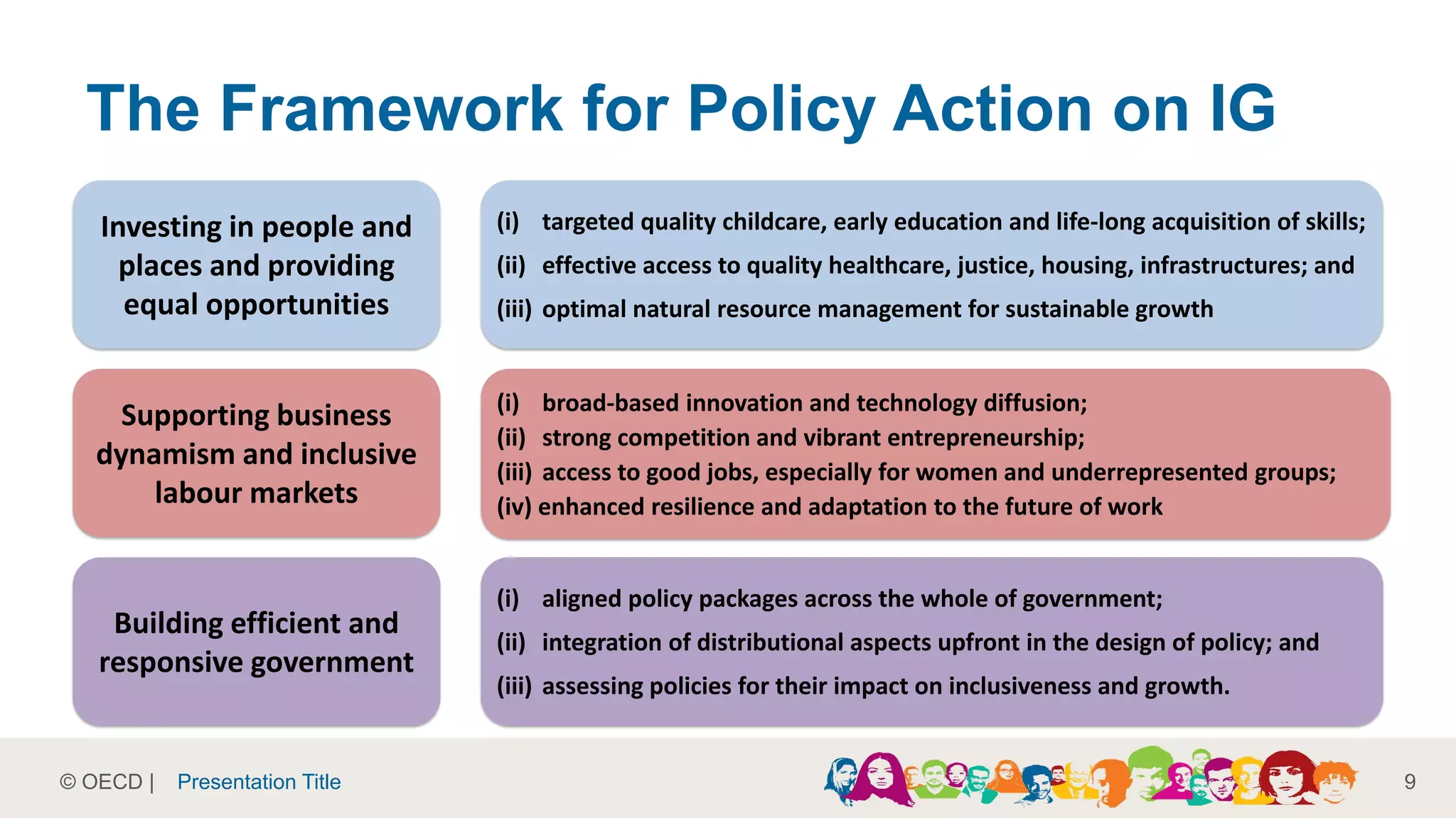
The Framework for Policy Action on IG
9
Investing in people and
places and providing
equal opportunities
Supporting business
dynamism and inclusive
labour markets
Building efficient and
responsive government
(i) targeted quality childcare, early education and life-long acquisition of skills;
(ii) effective access to quality healthcare, justice, housing, infrastructures; and
(iii) optimal natural resource management for sustainable growth
Presentation Title
(i) broad-based innovation and technology diffusion;
(ii) strong competition and vibrant entrepreneurship;
(iii) access to good jobs, especially for women and underrepresented groups;
(iv) enhanced resilience and adaptation to the future of work
(i) aligned policy packages across the whole of government;
(ii) integration of distributional aspects upfront in the design of policy; and
(iii) assessing policies for their impact on inclusiveness and growth.
© OECD | 10
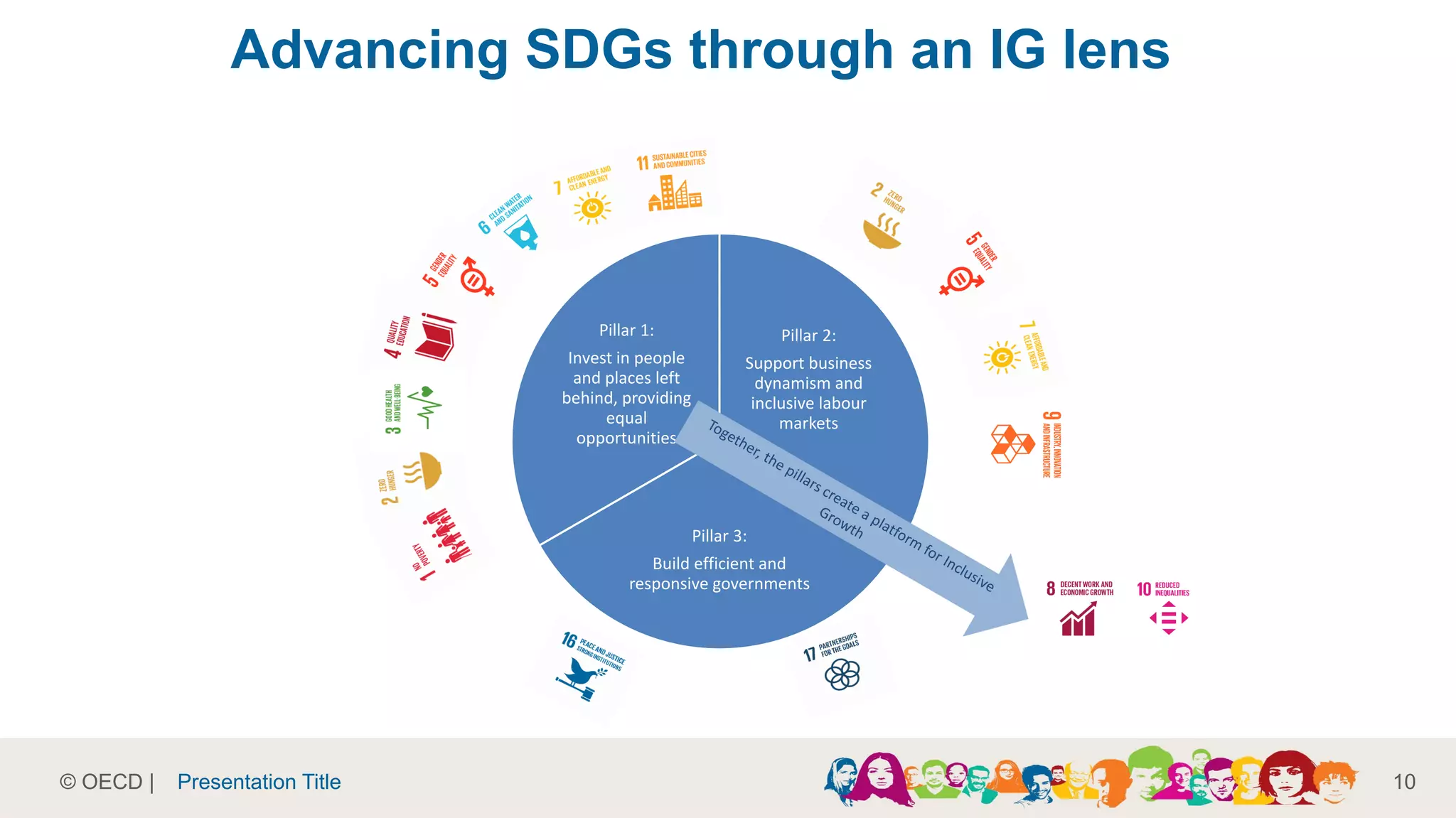
Advancing SDGs through an IG lens
Pillar 2:
Support business
dynamism and
inclusive labour
markets
Pillar 3:
Build efficient and
responsive governments
Pillar 1:
Invest in people
and places left
behind, providing
equal
opportunities
Presentation Title
© OECD |
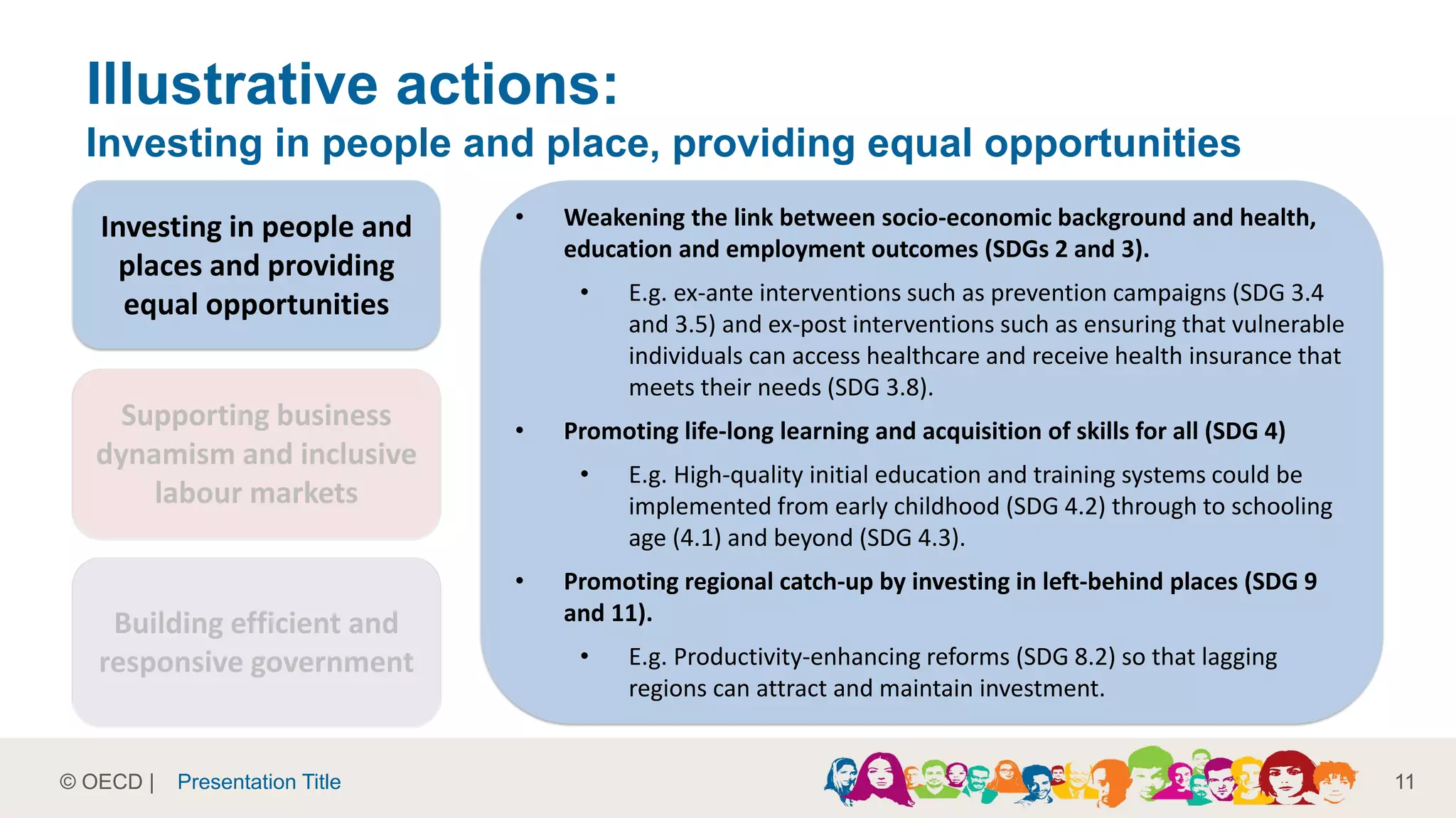
Illustrative actions:
Investing in people and place, providing equal opportunities
11
Investing in people and
places and providing
equal opportunities
Supporting business
dynamism and inclusive
labour markets
Building efficient and
responsive government
• Weakening the link between socio-economic background and health,
education and employment outcomes (SDGs 2 and 3).
• E.g. ex-ante interventions such as prevention campaigns (SDG 3.4
and 3.5) and ex-post interventions such as ensuring that vulnerable
individuals can access healthcare and receive health insurance that
meets their needs (SDG 3.8).
• Promoting life-long learning and acquisition of skills for all (SDG 4)
• E.g. High-quality initial education and training systems could be
implemented from early childhood (SDG 4.2) through to schooling
age (4.1) and beyond (SDG 4.3).
• Promoting regional catch-up by investing in left-behind places (SDG 9
and 11).
• E.g. Productivity-enhancing reforms (SDG 8.2) so that lagging
regions can attract and maintain investment.
Presentation Title
© OECD | 13
Investing in people and
places and providing
equal opportunities
Supporting business
dynamism and inclusive
labour markets
Building efficient and
responsive government
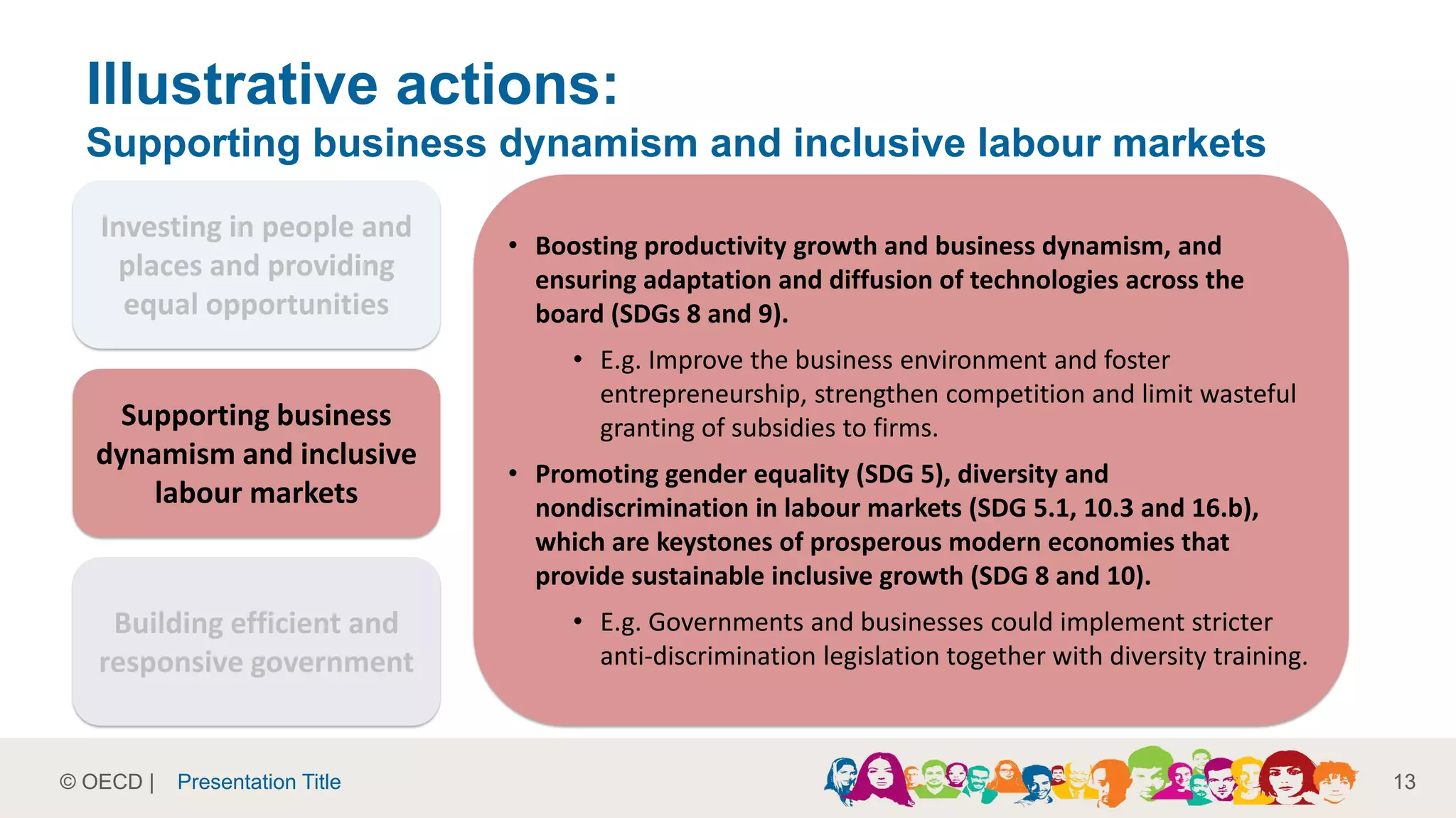
• Boosting productivity growth and business dynamism, and
ensuring adaptation and diffusion of technologies across the
board (SDGs 8 and 9).
• E.g. Improve the business environment and foster
entrepreneurship, strengthen competition and limit wasteful
granting of subsidies to firms.
• Promoting gender equality (SDG 5), diversity and
nondiscrimination in labour markets (SDG 5.1, 10.3 and 16.b),
which are keystones of prosperous modern economies that
provide sustainable inclusive growth (SDG 8 and 10).
• E.g. Governments and businesses could implement stricter
anti-discrimination legislation together with diversity training.
Presentation Title
Illustrative actions:
Supporting business dynamism and inclusive labour markets
© OECD | 16Presentation Title
Investing in people and
places and providing
equal opportunities
Supporting business
dynamism and inclusive
labour markets
Building efficient and
responsive government
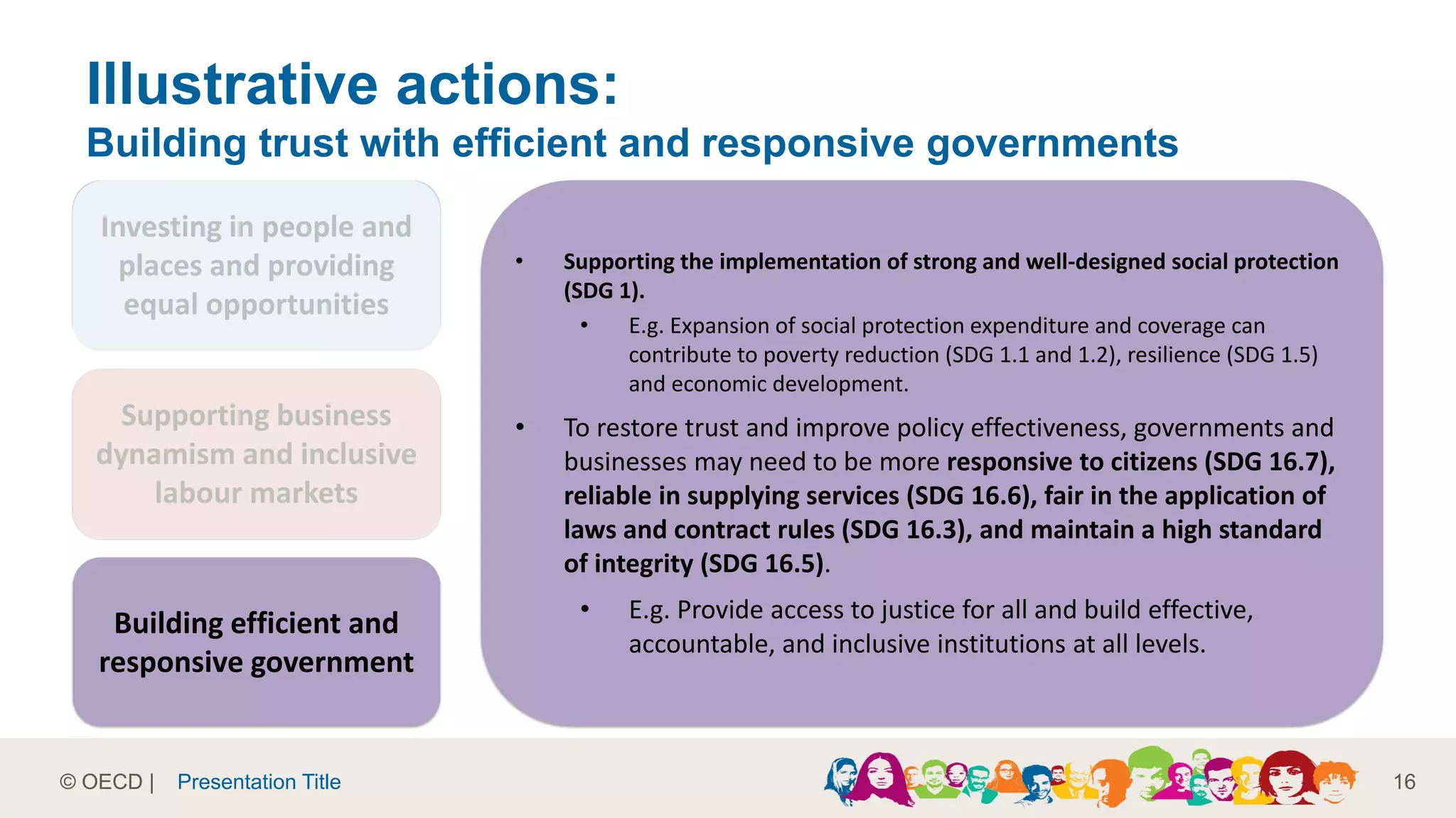
• Supporting the implementation of strong and well-designed social protection
(SDG 1).
• E.g. Expansion of social protection expenditure and coverage can
contribute to poverty reduction (SDG 1.1 and 1.2), resilience (SDG 1.5)
and economic development.
• To restore trust and improve policy effectiveness, governments and
businesses may need to be more responsive to citizens (SDG 16.7),
reliable in supplying services (SDG 16.6), fair in the application of
laws and contract rules (SDG 16.3), and maintain a high standard
of integrity (SDG 16.5).
• E.g. Provide access to justice for all and build effective,
accountable, and inclusive institutions at all levels.
Illustrative actions:
Building trust with efficient and responsive governments
© OECD | The Economy of Well-Being
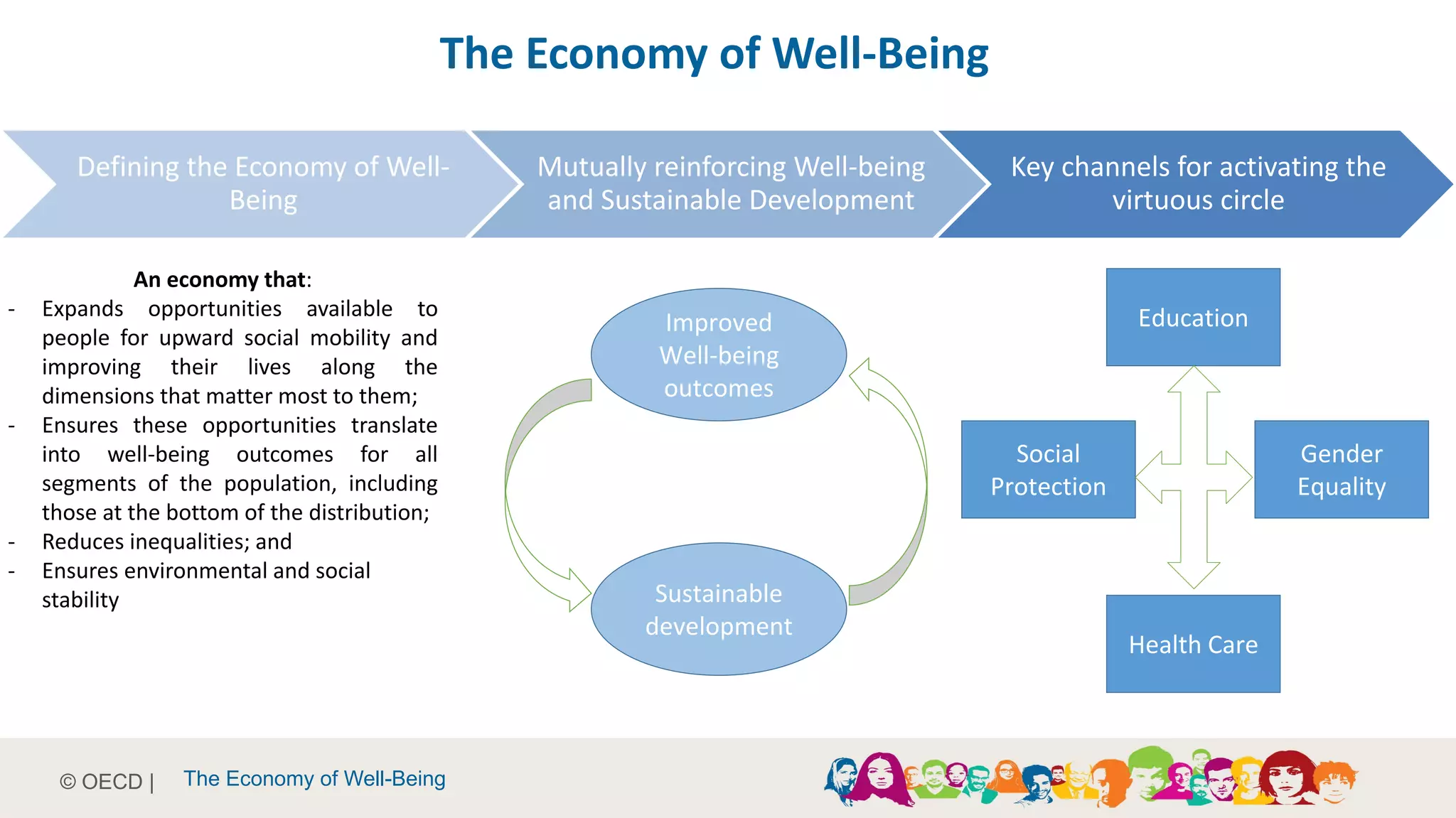
The Economy of Well-Being
Defining the Economy of Well-
Being
Mutually reinforcing Well-being
and Sustainable Development
Key channels for activating the
virtuous circle
An economy that:
- Expands opportunities available to
people for upward social mobility and
improving their lives along the
dimensions that matter most to them;
- Ensures these opportunities translate
into well-being outcomes for all
segments of the population, including
those at the bottom of the distribution;
- Reduces inequalities; and
- Ensures environmental and social
stability
Improved
Well-being
outcomes
Sustainable
development
Social
Protection
Gender
Equality
Education
Health Care
18
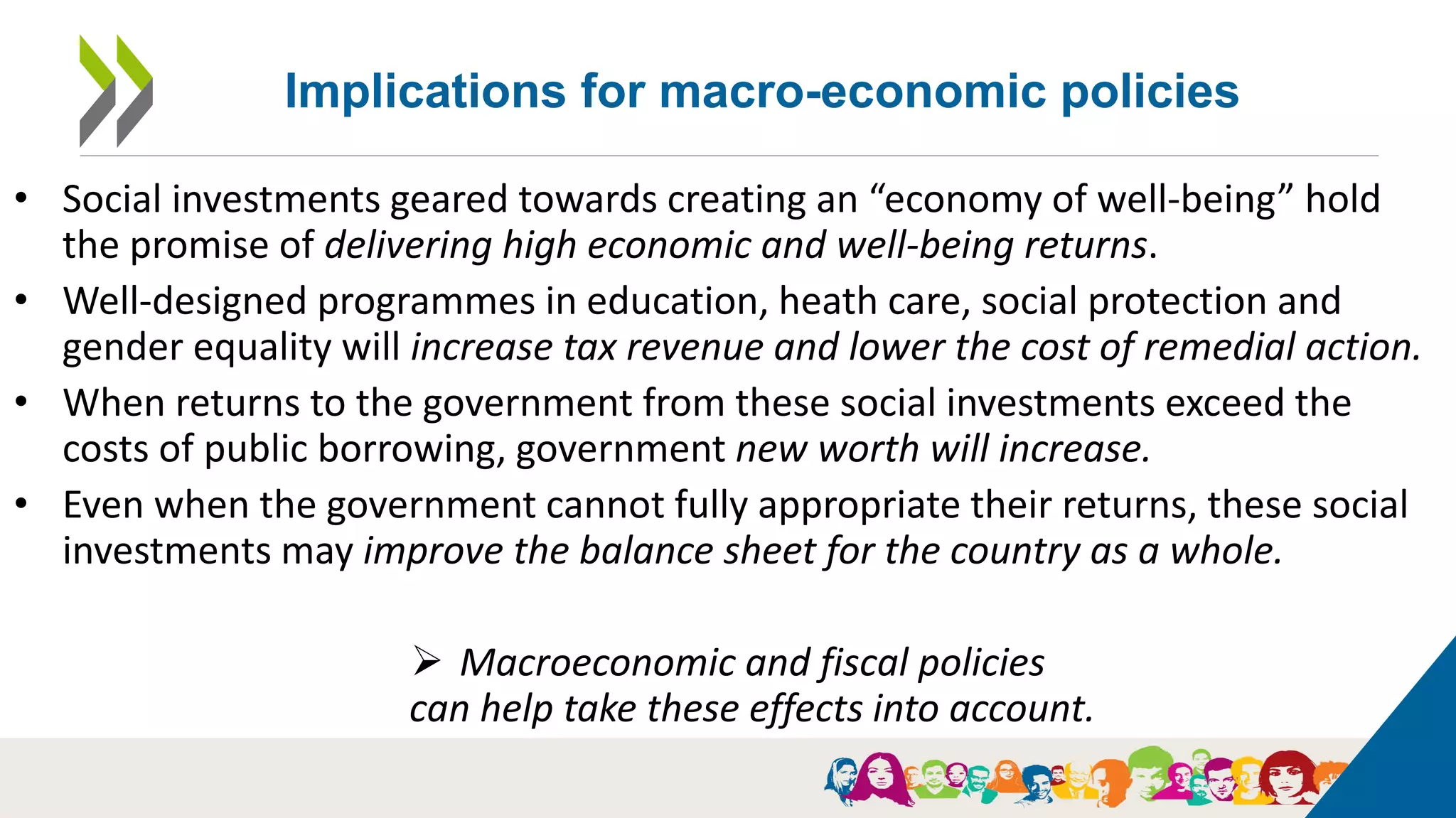
• Social investments geared towards creating an “economy of well-being” hold
the promise of delivering high economic and well-being returns.
• Well-designed programmes in education, heath care, social protection and
gender equality will increase tax revenue and lower the cost of remedial action.
• When returns to the government from these social investments exceed the
costs of public borrowing, government new worth will increase.
• Even when the government cannot fully appropriate their returns, these social
investments may improve the balance sheet for the country as a whole.
 Macroeconomic and fiscal policies
can help take these effects into account.
Implications for macro-economic policies
© OECD |
Thank you!
OECD Inclusive Growth Initiative:
http://www.oecd.org/inclusive-growth/
romina.boarini@oecd.org
19Opportunities for All: OECD Inclusive Growth Framework

Putting well being metrics into policy action, Romina Boarini

  • 1.
    THE OECD INCLUSIVEGROWTH INITIATIVE Identifying the policy drivers of multidimensional well-being 4 OCTOBER 2019 Romina Boarini OECD, Senior Advisor to the Secretary-General and OECD Inclusive Growth Initiative Co-ordinator
  • 2.
    © OECD | TheOECD’s well-being journey 1970s: Creation of the Club of Rome and work on Social Indicators 1990s: Sustainable Development Reviews and MDGs 2000s: Human Capital Green Growth Going Beyond GDP Going for Growth & Growing Unequal 2011-2012: Better Life Initiative (BLI) New Approaches to Economic Challenges (NAEC) Inclusive Growth Initiative (IG) The Economy of Well-Being 2018: IG Framework
  • 3.
    Since 2011: theOECD Well-Being Framework • Studied the policy drivers of 9 dimensions (with the exception of social connections and personal security) across countries, over time, place-based etc [Formal quantification for many of them] • Studied the intersections (e.g. how health has an impact of income; how access to green space affects subjective well-being, etc) • Mainstreaming of well-being within OECD successful: • Focus on multidimensionality • Focus on distribution • Focus on outcomes (including subjective)
  • 4.
    © OECD | HOWDO WE BRING IT TOGETHER ? 1. Multidimensional Living Standards 2. Framework for Action on Inclusive Growth (and linkages to SDGs) 3. Economy of Well-Being 3Presentation Title
  • 5.
    © OECD | •Focuses on the quality of growth: which benefits and for whom? Building on the OECD well-being framework centred on what matters to people • Based on the equivalent income methodology, and aggregates equivalent incomes at individual level through a generalised mean function (Kolm 1966, Atkinson 1970, Sen 1973, Fleurbaey and Blanchet, 2013) • The living standards components (income, health, unemployment) are expressed in monetary terms calculated through various methodologies (subjective well-being and model-based) A social welfare-approach: the Multidimensional Living Standards
  • 6.
    © OECD | MultidimensionalLiving Standards 5 Economic growth Start End Annual rate Median (τ=0.89) Percentile 20 (τ=3.36) Median (τ=0.89) Percentile 20 (τ=3.36) Australia 2005 2013 1.02 2.23 1.06 2.00 -0.55 1.01 -0.23 -1.40 Austria 2006 2013 0.67 0.10 -1.84 -0.17 -0.24 0.82 -0.31 -2.25 Belgium 2005 2013 0.31 0.64 -0.72 0.17 -0.43 1.01 -0.10 -1.47 Canada 2005 2013 0.56 2.94 1.13 2.02 -0.53 1.60 -0.16 -1.96 Chile 2008 2013 2.97 7.45 6.61 5.75 0.81 0.97 -0.08 -0.92 Czech Rep. 2007 2013 -0.23 -0.55 -2.65 -0.42 -1.59 1.70 -0.23 -2.33 Estonia 2008 2013 0.39 -0.48 -3.56 -0.70 -3.16 3.81 -0.43 -3.51 Finland 2006 2013 -0.48 1.39 -0.10 1.02 -0.77 1.21 -0.07 -1.56 France 2005 2013 0.28 0.41 -1.71 0.47 -1.08 1.47 -0.45 -2.56 Germany 2005 2013 1.32 4.01 2.34 0.75 2.17 1.33 -0.24 -1.91 Greece 2007 2013 -4.85 -17.98 -27.61 -5.94 -13.13 2.37 -1.28 -10.91 Hungary 2007 2013 -0.28 -1.62 -5.92 -1.04 -2.68 2.67 -0.57 -4.87 Ireland 2008 2013 -1.32 -7.96 -13.75 -1.91 -6.99 1.79 -0.84 -6.63 Italy 2007 2013 -1.96 -6.12 -8.90 -2.39 -4.29 1.05 -0.48 -3.27 Japan 2007 2013 0.20 1.45 0.26 0.81 -0.33 1.12 -0.15 -1.34 Mexico 2007 2012 0.56 -1.43 -3.75 0.34 -2.01 0.86 -0.61 -2.93 Netherlands 2007 2013 -0.58 -2.18 -4.12 -0.94 -2.20 0.99 -0.02 -1.96 New Zealand 2007 2012 0.22 -0.58 -3.80 1.04 -3.06 1.73 -0.29 -3.51 Poland 2007 2012 3.08 3.00 -0.20 2.44 -1.21 1.96 -0.18 -3.39 Portugal 2008 2013 -1.35 -7.86 -13.00 -1.58 -7.63 1.80 -0.44 -5.59 Slovakia 2010 2013 2.00 1.14 1.67 -0.59 -0.02 1.65 0.10 0.63 Slovenia 2009 2013 -0.68 -3.97 -6.26 -1.68 -4.10 1.94 -0.14 -2.42 South Korea 2010 2013 2.40 4.83 6.10 1.92 0.77 1.89 0.25 1.53 Spain 2007 2013 -1.57 -13.84 -24.33 -1.57 -12.57 2.25 -1.95 -12.44 Sweden 2007 2013 -0.21 0.56 -2.34 1.83 -1.50 0.66 -0.43 -3.33 Switzerland 2009 2012 1.11 2.00 2.92 0.73 -0.06 1.04 0.29 1.21 United Kingdom 2007 2013 -0.56 -1.15 -2.69 -0.37 -2.03 1.54 -0.29 -1.83 United States 2007 2013 0.12 -0.64 -3.43 0.49 -2.15 1.45 -0.42 -3.21 Average 0.11 -1.22 -3.88 0.09 -2.52 1.56 -0.35 -3.01 Period Growth of living standards Annual rate Contributions InequalityAverage household income Unemployment Longevity
  • 7.
    © OECD |6 Inclusive and well- functioning markets Equal opportunities (& foundations of future prosperity) Efficient and responsive governments Growth and equitable sharing of benefits from growth The IG Conceptual Framework and Dashboard Opportunities for All: OECD Inclusive Growth Framework
  • 8.
    © OECD | TheIG Dashboard – used by G7 Finance Track 7Presentation Title GROWTH & EQUITABLE SHARING OF BENEFITS FROM GROWTH 1.1 GDP per capita growth 1.2 Median income growth and level 1.3 S80/20 share of income ratio 1.4 Bottom 40% wealth share 1.5 Life expectancy 1.6 Mortality from outdoor air pollution INCLUSIVE & WELL-FUNCTIONING MARKETS EQUAL OPPORTUNITIES & FOUNDATIONS OF FUTURE PROSPERITY GOVERNANCE 4.1 Confidence in government 4.2 Voter turnout 4.3 Female political participation 2.1 Labour productivity growth and level 2.2 Employment 2.3 Earnings dispersion 2.4 Female wage gap 2.5 Involuntary part-time employment 2.6 Digital access services 2.7 Share of SME loans in total business loans 3.1 Variation in science performance by students' socio- economic status 3.2 Correlation of earnings outcomes across generations 3.3 Child-care enrolment rate 3.4 Young people in NEET(18-24) 3.5 Share of low performers adults in both literacy & numeracy 3.6 Regional life expectancy gap
  • 9.
    © OECD |8 The Framework for Policy Action: an integrated approach to growth that works for all From the dashboard an analysis of policy drivers across the board, synthetized in three sets of dynamics that policies can catalyse: 1. Investing in people and places that have been left behind [“Pre-Distribution”]; 2. Supporting business dynamism and inclusive labour markets [“Ïn-market Distribution”]; and 3. Building efficient and responsive governments [“Redistribution”+ “Inclusive Policy-Making”+ “Fair institutions”].
  • 10.
    © OECD | TheFramework for Policy Action on IG 9 Investing in people and places and providing equal opportunities Supporting business dynamism and inclusive labour markets Building efficient and responsive government (i) targeted quality childcare, early education and life-long acquisition of skills; (ii) effective access to quality healthcare, justice, housing, infrastructures; and (iii) optimal natural resource management for sustainable growth Presentation Title (i) broad-based innovation and technology diffusion; (ii) strong competition and vibrant entrepreneurship; (iii) access to good jobs, especially for women and underrepresented groups; (iv) enhanced resilience and adaptation to the future of work (i) aligned policy packages across the whole of government; (ii) integration of distributional aspects upfront in the design of policy; and (iii) assessing policies for their impact on inclusiveness and growth.
  • 11.
    © OECD |10 Advancing SDGs through an IG lens Pillar 2: Support business dynamism and inclusive labour markets Pillar 3: Build efficient and responsive governments Pillar 1: Invest in people and places left behind, providing equal opportunities Presentation Title
  • 12.
    © OECD | Illustrativeactions: Investing in people and place, providing equal opportunities 11 Investing in people and places and providing equal opportunities Supporting business dynamism and inclusive labour markets Building efficient and responsive government • Weakening the link between socio-economic background and health, education and employment outcomes (SDGs 2 and 3). • E.g. ex-ante interventions such as prevention campaigns (SDG 3.4 and 3.5) and ex-post interventions such as ensuring that vulnerable individuals can access healthcare and receive health insurance that meets their needs (SDG 3.8). • Promoting life-long learning and acquisition of skills for all (SDG 4) • E.g. High-quality initial education and training systems could be implemented from early childhood (SDG 4.2) through to schooling age (4.1) and beyond (SDG 4.3). • Promoting regional catch-up by investing in left-behind places (SDG 9 and 11). • E.g. Productivity-enhancing reforms (SDG 8.2) so that lagging regions can attract and maintain investment. Presentation Title
  • 13.
    © OECD |13 Investing in people and places and providing equal opportunities Supporting business dynamism and inclusive labour markets Building efficient and responsive government • Boosting productivity growth and business dynamism, and ensuring adaptation and diffusion of technologies across the board (SDGs 8 and 9). • E.g. Improve the business environment and foster entrepreneurship, strengthen competition and limit wasteful granting of subsidies to firms. • Promoting gender equality (SDG 5), diversity and nondiscrimination in labour markets (SDG 5.1, 10.3 and 16.b), which are keystones of prosperous modern economies that provide sustainable inclusive growth (SDG 8 and 10). • E.g. Governments and businesses could implement stricter anti-discrimination legislation together with diversity training. Presentation Title Illustrative actions: Supporting business dynamism and inclusive labour markets
  • 14.
    © OECD |16Presentation Title Investing in people and places and providing equal opportunities Supporting business dynamism and inclusive labour markets Building efficient and responsive government • Supporting the implementation of strong and well-designed social protection (SDG 1). • E.g. Expansion of social protection expenditure and coverage can contribute to poverty reduction (SDG 1.1 and 1.2), resilience (SDG 1.5) and economic development. • To restore trust and improve policy effectiveness, governments and businesses may need to be more responsive to citizens (SDG 16.7), reliable in supplying services (SDG 16.6), fair in the application of laws and contract rules (SDG 16.3), and maintain a high standard of integrity (SDG 16.5). • E.g. Provide access to justice for all and build effective, accountable, and inclusive institutions at all levels. Illustrative actions: Building trust with efficient and responsive governments
  • 15.
    © OECD |The Economy of Well-Being The Economy of Well-Being Defining the Economy of Well- Being Mutually reinforcing Well-being and Sustainable Development Key channels for activating the virtuous circle An economy that: - Expands opportunities available to people for upward social mobility and improving their lives along the dimensions that matter most to them; - Ensures these opportunities translate into well-being outcomes for all segments of the population, including those at the bottom of the distribution; - Reduces inequalities; and - Ensures environmental and social stability Improved Well-being outcomes Sustainable development Social Protection Gender Equality Education Health Care
  • 16.
    18 • Social investmentsgeared towards creating an “economy of well-being” hold the promise of delivering high economic and well-being returns. • Well-designed programmes in education, heath care, social protection and gender equality will increase tax revenue and lower the cost of remedial action. • When returns to the government from these social investments exceed the costs of public borrowing, government new worth will increase. • Even when the government cannot fully appropriate their returns, these social investments may improve the balance sheet for the country as a whole.  Macroeconomic and fiscal policies can help take these effects into account. Implications for macro-economic policies
  • 17.
    © OECD | Thankyou! OECD Inclusive Growth Initiative: http://www.oecd.org/inclusive-growth/ romina.boarini@oecd.org 19Opportunities for All: OECD Inclusive Growth Framework