PRESENTATION
ON
BEHAVIOURAL
DISORDERS
PRESENTED BY: AIN, NALAGARH
NILEKHA THAKUR
PARUL BHATIA
POOJA
PUSHPLATA
RINKU
INTRODUCTION
Normal children are happy, healthy and well
adjusted. This adjustment is developed by
providing basic emotional needs along with
physical and psychological needs for their mental
well -being. The emotional needs are considered
as emotional food for healthy environment. Major
behavioural problems are significant deviation
from socially accepted normal behaviour.
DEFINITION
Behavioural problems include disorders that
represents significant deviation from the normal
behaviour. The root of the problem usually is
traceable to the home or school environment
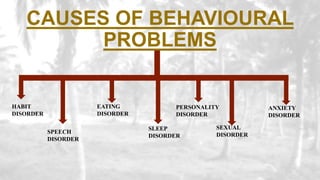
CAUSES OF BEHAVIOURAL
PROBLEMS
HABIT
DISORDER
SPEECH
DISORDER
EATING
DISORDER
SLEEP
DISORDER
PERSONALITY
DISORDER
SEXUAL
DISORDER
ANXIETY
DISORDER
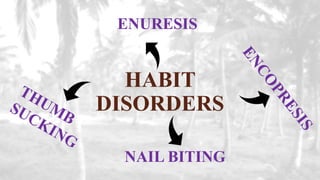
HABIT
DISORDERS
ENURESIS
NAIL BITING
1. ENURESIS
 The word derived from the Greek word
“enourein” means “to void urine”. It can
either during the day or at night.
 Enuresis is a disorders of involuntary
micturition in children who are beyond the
age when normal bladder control should
have been required.
 It is common during 4 years to 1 years
age.
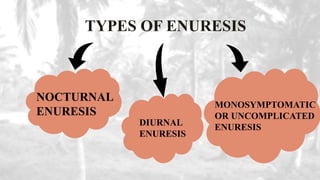
TYPES OF ENURESIS
NOCTURNAL
ENURESIS
DIURNAL
ENURESIS
MONOSYMPTOMATIC
OR UNCOMPLICATED
ENURESIS
CAUSES
 Faulty or defects in toilet training
 Overactive bladder
 Feeling of shame and guilt
 Emotional atmosphere
 Organic causes like UTI
SIGN AND SYMPTOMS:
 Wetting during the day
 Frequency urgency, or burning
urination.
 Straining, dribbling, or other
unusual symptoms with urination
 Cloudy or pinkish urine
MANAGEMENT
 The home condition, socioeconomic status and
habits of the family should be found out.
 Child parent relations should be explored.
 Analysis of the time of bed wetting frequency
and relation to sleep should be done.
 Restriction of flid intake in the evening and
helping the child in developing the habit of
passing urine before going to the bed.
2. ENCOPRESIS
Encopresis refers to passage
of feaces into inappropriate
place at any age when bowel
control should have been
established.
CAUSES:
 Anatomic abnormality
 Emotional disturbances
 Improper toilet training
 Stress in school activity
 Overprotection
 Fear related to toilet
 Poor parent child bonding.
SIGN AND SYMPTOMS:
 Withhold defecation
 Distended abdomen
 Diarrhoea related to irritation of
GI tract
 Tensed feeling
 Aggressiveness
DIAGNOSTIC
EVALUATION:
 History of bowel elimination
 Physical examination
 Detail about pattern of current
toilet practice
MANAGEMENT
-Establish regular bowel
habits
-Reassurance and help from
psychologist for counselling
of child and parents.
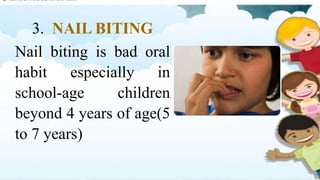
3. NAIL BITING
Nail biting is bad oral
habit especially in
school-age children
beyond 4 years of age(5
to 7 years)
 Persistent nail biting may be incidicative of emotional problem.
 Psychosomatic
 Sign and symptoms
 Rotation
 Alteration of incisal edge or incisor
 Inflammation of nail bud
 Management
 The child’s hand to be kept busy with creative activities or play.
 Punishment to be avoided.
 The child should be praised for well kept hand by breaking the
habit to maintain self -confidence.
ETIOLOGY
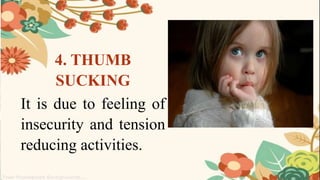
4. THUMB
SUCKING
It is due to feeling of
insecurity and tension
reducing activities.
CAUSES
 Emotional
insecurity.
 Feeling of isolation
 Boredom
 Stress
MANAGEMENT
 Positive reinforcement
 Identify the real issue and provide
comfort.
 Do not scold the child
 Offer gentle reminders
EATING
DISORDERS
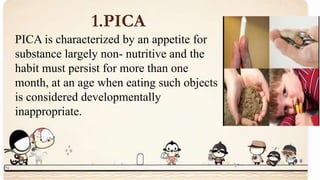
1.PICA
PICA is characterized by an appetite for
substance largely non- nutritive and the
habit must persist for more than one
month, at an age when eating such objects
is considered developmentally
inappropriate.
CAUSES
 Associated with mental retardation.
 Iron deficiency and vitamin deficiency
 Mineral deficiency
 Maternal deprivation
 Family issues
 Parental neglect
 Poverty
SIGN AND SYMPTOMS
 Children are often anaemic
 Minera and vitamin deficiencies
 Intestinal and parasitic infestation are generally
associated
MANAGEMENT
Psychotherapy
Proper supervision
2. ANOREXIA NERVOSA
It is a characterized by voluntary refusal
to eat, significant weight loss, a
pronounced disturbance of body image.
CAUSES
 Neurotransmitter
disturbances
 Deficit ego development
 Familial conflicts.
CLINICAL FEATURES
 Extreme wight loss
 Intense or irrational fear of
weight gain
 Distorted body image
 Hypothermia
 Cardiac dysrhythmia
 Cold intolerance
MANAGEMENT
 Nutritional counselling by a dietician regarding
healthy eating habits and balanced diet
 Individual therapy
 Family therapy
 Enhancement of self esteem
3. BULIMIA NERVOSA
It is a disorder of binge eating, where the
individual consume the large amount of
food with lack of control followed by the
various compensatory behaviours.
CAUSES:
 Family history of
depression
 Substance abuse
 Eating disorders
 Sports career in
which body weight
should low.
SIGN AND SYMPTOMS
 Intense fear of getting fat
 Binge eating stops when
abdominal discomforts
 occurs
 Self -induced vomiting.
 Fasting or excessive exercise.
MANAGEMENT
 Behaviour modification
 Cognitive therapy
 Dietary counselling
 SSRIs drugs
SLEEP
DISORDERS
1.Somnambulism
This is a common sleep disorder. It is also
called sleep walking. In this condition,
children are aware of the environment
during the episode but are indifferent to it.
MANAGEMENT:
 Locking the doors and windows of the
room in which the child is sleeping.
 Removing all the dangerous objects
and corrections of superstitions.
 Provide small doses of diazepam in
advanced cases.
2. Sleep talking(smililoquy)
It is sleep-disorder, in which child talks
during sleep.
These children talk irregularly and give the
gaps same like conversations.
Parents when observe they feels that child is
talking with somebody.
CAUSES:
 Children who are having
incomplete talk during the day
time by the influence of
parents.
 Stress and anxiety
 Childrens who are having the
conflicts with siblings and
school mates.
 Children who have more
feeling of the home sickness.
MANAGEMNET:
 Always sleep with these children
and assure them they are with
them.
 Satisfy the child’s need
 Resolve the child’s conflicts
 Don’t show any movie or story
video before sleep
 Give comfortable environment for
sleep
3. NIGHT MARES AND NIGHT
TERRORS
In this disorders, child awakens due to
frightening bad dream and child conscious
about surroundings, night mares associated
with dreams.
MANAGEMENT
 Child should have light diet in dinner and pleasant
scene and stories at bed time.
 Comforted the child and reassured him physically
and verbally
Sitting at the bed side until the child feel secure and
is ready to go back to sleep
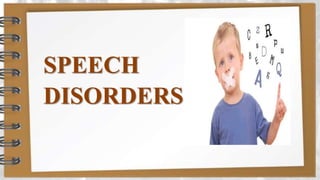
SPEECH
DISORDERS
1.SLUTTERING AND STAMMERING
Stammering is also known as sluttering.
It is a speech disorder in which the flow is
disrupted by involuntary repetitions and
prolongation of sounds, words and
syllables. Also there is involuntary silent
pause or blocks.
CAUSES:
 Developmental
factors
 Neurogenic
factors
 Psychological
factors
SIGN AND SYMPTOMS:
 Interruption in the flow of speech
 Prolongation and repetition of words
 Child may have hesitation
 Problems in starting a word or phrase
 Speech may come out in spurts
 Trembling lips and jaws when trying to
talk.
 Interjection of ‘uhm’ used more frequently
before attempting to utter
MANAGEMENT:
 Behaviour modification and relaxation therapy to resolve
conflict and emotional stress.
 Child should be reassured and helped in breath control
exercise and speech therapy.
 Parents need counselling to rationalize their expectations
of child’s achievement according to the potentiality.
 These children have normal or high IQ level, so they need
encouragement and guidance.
2. DYSLALIA
DYSLALIA is the most
common disorder of difficulty
in articulation
ANXIETY DISORDERS
School phobia
It is a refusal to go to school or to stay in school
without any attempts to conceal.
It is a emotional disorders o the children who are afraid
to leave the parents especially mothers.
School phobia is also called school refusal
CAUSES:
 Individual factors: withdrawl
 Separation anxiety
 Family factors
 Factors specific to school
SIGN AND SYMPTOMS
 High level of anxiety
 Headache
 Nausea
 Abdominal pain and palpitations
MANAGEMENT:
 Habit formation for regular school
attendance
 Play session and other recreational
activities
 Improvement of school environment
 Family counselling
NURSING
RESPONSIBILITY
 Nurse play a vital role for
prevention, early identification and
management of behavioural disorders
in children.
 Assessment of specific problems of
the child by appropriate history and
detection of the responsible factors.
 Informing the parents and making
them aware about the causes of
behavioural
 Problems of particular child.
 Assisting the parents, teachers
and family members for
necessary modification of
environment at home school
community.
 Encouraging the child for
behaviour modification as
needed.
 Promoting healthy emotional
development of child by
adequate physical, psychological
and social support.
 Creating awareness about
psychological disturbances which
may lead to behavioural
problems during developmental
stages.
PRESENTATION BEH^.pptx

PRESENTATION BEH^.pptx

  • 1.
    PRESENTATION ON BEHAVIOURAL DISORDERS PRESENTED BY: AIN,NALAGARH NILEKHA THAKUR PARUL BHATIA POOJA PUSHPLATA RINKU
  • 2.
    INTRODUCTION Normal children arehappy, healthy and well adjusted. This adjustment is developed by providing basic emotional needs along with physical and psychological needs for their mental well -being. The emotional needs are considered as emotional food for healthy environment. Major behavioural problems are significant deviation from socially accepted normal behaviour.
  • 3.
    DEFINITION Behavioural problems includedisorders that represents significant deviation from the normal behaviour. The root of the problem usually is traceable to the home or school environment
  • 4.
  • 6.
  • 7.
    1. ENURESIS  Theword derived from the Greek word “enourein” means “to void urine”. It can either during the day or at night.  Enuresis is a disorders of involuntary micturition in children who are beyond the age when normal bladder control should have been required.  It is common during 4 years to 1 years age.
  • 8.
  • 9.
    CAUSES  Faulty ordefects in toilet training  Overactive bladder  Feeling of shame and guilt  Emotional atmosphere  Organic causes like UTI
  • 10.
    SIGN AND SYMPTOMS: Wetting during the day  Frequency urgency, or burning urination.  Straining, dribbling, or other unusual symptoms with urination  Cloudy or pinkish urine
  • 11.
    MANAGEMENT  The homecondition, socioeconomic status and habits of the family should be found out.  Child parent relations should be explored.  Analysis of the time of bed wetting frequency and relation to sleep should be done.  Restriction of flid intake in the evening and helping the child in developing the habit of passing urine before going to the bed.
  • 12.
    2. ENCOPRESIS Encopresis refersto passage of feaces into inappropriate place at any age when bowel control should have been established.
  • 13.
    CAUSES:  Anatomic abnormality Emotional disturbances  Improper toilet training  Stress in school activity  Overprotection  Fear related to toilet  Poor parent child bonding.
  • 14.
    SIGN AND SYMPTOMS: Withhold defecation  Distended abdomen  Diarrhoea related to irritation of GI tract  Tensed feeling  Aggressiveness
  • 15.
    DIAGNOSTIC EVALUATION:  History ofbowel elimination  Physical examination  Detail about pattern of current toilet practice MANAGEMENT -Establish regular bowel habits -Reassurance and help from psychologist for counselling of child and parents.
  • 16.
    3. NAIL BITING Nailbiting is bad oral habit especially in school-age children beyond 4 years of age(5 to 7 years)
  • 17.
     Persistent nailbiting may be incidicative of emotional problem.  Psychosomatic  Sign and symptoms  Rotation  Alteration of incisal edge or incisor  Inflammation of nail bud  Management  The child’s hand to be kept busy with creative activities or play.  Punishment to be avoided.  The child should be praised for well kept hand by breaking the habit to maintain self -confidence. ETIOLOGY
  • 18.
    4. THUMB SUCKING It isdue to feeling of insecurity and tension reducing activities.
  • 19.
    CAUSES  Emotional insecurity.  Feelingof isolation  Boredom  Stress MANAGEMENT  Positive reinforcement  Identify the real issue and provide comfort.  Do not scold the child  Offer gentle reminders
  • 20.
  • 21.
    1.PICA PICA is characterizedby an appetite for substance largely non- nutritive and the habit must persist for more than one month, at an age when eating such objects is considered developmentally inappropriate.
  • 22.
    CAUSES  Associated withmental retardation.  Iron deficiency and vitamin deficiency  Mineral deficiency  Maternal deprivation  Family issues  Parental neglect  Poverty
  • 23.
    SIGN AND SYMPTOMS Children are often anaemic  Minera and vitamin deficiencies  Intestinal and parasitic infestation are generally associated
  • 24.
  • 25.
    2. ANOREXIA NERVOSA Itis a characterized by voluntary refusal to eat, significant weight loss, a pronounced disturbance of body image.
  • 26.
    CAUSES  Neurotransmitter disturbances  Deficitego development  Familial conflicts. CLINICAL FEATURES  Extreme wight loss  Intense or irrational fear of weight gain  Distorted body image  Hypothermia  Cardiac dysrhythmia  Cold intolerance
  • 27.
    MANAGEMENT  Nutritional counsellingby a dietician regarding healthy eating habits and balanced diet  Individual therapy  Family therapy  Enhancement of self esteem
  • 28.
    3. BULIMIA NERVOSA Itis a disorder of binge eating, where the individual consume the large amount of food with lack of control followed by the various compensatory behaviours.
  • 29.
    CAUSES:  Family historyof depression  Substance abuse  Eating disorders  Sports career in which body weight should low. SIGN AND SYMPTOMS  Intense fear of getting fat  Binge eating stops when abdominal discomforts  occurs  Self -induced vomiting.  Fasting or excessive exercise.
  • 30.
    MANAGEMENT  Behaviour modification Cognitive therapy  Dietary counselling  SSRIs drugs
  • 31.
  • 32.
    1.Somnambulism This is acommon sleep disorder. It is also called sleep walking. In this condition, children are aware of the environment during the episode but are indifferent to it.
  • 33.
    MANAGEMENT:  Locking thedoors and windows of the room in which the child is sleeping.  Removing all the dangerous objects and corrections of superstitions.  Provide small doses of diazepam in advanced cases.
  • 34.
    2. Sleep talking(smililoquy) Itis sleep-disorder, in which child talks during sleep. These children talk irregularly and give the gaps same like conversations. Parents when observe they feels that child is talking with somebody.
  • 35.
    CAUSES:  Children whoare having incomplete talk during the day time by the influence of parents.  Stress and anxiety  Childrens who are having the conflicts with siblings and school mates.  Children who have more feeling of the home sickness. MANAGEMNET:  Always sleep with these children and assure them they are with them.  Satisfy the child’s need  Resolve the child’s conflicts  Don’t show any movie or story video before sleep  Give comfortable environment for sleep
  • 36.
    3. NIGHT MARESAND NIGHT TERRORS In this disorders, child awakens due to frightening bad dream and child conscious about surroundings, night mares associated with dreams.
  • 37.
    MANAGEMENT  Child shouldhave light diet in dinner and pleasant scene and stories at bed time.  Comforted the child and reassured him physically and verbally Sitting at the bed side until the child feel secure and is ready to go back to sleep
  • 38.
  • 39.
    1.SLUTTERING AND STAMMERING Stammeringis also known as sluttering. It is a speech disorder in which the flow is disrupted by involuntary repetitions and prolongation of sounds, words and syllables. Also there is involuntary silent pause or blocks.
  • 40.
    CAUSES:  Developmental factors  Neurogenic factors Psychological factors SIGN AND SYMPTOMS:  Interruption in the flow of speech  Prolongation and repetition of words  Child may have hesitation  Problems in starting a word or phrase  Speech may come out in spurts  Trembling lips and jaws when trying to talk.  Interjection of ‘uhm’ used more frequently before attempting to utter
  • 41.
    MANAGEMENT:  Behaviour modificationand relaxation therapy to resolve conflict and emotional stress.  Child should be reassured and helped in breath control exercise and speech therapy.  Parents need counselling to rationalize their expectations of child’s achievement according to the potentiality.  These children have normal or high IQ level, so they need encouragement and guidance.
  • 42.
    2. DYSLALIA DYSLALIA isthe most common disorder of difficulty in articulation
  • 43.
  • 44.
    School phobia It isa refusal to go to school or to stay in school without any attempts to conceal. It is a emotional disorders o the children who are afraid to leave the parents especially mothers. School phobia is also called school refusal
  • 45.
    CAUSES:  Individual factors:withdrawl  Separation anxiety  Family factors  Factors specific to school
  • 46.
    SIGN AND SYMPTOMS High level of anxiety  Headache  Nausea  Abdominal pain and palpitations
  • 47.
    MANAGEMENT:  Habit formationfor regular school attendance  Play session and other recreational activities  Improvement of school environment  Family counselling
  • 48.
  • 49.
     Nurse playa vital role for prevention, early identification and management of behavioural disorders in children.  Assessment of specific problems of the child by appropriate history and detection of the responsible factors.  Informing the parents and making them aware about the causes of behavioural
  • 50.
     Problems ofparticular child.  Assisting the parents, teachers and family members for necessary modification of environment at home school community.  Encouraging the child for behaviour modification as needed.
  • 51.
     Promoting healthyemotional development of child by adequate physical, psychological and social support.  Creating awareness about psychological disturbances which may lead to behavioural problems during developmental stages.