AN AUTOMATED TOLL COLLECTION SYSTEM
BASED ON NEAR-FIELD COMMUNICATION
Team:
Naveen Sampath (21910205064)
Santhosh Ramesh (21910205088)
Vaibhav Ravichandran (21910205109)
Guides:
Ms R. Saktheeswari (Assistant Professor, Internal
– Sri Venkateswara College of Engineering)
Mr P. Sudhakar (Technical Architect, External –
Hexaware Technologies)
2
© Hexaware Technologies. All rights reserved.
Objectives
• Automated collection of toll from a customer using NFC
enabled smartphones & tablets.
• To reduce processing time of transaction and delivery of
receipt.
• To facilitate tracking of outstanding charges.
• Log maintenance allows customer to view his toll usage.
3
© Hexaware Technologies. All rights reserved.
Literature Survey
• “System Integration of NFC Ticketing into an Existing Public
Transport Infrastructure”
The integration of an NFC based ticketing system into an existing
public transport system is outlined. The system operates with the VDV
core application to provide a seamless way to travel using just an NFC
enabled smartphone as the ticket handler.
• “Security in Near Field Communication (NFC) – Strengths and
Weaknesses”
The authors explain about the various advantages of using NFC as
well as their shortcomings and active pursuits to reduce them. The
paper lists the threats, which are applicable to NFC, and describes
solutions to protect against these threats. All of this is given in the
context of currently available NFC hardware, NFC applications and
possible future developments of NFC.
4
© Hexaware Technologies. All rights reserved.
Literature Survey
• “Managing an NFC Ecosystem”
In a system where NFC must interact with other devices, the
management of such an infrastructure is not easy and the back-end
work is complicated. Madlmayr says that several NFC trials are
already established around the world but currently there are no mass
rolls out yet.
• “Everything You Need to Know About Near Field
Communication”
A general guide to NFC, its applications, future scope in day-to-day
applications, the security of using NFC, and its promulgation in
handheld devices. As NFC is a global standard, with more and more
manufacturers integrating NFC hardware into mobile devices, it is
only a matter of time before NFC becomes a natural way to perform
quick and easy transactions.
5
© Hexaware Technologies. All rights reserved.
Literature Survey
• “Conditional Privacy Preserving Security Protocol for NFC
Applications”
In this paper, the authors propose conditional privacy protection
methods based on pseudonyms to solve the problems of privacy is
information sharing over NFC. In addition, PDU (Protocol Data Unit)
for conditional privacy is defined. Users can inform the other party
that they will communicate according to the protocol proposed in this
paper by sending the conditional privacy preserved PDU through NFC
terminals. The proposed method succeeds in minimizing the update
cost and computation overhead by taking advantage of the physical
characteristics of NFC.
6
© Hexaware Technologies. All rights reserved.
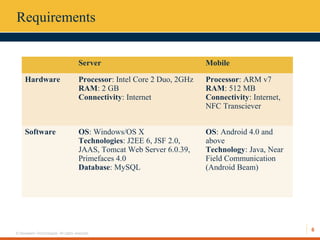
Requirements
Server Mobile
Hardware Processor: Intel Core 2 Duo, 2GHz
RAM: 2 GB
Connectivity: Internet
Processor: ARM v7
RAM: 512 MB
Connectivity: Internet,
NFC Transciever
Software OS: Windows/OS X
Technologies: J2EE 6, JSF 2.0,
JAAS, Tomcat Web Server 6.0.39,
Primefaces 4.0
Database: MySQL
OS: Android 4.0 and
above
Technology: Java, Near
Field Communication
(Android Beam)
7
© Hexaware Technologies. All rights reserved.
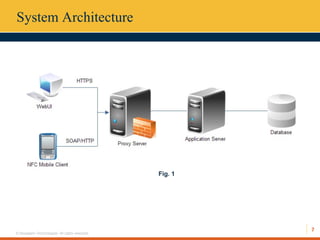
System Architecture
Fig. 1
8
© Hexaware Technologies. All rights reserved.
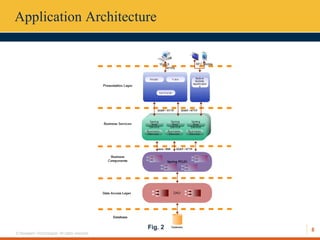
Application Architecture
Fig. 2
9
© Hexaware Technologies. All rights reserved.
Modules
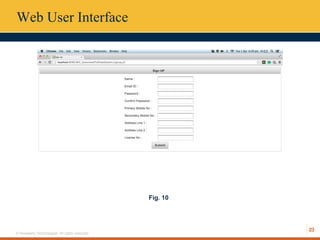
• Web User Interface
– This module contains the input form to register a new user into the system
and accepts the requisite credentials to perform login.
• Tollgate Web Service
– Contains business logic, which performs toll fee collection.
• Mobile Android Application using NFC
– The NFC enabled smartphone which interacts through NFC with the
payment terminal.
10
© Hexaware Technologies. All rights reserved.
Web User Interface
• Web application is built using Java Server Faces (JSF) and
its component PrimeFaces to provide rich look.
• The customer credentials entered in the login page was
authenticated and authorization provided using Java
Authentication and Authorization Service(JAAS).
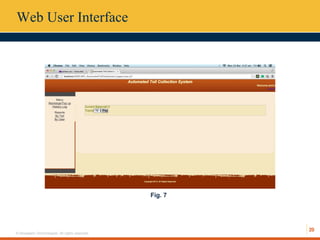
• It provides a page where the customer may view his/her
account balance, and recharge an amount if needed.
11
© Hexaware Technologies. All rights reserved.
Web User Interface
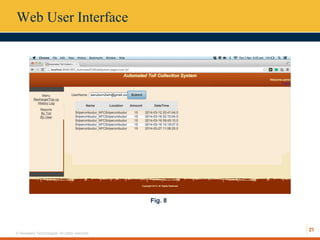
• The customer can also view his usage history which shows
time, tollgate and the location.
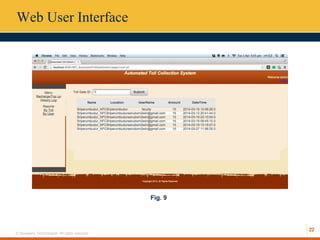
• In an administrator role log in, the admin is able to view
history reports, by tollgate usage or by user. The admin
can also lookup a user's history by searching for the user
by his username.
12
© Hexaware Technologies. All rights reserved.
Mobile Android Application using NFC
• The android application that the customer interacts with is
a simple application written in java for the android
platform. There are two applications that are needed in
order for the system to function as intended.
• Client application, which encrypts the information using
AES 128-bit cipher and sends over NFC to the terminal.
• Terminal application, which receives the credentials from
the client and calls the web service to perform its
operations.
13
© Hexaware Technologies. All rights reserved.
Tollgate Web Service
• The web service is implemented using the JAX-WS
standard.
• The tollgate system web service is called by the terminal on
receiving the credentials from the customer over NFC.
• The web method receives the username and password from
the terminal.
• The credentials are secured using 128-bit AES cipher and
the decryption occurs here.
14
© Hexaware Technologies. All rights reserved.
Tollgate Web Service
• Once the credentials are decrypted into the plain text, then
the user is authenticated.
• The web method proceeds to check if the balance in the
user account is sufficient to pay the toll fee and returns a
message indicating the status of the action.
• The web service uses JDBC to interact with the MySQL
database.
15
© Hexaware Technologies. All rights reserved.
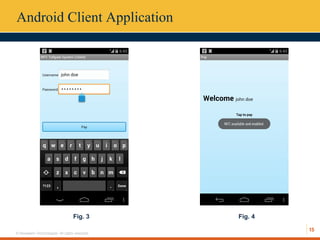
Android Client Application
Fig. 3 Fig. 4
16
© Hexaware Technologies. All rights reserved.
Android Client Application
• The client application asks the customer to enter his/her
username and password (Fig. 1)
• It encrypts the credentials using AES 128-bit cipher and
transmits the information over NFC to the tollgate
terminal.
• The client makes use of Android Beam API in order to
transmit the credentials over NFC (Fig. 2)
17
© Hexaware Technologies. All rights reserved.
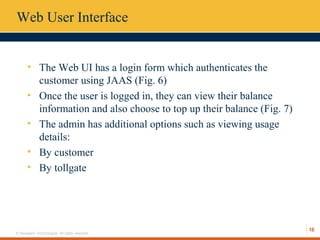
Android Terminal Application
Fig. 5
• The terminal application also uses
the Android Beam API to receive
the customer credentials over
NFC.
• Once received, the application
invokes a web service on a server
that proceeds to perform toll fee
transactions.
• Based on the result of the
transaction, an SMS is sent from
the terminal to the customer.
18
© Hexaware Technologies. All rights reserved.
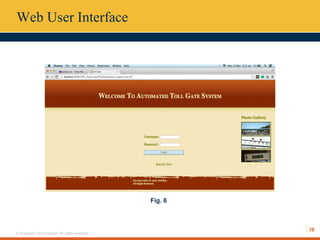
Web User Interface
• The Web UI has a login form which authenticates the
customer using JAAS (Fig. 6)
• Once the user is logged in, they can view their balance
information and also choose to top up their balance (Fig. 7)
• The admin has additional options such as viewing usage
details:
• By customer
• By tollgate
19
© Hexaware Technologies. All rights reserved.
Web User Interface
Fig. 6
20
© Hexaware Technologies. All rights reserved.
Web User Interface
Fig. 7
21
© Hexaware Technologies. All rights reserved.
Web User Interface
Fig. 8
22
© Hexaware Technologies. All rights reserved.
Web User Interface
Fig. 9
23
© Hexaware Technologies. All rights reserved.
Web User Interface
Fig. 10
24
© Hexaware Technologies. All rights reserved.
References
• [1]Widmann, R.; Grunbeger , S.; Stadlmann, B.; Langer , J., “System Integration of
NFC Ticketing into an Existing Public Transport Infrastructure,” Near Field
Communication (NFC) 2012
• [2]E. Haselsteiner and K. Breitfuß, “Security in Near Field Communication (NFC) –
Strengths and Weaknesses”, RFIDSec 2006, Jul. 2006
• [3]Madlmayr, G.; Langer, J.; Scharinger, J. “Managing an NFC Ecosystem,” 7th
International Conference on NFC Mobile Business (ICMB), 2008
• [4]Eun, Hasoo; Lee, Hoonjung; Oh, Heekuck. “Conditional Privacy Preserving
Security Protocol for NFC Applications,” IEEE Transactions on Consumer
Electronics, Vol. 59, No. 1, February 2013
• [5]Nosowitz, Dan (1 March 2011). "Everything You Need to Know About Near Field
Communication". Popular Science Magazine. Popular Science.

Presentation

  • 1.
    AN AUTOMATED TOLLCOLLECTION SYSTEM BASED ON NEAR-FIELD COMMUNICATION Team: Naveen Sampath (21910205064) Santhosh Ramesh (21910205088) Vaibhav Ravichandran (21910205109) Guides: Ms R. Saktheeswari (Assistant Professor, Internal – Sri Venkateswara College of Engineering) Mr P. Sudhakar (Technical Architect, External – Hexaware Technologies)
  • 2.
    2 © Hexaware Technologies.All rights reserved. Objectives • Automated collection of toll from a customer using NFC enabled smartphones & tablets. • To reduce processing time of transaction and delivery of receipt. • To facilitate tracking of outstanding charges. • Log maintenance allows customer to view his toll usage.
  • 3.
    3 © Hexaware Technologies.All rights reserved. Literature Survey • “System Integration of NFC Ticketing into an Existing Public Transport Infrastructure” The integration of an NFC based ticketing system into an existing public transport system is outlined. The system operates with the VDV core application to provide a seamless way to travel using just an NFC enabled smartphone as the ticket handler. • “Security in Near Field Communication (NFC) – Strengths and Weaknesses” The authors explain about the various advantages of using NFC as well as their shortcomings and active pursuits to reduce them. The paper lists the threats, which are applicable to NFC, and describes solutions to protect against these threats. All of this is given in the context of currently available NFC hardware, NFC applications and possible future developments of NFC.
  • 4.
    4 © Hexaware Technologies.All rights reserved. Literature Survey • “Managing an NFC Ecosystem” In a system where NFC must interact with other devices, the management of such an infrastructure is not easy and the back-end work is complicated. Madlmayr says that several NFC trials are already established around the world but currently there are no mass rolls out yet. • “Everything You Need to Know About Near Field Communication” A general guide to NFC, its applications, future scope in day-to-day applications, the security of using NFC, and its promulgation in handheld devices. As NFC is a global standard, with more and more manufacturers integrating NFC hardware into mobile devices, it is only a matter of time before NFC becomes a natural way to perform quick and easy transactions.
  • 5.
    5 © Hexaware Technologies.All rights reserved. Literature Survey • “Conditional Privacy Preserving Security Protocol for NFC Applications” In this paper, the authors propose conditional privacy protection methods based on pseudonyms to solve the problems of privacy is information sharing over NFC. In addition, PDU (Protocol Data Unit) for conditional privacy is defined. Users can inform the other party that they will communicate according to the protocol proposed in this paper by sending the conditional privacy preserved PDU through NFC terminals. The proposed method succeeds in minimizing the update cost and computation overhead by taking advantage of the physical characteristics of NFC.
  • 6.
    6 © Hexaware Technologies.All rights reserved. Requirements Server Mobile Hardware Processor: Intel Core 2 Duo, 2GHz RAM: 2 GB Connectivity: Internet Processor: ARM v7 RAM: 512 MB Connectivity: Internet, NFC Transciever Software OS: Windows/OS X Technologies: J2EE 6, JSF 2.0, JAAS, Tomcat Web Server 6.0.39, Primefaces 4.0 Database: MySQL OS: Android 4.0 and above Technology: Java, Near Field Communication (Android Beam)
  • 7.
    7 © Hexaware Technologies.All rights reserved. System Architecture Fig. 1
  • 8.
    8 © Hexaware Technologies.All rights reserved. Application Architecture Fig. 2
  • 9.
    9 © Hexaware Technologies.All rights reserved. Modules • Web User Interface – This module contains the input form to register a new user into the system and accepts the requisite credentials to perform login. • Tollgate Web Service – Contains business logic, which performs toll fee collection. • Mobile Android Application using NFC – The NFC enabled smartphone which interacts through NFC with the payment terminal.
  • 10.
    10 © Hexaware Technologies.All rights reserved. Web User Interface • Web application is built using Java Server Faces (JSF) and its component PrimeFaces to provide rich look. • The customer credentials entered in the login page was authenticated and authorization provided using Java Authentication and Authorization Service(JAAS). • It provides a page where the customer may view his/her account balance, and recharge an amount if needed.
  • 11.
    11 © Hexaware Technologies.All rights reserved. Web User Interface • The customer can also view his usage history which shows time, tollgate and the location. • In an administrator role log in, the admin is able to view history reports, by tollgate usage or by user. The admin can also lookup a user's history by searching for the user by his username.
  • 12.
    12 © Hexaware Technologies.All rights reserved. Mobile Android Application using NFC • The android application that the customer interacts with is a simple application written in java for the android platform. There are two applications that are needed in order for the system to function as intended. • Client application, which encrypts the information using AES 128-bit cipher and sends over NFC to the terminal. • Terminal application, which receives the credentials from the client and calls the web service to perform its operations.
  • 13.
    13 © Hexaware Technologies.All rights reserved. Tollgate Web Service • The web service is implemented using the JAX-WS standard. • The tollgate system web service is called by the terminal on receiving the credentials from the customer over NFC. • The web method receives the username and password from the terminal. • The credentials are secured using 128-bit AES cipher and the decryption occurs here.
  • 14.
    14 © Hexaware Technologies.All rights reserved. Tollgate Web Service • Once the credentials are decrypted into the plain text, then the user is authenticated. • The web method proceeds to check if the balance in the user account is sufficient to pay the toll fee and returns a message indicating the status of the action. • The web service uses JDBC to interact with the MySQL database.
  • 15.
    15 © Hexaware Technologies.All rights reserved. Android Client Application Fig. 3 Fig. 4
  • 16.
    16 © Hexaware Technologies.All rights reserved. Android Client Application • The client application asks the customer to enter his/her username and password (Fig. 1) • It encrypts the credentials using AES 128-bit cipher and transmits the information over NFC to the tollgate terminal. • The client makes use of Android Beam API in order to transmit the credentials over NFC (Fig. 2)
  • 17.
    17 © Hexaware Technologies.All rights reserved. Android Terminal Application Fig. 5 • The terminal application also uses the Android Beam API to receive the customer credentials over NFC. • Once received, the application invokes a web service on a server that proceeds to perform toll fee transactions. • Based on the result of the transaction, an SMS is sent from the terminal to the customer.
  • 18.
    18 © Hexaware Technologies.All rights reserved. Web User Interface • The Web UI has a login form which authenticates the customer using JAAS (Fig. 6) • Once the user is logged in, they can view their balance information and also choose to top up their balance (Fig. 7) • The admin has additional options such as viewing usage details: • By customer • By tollgate
  • 19.
    19 © Hexaware Technologies.All rights reserved. Web User Interface Fig. 6
  • 20.
    20 © Hexaware Technologies.All rights reserved. Web User Interface Fig. 7
  • 21.
    21 © Hexaware Technologies.All rights reserved. Web User Interface Fig. 8
  • 22.
    22 © Hexaware Technologies.All rights reserved. Web User Interface Fig. 9
  • 23.
    23 © Hexaware Technologies.All rights reserved. Web User Interface Fig. 10
  • 24.
    24 © Hexaware Technologies.All rights reserved. References • [1]Widmann, R.; Grunbeger , S.; Stadlmann, B.; Langer , J., “System Integration of NFC Ticketing into an Existing Public Transport Infrastructure,” Near Field Communication (NFC) 2012 • [2]E. Haselsteiner and K. Breitfuß, “Security in Near Field Communication (NFC) – Strengths and Weaknesses”, RFIDSec 2006, Jul. 2006 • [3]Madlmayr, G.; Langer, J.; Scharinger, J. “Managing an NFC Ecosystem,” 7th International Conference on NFC Mobile Business (ICMB), 2008 • [4]Eun, Hasoo; Lee, Hoonjung; Oh, Heekuck. “Conditional Privacy Preserving Security Protocol for NFC Applications,” IEEE Transactions on Consumer Electronics, Vol. 59, No. 1, February 2013 • [5]Nosowitz, Dan (1 March 2011). "Everything You Need to Know About Near Field Communication". Popular Science Magazine. Popular Science.