Event processing with Node.js and RabbitMQ
by Zlatko Duric
Disclaimer (AKA about me)
● Experience
– Node.js? Lots
– NoSQL? Lots.
– Messaging? Little
● Backend Developer at ThinxNet.com
(http://thinxnet.com/#jobs)
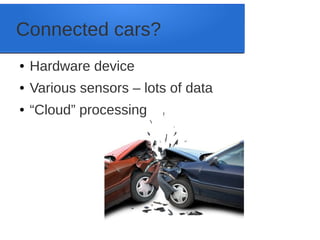
Connected cars?
● Hardware device
● Various sensors – lots of data
● “Cloud” processing
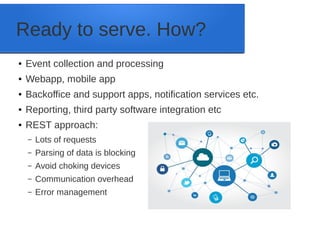
Ready to serve. How?
● Event collection and processing
● Webapp, mobile app
● Backoffice and support apps, notification services etc.
● Reporting, third party software integration etc
● REST approach:
– Lots of requests
– Parsing of data is blocking
– Avoid choking devices
– Communication overhead
– Error management
What service? Microservice!
● Redis PUBSUB
● ZeroMQ, MQTT, AMQP
● RabbitMQ, ActiveMQ
About RabbitMQ
● Messaging broker based on AMQP protocol
● Platform/language independent
● Extensible (Erlang)
● Persistent message queues
● Node.js drivers (node-amqp, rabbit.js...)
Hello world
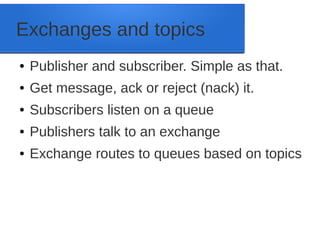
Exchanges and topics
● Publisher and subscriber. Simple as that.
● Get message, ack or reject (nack) it.
● Subscribers listen on a queue
● Publishers talk to an exchange
● Exchange routes to queues based on topics
Example
Channels and connections
● 1 node process = 1 connection
● Many channels, share same connection
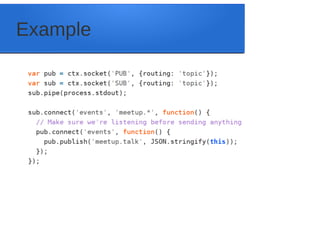
PUBSUB
● Simple PUBSUB, as used elsewhere
● All listeners get the same message
● Suboptimal
Example
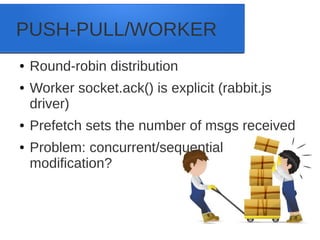
PUSH-PULL/WORKER
● Round-robin distribution
● Worker socket.ack() is explicit (rabbit.js
driver)
● Prefetch sets the number of msgs received
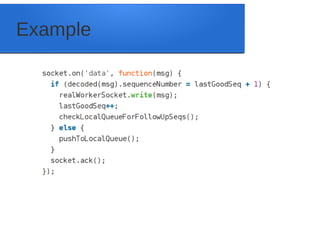
● Problem: concurrent/sequential
modification?
Example
Content-based routing
● Erlang extensions? Not standard.
● App-side:
– Keep internal mini-queue
– Do not ack a msg if it's not first on local
queue
– Hold internal messages based on
internal “topic”, ie “user.<ID>.save” -
hold msgs for that user
– Item.update() instead of item.save()
● Gets nasty fast, should minimize
these scenarios
Example
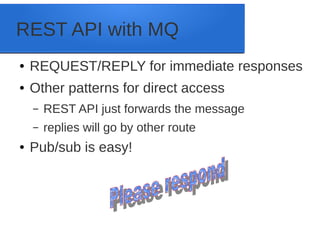
REST API with MQ
● REQUEST/REPLY for immediate responses
● Other patterns for direct access
– REST API just forwards the message
– replies will go by other route
● Pub/sub is easy!
Example
Error handling
● Uncaught exceptions are covered
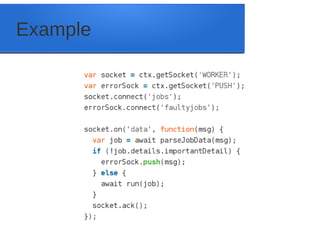
● Retry logic is simplified – push incomplete
messages to a 'fixer' queue, requeue failed
jobs or when no resources
● Dedicated error handling
Example
Error handling
● Uncaught exceptions are covered
● Retry logic is simplified – push incomplete
messages to a 'fixer' queue, requeue failed
jobs or when no resources
● Dedicated error handling
Testing
● No good known mocks, please help
● RabbitMQ always on on Jenkins machine
● Test handlers directly
Buzzwords index
● Cloud
● Connected car
● Microservice
● Patterns
:)
Info sources
● https://www.rabbitmq.com/
● http://www.squaremobius.net/rabbit.js/
● http://www.manning.com/videla/
Note to self
● Thank the audience for patience
● Invite audience for a discussion and questions

Presentation

  • 1.
    Event processing withNode.js and RabbitMQ by Zlatko Duric
  • 2.
    Disclaimer (AKA aboutme) ● Experience – Node.js? Lots – NoSQL? Lots. – Messaging? Little ● Backend Developer at ThinxNet.com (http://thinxnet.com/#jobs)
  • 3.
    Connected cars? ● Hardwaredevice ● Various sensors – lots of data ● “Cloud” processing
  • 4.
    Ready to serve.How? ● Event collection and processing ● Webapp, mobile app ● Backoffice and support apps, notification services etc. ● Reporting, third party software integration etc ● REST approach: – Lots of requests – Parsing of data is blocking – Avoid choking devices – Communication overhead – Error management
  • 5.
    What service? Microservice! ●Redis PUBSUB ● ZeroMQ, MQTT, AMQP ● RabbitMQ, ActiveMQ
  • 6.
    About RabbitMQ ● Messagingbroker based on AMQP protocol ● Platform/language independent ● Extensible (Erlang) ● Persistent message queues ● Node.js drivers (node-amqp, rabbit.js...)
  • 7.
  • 8.
    Exchanges and topics ●Publisher and subscriber. Simple as that. ● Get message, ack or reject (nack) it. ● Subscribers listen on a queue ● Publishers talk to an exchange ● Exchange routes to queues based on topics
  • 9.
  • 10.
    Channels and connections ●1 node process = 1 connection ● Many channels, share same connection
  • 11.
    PUBSUB ● Simple PUBSUB,as used elsewhere ● All listeners get the same message ● Suboptimal
  • 12.
  • 13.
    PUSH-PULL/WORKER ● Round-robin distribution ●Worker socket.ack() is explicit (rabbit.js driver) ● Prefetch sets the number of msgs received ● Problem: concurrent/sequential modification?
  • 14.
  • 15.
    Content-based routing ● Erlangextensions? Not standard. ● App-side: – Keep internal mini-queue – Do not ack a msg if it's not first on local queue – Hold internal messages based on internal “topic”, ie “user.<ID>.save” - hold msgs for that user – Item.update() instead of item.save() ● Gets nasty fast, should minimize these scenarios
  • 16.
  • 17.
    REST API withMQ ● REQUEST/REPLY for immediate responses ● Other patterns for direct access – REST API just forwards the message – replies will go by other route ● Pub/sub is easy!
  • 18.
  • 19.
    Error handling ● Uncaughtexceptions are covered ● Retry logic is simplified – push incomplete messages to a 'fixer' queue, requeue failed jobs or when no resources ● Dedicated error handling
  • 20.
  • 21.
    Error handling ● Uncaughtexceptions are covered ● Retry logic is simplified – push incomplete messages to a 'fixer' queue, requeue failed jobs or when no resources ● Dedicated error handling
  • 22.
    Testing ● No goodknown mocks, please help ● RabbitMQ always on on Jenkins machine ● Test handlers directly
  • 23.
    Buzzwords index ● Cloud ●Connected car ● Microservice ● Patterns :)
  • 24.
    Info sources ● https://www.rabbitmq.com/ ●http://www.squaremobius.net/rabbit.js/ ● http://www.manning.com/videla/
  • 25.
    Note to self ●Thank the audience for patience ● Invite audience for a discussion and questions