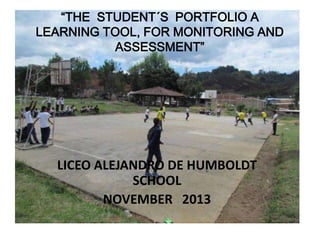
“THE STUDENT´S PORTFOLIO A
LEARNING TOOL, FOR MONITORING AND
ASSESSMENT”

LICEO ALEJANDRO DE HUMBOLDT
SCHOOL
NOVEMBER 2013
INTRODUCTION
OUR
ROLE
AS
TEACHER
MUST
ENCOURAGE
THE
STUDENT S
CONGNITIVE
DEVELOPMENT,
FACILITATING
EXPERIENCES
AND
GIVING
THE
STUDENTS
THE
POSSIBILITY
OF
MEANINGFUL LEARNING
EXPERIENCES
FOR DEVELOPING THEIR
REFLECTIVE
AND CRITICAL
THINKING NECESSARY
FOR THE LIFE THEY HAVE TO FACE.
MY SCHOOL

A WONDERFUL PLACE FOR
STUDYING
THE BEST HUMAN BEINGS
GENERAL PURPOSE
• Implement the portfolio as a learning
tool of monitoring, assessing and
training students.
• Contribute to the improvement of the
student s adquisition learning process.
SPECIFIC PURPOSES
Implement the portfolio as a tool of
learning, monitoring, assessing and
training the students of the tenth and
eleventh grade of high school at liceo
school.
Collect the materials worked in class
with the purpose of improving when it
is necessary or strengthen it.
Incorporate the portfolio as an individual
tool for qualitive assessment of student's
achievements.

Sentizate the students to be responsible of
their own learning.
WHAT IS PORTFOLIO?
It is a method of teaching and learning because
it is a purposeful collection of the student works
that shows the student s effort, progress and
achievements in the English learning process.
It contains a variety of dated student product
allowing to judge the student work.
HOW IT IS MADE
• It is made in a folder.
• it has a presentation page.
• The folder keeps the collection of dated
student works.
• It keeps the Improvements of works.
HOW IT WORKS
• Each student has his/ her own portfolio.
• the student keeps his/ her works there.
• when the teacher review his /her works the
student must improve them.
• By the work done the student gives his /her
self assessment and the teacher do the same.
• Most of the time the student's
portfolios are in the locate store space.
• together as the teacher as the student
review and assess the portfolio
TEORICAL FRAMEWORK
• The portfolio is supported by a
constructivist view of
learning, conceived as a process in
which the learner builds the concepts
according to their own
experience shared with others and
actively participates in
making decisions about their learning
CONSTRUCTIVISM
• Vygotsky’s theory promotes learning contexts
in which students play an active role in
learning. Roles of the teacher and student are
therefore shifted, as a teacher should
collaborate with his or her students in order to
help facilitate meaning construction in
students. Learning therefore becomes a
reciprocal experience for the students and
teacher.
MEANINFUL LEARNING
• David Ausubel of meaningful learning, like
other
cognitivists
theory
postulates
that learning involves active restructuring of
perceptions, ideas, concepts and schemes that
the learner has in his cognitive structure. Its
position
can
be
classified as constructivist (learning is not
simply
a
passive
assimilationof
information literally transforms the subject and
structure) to that extent the portfolio is a tool
to re think and re-thought by improving the
papers
that
lead
the student to learn.
THE ERROR AS A WAY OF LEARNING
• A second look and how the student can
improve it for future works.
• The student learn from a mistake after he/ she
admits she/he’s made it.
EVALUATION OF THE PORTFOLIO
• According to Paulson, Paulson and
Meyer, (1991, p. 63): "Portfolios offer a way of
assessing student learning that is different
than traditional methods. Portfolio
assessment provides the teacher and students
an opportunity to observe students in a
broader context: taking risks, developing
creative solutions, and learning to make
judgments about their own performances."
CONCLUTIONS
integrate diverse experiences in and out of the
classroom.
Encourage the student to self reflection.
 gather authentic assessment information.
 Promote an ongoing process where the
student demonstrate, assess and revise in
order to improve and produce better works.

Presentation

  • 1.
    “THE STUDENT´S PORTFOLIOA LEARNING TOOL, FOR MONITORING AND ASSESSMENT” LICEO ALEJANDRO DE HUMBOLDT SCHOOL NOVEMBER 2013
  • 2.
  • 3.
    MY SCHOOL A WONDERFULPLACE FOR STUDYING
  • 4.
  • 5.
    GENERAL PURPOSE • Implementthe portfolio as a learning tool of monitoring, assessing and training students. • Contribute to the improvement of the student s adquisition learning process.
  • 6.
    SPECIFIC PURPOSES Implement theportfolio as a tool of learning, monitoring, assessing and training the students of the tenth and eleventh grade of high school at liceo school. Collect the materials worked in class with the purpose of improving when it is necessary or strengthen it.
  • 7.
    Incorporate the portfolioas an individual tool for qualitive assessment of student's achievements. Sentizate the students to be responsible of their own learning.
  • 8.
    WHAT IS PORTFOLIO? Itis a method of teaching and learning because it is a purposeful collection of the student works that shows the student s effort, progress and achievements in the English learning process. It contains a variety of dated student product allowing to judge the student work.
  • 9.
    HOW IT ISMADE • It is made in a folder. • it has a presentation page. • The folder keeps the collection of dated student works. • It keeps the Improvements of works.
  • 10.
    HOW IT WORKS •Each student has his/ her own portfolio. • the student keeps his/ her works there. • when the teacher review his /her works the student must improve them. • By the work done the student gives his /her self assessment and the teacher do the same.
  • 11.
    • Most ofthe time the student's portfolios are in the locate store space. • together as the teacher as the student review and assess the portfolio
  • 12.
    TEORICAL FRAMEWORK • Theportfolio is supported by a constructivist view of learning, conceived as a process in which the learner builds the concepts according to their own experience shared with others and actively participates in making decisions about their learning
  • 13.
    CONSTRUCTIVISM • Vygotsky’s theorypromotes learning contexts in which students play an active role in learning. Roles of the teacher and student are therefore shifted, as a teacher should collaborate with his or her students in order to help facilitate meaning construction in students. Learning therefore becomes a reciprocal experience for the students and teacher.
  • 15.
    MEANINFUL LEARNING • DavidAusubel of meaningful learning, like other cognitivists theory postulates that learning involves active restructuring of perceptions, ideas, concepts and schemes that the learner has in his cognitive structure. Its position can be classified as constructivist (learning is not simply a passive assimilationof information literally transforms the subject and structure) to that extent the portfolio is a tool to re think and re-thought by improving the papers that lead the student to learn.
  • 17.
    THE ERROR ASA WAY OF LEARNING • A second look and how the student can improve it for future works. • The student learn from a mistake after he/ she admits she/he’s made it.
  • 18.
    EVALUATION OF THEPORTFOLIO • According to Paulson, Paulson and Meyer, (1991, p. 63): "Portfolios offer a way of assessing student learning that is different than traditional methods. Portfolio assessment provides the teacher and students an opportunity to observe students in a broader context: taking risks, developing creative solutions, and learning to make judgments about their own performances."
  • 19.
    CONCLUTIONS integrate diverse experiencesin and out of the classroom. Encourage the student to self reflection.  gather authentic assessment information.  Promote an ongoing process where the student demonstrate, assess and revise in order to improve and produce better works.