What about these National Strategic Imperatives?
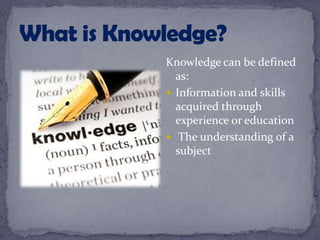
Knowledge can be defined
as:
 Information and skills
acquired through
experience or education
 The understanding of a
subject
 A Human Society
 Knowledge should
bring:
 justice,
 solidarity,
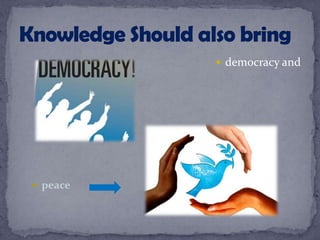
 democracy and
 peace
It should provide universal and equitable access to
information.
Information and communication technology (ICT)
must be integrated in order to build the Knowledge
Society.
The Knowledge Society needs new kinds of
Knowledge that cannot reduce to traditional
disciplines
 The school in the knowledge society involves a
new conception of teaching, training, interactive
content and interactive tutoring.
 The school of the future is about extending the
market model, “re-schooling” and “de-schooling”.
 In the knowledge society
new competencies are
required.
 A teacher has to deal
with new knowledge
 Discover new ways for
accessing knowledge
 Teachers are the key
agents in the
education system
 It is our common
responsibility to train
and recruit teachers,
and,
 To involve all teachers
in international
networks.
Knowledge of :
Technology,
 New pedagogical possibilities,
New management of time and space,
New knowledge, new networked form of
knowledge and ,
New expectations of Society.
Enables all children and
all people to access knowledge
and to benefit from being
educated. Educators have a
major mission. Particularly,
it is the responsibility of all
educators and decision-
makers around the world to
help take part in the
developments of ICT in
Education.
Education is a
key issue in the
Knowledge
Society!
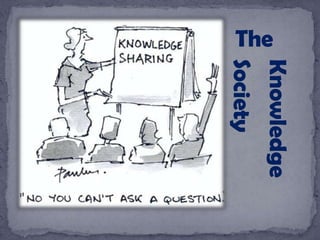
The
Knowledge
Society
Shortages of qualified
teachers threaten the
achievement of
“Education for all”
(EFA)
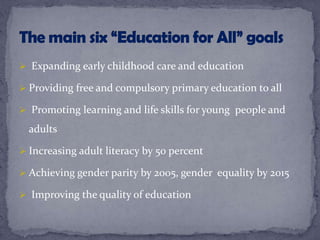
 Expanding early childhood care and education
 Providing free and compulsory primary education to all
 Promoting learning and life skills for young people and
adults
 Increasing adult literacy by 50 percent
 Achieving gender parity by 2005, gender equality by 2015
 Improving the quality of education
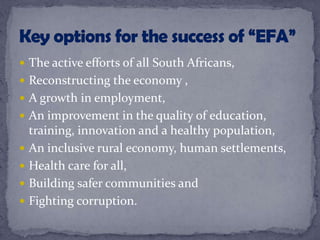
 The active efforts of all South Africans,
 Reconstructing the economy ,
 A growth in employment,
 An improvement in the quality of education,
training, innovation and a healthy population,
 An inclusive rural economy, human settlements,
 Health care for all,
 Building safer communities and
 Fighting corruption.
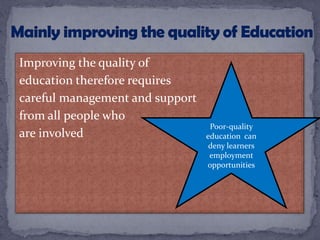
Improving the quality of
education therefore requires
careful management and support
from all people who
are involved
Poor-quality
education can
deny learners
employment
opportunities
Firstly within the households and the communities.
Secondly there must be an improvement in the
management of the education system.
Thirdly they aim to improve the
competence and capacity of school
principles
Fourthly and more importantly teacher
performance must have the appropriate
content and pedagogical support.
 Get rid of all nutrient deficiencies in children
under 18 months
 . Also all children should have at least two years of
pre-school education a
 And at least 80 percent of children should
complete 12 years of schooling and achieve 50
percent and above in literacy, mathematics and
sciences.
 Designing a nutrition intervention for pregnant
women and young children to avoid malnutrition.
 Improving the further education and training
graduation rate to 75 percent by 2030
 And significantly expanding further education.
To increase the higher education participation rate from
17 percent to 30 percent.
The actions towards the targets with regard to schooling
include increasing teacher training by expanding Funza
Lushaka Bursaries to attract learners into teaching,
especially those with good maths, science and language
grades.
Also... To regularly test teachers in subjects they
teach to determine their level of knowledge and
competence and link teacher pay to learner
performance and improvements. Then the schools
performing very poorly should receive the closest
attention.
And... The further education and training system must
strengthen and expand the number of colleges in order for the
participation rate to also increase, by building new universities
in provinces such as Mpumalanga and the Northern Cape and
the also providing full assistance covering tuition, books
accommodation and living allowance in the form of loans and
bursaries to all students who need it.
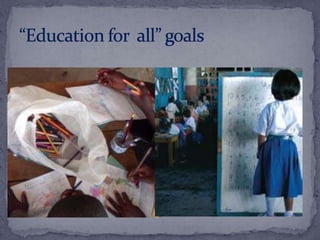
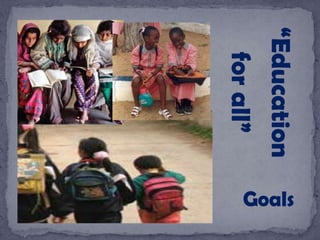
Goals
“Education
forall”
 The fact that all teachers will thus require the
knowledge, skills, values and attitudes,
 The necessary support, to integrate ICT into
teaching and learning,
 And support in their various roles as mediators of
learning, interpreters and designers of learning
programmes, leaders, administrators, scholars,
assessors and subject specialists.
 In ICT development takes place by bringing in
certain essential principles, this document reflects
a holistic approach to teacher development in ICT.
 It acknowledges that ICT skills cannot be practised
without their context.
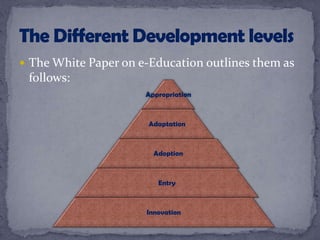
 The White Paper on e-Education outlines them as
follows:
Appropriation
Adaptation
Adoption
Entry
Innovation
 The teacher is computer literate and is able to use
computers.
Although frustrations are common in the
introduction of ICT and may influence teachers to
lack confidence.
 The teacher is able to use various ICT, including
computers, to support administration, teaching
and learning, and is able to teach learners how to
use ICT.
 In the Adaptation level the teacher is able to use
ICT to support everyday classroom activities at an
appropriate NCS level, assess the learning that
takes place and ensure progression.
 He/she is able to reflect critically on how ICT
changes the teaching and learning processes and
to use ICT systems for management and
administration. Productivity increases at this level.
 The teacher has a holistic approach towards the
ways in which ICT contributes to teaching and
learning.
 He/she has an understanding of the developing
nature of ICT, and an awareness to the structure
and purposes of the NCS.
 He/she has the experience and confidence to
reflect on how ICT can influence teaching and
learning strategies, and to use new strategies.
 The teacher is able to develop new learning
environments that use ICT as a flexible tool, so
that learning becomes collaborative and
interactive.
 With regard to ICT Professional Aptitude, the
teacher has the confidence, flexibility and vision to
develop learning approaches that use ICT, and
understands that ICT is essential for entire school
development.
 Department of Education. (2004). White
Paper on e-Education. Government Gazette.
(No. 26734).
 Education international. (2008).Education
For All by 2015. Response to the Global
Monitoring Report. www.ei-ie.org
 Hindle, D. (2007). Guidelines for Teacher
Training and Professional Development in
ICT.
 Cornu B. (2001). Being a Teacher in the
Knowledge Society. Presentation (INRP,
CNED-EIFAD, France).
References

National Strategic Imperatives Presentation

  • 1.
    What about theseNational Strategic Imperatives?
  • 2.
    Knowledge can bedefined as:  Information and skills acquired through experience or education  The understanding of a subject
  • 3.
     A HumanSociety  Knowledge should bring:  justice,  solidarity,
  • 4.
  • 5.
    It should provideuniversal and equitable access to information. Information and communication technology (ICT) must be integrated in order to build the Knowledge Society. The Knowledge Society needs new kinds of Knowledge that cannot reduce to traditional disciplines
  • 6.
     The schoolin the knowledge society involves a new conception of teaching, training, interactive content and interactive tutoring.  The school of the future is about extending the market model, “re-schooling” and “de-schooling”.
  • 7.
     In theknowledge society new competencies are required.  A teacher has to deal with new knowledge  Discover new ways for accessing knowledge  Teachers are the key agents in the education system  It is our common responsibility to train and recruit teachers, and,  To involve all teachers in international networks.
  • 8.
    Knowledge of : Technology, New pedagogical possibilities, New management of time and space, New knowledge, new networked form of knowledge and , New expectations of Society.
  • 9.
    Enables all childrenand all people to access knowledge and to benefit from being educated. Educators have a major mission. Particularly, it is the responsibility of all educators and decision- makers around the world to help take part in the developments of ICT in Education. Education is a key issue in the Knowledge Society!
  • 10.
  • 12.
    Shortages of qualified teachersthreaten the achievement of “Education for all” (EFA)
  • 13.
     Expanding earlychildhood care and education  Providing free and compulsory primary education to all  Promoting learning and life skills for young people and adults  Increasing adult literacy by 50 percent  Achieving gender parity by 2005, gender equality by 2015  Improving the quality of education
  • 14.
     The activeefforts of all South Africans,  Reconstructing the economy ,  A growth in employment,  An improvement in the quality of education, training, innovation and a healthy population,  An inclusive rural economy, human settlements,  Health care for all,  Building safer communities and  Fighting corruption.
  • 15.
    Improving the qualityof education therefore requires careful management and support from all people who are involved Poor-quality education can deny learners employment opportunities
  • 16.
    Firstly within thehouseholds and the communities. Secondly there must be an improvement in the management of the education system.
  • 17.
    Thirdly they aimto improve the competence and capacity of school principles
  • 18.
    Fourthly and moreimportantly teacher performance must have the appropriate content and pedagogical support.
  • 19.
     Get ridof all nutrient deficiencies in children under 18 months  . Also all children should have at least two years of pre-school education a  And at least 80 percent of children should complete 12 years of schooling and achieve 50 percent and above in literacy, mathematics and sciences.
  • 20.
     Designing anutrition intervention for pregnant women and young children to avoid malnutrition.  Improving the further education and training graduation rate to 75 percent by 2030  And significantly expanding further education.
  • 21.
    To increase thehigher education participation rate from 17 percent to 30 percent. The actions towards the targets with regard to schooling include increasing teacher training by expanding Funza Lushaka Bursaries to attract learners into teaching, especially those with good maths, science and language grades.
  • 22.
    Also... To regularlytest teachers in subjects they teach to determine their level of knowledge and competence and link teacher pay to learner performance and improvements. Then the schools performing very poorly should receive the closest attention.
  • 23.
    And... The furthereducation and training system must strengthen and expand the number of colleges in order for the participation rate to also increase, by building new universities in provinces such as Mpumalanga and the Northern Cape and the also providing full assistance covering tuition, books accommodation and living allowance in the form of loans and bursaries to all students who need it.
  • 25.
  • 27.
     The factthat all teachers will thus require the knowledge, skills, values and attitudes,  The necessary support, to integrate ICT into teaching and learning,  And support in their various roles as mediators of learning, interpreters and designers of learning programmes, leaders, administrators, scholars, assessors and subject specialists.
  • 28.
     In ICTdevelopment takes place by bringing in certain essential principles, this document reflects a holistic approach to teacher development in ICT.  It acknowledges that ICT skills cannot be practised without their context.
  • 29.
     The WhitePaper on e-Education outlines them as follows: Appropriation Adaptation Adoption Entry Innovation
  • 30.
     The teacheris computer literate and is able to use computers. Although frustrations are common in the introduction of ICT and may influence teachers to lack confidence.
  • 31.
     The teacheris able to use various ICT, including computers, to support administration, teaching and learning, and is able to teach learners how to use ICT.
  • 32.
     In theAdaptation level the teacher is able to use ICT to support everyday classroom activities at an appropriate NCS level, assess the learning that takes place and ensure progression.  He/she is able to reflect critically on how ICT changes the teaching and learning processes and to use ICT systems for management and administration. Productivity increases at this level.
  • 33.
     The teacherhas a holistic approach towards the ways in which ICT contributes to teaching and learning.  He/she has an understanding of the developing nature of ICT, and an awareness to the structure and purposes of the NCS.  He/she has the experience and confidence to reflect on how ICT can influence teaching and learning strategies, and to use new strategies.
  • 34.
     The teacheris able to develop new learning environments that use ICT as a flexible tool, so that learning becomes collaborative and interactive.  With regard to ICT Professional Aptitude, the teacher has the confidence, flexibility and vision to develop learning approaches that use ICT, and understands that ICT is essential for entire school development.
  • 35.
     Department ofEducation. (2004). White Paper on e-Education. Government Gazette. (No. 26734).  Education international. (2008).Education For All by 2015. Response to the Global Monitoring Report. www.ei-ie.org  Hindle, D. (2007). Guidelines for Teacher Training and Professional Development in ICT.  Cornu B. (2001). Being a Teacher in the Knowledge Society. Presentation (INRP, CNED-EIFAD, France). References

Editor's Notes

  • #2 In this presentation we will explore national strategic imperatives. This includes the different Educational aspects, goals, agendas objectives and broad aims of the present and future national strategic imperatives.
  • #3 First let us take a look at the Knowledge Society Agenda. Knowledge can be defined as the output of the reconstruction of information by a person, according to their history and context, depending on the person. Information can be is given and knowledge is then acquired.
  • #4 Knowledge society is a human society, where knowledge should bring justice, solidarity, democracy and peace.
  • #5 It is a society in which knowledge could be a force for changing society.
  • #6 It should provide universal and equitable access to information. Information and communication technology (ICT) must be integrated in order to build the Knowledge Society.The Knowledge Society needs new kinds of Knowledge that cannot reduce to traditional disciplines.
  • #7 The school in the knowledge society involves not only technology, but a new conception of teaching, training, learning, managing differently time and space, individualisation and collaboration, interactive content and interactive tutoring. The school of the future is about extending the market model, “re-schooling” (Schools as core social centres and focused learning organisations) and “de-schooling” (Learner networks and the network society),
  • #8 Being a teacher in the Knowledge Society requires new specific competencies: a teacher has to deal with new knowledge, discover new ways for accessing knowledge; with a networked world and with new types of co-operation and collaboration; with a society in which knowledge plays a crucial role; with lifelong learning. Teachers are the key agents in the education system. It is our common responsibility to help all countries to train and recruit teachers, and to involve all teachers in international networks. ICT changes teaching and learning, but technology is not the main issue. “Technology matters, but good teachers and good teaching, matters more”.
  • #9 Being a teacher in the knowledge society, knowledge of Technology, new pedagogical possibilities, new management of time and space, new knowledge, new networked form of knowledge and new expectations of Society.
  • #10 As educators, we want not only an Information Society, but a Knowledge Society, enabling all children and all people to access Knowledge and to benefit from being educated. Education is a key issue in the Knowledge Society, and therefore Educators have a major mission. Particularly, it is the responsibility of all educators and decision-makers around the world to help developing countries to take part in the developments of ICT in Education.
  • #11 The Knowledge Society therefore basically is about knowledge, in it’s various aspects but it results in being Knowledge driven.
  • #12 Secondly let us take a look at the “Education for all” Goals
  • #13 The National Planning Commission and the Monitoring Report on Education for all by 2015 discusses various qualities that need to take place towards Education.
  • #14 The six main goals for the “Education for all” initiative include: Expanding early childhood care and education, Providing free and compulsory primaryeducation to all, Promoting learning and life skills for youngpeople and adults, Increasing adult literacy by 50 percent, Achieving gender parity by 2005, genderequality by 2015 and Improving the quality of education.
  • #15 Furthermore the key options for success in this regard are the following: The active efforts of all South Africans, reconstructing the economy and a growth in employment, an improvement in the quality of education, training, innovation and a healthy population, an inclusive rural economy, human settlements, health care for all, building safer communities and fighting corruption.
  • #16 Mainly improving the quality of education because poor-quality education denies many learners of employment opportunities and it affects the South African business. Improving the quality of education therefore requires careful management and support from all people who are involved.
  • #17 Both theNational Planning Commission and the Monitoring Report on Education say that urgent action needs to take place, firstly within the households and the communities. Secondly there must be an improvement in the management of the education system.
  • #18 Thirdly they aim to improve the competence and capacity of school principles.
  • #19 Fourthly and more importantly teacher performance must have the appropriate content and pedagogical support.
  • #20 In further detail the targets are to get rid of all nutrient deficiencies in children under 18 months by designing a nutrition intervention for pregnant women and young children to avoid malnutrition and difficulty in receiving quality education. Also all children should have at least two years of pre-school education and at least 80 percent of children should complete 12 years of schooling and achieve 50 percent and above in literacy, mathematics and sciences.
  • #21 The actions towards achieving this involves improving the further education and training graduation rate to 75 percent by 2030 and significantly expanding further education and training sectors as they improve the quality and relevance of their courses.
  • #22 To increase the higher education participation rate from 17 percent to 30 percent.The actions towards the targets with regard to schooling include increasing teacher training by expanding FunzaLushaka Bursaries to attract learners into teaching, especially those with good maths, science and language grades.
  • #23 To regularly test teachers in subjects they teach to determine their level of knowledge and competence and link teacher pay to learner performance and improvements. Then the schools performing very poorly should receive the closest attention.
  • #24 The further education and training system must strengthen and expand the number of colleges in order for the participation rate to also increase, by building new universities in provinces such as Mpumalanga and the Northern Cape and the also providing full assistance covering tuition, books accommodation and living allowance in the form of loans and bursaries to all students who need it.
  • #25 All of these characteristics and targets can be achieved by nationally changing society and uniting the nation.
  • #27 Then let us take a look atThe broad aims of the various national and international initiatives regarding continuous professional development of teachers with regard to teacher competency standards relating to ICTs and professional aptitude.
  • #28 Begin with the fact that all teachers will thus require the knowledge, skills, values and attitudes, as well as the necessary support, to integrate ICT into teaching and learning, and to support them in their various roles as mediators of learning, interpreters and designers of learning programmes, leaders, administrators, scholars, assessors and subject specialists.
  • #29  In the approach to teacher development, in ICT it takes place by bringing in certain essential principles, this document reflects a holistic approach to teacher development in ICT. It acknowledges that ICT skills cannot be practised without their context
  • #30 There are five different Development levelsThe White Paper on e-Education outlines them as follows:
  • #31 In the Entry level the teacher is computer literate and is able to use computers. Although frustrations are common in the introduction of ICT and they may influence teachers to lack confidence.
  • #32 In the Adoption level the teacher is able to use various ICT, including computers, to support administration, teaching and learning, and is able to teach learners how to use ICT.
  • #33 In the Adaptation level the teacher is able to use ICT to support everyday classroom activities at an appropriate NCS level, assess the learning that takes place and ensure progression. He/she is able to reflect critically on how ICT changes the teaching and learning processes and to use ICT systems for management and administration. Productivity increases at this level.
  • #34 In theAppropriation level the teacher has a holistic approach towards the ways in which ICT contributes to teaching and learning. He/she has an understanding of the developing nature of ICT, and an awarenessto the structure and purposes of the NCS. He/she has the experience and confidence to reflect on how ICT can influence teaching and learning strategies, and to use new strategies.
  • #35 In the innovation level the teacher is able to develop entirely new learning environments that use ICT as a flexible tool, so that learning becomes collaborative and interactive. ICT is integrated as a flexible tool for whole-school development through reconstructing the classrooms and creating learning experiences influenced by technology. With regard to ICT Professional Aptitude, the teacher has the confidence, flexibility and vision to develop learning approaches that use ICT, and understands that ICT is essential for entireschool development