


BUILDING A SYSTEM 
FOR 
RAPID DEPLOYMENT 
OF 
FISCALLY SOUND 
TELEHEALTH TECHNOLOGIES 
FOR 
ALS PATIENTS 
Richard Strozewski 
SCI/D Telehealth Program Specialist/Telehealth Master Preceptor 
Louis Stokes Cleveland VA Medical Center 
Spinal Cord Injury/Disorders (SCI/D) Service
Contact Information 
Phone: (216) 791-3800 ext. 4702 
E-Mail: Richard.Strozewski@va.gov 
Alternative E-Mail: ALS-Veteran-Assist@technologist.com
Disclosures 
• Commercial Support was not received for this activity. 
• Richard Strozewski has no financial interest to disclose
Presentation Learning Objectives 
• Definitions of Telehealth/Telemedicine. 
• Making a Business Case – The Financials behind using Telehealth for ALS Patients. 
• Developing a Telehealth Technology Matrix - The different telehealth technologies 
and deciding which technology will work best. 
• Building a working Telehealth System – Installation, security and support issues. 
• Making Your Telehealth System Work – For your patients and for your practice.
Question (Raise your Hands) 
How many are VA Employees? 
How many are Non-VA Hospital Employees? 
How many are in Private practice?
Telehealth/Telemedicine 
Definitions and Distinctions
Telehealth 
The use of electronic information and telecommunications technologies (ICT 
or E/ICT) to support long-distance clinical health care, patient and professional 
health-related education, public health and health administration, all in the 
interests of advancing the health of individuals and their communities”
Telemedicine 
• Term coined in the 1970’s 
• Literally “HEALING AT A DISTANCE” 
• The delivery of health care services, where distance is a critical factor, by all health care 
professionals using information and communication technologies for the exchange of valid 
information for diagnosis, treatment and prevention of disease and injuries, research and 
evaluation, The delivery of health care services, where distance is a critical factor, by all health 
care professionals using information and communication technologies for the exchange of 
valid information for diagnosis, treatment and prevention of disease and injuries, research and 
evaluation, and for the continuing education of health care providers, all in the interests of 
advancing the health of individuals and their communities” (WHO Definition)
4 Elements 
• Its purpose is to a provide clinical service. 
• Overcome geographical barriers, connecting users who are not in the same 
physical location as their provider. 
• It involves the use of various types of ICT. 
• Its goal is to improve health outcomes and/or Quality of Life.
The Financials behind using 
Telehealth for ALS Patients
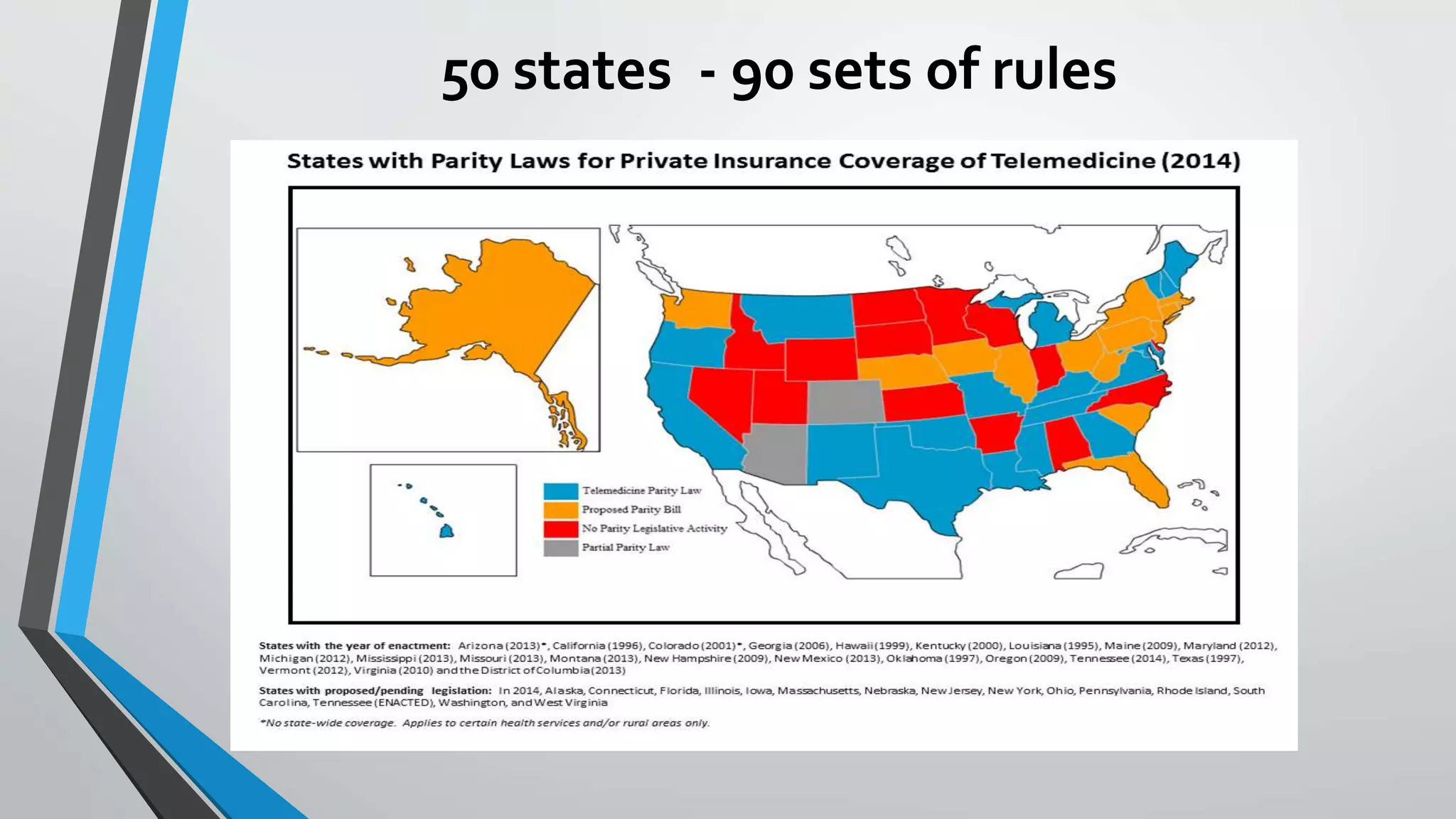
50 states - 90 sets of rules
What are telehealth parity statutes ? 
Laws that require private insurers to 
cover telemedicine services if those 
same services are covered when 
provided in-person.
Current Status of Telemedicine Parity Statutes. 
• Currently, 17 states have telemedicine parity statutes in place, 
• 13 states have legislation pending regarding telemedicine parity for private 
insurers. 
• The vast majority of Medicaid programs (47 states) do cover telemedicine 
services for their beneficiaries, although coverage is usually limited to those 
services provided via live interactive communication and/or have 
geographical limitations. 
• Other Medicaid programs expressly cover remote monitoring services 
(Telehealth). (While these statutes require coverage, many don’t mandate 
the same level of reimbursement for telehealth as those services 
provided face-to-face.)
Making a Business Case 
• Reduced costs 
• Reimbursements from Medicare; Medicaid; the Children's Health Insurance 
Program; TRICARE and Private Insurance companies regulated by the Affordable 
Care Act. 
• Improved Customer Communications and Customer Service 
• Increased Throughput 
• Additional Services 
• Inter-State Licensing 
• Plan on a long term ROI
Developing a Telehealth 
Technology Matrix: 
The different telehealth 
technologies and deciding which 
technology will work best.
The Basics 
Synchronous – Live and Interactive 
Asynchronous – Delayed Interaction
Synchronous 
Examples 
Video Visits 
Telephone 
Online Interactive communications
Asynchronous Examples 
Store and Forward technologies 
Electronic Medical Records 
Readings from home biosensor instruments connected 
to a personal computer transferring data to a home 
telemedicine web site.
Building a working Telehealth 
System – Installation, security 
and support issues.
Rules – Security 
• HIPAA Requirements are the same as “in-Person” visits 
• Telemedicine clinicians have the same duty to safeguard a patient’s medical records and 
keep their treatments confidential. 
• Use common sense. 
• Storage of electronic files, images, audio/video tapes etc., needs to be done with the same 
precaution and care ascribed to paper documents. 
• Set your protocols to be compliant 
• Follow your protocols 
• Document that the protocols have been followed 
• Never, Never use open Internet connections. 
• Ask the question “Is my carrier HIPAA Compliant” 
• Do they have documentation to prove it 
• CYA yourself with Patient Informed Consent
Rules – Implementation 
• Don’t fret the Tech 
•Work with a technologist who understands Clinical 
Processes, Clinicians and Patients. 
• Schedule internal installation during off. 
• Test, Test, Test before you bring patients online
Rules – Support 
• Stick with a single Vendor for supporting you entire telehealth operation 
• Your office, your network, your software and your patients 
• Have a single point of contact. 
• Have a tight, well defined Service Level Agreement. 
• Have a Plan B.
Making Your Telehealth System 
Work 
For your patients and for your 
practice.
• Be confident in the technology – do not try to out-think it 
• Be confident in your support structure 
• Consider your support staff your partners in success. 
• Use it in appropriate circumstances when there is a benefit to the patient 
• Not just because it is there 
• If using video , Learn how to talk in front of a camera. 
• Do not make is stressful for patients. 
• Don’t Fret the Tech
Telemedicine and 
Telehealth 
are 
A Means to an End
And Now 
The Commercial
Ask your patient if he or she is a 
Veteran, 
If they are, 
Referring them the local 
Veterans Health Administration 
facility could be one of the best 
services you could provide to 
them…
Richard Strozewski 
Louis Stokes Cleveland VA Medical Center 
Phone: 216-791-3800 Ext: 4702 
VA-Email: Richard.Strozewski@va.gov 
Alt. Email: ALS-Veteran-Assist@technologist.com
Questions?

Presentation 220 richard strozewski building an als telehealth support system -

  • 1.
    BUILDING A SYSTEM FOR RAPID DEPLOYMENT OF FISCALLY SOUND TELEHEALTH TECHNOLOGIES FOR ALS PATIENTS Richard Strozewski SCI/D Telehealth Program Specialist/Telehealth Master Preceptor Louis Stokes Cleveland VA Medical Center Spinal Cord Injury/Disorders (SCI/D) Service
  • 2.
    Contact Information Phone:(216) 791-3800 ext. 4702 E-Mail: Richard.Strozewski@va.gov Alternative E-Mail: ALS-Veteran-Assist@technologist.com
  • 3.
    Disclosures • CommercialSupport was not received for this activity. • Richard Strozewski has no financial interest to disclose
  • 4.
    Presentation Learning Objectives • Definitions of Telehealth/Telemedicine. • Making a Business Case – The Financials behind using Telehealth for ALS Patients. • Developing a Telehealth Technology Matrix - The different telehealth technologies and deciding which technology will work best. • Building a working Telehealth System – Installation, security and support issues. • Making Your Telehealth System Work – For your patients and for your practice.
  • 5.
    Question (Raise yourHands) How many are VA Employees? How many are Non-VA Hospital Employees? How many are in Private practice?
  • 6.
  • 7.
    Telehealth The useof electronic information and telecommunications technologies (ICT or E/ICT) to support long-distance clinical health care, patient and professional health-related education, public health and health administration, all in the interests of advancing the health of individuals and their communities”
  • 8.
    Telemedicine • Termcoined in the 1970’s • Literally “HEALING AT A DISTANCE” • The delivery of health care services, where distance is a critical factor, by all health care professionals using information and communication technologies for the exchange of valid information for diagnosis, treatment and prevention of disease and injuries, research and evaluation, The delivery of health care services, where distance is a critical factor, by all health care professionals using information and communication technologies for the exchange of valid information for diagnosis, treatment and prevention of disease and injuries, research and evaluation, and for the continuing education of health care providers, all in the interests of advancing the health of individuals and their communities” (WHO Definition)
  • 9.
    4 Elements •Its purpose is to a provide clinical service. • Overcome geographical barriers, connecting users who are not in the same physical location as their provider. • It involves the use of various types of ICT. • Its goal is to improve health outcomes and/or Quality of Life.
  • 10.
    The Financials behindusing Telehealth for ALS Patients
  • 11.
    50 states -90 sets of rules
  • 12.
    What are telehealthparity statutes ? Laws that require private insurers to cover telemedicine services if those same services are covered when provided in-person.
  • 13.
    Current Status ofTelemedicine Parity Statutes. • Currently, 17 states have telemedicine parity statutes in place, • 13 states have legislation pending regarding telemedicine parity for private insurers. • The vast majority of Medicaid programs (47 states) do cover telemedicine services for their beneficiaries, although coverage is usually limited to those services provided via live interactive communication and/or have geographical limitations. • Other Medicaid programs expressly cover remote monitoring services (Telehealth). (While these statutes require coverage, many don’t mandate the same level of reimbursement for telehealth as those services provided face-to-face.)
  • 14.
    Making a BusinessCase • Reduced costs • Reimbursements from Medicare; Medicaid; the Children's Health Insurance Program; TRICARE and Private Insurance companies regulated by the Affordable Care Act. • Improved Customer Communications and Customer Service • Increased Throughput • Additional Services • Inter-State Licensing • Plan on a long term ROI
  • 15.
    Developing a Telehealth Technology Matrix: The different telehealth technologies and deciding which technology will work best.
  • 16.
    The Basics Synchronous– Live and Interactive Asynchronous – Delayed Interaction
  • 17.
    Synchronous Examples VideoVisits Telephone Online Interactive communications
  • 18.
    Asynchronous Examples Storeand Forward technologies Electronic Medical Records Readings from home biosensor instruments connected to a personal computer transferring data to a home telemedicine web site.
  • 19.
    Building a workingTelehealth System – Installation, security and support issues.
  • 20.
    Rules – Security • HIPAA Requirements are the same as “in-Person” visits • Telemedicine clinicians have the same duty to safeguard a patient’s medical records and keep their treatments confidential. • Use common sense. • Storage of electronic files, images, audio/video tapes etc., needs to be done with the same precaution and care ascribed to paper documents. • Set your protocols to be compliant • Follow your protocols • Document that the protocols have been followed • Never, Never use open Internet connections. • Ask the question “Is my carrier HIPAA Compliant” • Do they have documentation to prove it • CYA yourself with Patient Informed Consent
  • 21.
    Rules – Implementation • Don’t fret the Tech •Work with a technologist who understands Clinical Processes, Clinicians and Patients. • Schedule internal installation during off. • Test, Test, Test before you bring patients online
  • 22.
    Rules – Support • Stick with a single Vendor for supporting you entire telehealth operation • Your office, your network, your software and your patients • Have a single point of contact. • Have a tight, well defined Service Level Agreement. • Have a Plan B.
  • 23.
    Making Your TelehealthSystem Work For your patients and for your practice.
  • 24.
    • Be confidentin the technology – do not try to out-think it • Be confident in your support structure • Consider your support staff your partners in success. • Use it in appropriate circumstances when there is a benefit to the patient • Not just because it is there • If using video , Learn how to talk in front of a camera. • Do not make is stressful for patients. • Don’t Fret the Tech
  • 25.
    Telemedicine and Telehealth are A Means to an End
  • 26.
    And Now TheCommercial
  • 27.
    Ask your patientif he or she is a Veteran, If they are, Referring them the local Veterans Health Administration facility could be one of the best services you could provide to them…
  • 28.
    Richard Strozewski LouisStokes Cleveland VA Medical Center Phone: 216-791-3800 Ext: 4702 VA-Email: Richard.Strozewski@va.gov Alt. Email: ALS-Veteran-Assist@technologist.com
  • 29.