

Telehealth
in an evolving healthcare
environment
Karen S. Rheuban MD
Professor of Pediatrics
Senior Associate Dean for CME and External Affairs
Director, Center for Telehealth
University of Virginia
No COI to disclose
Verizon Foundation grant
Objectives
• Understand the landscape of telehealth across
the healthcare continuum
• Identify opportunities to advance telehealth
through favorable public policy collaborations
Definition
The use of technology to enhance access to
health care, to improve public health, and to
support health-related education using
communications services
•
•
•
•

Live interactive videoconferencing
Store and forward technologies
Remote patient monitoring
Health related distance learning

• Telehealth is not a specialty in and of itself!
• Patients:

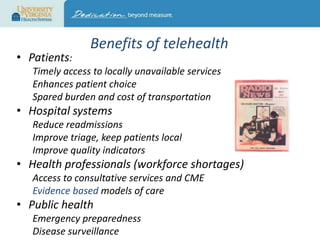
Benefits of telehealth

Timely access to locally unavailable services
Enhances patient choice
Spared burden and cost of transportation

• Hospital systems
Reduce readmissions
Improve triage, keep patients local
Improve quality indicators

• Health professionals (workforce shortages)
Access to consultative services and CME
Evidence based models of care

• Public health
Emergency preparedness
Disease surveillance
UVA Center for Telehealth
• Integrated program across the service lines and
schools within the University that facilitate our
missions of:
Clinical Care
Teaching across the continuum
Research and innovation
Public service/Public policy
• HRSA funded Mid Atlantic Telehealth Resource Center
• Academic partner with Specialists on Call
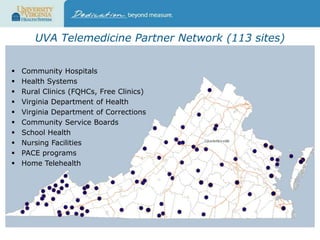
UVA Telemedicine Partner Network (113 sites)











Community Hospitals
Health Systems
Rural Clinics (FQHCs, Free Clinics)
Virginia Department of Health
Virginia Department of Corrections
Community Service Boards
School Health
Nursing Facilities
PACE programs
Home Telehealth
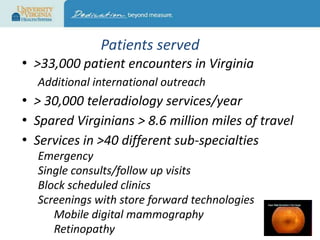
Patients served
• >33,000 patient encounters in Virginia
Additional international outreach

• > 30,000 teleradiology services/year
• Spared Virginians > 8.6 million miles of travel
• Services in >40 different sub-specialties
Emergency
Single consults/follow up visits
Block scheduled clinics
Screenings with store forward technologies
Mobile digital mammography
Retinopathy
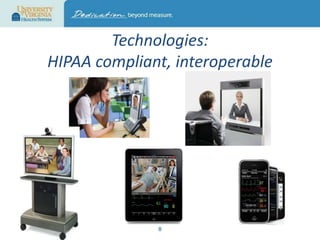
Technologies:
HIPAA compliant, interoperable

8
Clinical services
o

Cancer Center

o

Mammography

o

Pediatric Critical Care

o

Cardiology

o

Neonatology

o

Plastic Surgery

o

Dentistry

o

Nephrology

o

Psychiatry – Adult

o

Dermatology

o

Neurology - general

o

Psychiatry – Child & Family

o

Diabetes Education

o

Neurology - stroke

o

Psychiatry – Emergency

o

Endocrinology

o

Neurosurgery

o

Pulmonology – Cystic Fibrosis

o

ENT

o

Nutrition

o

Radiology

o

Emergency Medicine

o

Obstetrics – High Risk

o

Rheumatology

o

Gastroenterology

o

Ophthalmology

o

Surgery

o

Genetic Counseling

o

Orthopedics

o

Thoracic Cardiovascular Surgery

o

Geriatrics

o

Ostomy

o

Toxicology / Poison Control

o

Gynecology

o

Pain Management

o

Transplant

o

Hematology

o

Patient Monitoring

o

Urology

o

Infectious Disease

o

Pediatric specialties

o

Wound Care
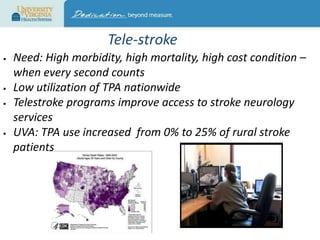
Tele-stroke







Need: High morbidity, high mortality, high cost condition –
when every second counts
Low utilization of TPA nationwide
Telestroke programs improve access to stroke neurology
services
UVA: TPA use increased from 0% to 25% of rural stroke
patients
The evidence
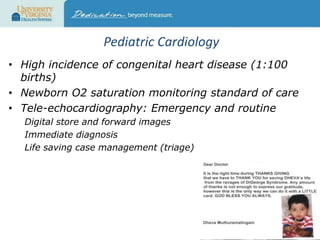
Pediatric Cardiology
• High incidence of congenital heart disease (1:100
births)
• Newborn O2 saturation monitoring standard of care
• Tele-echocardiography: Emergency and routine
Digital store and forward images
Immediate diagnosis
Life saving case management (triage)
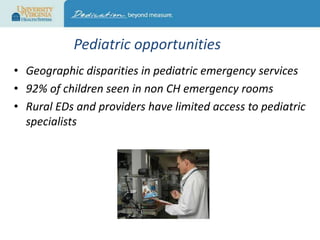
Pediatric opportunities
• Geographic disparities in pediatric emergency services
• 92% of children seen in non CH emergency rooms
• Rural EDs and providers have limited access to pediatric
specialists
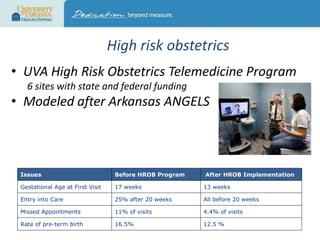
High risk obstetrics
• UVA High Risk Obstetrics Telemedicine Program
6 sites with state and federal funding

• Modeled after Arkansas ANGELS

Issues

Before HROB Program

After HROB Implementation

Gestational Age at First Visit

17 weeks

13 weeks

Entry into Care

25% after 20 weeks

All before 20 weeks

Missed Appointments

11% of visits

4.4% of visits

Rate of pre-term birth

16.5%

12.5 %
Emergency telemedicine
•
•
•
•

Serious staffing challenges in rural (and urban) EDs
Provides access to specialty care
Transfer avoidance when appropriate
Improved triage when transfer needed
‒
‒
‒
‒

University of Mississippi >500,000 ED tele-services!!!
UC Davis: Pediatric emergency telemedicine
Dartmouth: Tele-trauma training and care
UVA: Medical Toxicology, telestroke, emergency
telepsychiatry, pediatrics and other emergency consults as
requested
Tele-mental health
• Shortage of mental health providers in rural areas
• Consultations, medication management
Improve access, shorter wait times
High rates of patient satisfaction in all age groups
Controlled studies show efficacy comparable to face to face
psychiatry

• NUMBER ONE request for services
• Adult, Child and adolescent services
• Emergency telepsychiatry
*Terry Rabinowitz – “Think inside the box”
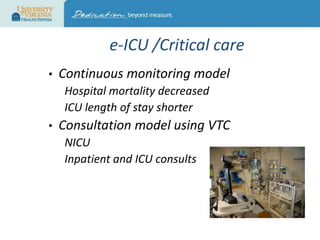
e-ICU /Critical care
•

Continuous monitoring model
Hospital mortality decreased
ICU length of stay shorter

•

Consultation model using VTC
NICU
Inpatient and ICU consults
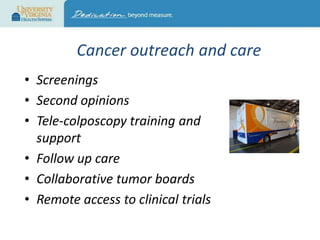
Cancer outreach and care
• Screenings
• Second opinions
• Tele-colposcopy training and
support
• Follow up care
• Collaborative tumor boards
• Remote access to clinical trials
Chronic Disease Management: RPM
• ACA: Incentives and penalties
Hospital penalties for readmissions
Medicare shared savings programs
Models of capitated care

• Examples:
Vidant Health (North Carolina)
Sentara Home health (Virginia)
VA Care Coordination and Home Telehealth
UVA C3 – initial focus on CHF, COPD, AMI, Pneum
8% readmission rate (76% reduction)
Public policy
Alignment with State and Federal Goals
•
•
•
•
•
•

Improves access to care
Improves quality
Lowers costs
Improves population health
Mitigates specialty workforce shortages
Facilitates disease surveillance/emergency
preparedness
• Increases broadband deployment/adoption
Issues for consideration
•
•
•
•
•
•
•
•
•
•
•

Reimbursement
Funding of telehealth (Stark, Anti-kickback)
Informed consent
Ensure privacy and confidentiality (HIPAA)
Credentialing and privileging – CMS, Joint Commission
Licensure
Malpractice
Practice guidelines and technical standards
Telecommunications venue/costs
Integration with EMRS/HIE
Interagency malalignment related to policies
21
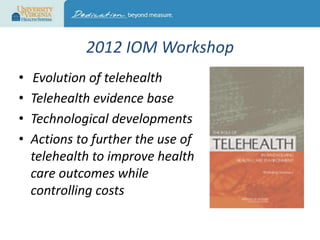
2012 IOM Workshop
•
•
•
•

Evolution of telehealth
Telehealth evidence base
Technological developments
Actions to further the use of
telehealth to improve health
care outcomes while
controlling costs
Key Findings
• Improve payment mechanisms
• Streamline licensure and credentialing processes
• Develop a trained workforce in the practice and
delivery of telehealth services
• Explore the role of telehealth in new care delivery
models
• Conduct more research to improve the evidence
base for telehealth
Federal payment mechanisms
•
•
•
•
•

Centers for Medicare and Medicaid Services
Department of Veterans Affairs
Department of Defense
Indian Health Service
Federal employee benefit plans
Improve Federal Payment Mechanisms
Medicare reimbursement of telehealth services
remains low
•
•
•
•

2011: CMS reported <$6 million dollars in
reimbursements nationwide to distant site providers
Rural requirement for originating site including for ACOs
Non-MSA definition of rural limits sustainability models
and more importantly, access to care for our seniors
Rural definition is poorly aligned with specialty workforce
shortages
Urban areas under Medicare
• The Grand Canyon, Arizona
Other Federal Roles in Telehealth:
16 federal agencies
•
•
•
•
•
•

HHS: HRSA, NIH, AHRQ, CMMI, ONC
USDA, Commerce
Rural healthcare support mechanism (FCC)
NASA
Department of Defense
FDA
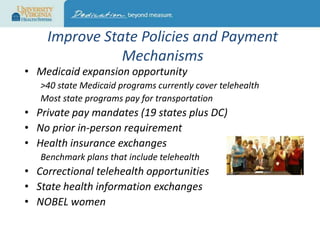
Improve State Policies and Payment
Mechanisms

• Medicaid expansion opportunity

>40 state Medicaid programs currently cover telehealth
Most state programs pay for transportation

• Private pay mandates (19 states plus DC)
• No prior in-person requirement
• Health insurance exchanges
Benchmark plans that include telehealth

• Correctional telehealth opportunities
• State health information exchanges
• NOBEL women
State Commitments to Telehealth
•
•
•
•
•
•
•
•
•
•

Virginia Department of Health
State Rural Health Plan
State Stroke Systems of Care Task Force
Joint Commission on Health Care
Tobacco Indemnification Commission
Medical Society of Virginia
Virginia Health Reform Initiative
HBE Benchmark plan
Workforce Development Authority
State Board of Medicine
Virginia Medicaid
• Began coverage in 1995
• Broadened statewide in 2003 as non-statutory
administrative decision
• Covers store forward for ophthalmology
• School as originating site for speech and language
• State-wide managed care networks
• 2013 Dual enrollee contract with CMS
– 77,000 Virginians covered
– Urban telemedicine for Medicare enrollees
– Remote patient monitoring
Credentialing and Privileging
• CMS 2011 rule change allows for a proxy
credentialing and privileging process in the revised
Conditions of Participation standards
• Must hold an accepted license within the state
• Must be bound by a legal agreement between
entities
• Must share quality data
Licensure
•
•
•
•

Movement towards licensure portability
FSMB compact model
HRSA licensure grant program
Consider malpractice coverage implications!
Develop the Telehealth Workforce
• Prepare the next generation of healthcare
professionals to integrate telehealth into models of
practice
• Training programs developed – ATA, VA, HRSA
funded projects
• Integration into medical and nursing school curricula
• Create innovative workforce development models, to
include physician extenders
Recent federal legislation/actions
• Harper - Telehealth Enhancement Act of 2013 (HR 3306)*
–
–
–
–

Add incentive to reduce Medicare hospital readmissions
Create new Medicaid optional package for high-risk OB
Expands originating sites to include the home
Allow Medicare accountable care organizations (ACOs) to use telehealth

• Nunes – Medicare Telemedicine Enhancement Act of 2013
(HR 3077)
– Licensure portability to serve Medicare beneficiaries

• Rangel – VETS Act (HR 2001)
– Licensure portability for VA providers

• 2014 CMS physician payment schedule*
• FDA guidance document on mobile medical applications
The future of telehealth
•
•
•
•
•
•
•
•
•

Outcomes
Practice guidelines
Standards of interoperability
Demonstration projects including with FSMB
Collaboration amongst providers, policymakers
Collaboration with AMA and state medical societies
Telehealth resource centers
Champions at all levels
Integration into mainstream medicine
Telemedicine - for the patient.....

Why Telehealth - Telehealth in an Evolving Healthcare Environment

  • 1.
    Telehealth in an evolvinghealthcare environment Karen S. Rheuban MD Professor of Pediatrics Senior Associate Dean for CME and External Affairs Director, Center for Telehealth University of Virginia No COI to disclose Verizon Foundation grant
  • 2.
    Objectives • Understand thelandscape of telehealth across the healthcare continuum • Identify opportunities to advance telehealth through favorable public policy collaborations
  • 3.
    Definition The use oftechnology to enhance access to health care, to improve public health, and to support health-related education using communications services • • • • Live interactive videoconferencing Store and forward technologies Remote patient monitoring Health related distance learning • Telehealth is not a specialty in and of itself!
  • 4.
    • Patients: Benefits oftelehealth Timely access to locally unavailable services Enhances patient choice Spared burden and cost of transportation • Hospital systems Reduce readmissions Improve triage, keep patients local Improve quality indicators • Health professionals (workforce shortages) Access to consultative services and CME Evidence based models of care • Public health Emergency preparedness Disease surveillance
  • 5.
    UVA Center forTelehealth • Integrated program across the service lines and schools within the University that facilitate our missions of: Clinical Care Teaching across the continuum Research and innovation Public service/Public policy • HRSA funded Mid Atlantic Telehealth Resource Center • Academic partner with Specialists on Call
  • 6.
    UVA Telemedicine PartnerNetwork (113 sites)           Community Hospitals Health Systems Rural Clinics (FQHCs, Free Clinics) Virginia Department of Health Virginia Department of Corrections Community Service Boards School Health Nursing Facilities PACE programs Home Telehealth
  • 7.
    Patients served • >33,000patient encounters in Virginia Additional international outreach • > 30,000 teleradiology services/year • Spared Virginians > 8.6 million miles of travel • Services in >40 different sub-specialties Emergency Single consults/follow up visits Block scheduled clinics Screenings with store forward technologies Mobile digital mammography Retinopathy
  • 8.
  • 9.
    Clinical services o Cancer Center o Mammography o PediatricCritical Care o Cardiology o Neonatology o Plastic Surgery o Dentistry o Nephrology o Psychiatry – Adult o Dermatology o Neurology - general o Psychiatry – Child & Family o Diabetes Education o Neurology - stroke o Psychiatry – Emergency o Endocrinology o Neurosurgery o Pulmonology – Cystic Fibrosis o ENT o Nutrition o Radiology o Emergency Medicine o Obstetrics – High Risk o Rheumatology o Gastroenterology o Ophthalmology o Surgery o Genetic Counseling o Orthopedics o Thoracic Cardiovascular Surgery o Geriatrics o Ostomy o Toxicology / Poison Control o Gynecology o Pain Management o Transplant o Hematology o Patient Monitoring o Urology o Infectious Disease o Pediatric specialties o Wound Care
  • 10.
    Tele-stroke     Need: High morbidity,high mortality, high cost condition – when every second counts Low utilization of TPA nationwide Telestroke programs improve access to stroke neurology services UVA: TPA use increased from 0% to 25% of rural stroke patients
  • 11.
  • 12.
    Pediatric Cardiology • Highincidence of congenital heart disease (1:100 births) • Newborn O2 saturation monitoring standard of care • Tele-echocardiography: Emergency and routine Digital store and forward images Immediate diagnosis Life saving case management (triage)
  • 13.
    Pediatric opportunities • Geographicdisparities in pediatric emergency services • 92% of children seen in non CH emergency rooms • Rural EDs and providers have limited access to pediatric specialists
  • 14.
    High risk obstetrics •UVA High Risk Obstetrics Telemedicine Program 6 sites with state and federal funding • Modeled after Arkansas ANGELS Issues Before HROB Program After HROB Implementation Gestational Age at First Visit 17 weeks 13 weeks Entry into Care 25% after 20 weeks All before 20 weeks Missed Appointments 11% of visits 4.4% of visits Rate of pre-term birth 16.5% 12.5 %
  • 15.
    Emergency telemedicine • • • • Serious staffingchallenges in rural (and urban) EDs Provides access to specialty care Transfer avoidance when appropriate Improved triage when transfer needed ‒ ‒ ‒ ‒ University of Mississippi >500,000 ED tele-services!!! UC Davis: Pediatric emergency telemedicine Dartmouth: Tele-trauma training and care UVA: Medical Toxicology, telestroke, emergency telepsychiatry, pediatrics and other emergency consults as requested
  • 16.
    Tele-mental health • Shortageof mental health providers in rural areas • Consultations, medication management Improve access, shorter wait times High rates of patient satisfaction in all age groups Controlled studies show efficacy comparable to face to face psychiatry • NUMBER ONE request for services • Adult, Child and adolescent services • Emergency telepsychiatry *Terry Rabinowitz – “Think inside the box”
  • 17.
    e-ICU /Critical care • Continuousmonitoring model Hospital mortality decreased ICU length of stay shorter • Consultation model using VTC NICU Inpatient and ICU consults
  • 18.
    Cancer outreach andcare • Screenings • Second opinions • Tele-colposcopy training and support • Follow up care • Collaborative tumor boards • Remote access to clinical trials
  • 19.
    Chronic Disease Management:RPM • ACA: Incentives and penalties Hospital penalties for readmissions Medicare shared savings programs Models of capitated care • Examples: Vidant Health (North Carolina) Sentara Home health (Virginia) VA Care Coordination and Home Telehealth UVA C3 – initial focus on CHF, COPD, AMI, Pneum 8% readmission rate (76% reduction)
  • 20.
    Public policy Alignment withState and Federal Goals • • • • • • Improves access to care Improves quality Lowers costs Improves population health Mitigates specialty workforce shortages Facilitates disease surveillance/emergency preparedness • Increases broadband deployment/adoption
  • 21.
    Issues for consideration • • • • • • • • • • • Reimbursement Fundingof telehealth (Stark, Anti-kickback) Informed consent Ensure privacy and confidentiality (HIPAA) Credentialing and privileging – CMS, Joint Commission Licensure Malpractice Practice guidelines and technical standards Telecommunications venue/costs Integration with EMRS/HIE Interagency malalignment related to policies 21
  • 22.
    2012 IOM Workshop • • • • Evolutionof telehealth Telehealth evidence base Technological developments Actions to further the use of telehealth to improve health care outcomes while controlling costs
  • 23.
    Key Findings • Improvepayment mechanisms • Streamline licensure and credentialing processes • Develop a trained workforce in the practice and delivery of telehealth services • Explore the role of telehealth in new care delivery models • Conduct more research to improve the evidence base for telehealth
  • 24.
    Federal payment mechanisms • • • • • Centersfor Medicare and Medicaid Services Department of Veterans Affairs Department of Defense Indian Health Service Federal employee benefit plans
  • 25.
    Improve Federal PaymentMechanisms Medicare reimbursement of telehealth services remains low • • • • 2011: CMS reported <$6 million dollars in reimbursements nationwide to distant site providers Rural requirement for originating site including for ACOs Non-MSA definition of rural limits sustainability models and more importantly, access to care for our seniors Rural definition is poorly aligned with specialty workforce shortages
  • 26.
    Urban areas underMedicare • The Grand Canyon, Arizona
  • 27.
    Other Federal Rolesin Telehealth: 16 federal agencies • • • • • • HHS: HRSA, NIH, AHRQ, CMMI, ONC USDA, Commerce Rural healthcare support mechanism (FCC) NASA Department of Defense FDA
  • 28.
    Improve State Policiesand Payment Mechanisms • Medicaid expansion opportunity >40 state Medicaid programs currently cover telehealth Most state programs pay for transportation • Private pay mandates (19 states plus DC) • No prior in-person requirement • Health insurance exchanges Benchmark plans that include telehealth • Correctional telehealth opportunities • State health information exchanges • NOBEL women
  • 29.
    State Commitments toTelehealth • • • • • • • • • • Virginia Department of Health State Rural Health Plan State Stroke Systems of Care Task Force Joint Commission on Health Care Tobacco Indemnification Commission Medical Society of Virginia Virginia Health Reform Initiative HBE Benchmark plan Workforce Development Authority State Board of Medicine
  • 30.
    Virginia Medicaid • Begancoverage in 1995 • Broadened statewide in 2003 as non-statutory administrative decision • Covers store forward for ophthalmology • School as originating site for speech and language • State-wide managed care networks • 2013 Dual enrollee contract with CMS – 77,000 Virginians covered – Urban telemedicine for Medicare enrollees – Remote patient monitoring
  • 31.
    Credentialing and Privileging •CMS 2011 rule change allows for a proxy credentialing and privileging process in the revised Conditions of Participation standards • Must hold an accepted license within the state • Must be bound by a legal agreement between entities • Must share quality data
  • 32.
    Licensure • • • • Movement towards licensureportability FSMB compact model HRSA licensure grant program Consider malpractice coverage implications!
  • 33.
    Develop the TelehealthWorkforce • Prepare the next generation of healthcare professionals to integrate telehealth into models of practice • Training programs developed – ATA, VA, HRSA funded projects • Integration into medical and nursing school curricula • Create innovative workforce development models, to include physician extenders
  • 34.
    Recent federal legislation/actions •Harper - Telehealth Enhancement Act of 2013 (HR 3306)* – – – – Add incentive to reduce Medicare hospital readmissions Create new Medicaid optional package for high-risk OB Expands originating sites to include the home Allow Medicare accountable care organizations (ACOs) to use telehealth • Nunes – Medicare Telemedicine Enhancement Act of 2013 (HR 3077) – Licensure portability to serve Medicare beneficiaries • Rangel – VETS Act (HR 2001) – Licensure portability for VA providers • 2014 CMS physician payment schedule* • FDA guidance document on mobile medical applications
  • 35.
    The future oftelehealth • • • • • • • • • Outcomes Practice guidelines Standards of interoperability Demonstration projects including with FSMB Collaboration amongst providers, policymakers Collaboration with AMA and state medical societies Telehealth resource centers Champions at all levels Integration into mainstream medicine
  • 36.
    Telemedicine - forthe patient.....