Special Senses
THE EYE AND EAR
The Ear
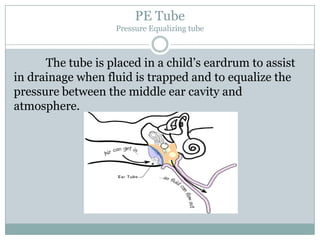
PE Tube
Pressure Equalizing tube

The tube is placed in a child’s eardrum to assist
in drainage when fluid is trapped and to equalize the
pressure between the middle ear cavity and
atmosphere.
EENT
Eyes, Ears, Nose and Throat

 Abbreviation used for eyes, ears, nose and throat.
 The eyes, ears, nose and throat are interconnected

organs.
BC
Bone Conduction

 Bone Conduction is used to conduce sound to the

inner ears through the bones skull.
 It is used for people who have a normal hearing to
hearing impairment.
 “bone headphones” are better than headphones
because it transmits sound directly to the innermost
part of the ear that sends
signals to the brain whilst
bypassing portions of the ear.
AU
Both Ears

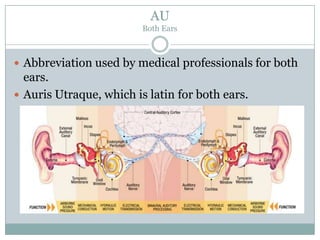
 Abbreviation used by medical professionals for both

ears.
 Auris Utraque, which is latin for both ears.
OM- Otitis Media
 OM is inflammation of the middle ear, mostly seen in

children.
 Common after an upper respiratory infection, which
is moved from the pharynx to the middle ear
 Fluid accumulates
in the middle ear.
EM
Emmetropia

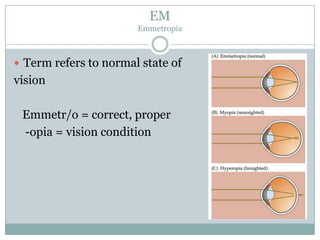
 Term refers to normal state of

vision
Emmetr/o = correct, proper
-opia = vision condition
XT
Exotropia

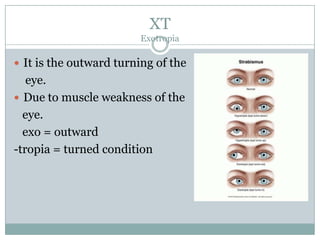
 It is the outward turning of the

eye.
 Due to muscle weakness of the
eye.
exo = outward
-tropia = turned condition
OS
left eye

 Oculus sinister, which is latin for left eye.
EOM
Extarocular movement

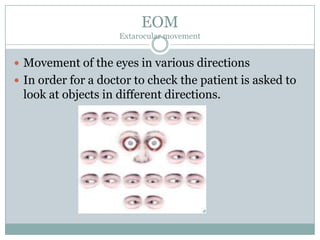
 Movement of the eyes in various directions
 In order for a doctor to check the patient is asked to

look at objects in different directions.
VA
Visual Acuity

 Visual acuity is the sharpness of the patients vision.
 Usually measured my an optometrist with

a chart of letters in different sizes
from a distance.
Works cited
”How Bone-conducting headphones work.”HowStuffWorks. N.p.,
n.d. Web. 20 Nov. 2013
Fremgen, Bonnie F., and Suzanne S. Frucht. Medical Terminology:
A Living Language. Upper Saddle River, NJ: Prentica Hall, 2005.
Print.

Eye and ear presentation

  • 1.
  • 2.
  • 3.
    PE Tube Pressure Equalizingtube The tube is placed in a child’s eardrum to assist in drainage when fluid is trapped and to equalize the pressure between the middle ear cavity and atmosphere.
  • 4.
    EENT Eyes, Ears, Noseand Throat  Abbreviation used for eyes, ears, nose and throat.  The eyes, ears, nose and throat are interconnected organs.
  • 5.
    BC Bone Conduction  BoneConduction is used to conduce sound to the inner ears through the bones skull.  It is used for people who have a normal hearing to hearing impairment.  “bone headphones” are better than headphones because it transmits sound directly to the innermost part of the ear that sends signals to the brain whilst bypassing portions of the ear.
  • 6.
    AU Both Ears  Abbreviationused by medical professionals for both ears.  Auris Utraque, which is latin for both ears.
  • 7.
    OM- Otitis Media OM is inflammation of the middle ear, mostly seen in children.  Common after an upper respiratory infection, which is moved from the pharynx to the middle ear  Fluid accumulates in the middle ear.
  • 8.
    EM Emmetropia  Term refersto normal state of vision Emmetr/o = correct, proper -opia = vision condition
  • 9.
    XT Exotropia  It isthe outward turning of the eye.  Due to muscle weakness of the eye. exo = outward -tropia = turned condition
  • 10.
    OS left eye  Oculussinister, which is latin for left eye.
  • 11.
    EOM Extarocular movement  Movementof the eyes in various directions  In order for a doctor to check the patient is asked to look at objects in different directions.
  • 12.
    VA Visual Acuity  Visualacuity is the sharpness of the patients vision.  Usually measured my an optometrist with a chart of letters in different sizes from a distance.
  • 13.
    Works cited ”How Bone-conductingheadphones work.”HowStuffWorks. N.p., n.d. Web. 20 Nov. 2013 Fremgen, Bonnie F., and Suzanne S. Frucht. Medical Terminology: A Living Language. Upper Saddle River, NJ: Prentica Hall, 2005. Print.