Enhancing School English Language Programmes   Blogging: Beyond the Curriculum
A one-year review as conducted at Hwa Chong Institution Using blogs to enable independent learning
Why Blog?
Why Blog? ‘ 23,000 new weblogs are created every day – or about one every three seconds.’ Fortune  Magazine   2005
Why Blog? 1  Students (digital natives) student-owned technology  motivation  to write  2 Offers a wealth of opportunities for students to write  purposefully & collaboratively 3 Facilitates differentiated instruction (DI) – students & their learning styles
Digital literacy ‘ refers to the ways people become comfortable using technology as they would any other natural language.’  ( Huffaker) ‘ digital fluency will be another prerequisite for sociability, lifelong learning, and employment opportunities.’  (Resnick, 2002)
Digital literacy Weblogs allow for the fusion of educational technology and traditional narrative writing inside the classroom and beyond
Blogging and language acquisition Students will be able to improve their writing Students are able to engage in critical, creative & reflective thinking
Blogging and independent learning ‘ It is essential for schools to  reduce   students’ dependence   on schools and teachers for their learning and  increase students’ capability to set and meet their own learning goals.’  (Core Curriculum Advisory Committee, 1986,  p. 13)
Blogging and independent learning Students  assume responsibility   for creating and maintaining blogs = tasking them with the onus for their learning Blogging allows a shift from teacher to student-centered learning Students see the need to become ‘ lifetime learners ’
Integrating blogging into curriculum Blogging is incorporated into Sec 1 Language Art Programme (LAP) at Hwa Chong Institution: Module plan Resources/Pedagogies 1 student – 1 blog policy
Integration ‘ Complexity that works is built up out of modules that work perfectly, layered one over the other’ (Kevin Kelly)
Layered learning Blogging Reading & Writing Narrative & short story Situational writing Literature & philosophy Comprehenshion & summary Art & acts of persuasion Informal Formal Integration
Process Pre test Journaling vs blogging (similarities & differences) Analysis of newspaper articles of racist bloggers Socratic seminar on the ‘dangers of blogging’ Creation of Class Blog Policy Creating personal blogs
 
For students with existing blogs 1  Do you have a blog that you have been posting actively for the last 3 months? 2 Why did you start your blog? What do you blog about? 3 Is your blog private or public? 4 What are some of the challenges that you face while maintaining your blog?
 
Content Student-initiated Teacher-initiated: blog prompts Rodger’s blog Readers for Life weread.com Micro Fiction Wetpaint  E-learning New arrival book reviews: CCA
Evaluation Major ACE activity (10 CPs) 20 blogs 12 quality comments Multi-media elements: video & photo-montage Monitoring and commenting Rubric
Total: /10CPs 0/1 CPs Name of Student: ……………………..( ) Class: ………… Termly Blog Review Rubrics  Circle one in each box(T1) Circle one in each box(T2) Circle one in each box(T3) /4CPs /3CPs /3CPs Mostly Excellent 3CPs Mostly Satisfactory 2 CPs Mostly Unsatisfactory 1 CPs Excellent Satisfactory Unsatisfactory  Blog is coherent(content & style) and is easy to navigate. Layout is attractive. Overall# (1CP) Excellent Satisfactory Unsatisfactory Excellent Satisfactory Unsatisfactory Excellent Satisfactory Unsatisfactory Multi-media activity is thought-provoking and is relevant to the concepts, themes and issues taught. It enhances learning of the creator and his peers. Multi-Media Excellent Satisfactory Unsatisfactory Excellent Satisfactory Unsatisfactory Excellent Satisfactory Unsatisfactory The writing is clear, concise, and easy to understand. Ideas and responses are communicated clearly and coherently. Writing Standards Excellent Satisfactory Unsatisfactory Excellent Satisfactory Unsatisfactory Excellent Satisfactory Unsatisfactory Blog posts and comments share personal connections to class content or discussion. Connections are also made beyond the classroom. Making Connections Excellent Satisfactory Unsatisfactory Excellent Satisfactory Unsatisfactory Excellent Satisfactory Unsatisfactory Critical thinking is evident in each post and comment. There is a sustained attempt to engage in self-reflection.  Quality of posts & comments Excellent Satisfactory Unsatisfactory Excellent Satisfactory Unsatisfactory Excellent Satisfactory Unsatisfactory There are at least 5 posts in the blog, each at least 200 words. At least 3 comments have been made in classmates’blogs. Each comment is at least 75 words. Posts & Comments # This component should be reviewed in Term 3
Advantages Promotes  editing Provides an  interactive platform   for students to write and publish their thoughts Creates opportunities for students  to write creatively, critically and reflectively Actively engaged in  tracking and reviewing of  books online via the electronic bookshelf Student/teacher relationship…positive Feedback from LAP review—please continue next year
Joy
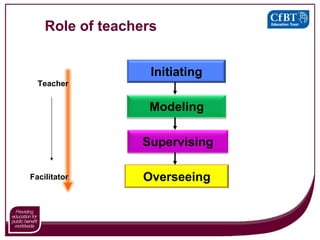
Role of teachers Initiating Modeling Supervising Overseeing Teacher Facilitator
Final observations Instant  access to a student’s thoughts, learning styles, learning needs; e-learning comment from teacher NOT blogging Making connections with themes and texts Allows students to function as a writer/audience 4. Critical thinking framework – a necessity? Does IT help students in their LAP? And the verdict is……

Presentation 1 Using Blogs

  • 1.
    Enhancing School EnglishLanguage Programmes Blogging: Beyond the Curriculum
  • 2.
    A one-year reviewas conducted at Hwa Chong Institution Using blogs to enable independent learning
  • 3.
  • 4.
    Why Blog? ‘23,000 new weblogs are created every day – or about one every three seconds.’ Fortune Magazine 2005
  • 5.
    Why Blog? 1 Students (digital natives) student-owned technology motivation to write 2 Offers a wealth of opportunities for students to write purposefully & collaboratively 3 Facilitates differentiated instruction (DI) – students & their learning styles
  • 6.
    Digital literacy ‘refers to the ways people become comfortable using technology as they would any other natural language.’ ( Huffaker) ‘ digital fluency will be another prerequisite for sociability, lifelong learning, and employment opportunities.’ (Resnick, 2002)
  • 7.
    Digital literacy Weblogsallow for the fusion of educational technology and traditional narrative writing inside the classroom and beyond
  • 8.
    Blogging and languageacquisition Students will be able to improve their writing Students are able to engage in critical, creative & reflective thinking
  • 9.
    Blogging and independentlearning ‘ It is essential for schools to reduce students’ dependence on schools and teachers for their learning and increase students’ capability to set and meet their own learning goals.’ (Core Curriculum Advisory Committee, 1986, p. 13)
  • 10.
    Blogging and independentlearning Students assume responsibility for creating and maintaining blogs = tasking them with the onus for their learning Blogging allows a shift from teacher to student-centered learning Students see the need to become ‘ lifetime learners ’
  • 11.
    Integrating blogging intocurriculum Blogging is incorporated into Sec 1 Language Art Programme (LAP) at Hwa Chong Institution: Module plan Resources/Pedagogies 1 student – 1 blog policy
  • 12.
    Integration ‘ Complexitythat works is built up out of modules that work perfectly, layered one over the other’ (Kevin Kelly)
  • 13.
    Layered learning BloggingReading & Writing Narrative & short story Situational writing Literature & philosophy Comprehenshion & summary Art & acts of persuasion Informal Formal Integration
  • 14.
    Process Pre testJournaling vs blogging (similarities & differences) Analysis of newspaper articles of racist bloggers Socratic seminar on the ‘dangers of blogging’ Creation of Class Blog Policy Creating personal blogs
  • 15.
  • 16.
    For students withexisting blogs 1 Do you have a blog that you have been posting actively for the last 3 months? 2 Why did you start your blog? What do you blog about? 3 Is your blog private or public? 4 What are some of the challenges that you face while maintaining your blog?
  • 17.
  • 18.
    Content Student-initiated Teacher-initiated:blog prompts Rodger’s blog Readers for Life weread.com Micro Fiction Wetpaint E-learning New arrival book reviews: CCA
  • 19.
    Evaluation Major ACEactivity (10 CPs) 20 blogs 12 quality comments Multi-media elements: video & photo-montage Monitoring and commenting Rubric
  • 20.
    Total: /10CPs 0/1CPs Name of Student: ……………………..( ) Class: ………… Termly Blog Review Rubrics Circle one in each box(T1) Circle one in each box(T2) Circle one in each box(T3) /4CPs /3CPs /3CPs Mostly Excellent 3CPs Mostly Satisfactory 2 CPs Mostly Unsatisfactory 1 CPs Excellent Satisfactory Unsatisfactory Blog is coherent(content & style) and is easy to navigate. Layout is attractive. Overall# (1CP) Excellent Satisfactory Unsatisfactory Excellent Satisfactory Unsatisfactory Excellent Satisfactory Unsatisfactory Multi-media activity is thought-provoking and is relevant to the concepts, themes and issues taught. It enhances learning of the creator and his peers. Multi-Media Excellent Satisfactory Unsatisfactory Excellent Satisfactory Unsatisfactory Excellent Satisfactory Unsatisfactory The writing is clear, concise, and easy to understand. Ideas and responses are communicated clearly and coherently. Writing Standards Excellent Satisfactory Unsatisfactory Excellent Satisfactory Unsatisfactory Excellent Satisfactory Unsatisfactory Blog posts and comments share personal connections to class content or discussion. Connections are also made beyond the classroom. Making Connections Excellent Satisfactory Unsatisfactory Excellent Satisfactory Unsatisfactory Excellent Satisfactory Unsatisfactory Critical thinking is evident in each post and comment. There is a sustained attempt to engage in self-reflection. Quality of posts & comments Excellent Satisfactory Unsatisfactory Excellent Satisfactory Unsatisfactory Excellent Satisfactory Unsatisfactory There are at least 5 posts in the blog, each at least 200 words. At least 3 comments have been made in classmates’blogs. Each comment is at least 75 words. Posts & Comments # This component should be reviewed in Term 3
  • 21.
    Advantages Promotes editing Provides an interactive platform for students to write and publish their thoughts Creates opportunities for students to write creatively, critically and reflectively Actively engaged in tracking and reviewing of books online via the electronic bookshelf Student/teacher relationship…positive Feedback from LAP review—please continue next year
  • 22.
  • 23.
    Role of teachersInitiating Modeling Supervising Overseeing Teacher Facilitator
  • 24.
    Final observations Instant access to a student’s thoughts, learning styles, learning needs; e-learning comment from teacher NOT blogging Making connections with themes and texts Allows students to function as a writer/audience 4. Critical thinking framework – a necessity? Does IT help students in their LAP? And the verdict is……