Blogging in Education
Module 6: Presenting Technology
Research
by Sarah Konkey
MENU
Slide 3……….. Article 1: Five Don’ts of Classroom
Blogging (click title on slide to view full article)
Slide 4……….. Reflection
Slides 5-6…… Article 2: Reflections on Using Blogs to
Expand In-class Discussion (click title on slide to view full article)
Slide 7……….. Reflection
Slides 8-9…… Article 3: The Pros (and a few cons too) of
Blogging (click title on slide to view full article)
Slide 10……… Reflection
Slide 11-12… Conclusion
Five Don’ts of Classroom Blogging
by J. Sturgeon
 1. DON’T just dive in- possibly have students and parents sign a code of
conduct and spend time practicing with students before letting them do it
on their own
 2. DON’T confuse blogging with social networking- educational blogs are
about students helping each other and doing assignments
 3. DON’T leap at freebies- free sites sometimes have a wide range of
advertisements that teachers cannot control
 4. DON’T force a sequential style- structuring blogs by topics instead of
by time can be more beneficial to students
 5. DON’T leave the blogging to the students- as a teacher get in there and
blog too! Provide questions for students to answer by commenting on
your blog and get them to give their opinions as well
Citation: Sturgeon, J. (2008, February). Five Don’ts of Classroom Blogging. THE Journal,
35(2), 26-30. Retrieved April 27, 2009, from Academic Search
Premiere database.
Reflection
• Interesting Quote:“A blog becomes a community. You get to
know students in ways that they won’t reveal otherwise. A
quiet child will give you their opinion [in a blog].”
– I liked this quote because it is true. There are lots of students who are
too afraid to speak up during class but may be more willing to express
their opinions on a blog.
A-HA!
• I did not know you could structure the blogs by topic
• Sometimes the voice that blogging gives to students can be troublesome
when they try to push the limits
• Teachers need to keep their own blog as well so that they can be an
example of what students should be doing and writing about as well as
get feedback from students
Reflections on Using Blogs to
Expand In-class Discussion
by S. Wang and H. Hsua
 Blogs can create online communities and can serve as “interactive
knowledge exchange tools”
 Found that learning could be more meaningful to students if they are able
to exchange ideas with other students
 Some ideas: instructors can invite participants from another school or just
another class to participate in a discussion, faculty can work with faculty
from another school on a project blog, or have students design a class
newsletter together
 Some problems: students may consider blogging outside of the classroom
an extra burden, it can be time-consuming, and some students may feel
overwhelmed
Cont’d
 Instructors should offer training sessions to demonstrate how to do it and
to explain what is and what is not appropriate
 Students can share stories about themselves that they would not be able
to do in-class because time is limited during class
Citation: Wang, S., Hsua, H. (2008, May). Reflections on Using Blogs to Expand In-class
Discussion. TechTrends: Linking Research & Practice to Improve Learning, 52(3), 81-85.
Retrieved April 27, 2009, doi:10.1007/s11528-008-0160-y
Reflection
• Interesting Quote: “ Blog participants may write for readers
beyond the classroom, an opportunity that is not possible in
discussion boards.”
– I liked this quote because blogs are a good way to have your students write things that
other teachers or students from other schools can read and respond to. At the same
time, some teachers may want their classroom blog to be private so that only students
that are in the class can read and respond.
A-HA!
• Working with a class from another school on a group project is a fun and
interesting idea that I had not thought about
• From the article, it seem as thought students respond to blogging better
when they are shown how to use it properly and are allowed some
flexibility in their assignments
• A training session with the students is the best way to ensure that they
know how to use a blogging tool properly and to be clear about what they
are supposed to do
The Pros (and a few cons too) of
Blogging
by R. Ramaswami
 One teacher did a study in which his students kept a blog
throughout the process of writing a research paper where they
wrote about new ideas and got feedback from teachers and
classmates
 Study found that 60% of students found that blogging helped them
get started on their research paper, which students say is the
hardest part of a research paper
 Students also said that it helped them organize their thoughts and
that they benefitted from classmates’ feedback
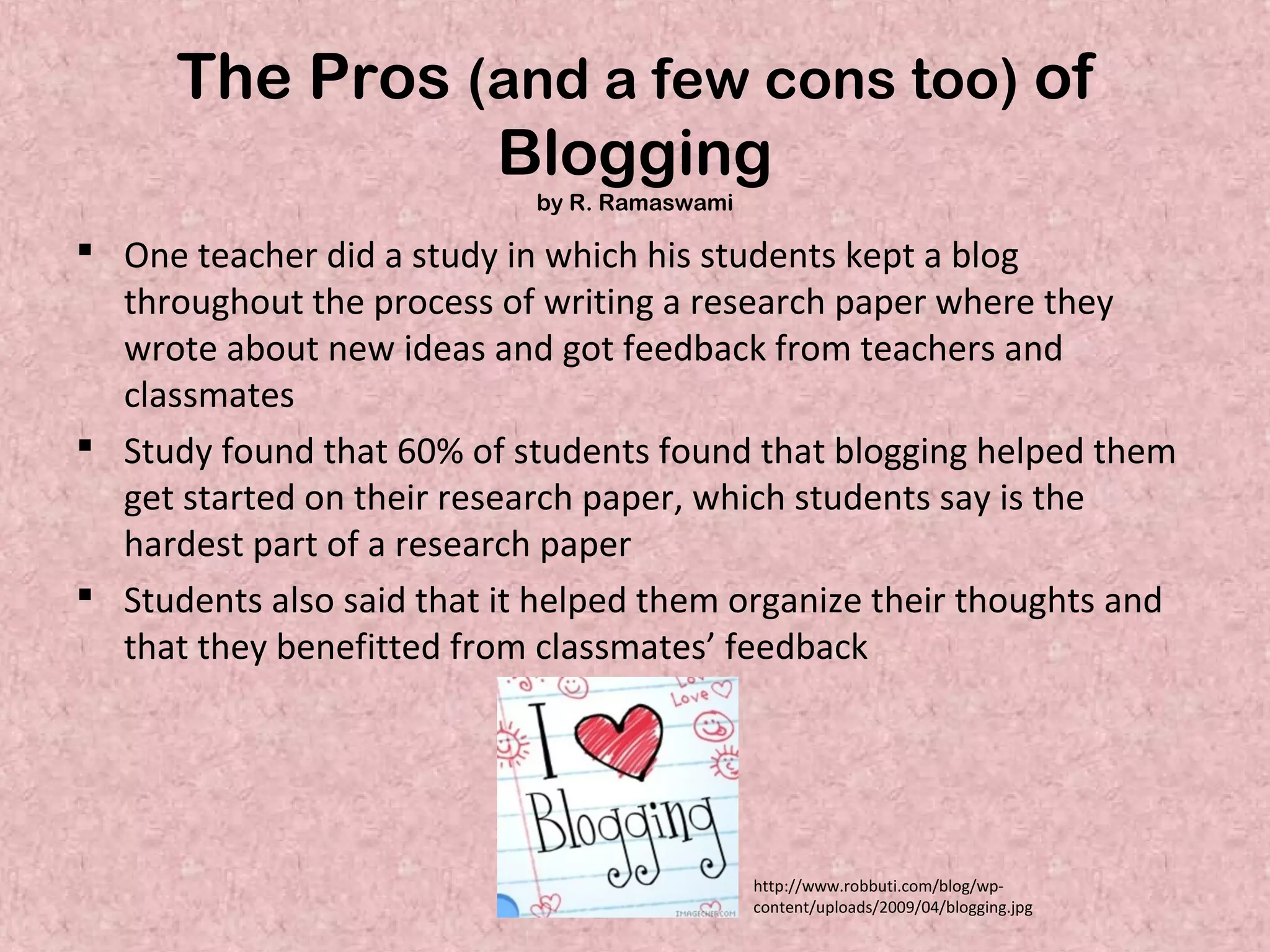
http://www.robbuti.com/blog/wp-
content/uploads/2009/04/blogging.jpg
Cont’d
 In another study elementary students were asked to write a five-
paragraph essay and make an online presentation to go with their essay
while keeping a blog throughout the process
 Students posted one paragraph as a time to their blog and received
feedback
 Found that the students’ general attitudes towards writing improved as
well as their motivation
 Also, the quality of their writing samples improved compared to earlier
samples from the students’ writings
Citation: Ramaswami, R. (2008, November). The Prose (and a Few Cons, too) of Blogging. (Cover
Story). T H E Journal, 35(11), 21-25. Retrieved April 27, 2009, from
Academic Search Premier database.
Reflection
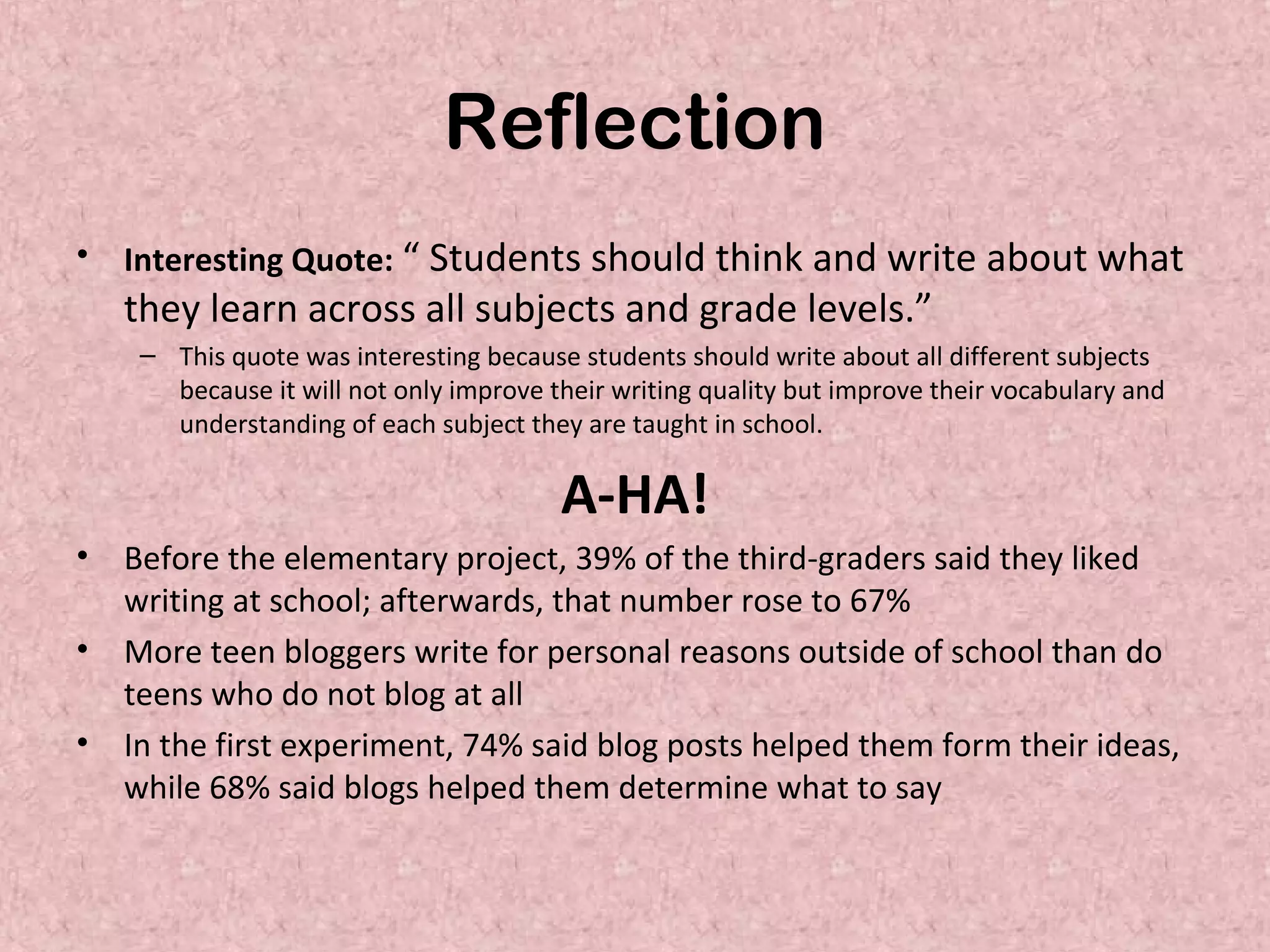
• Interesting Quote: “ Students should think and write about what
they learn across all subjects and grade levels.”
– This quote was interesting because students should write about all different subjects
because it will not only improve their writing quality but improve their vocabulary and
understanding of each subject they are taught in school.
A-HA!
• Before the elementary project, 39% of the third-graders said they liked
writing at school; afterwards, that number rose to 67%
• More teen bloggers write for personal reasons outside of school than do
teens who do not blog at all
• In the first experiment, 74% said blog posts helped them form their ideas,
while 68% said blogs helped them determine what to say
Conclusion
Blogging is a very new type of resource that
can be used in a good way. Teachers should
definitely take advantage of this unique and
colorful resource to get their students minds
working and to get them interested in what they
are learning in school everyday. By using this
technology teachers will see a difference in their
students’ motivation and the quality of their
work, in all subjects.
http://eveliascribbles.files.wordpress.com/2009/04/blogging1.jpg

Blogging in Education

  • 1.
    Blogging in Education Module6: Presenting Technology Research by Sarah Konkey
  • 2.
    MENU Slide 3……….. Article1: Five Don’ts of Classroom Blogging (click title on slide to view full article) Slide 4……….. Reflection Slides 5-6…… Article 2: Reflections on Using Blogs to Expand In-class Discussion (click title on slide to view full article) Slide 7……….. Reflection Slides 8-9…… Article 3: The Pros (and a few cons too) of Blogging (click title on slide to view full article) Slide 10……… Reflection Slide 11-12… Conclusion
  • 3.
    Five Don’ts ofClassroom Blogging by J. Sturgeon  1. DON’T just dive in- possibly have students and parents sign a code of conduct and spend time practicing with students before letting them do it on their own  2. DON’T confuse blogging with social networking- educational blogs are about students helping each other and doing assignments  3. DON’T leap at freebies- free sites sometimes have a wide range of advertisements that teachers cannot control  4. DON’T force a sequential style- structuring blogs by topics instead of by time can be more beneficial to students  5. DON’T leave the blogging to the students- as a teacher get in there and blog too! Provide questions for students to answer by commenting on your blog and get them to give their opinions as well Citation: Sturgeon, J. (2008, February). Five Don’ts of Classroom Blogging. THE Journal, 35(2), 26-30. Retrieved April 27, 2009, from Academic Search Premiere database.
  • 4.
    Reflection • Interesting Quote:“Ablog becomes a community. You get to know students in ways that they won’t reveal otherwise. A quiet child will give you their opinion [in a blog].” – I liked this quote because it is true. There are lots of students who are too afraid to speak up during class but may be more willing to express their opinions on a blog. A-HA! • I did not know you could structure the blogs by topic • Sometimes the voice that blogging gives to students can be troublesome when they try to push the limits • Teachers need to keep their own blog as well so that they can be an example of what students should be doing and writing about as well as get feedback from students
  • 5.
    Reflections on UsingBlogs to Expand In-class Discussion by S. Wang and H. Hsua  Blogs can create online communities and can serve as “interactive knowledge exchange tools”  Found that learning could be more meaningful to students if they are able to exchange ideas with other students  Some ideas: instructors can invite participants from another school or just another class to participate in a discussion, faculty can work with faculty from another school on a project blog, or have students design a class newsletter together  Some problems: students may consider blogging outside of the classroom an extra burden, it can be time-consuming, and some students may feel overwhelmed
  • 6.
    Cont’d  Instructors shouldoffer training sessions to demonstrate how to do it and to explain what is and what is not appropriate  Students can share stories about themselves that they would not be able to do in-class because time is limited during class Citation: Wang, S., Hsua, H. (2008, May). Reflections on Using Blogs to Expand In-class Discussion. TechTrends: Linking Research & Practice to Improve Learning, 52(3), 81-85. Retrieved April 27, 2009, doi:10.1007/s11528-008-0160-y
  • 7.
    Reflection • Interesting Quote:“ Blog participants may write for readers beyond the classroom, an opportunity that is not possible in discussion boards.” – I liked this quote because blogs are a good way to have your students write things that other teachers or students from other schools can read and respond to. At the same time, some teachers may want their classroom blog to be private so that only students that are in the class can read and respond. A-HA! • Working with a class from another school on a group project is a fun and interesting idea that I had not thought about • From the article, it seem as thought students respond to blogging better when they are shown how to use it properly and are allowed some flexibility in their assignments • A training session with the students is the best way to ensure that they know how to use a blogging tool properly and to be clear about what they are supposed to do
  • 8.
    The Pros (anda few cons too) of Blogging by R. Ramaswami  One teacher did a study in which his students kept a blog throughout the process of writing a research paper where they wrote about new ideas and got feedback from teachers and classmates  Study found that 60% of students found that blogging helped them get started on their research paper, which students say is the hardest part of a research paper  Students also said that it helped them organize their thoughts and that they benefitted from classmates’ feedback http://www.robbuti.com/blog/wp- content/uploads/2009/04/blogging.jpg
  • 9.
    Cont’d  In anotherstudy elementary students were asked to write a five- paragraph essay and make an online presentation to go with their essay while keeping a blog throughout the process  Students posted one paragraph as a time to their blog and received feedback  Found that the students’ general attitudes towards writing improved as well as their motivation  Also, the quality of their writing samples improved compared to earlier samples from the students’ writings Citation: Ramaswami, R. (2008, November). The Prose (and a Few Cons, too) of Blogging. (Cover Story). T H E Journal, 35(11), 21-25. Retrieved April 27, 2009, from Academic Search Premier database.
  • 10.
    Reflection • Interesting Quote:“ Students should think and write about what they learn across all subjects and grade levels.” – This quote was interesting because students should write about all different subjects because it will not only improve their writing quality but improve their vocabulary and understanding of each subject they are taught in school. A-HA! • Before the elementary project, 39% of the third-graders said they liked writing at school; afterwards, that number rose to 67% • More teen bloggers write for personal reasons outside of school than do teens who do not blog at all • In the first experiment, 74% said blog posts helped them form their ideas, while 68% said blogs helped them determine what to say
  • 11.
    Conclusion Blogging is avery new type of resource that can be used in a good way. Teachers should definitely take advantage of this unique and colorful resource to get their students minds working and to get them interested in what they are learning in school everyday. By using this technology teachers will see a difference in their students’ motivation and the quality of their work, in all subjects.
  • 12.