
Student Misconception Series – English (Part 1)
Do your Student Learn or Mug up ?Students of all ages seem to have a mind of their own when it comes to responding to any situation or performing any task.As teachers, most of us go back home thinking that our students have understood every concept that we teach them. It is only when we test them that we find that some concepts have not been understood as clearly as they should have been.It is this desire to understand student thinking that prompted us to examine ASSET questions of the past rounds, in English, examining the most common wrong answers to understand what could have made students select the options they did.
ReadingForUnderstanding – Extended ReasoningClass 3
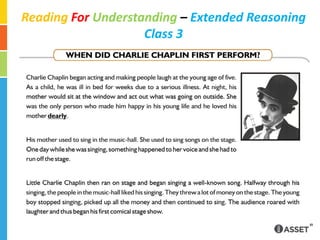
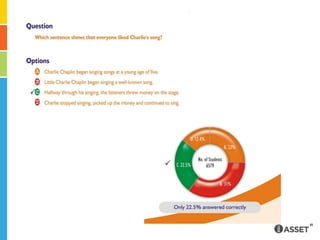
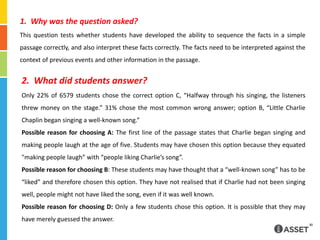
1.  Why was the question asked?This question tests whether students have developed the ability to sequence the facts in a simple passage correctly, and also interpret these facts correctly. The facts need to be interpreted against the context of previous events and other information in the passage.2.  What did students answer?Only 22% of 6579 students chose the correct option C, “Halfway through his singing, the listeners threw money on the stage.” 31% chose the most common wrong answer; option B, “Little Charlie Chaplin began singing a well-known song.”Possible reason for choosing A: The first line of the passage states that Charlie began singing and making people laugh at the age of five. Students may have chosen this option because they equated "making people laugh” with “people liking Charlie’s song”.  Possible reason for choosing B: These students may have thought that a “well-known song” has to be “liked” and therefore chosen this option. They have not realised that if Charlie had not been singing well, people might not have liked the song, even if it was well known.  Possible reason for choosing D: Only a few students chose this option. It is possible that they may have merely guessed the answer.
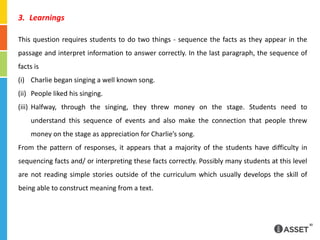
LearningsThis question requires students to do two things - sequence the facts as they appear in the passage and interpret information to answer correctly. In the last paragraph, the sequence of facts is Charlie began singing a well known song. People liked his singing. Halfway, through the singing, they threw money on the stage. Students need to understand this sequence of events and also make the connection that people threw money on the stage as appreciation for Charlie’s song.  From the pattern of responses, it appears that a majority of the students have difficulty in sequencing facts and/ or interpreting these facts correctly. Possibly many students at this level are not reading simple stories outside of the curriculum which usually develops the skill of being able to construct meaning from a text.
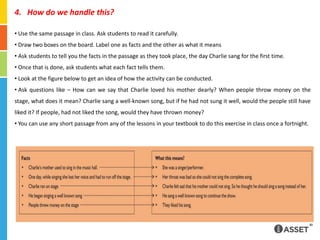
How do we handle this? Use the same passage in class. Ask students to read it carefully.
 Draw two boxes on the board. Label one as facts and the other as what it means

Misconception Series (Part 1) - English

  • 1.
    Student Misconception Series– English (Part 1)
  • 2.
    Do your StudentLearn or Mug up ?Students of all ages seem to have a mind of their own when it comes to responding to any situation or performing any task.As teachers, most of us go back home thinking that our students have understood every concept that we teach them. It is only when we test them that we find that some concepts have not been understood as clearly as they should have been.It is this desire to understand student thinking that prompted us to examine ASSET questions of the past rounds, in English, examining the most common wrong answers to understand what could have made students select the options they did.
  • 3.
  • 5.
    1. Whywas the question asked?This question tests whether students have developed the ability to sequence the facts in a simple passage correctly, and also interpret these facts correctly. The facts need to be interpreted against the context of previous events and other information in the passage.2. What did students answer?Only 22% of 6579 students chose the correct option C, “Halfway through his singing, the listeners threw money on the stage.” 31% chose the most common wrong answer; option B, “Little Charlie Chaplin began singing a well-known song.”Possible reason for choosing A: The first line of the passage states that Charlie began singing and making people laugh at the age of five. Students may have chosen this option because they equated "making people laugh” with “people liking Charlie’s song”. Possible reason for choosing B: These students may have thought that a “well-known song” has to be “liked” and therefore chosen this option. They have not realised that if Charlie had not been singing well, people might not have liked the song, even if it was well known. Possible reason for choosing D: Only a few students chose this option. It is possible that they may have merely guessed the answer.
  • 6.
    LearningsThis question requiresstudents to do two things - sequence the facts as they appear in the passage and interpret information to answer correctly. In the last paragraph, the sequence of facts is Charlie began singing a well known song. People liked his singing. Halfway, through the singing, they threw money on the stage. Students need to understand this sequence of events and also make the connection that people threw money on the stage as appreciation for Charlie’s song. From the pattern of responses, it appears that a majority of the students have difficulty in sequencing facts and/ or interpreting these facts correctly. Possibly many students at this level are not reading simple stories outside of the curriculum which usually develops the skill of being able to construct meaning from a text.
  • 7.
    How do wehandle this? Use the same passage in class. Ask students to read it carefully.
  • 8.
    Draw twoboxes on the board. Label one as facts and the other as what it means