New epigenetic tools for
cancer diagnostics
Gonchar D.A., Kuznetsov V.V.,
Akishev A.G., Abdurashitov M.A.,
Degtyarev S.Kh.
1
DNA methylation in mammalians genomes is mostly
DNA methylation of CG dinucleotides with formation
of 5-methylcytosine (5mC) in both DNA strands.
Mammalian DNA-methyltransferases DNMT1,
DNMT3a and DNMT3b catalyze a reaction of DNA
methylation.
DNMT1 maintains DNA methylation pattern in vivo
modifying a new strand after replication.
DNMT3a and DNMT3b are responsible for DNA
methylation de novo. This modification in regulation
region (promotor and first exon) of gene results in the
gene silencing.
2
At present time 5mC is determined mostly by a
chemical treatment of DNA with sodium bisulphite,
which results in cytosine transformation into uracil,
whereas 5mC is resistant against this modification.
A subsequent analysis of modified and native DNA
allows to locate positions of methylated cytosines in
studied DNA.
Method of bisulphite conversion is quite
sophisticated and often results in obtaining false
positive data.
3
There is another approach — enzymatic methods of
determination of DNA methylation. Among enzymatic
methods of 5mC determination, so called methyl-
sensitive PCR assay (MS PCR) is
the most popular. Determination of DNA methylation by
MS PCR proceeds in two steps:
DNA hydrolysis with site-specific DNA endonuclease
(e.g., restriction enzyme) followed
by PCR with primers located upsteam and downstream
DNA region of interest.
4
This method is based on inability of restriction
enzymes, which contain CG dinucleotide in the
recognition site, to cut this site if 5mC is present in the
dinucleotide.
A subsequent PCR from primers, which are located
around a chosen recognition site, produces a
corresponding DNA fragment if there is a methylated
CG-dinucleotide within this site. On the contrary,
DNA fragment is not produced in PCR if there is
no methylated CG-dinucleotide in a recognition
sequence of restriction enzyme.
5
HpaII (recognition site CCGG) cleaves DNA
sequence CCGG, but doesn't cut C(5mC)GG.
Singer-Sam et.al.(Mol. Cell Biol. (1990) Vol.
10, 4987-4989) called a method of methyl-
sensitive PCR with HpaII as HpaII-PCR assay.
HpaII-PCR assay includes DNA hydrolysis with
HpaII followed by PCR with primers located
upsteam and downstream DNA region of interest.
6
Application of methyl-sensitive PCR assays similar to
HpaII-PCR assay is limited by a very short list of
recognition sequences of corresponding restriction
endonucleases.
7
Study of DNMT3a and DNMT3b substrate
specificity has shown that both enzymes
methylate CG-dinucleotide mostly in DNA
sequence PuCGPy. This is a reason why
restriction enzymes with recognition sites
ACGT and GCGC (MaeII and HhaI,
respectively) are widely used in methyl-
sensitive PCR study of de novo DNA
methylation.
8
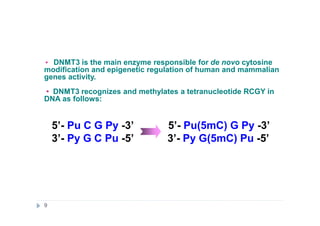
• DNMT3 is the main enzyme responsible for de novo cytosine
modification and epigenetic regulation of human and mammalian
genes activity.
• DNMT3 recognizes and methylates a tetranucleotide RCGY in
DNA as follows:
5’- Pu C G Py -3’ 5’- Pu(5mC) G Py -3’
3’- Py G C Pu -5’ 3’- Py G(5mC) Pu -5’
9
New enzymes
BlsI and GlaI
belong to a new type of 5-methylcytosine-directed site-specific DNA
endonucleases that cleave only methylated DNA.
10
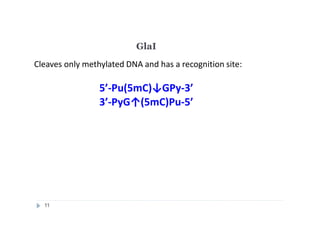
GlaI
Cleaves only methylated DNA and has a recognition site:
5’-Pu(5mC)↓GPy-3’
3’-PyG↑(5mC)Pu-5’
11
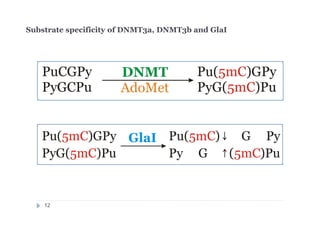
Substrate specificity of DNMT3a, DNMT3b and GlaI
PuCGPy Pu( )GPy
PyGCPu PyG( )Pu
5mC
5mC
DNMT
AdoMet
Pu( )GPy Pu( ) G Py
PyG( )Pu Py G ( )Pu
↓
↑
5mC 5mC
5mC 5mC
GlaI
12
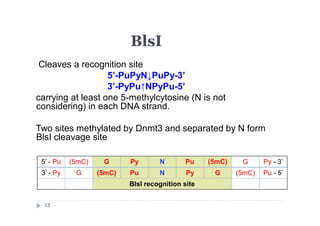
BlsI
Cleaves a recognition site
5’-PuPyN↓PuPy-3’
3’-PyPu↑NPyPu-5’
carrying at least one 5-methylcytosine (N is not
considering) in each DNA strand.
Two sites methylated by Dnmt3 and separated by N form
BlsI cleavage site
5’ - Pu (5mC) G Py N Pu (5mC) G Py - 3’
3’ - Py G (5mC) Pu N Py G (5mC) Pu - 5’
BlsI recognition site
13
BLSI- AND GLAI- PCR
ASSAY
14
BlsI- и GlaI-PCR assays include DNA hydrolysis
with BlsI or GlaI, respectively, followed by PCR
with primers located upsteam and downstream
DNA region of interest.
15
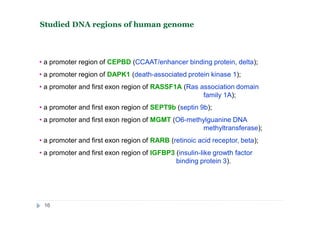
• a promoter region of CEPBD (CCAAT/enhancer binding protein, delta);
• a promoter region of DAPK1 (death-associated protein kinase 1);
• a promoter and first exon region of RASSF1A (Ras association domain
family 1A);
• a promoter and first exon region of SEPT9b (septin 9b);
• a promoter and first exon region of MGMT (O6-methylguanine DNA
methyltransferase);
• a promoter and first exon region of RARB (retinoic acid receptor, beta);
• a promoter and first exon region of IGFBP3 (insulin-like growth factor
binding protein 3).
Studied DNА regions of human genome
16
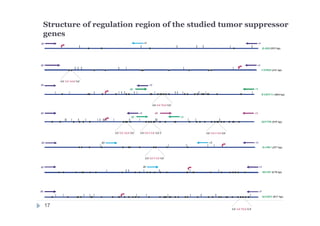
Structure of regulation region of the studied tumor suppressor
genes
SEPT9b (939 bp)
GCGCAGCGC GCGCCGCGCC GC GCCGCGC
d1
d2
d3r1
r2
r3
GCGCTGCGC
r3d1
d2 r1
RASSF1A (804 bp)
CEPBD (341 bp)
GC GCAGCGC
d1 r1
RARB (853 bp)
d1 r1r2
DAPK1 (357 bp)
GCGCCGCGC
d1 r1d2 r2
d1 r1d2
MGMT (678 bp)
r1
IGFBP3 (817 bp)
d1
GC GCTGCGT
17
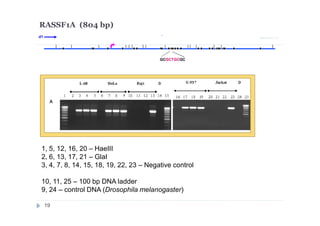
DNA preparations from five human cell lines:
L-68 (control, lung fibroblast), HeLa (cerbix adenocarcinoma),
Raji (Burkitt’s lymphoma), U-937 (histiocystic lymphoma)
and Jurkat (acute T-cell leukemia) have been treated separately with:
1) Restriction enzyme with recognition site in studied region
(HaeIII for CEPBD, RASSF1A and SEPT9b; FatI for RARB), positive
control;
2) GlaI (recognizes 5'-Pu(5mC)GPy-3' [2]);
3) BlsI (recognizes 5'-GCNGC-3' if at least two 5-methylcytosines (N isn't
considering) are present in both DNA strands [3]);
4) no added enzyme, negative control.
After incubation 4 reaction mixtures have been used as a DNA template for
PCR. DNA from Drosophila melanogaster at the same concentration has
been used as a negative PCR control.
Protocol of BlsI- and GlaI- PCR assay
18
RASSF1A (804 bp)
1, 5, 12, 16, 20 – HaeIII
2, 6, 13, 17, 21 – GlaI
3, 4, 7, 8, 14, 15, 18, 19, 22, 23 – Negative control
10, 11, 25 – 100 bp DNA ladder
9, 24 – control DNA (Drosophila melanogaster)
GCGCTGCGC
r1d1
d2 r2
GCGCTGCGC
r1
19
GCGCAGCGC
d1 r1
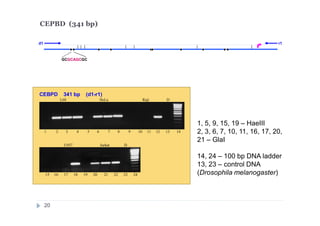
CEPBD (341 bp)
CEBPD 341 bp (d1-r1)
L68 HeLa Raji D
1 2 3 4 5 6 7 8 9 10 11 12 13 14
U937 Jurkat D
15 16 17 18 19 20 21 22 23 24
1, 5, 9, 15, 19 – HaeIII
2, 3, 6, 7, 10, 11, 16, 17, 20,
21 – GlaI
14, 24 – 100 bp DNA ladder
13, 23 – control DNA
(Drosophila melanogaster)
GCGCAGCGC
20
d1 r1
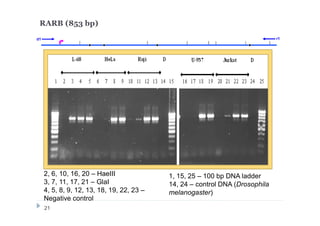
2, 6, 10, 16, 20 – HaeIII
3, 7, 11, 17, 21 – GlaI
4, 5, 8, 9, 12, 13, 18, 19, 22, 23 –
Negative control
1, 15, 25 – 100 bp DNA ladder
14, 24 – control DNA (Drosophila
melanogaster)
RARB (853 bp)
21
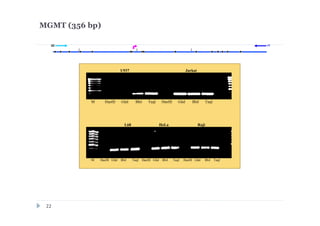
MGMT (356 bp)
U937 Jurkat
M HaeIII GlaI BlsI TaqI HaeIII GlaI BlsI TaqI
L68 HeLa Raji
M HaeIII GlaI BlsI TaqI HaeIII GlaI BlsI TaqI HaeIII GlaI BlsI TaqI
r1d2
22
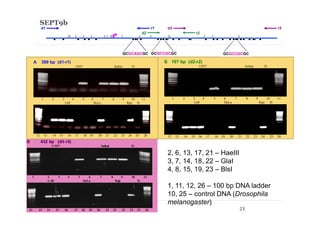
SEPT9b
A 399 bp (d1-r1)
U937 Jurkat D
1 2 3 4 5 6 7 8 9 10 11
L68 HeLa Raji D
12 13 14 15 16 17 18 19 20 21 22 23 24 25 26
Б 197 bp (d2-r2)
U937 Jurkat D
1 2 3 4 5 6 7 8 9 10 11
L68 HeLa Raji D
12 13 14 15 16 17 18 19 20 21 22 23 24 25 26
GCGCAGCGC GCGCCGCGC GCGCCGCGC
d1
d2
d3r1
r2
r3
2, 6, 13, 17, 21 – HaeIII
3, 7, 14, 18, 22 – GlaI
4, 8, 15, 19, 23 – BlsI
1, 11, 12, 26 – 100 bp DNA ladder
10, 25 – control DNA (Drosophila
melanogaster)
23
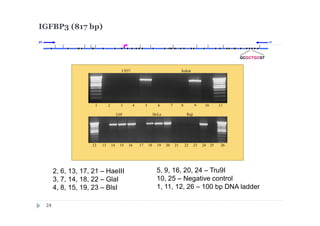
U937 Jurkat
1 2 3 4 5 6 7 8 9 10 11
L68 HeLa Raji
12 13 14 15 16 17 18 19 20 21 22 23 24 25 26
2, 6, 13, 17, 21 – HaeIII
3, 7, 14, 18, 22 – GlaI
4, 8, 15, 19, 23 – BlsI
5, 9, 16, 20, 24 – Tru9I
10, 25 – Negative control
1, 11, 12, 26 – 100 bp DNA ladder
IGFBP3 (817 bp)
r1d1
GCGCTGCGT
24
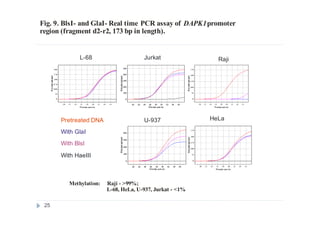
Fig. . BlsI- and GlaI- PCR assay of promoter
region (fragment d2-r2, 173 bp in length).
9 Real time DAPK1
U-937
JurkatL-68
HeLa
Raji
Pretreated DNA
With GlaI
With BlsI
With HaeIII
Methylation: Raji - >99%;
L-68, HeLa, U-937, Jurkat - <1%
25
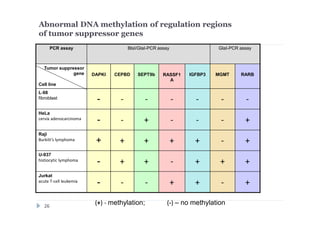
(+) - methylation; (-) – no methylation
Abnormal DNA methylation of regulation regions
of tumor suppressor genes
PCR assay BlsI/GlaI-PCR assay GlaI-PCR assay
Tumor suppressor
gene
Cell line
DAPKI CEPBD SEPT9b RASSF1
A
IGFBP3 MGMT RARB
L-68
fibroblast
- - - - - - -
HeLa
cervix adenocarcinoma
- - + - - - +
Raji
Burkitt’s lymphoma + + + + + - +
U-937
histiocytic lymphoma
- + + - + + +
Jurkat
acute T-cell leukemia
- - - + + - +
26
Comparison of bisulphite conversion and BlsI- and GlaI- PCR
assay
 A quantity of DNA for analysis:
2-5 DNA molecules for BlsI- and GlaI- PCR assay
 Fidelity of BlsI- and GlaI- PCR assay – 2%
Bisulphite conversion – 15%
 BlsI- and GlaI- PCR assay analyzes DNA fragments from
100 to 10000 b.p., while bisulphite conversion only 150-
200 b.p.
27
GLAD-PCR ASSAY
28
Introduction to GLAD-PCR assay
29
 There is one vital disadvantage of BlsI- and GlaI- PCR
assay – it is good for epigenetic typing of cancer cell lines
and is hardly ever may be applied in clinical practice
because the studied DNA samples include unmethylated
DNA from stroma, blood cells, etc.
 A new GLAD-PCR assay we have developed recently
allows to determine minimal quantities of methylated
sites in presence of excess of unmethylated DNA.
 GLAD-PCR assay may find a wide application in routine
clinical practice
Method
NNNNNRC
NNNNNYG
CH3
GYNNNNN
CRNNNNN
CH3
Double stranded methylated DNA
Universal
adapter
GlaILigase
NNNNNN
NNNNNN
2. Adapter ligation3. Real-time PCR1. GlaI digestion
Genome
primer
TaqMan
probe
Hybrid
primer
30
GLAD-PCR assay
31
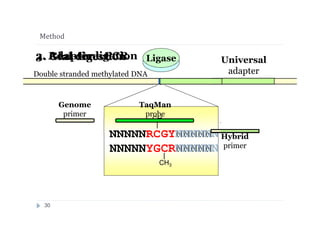
 GlaI hydrolysis and Ligation Adapter Dependent
PCR (GLAD-PCR) is the novel method to determine
R(5mC)GY sites produced by methylation with
DNMT3A and DNMT3B. GLAD PCR analysis is
performed in one tube and includes 3 steps: DNA
hydrolysis with site-specific methyl-directed DNA
endonuclease GlaI, universal adapter ligation and
Real-time PCR with
Taqman probe.
 One primer is designed for DNA region of interest,
structure of another primer is based on an adapter
sequence.
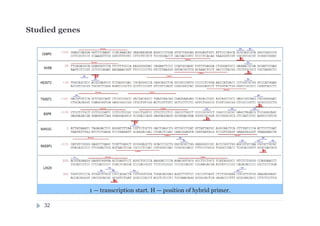
Studied genes
1 — transcription start. H — position of hybrid primer.
32
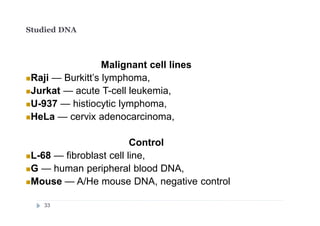
Studied DNA
Malignant cell lines
Raji — Burkitt’s lymphoma,
Jurkat — acute T-cell leukemia,
U-937 — histiocytic lymphoma,
HeLa — cervix adenocarcinoma,
Control
L-68 — fibroblast cell line,
G — human peripheral blood DNA,
Mouse — A/He mouse DNA, negative control
33
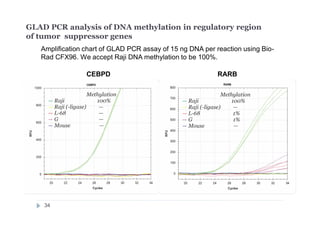
GLAD PCR analysis of DNA methylation in regulatory region
of tumor suppressor genes
Amplification chart of GLAD PCR assay of 15 ng DNA per reaction using Bio-
Rad CFX96. We accept Raji DNA methylation to be 100%.
CEBPD RARB
34
GLAD PCR analysis of DNA methylation in regulatory region
of tumor suppressor genes
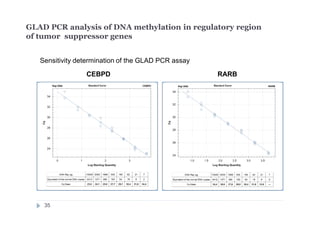
Sensitivity determination of the GLAD PCR assay
CEBPD RARB
35
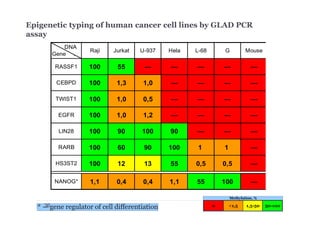
Epigenetic typing of human cancer cell lines by GLAD PCR
assay
* — gene regulator of cell differentiation
DNA
Gene .
Raji Jurkat U-937 Hela L-68 G Mouse
RASSF1 100 55 — — — — —
CEBPD 100 1,3 1,0 — — — —
TWIST1 100 1,0 0,5 — — — —
EGFR 100 1,0 1,2 — — — —
LIN28 100 90 100 90 — — —
RARB 100 60 90 100 1 1 —
HS3ST2 100 12 13 55 0,5 0,5 —
NANOG* 1,1 0,4 0,4 1,1 55 100 —
36
Conclusions
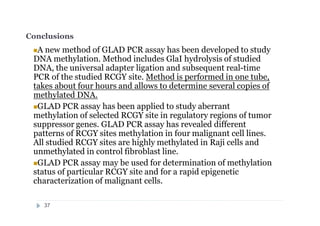
A new method of GLAD PCR assay has been developed to study
DNA methylation. Method includes GlaI hydrolysis of studied
DNA, the universal adapter ligation and subsequent real-time
PCR of the studied RCGY site. Method is performed in one tube,
takes about four hours and allows to determine several copies of
methylated DNA.
GLAD PCR assay has been applied to study aberrant
methylation of selected RCGY site in regulatory regions of tumor
suppressor genes. GLAD PCR assay has revealed different
patterns of RCGY sites methylation in four malignant cell lines.
All studied RCGY sites are highly methylated in Raji cells and
unmethylated in control fibroblast line.
GLAD PCR assay may be used for determination of methylation
status of particular RCGY site and for a rapid epigenetic
characterization of malignant cells.
37

Семинар ДНК 16/05/2014 Сибэнзим

  • 1.
    New epigenetic toolsfor cancer diagnostics Gonchar D.A., Kuznetsov V.V., Akishev A.G., Abdurashitov M.A., Degtyarev S.Kh. 1
  • 2.
    DNA methylation inmammalians genomes is mostly DNA methylation of CG dinucleotides with formation of 5-methylcytosine (5mC) in both DNA strands. Mammalian DNA-methyltransferases DNMT1, DNMT3a and DNMT3b catalyze a reaction of DNA methylation. DNMT1 maintains DNA methylation pattern in vivo modifying a new strand after replication. DNMT3a and DNMT3b are responsible for DNA methylation de novo. This modification in regulation region (promotor and first exon) of gene results in the gene silencing. 2
  • 3.
    At present time5mC is determined mostly by a chemical treatment of DNA with sodium bisulphite, which results in cytosine transformation into uracil, whereas 5mC is resistant against this modification. A subsequent analysis of modified and native DNA allows to locate positions of methylated cytosines in studied DNA. Method of bisulphite conversion is quite sophisticated and often results in obtaining false positive data. 3
  • 4.
    There is anotherapproach — enzymatic methods of determination of DNA methylation. Among enzymatic methods of 5mC determination, so called methyl- sensitive PCR assay (MS PCR) is the most popular. Determination of DNA methylation by MS PCR proceeds in two steps: DNA hydrolysis with site-specific DNA endonuclease (e.g., restriction enzyme) followed by PCR with primers located upsteam and downstream DNA region of interest. 4
  • 5.
    This method isbased on inability of restriction enzymes, which contain CG dinucleotide in the recognition site, to cut this site if 5mC is present in the dinucleotide. A subsequent PCR from primers, which are located around a chosen recognition site, produces a corresponding DNA fragment if there is a methylated CG-dinucleotide within this site. On the contrary, DNA fragment is not produced in PCR if there is no methylated CG-dinucleotide in a recognition sequence of restriction enzyme. 5
  • 6.
    HpaII (recognition siteCCGG) cleaves DNA sequence CCGG, but doesn't cut C(5mC)GG. Singer-Sam et.al.(Mol. Cell Biol. (1990) Vol. 10, 4987-4989) called a method of methyl- sensitive PCR with HpaII as HpaII-PCR assay. HpaII-PCR assay includes DNA hydrolysis with HpaII followed by PCR with primers located upsteam and downstream DNA region of interest. 6
  • 7.
    Application of methyl-sensitivePCR assays similar to HpaII-PCR assay is limited by a very short list of recognition sequences of corresponding restriction endonucleases. 7
  • 8.
    Study of DNMT3aand DNMT3b substrate specificity has shown that both enzymes methylate CG-dinucleotide mostly in DNA sequence PuCGPy. This is a reason why restriction enzymes with recognition sites ACGT and GCGC (MaeII and HhaI, respectively) are widely used in methyl- sensitive PCR study of de novo DNA methylation. 8
  • 9.
    • DNMT3 isthe main enzyme responsible for de novo cytosine modification and epigenetic regulation of human and mammalian genes activity. • DNMT3 recognizes and methylates a tetranucleotide RCGY in DNA as follows: 5’- Pu C G Py -3’ 5’- Pu(5mC) G Py -3’ 3’- Py G C Pu -5’ 3’- Py G(5mC) Pu -5’ 9
  • 10.
    New enzymes BlsI andGlaI belong to a new type of 5-methylcytosine-directed site-specific DNA endonucleases that cleave only methylated DNA. 10
  • 11.
    GlaI Cleaves only methylatedDNA and has a recognition site: 5’-Pu(5mC)↓GPy-3’ 3’-PyG↑(5mC)Pu-5’ 11
  • 12.
    Substrate specificity ofDNMT3a, DNMT3b and GlaI PuCGPy Pu( )GPy PyGCPu PyG( )Pu 5mC 5mC DNMT AdoMet Pu( )GPy Pu( ) G Py PyG( )Pu Py G ( )Pu ↓ ↑ 5mC 5mC 5mC 5mC GlaI 12
  • 13.
    BlsI Cleaves a recognitionsite 5’-PuPyN↓PuPy-3’ 3’-PyPu↑NPyPu-5’ carrying at least one 5-methylcytosine (N is not considering) in each DNA strand. Two sites methylated by Dnmt3 and separated by N form BlsI cleavage site 5’ - Pu (5mC) G Py N Pu (5mC) G Py - 3’ 3’ - Py G (5mC) Pu N Py G (5mC) Pu - 5’ BlsI recognition site 13
  • 14.
    BLSI- AND GLAI-PCR ASSAY 14
  • 15.
    BlsI- и GlaI-PCRassays include DNA hydrolysis with BlsI or GlaI, respectively, followed by PCR with primers located upsteam and downstream DNA region of interest. 15
  • 16.
    • a promoterregion of CEPBD (CCAAT/enhancer binding protein, delta); • a promoter region of DAPK1 (death-associated protein kinase 1); • a promoter and first exon region of RASSF1A (Ras association domain family 1A); • a promoter and first exon region of SEPT9b (septin 9b); • a promoter and first exon region of MGMT (O6-methylguanine DNA methyltransferase); • a promoter and first exon region of RARB (retinoic acid receptor, beta); • a promoter and first exon region of IGFBP3 (insulin-like growth factor binding protein 3). Studied DNА regions of human genome 16
  • 17.
    Structure of regulationregion of the studied tumor suppressor genes SEPT9b (939 bp) GCGCAGCGC GCGCCGCGCC GC GCCGCGC d1 d2 d3r1 r2 r3 GCGCTGCGC r3d1 d2 r1 RASSF1A (804 bp) CEPBD (341 bp) GC GCAGCGC d1 r1 RARB (853 bp) d1 r1r2 DAPK1 (357 bp) GCGCCGCGC d1 r1d2 r2 d1 r1d2 MGMT (678 bp) r1 IGFBP3 (817 bp) d1 GC GCTGCGT 17
  • 18.
    DNA preparations fromfive human cell lines: L-68 (control, lung fibroblast), HeLa (cerbix adenocarcinoma), Raji (Burkitt’s lymphoma), U-937 (histiocystic lymphoma) and Jurkat (acute T-cell leukemia) have been treated separately with: 1) Restriction enzyme with recognition site in studied region (HaeIII for CEPBD, RASSF1A and SEPT9b; FatI for RARB), positive control; 2) GlaI (recognizes 5'-Pu(5mC)GPy-3' [2]); 3) BlsI (recognizes 5'-GCNGC-3' if at least two 5-methylcytosines (N isn't considering) are present in both DNA strands [3]); 4) no added enzyme, negative control. After incubation 4 reaction mixtures have been used as a DNA template for PCR. DNA from Drosophila melanogaster at the same concentration has been used as a negative PCR control. Protocol of BlsI- and GlaI- PCR assay 18
  • 19.
    RASSF1A (804 bp) 1,5, 12, 16, 20 – HaeIII 2, 6, 13, 17, 21 – GlaI 3, 4, 7, 8, 14, 15, 18, 19, 22, 23 – Negative control 10, 11, 25 – 100 bp DNA ladder 9, 24 – control DNA (Drosophila melanogaster) GCGCTGCGC r1d1 d2 r2 GCGCTGCGC r1 19
  • 20.
    GCGCAGCGC d1 r1 CEPBD (341bp) CEBPD 341 bp (d1-r1) L68 HeLa Raji D 1 2 3 4 5 6 7 8 9 10 11 12 13 14 U937 Jurkat D 15 16 17 18 19 20 21 22 23 24 1, 5, 9, 15, 19 – HaeIII 2, 3, 6, 7, 10, 11, 16, 17, 20, 21 – GlaI 14, 24 – 100 bp DNA ladder 13, 23 – control DNA (Drosophila melanogaster) GCGCAGCGC 20
  • 21.
    d1 r1 2, 6,10, 16, 20 – HaeIII 3, 7, 11, 17, 21 – GlaI 4, 5, 8, 9, 12, 13, 18, 19, 22, 23 – Negative control 1, 15, 25 – 100 bp DNA ladder 14, 24 – control DNA (Drosophila melanogaster) RARB (853 bp) 21
  • 22.
    MGMT (356 bp) U937Jurkat M HaeIII GlaI BlsI TaqI HaeIII GlaI BlsI TaqI L68 HeLa Raji M HaeIII GlaI BlsI TaqI HaeIII GlaI BlsI TaqI HaeIII GlaI BlsI TaqI r1d2 22
  • 23.
    SEPT9b A 399 bp(d1-r1) U937 Jurkat D 1 2 3 4 5 6 7 8 9 10 11 L68 HeLa Raji D 12 13 14 15 16 17 18 19 20 21 22 23 24 25 26 Б 197 bp (d2-r2) U937 Jurkat D 1 2 3 4 5 6 7 8 9 10 11 L68 HeLa Raji D 12 13 14 15 16 17 18 19 20 21 22 23 24 25 26 GCGCAGCGC GCGCCGCGC GCGCCGCGC d1 d2 d3r1 r2 r3 2, 6, 13, 17, 21 – HaeIII 3, 7, 14, 18, 22 – GlaI 4, 8, 15, 19, 23 – BlsI 1, 11, 12, 26 – 100 bp DNA ladder 10, 25 – control DNA (Drosophila melanogaster) 23
  • 24.
    U937 Jurkat 1 23 4 5 6 7 8 9 10 11 L68 HeLa Raji 12 13 14 15 16 17 18 19 20 21 22 23 24 25 26 2, 6, 13, 17, 21 – HaeIII 3, 7, 14, 18, 22 – GlaI 4, 8, 15, 19, 23 – BlsI 5, 9, 16, 20, 24 – Tru9I 10, 25 – Negative control 1, 11, 12, 26 – 100 bp DNA ladder IGFBP3 (817 bp) r1d1 GCGCTGCGT 24
  • 25.
    Fig. . BlsI-and GlaI- PCR assay of promoter region (fragment d2-r2, 173 bp in length). 9 Real time DAPK1 U-937 JurkatL-68 HeLa Raji Pretreated DNA With GlaI With BlsI With HaeIII Methylation: Raji - >99%; L-68, HeLa, U-937, Jurkat - <1% 25
  • 26.
    (+) - methylation;(-) – no methylation Abnormal DNA methylation of regulation regions of tumor suppressor genes PCR assay BlsI/GlaI-PCR assay GlaI-PCR assay Tumor suppressor gene Cell line DAPKI CEPBD SEPT9b RASSF1 A IGFBP3 MGMT RARB L-68 fibroblast - - - - - - - HeLa cervix adenocarcinoma - - + - - - + Raji Burkitt’s lymphoma + + + + + - + U-937 histiocytic lymphoma - + + - + + + Jurkat acute T-cell leukemia - - - + + - + 26
  • 27.
    Comparison of bisulphiteconversion and BlsI- and GlaI- PCR assay  A quantity of DNA for analysis: 2-5 DNA molecules for BlsI- and GlaI- PCR assay  Fidelity of BlsI- and GlaI- PCR assay – 2% Bisulphite conversion – 15%  BlsI- and GlaI- PCR assay analyzes DNA fragments from 100 to 10000 b.p., while bisulphite conversion only 150- 200 b.p. 27
  • 28.
  • 29.
    Introduction to GLAD-PCRassay 29  There is one vital disadvantage of BlsI- and GlaI- PCR assay – it is good for epigenetic typing of cancer cell lines and is hardly ever may be applied in clinical practice because the studied DNA samples include unmethylated DNA from stroma, blood cells, etc.  A new GLAD-PCR assay we have developed recently allows to determine minimal quantities of methylated sites in presence of excess of unmethylated DNA.  GLAD-PCR assay may find a wide application in routine clinical practice
  • 30.
    Method NNNNNRC NNNNNYG CH3 GYNNNNN CRNNNNN CH3 Double stranded methylatedDNA Universal adapter GlaILigase NNNNNN NNNNNN 2. Adapter ligation3. Real-time PCR1. GlaI digestion Genome primer TaqMan probe Hybrid primer 30
  • 31.
    GLAD-PCR assay 31  GlaIhydrolysis and Ligation Adapter Dependent PCR (GLAD-PCR) is the novel method to determine R(5mC)GY sites produced by methylation with DNMT3A and DNMT3B. GLAD PCR analysis is performed in one tube and includes 3 steps: DNA hydrolysis with site-specific methyl-directed DNA endonuclease GlaI, universal adapter ligation and Real-time PCR with Taqman probe.  One primer is designed for DNA region of interest, structure of another primer is based on an adapter sequence.
  • 32.
    Studied genes 1 —transcription start. H — position of hybrid primer. 32
  • 33.
    Studied DNA Malignant celllines Raji — Burkitt’s lymphoma, Jurkat — acute T-cell leukemia, U-937 — histiocytic lymphoma, HeLa — cervix adenocarcinoma, Control L-68 — fibroblast cell line, G — human peripheral blood DNA, Mouse — A/He mouse DNA, negative control 33
  • 34.
    GLAD PCR analysisof DNA methylation in regulatory region of tumor suppressor genes Amplification chart of GLAD PCR assay of 15 ng DNA per reaction using Bio- Rad CFX96. We accept Raji DNA methylation to be 100%. CEBPD RARB 34
  • 35.
    GLAD PCR analysisof DNA methylation in regulatory region of tumor suppressor genes Sensitivity determination of the GLAD PCR assay CEBPD RARB 35
  • 36.
    Epigenetic typing ofhuman cancer cell lines by GLAD PCR assay * — gene regulator of cell differentiation DNA Gene . Raji Jurkat U-937 Hela L-68 G Mouse RASSF1 100 55 — — — — — CEBPD 100 1,3 1,0 — — — — TWIST1 100 1,0 0,5 — — — — EGFR 100 1,0 1,2 — — — — LIN28 100 90 100 90 — — — RARB 100 60 90 100 1 1 — HS3ST2 100 12 13 55 0,5 0,5 — NANOG* 1,1 0,4 0,4 1,1 55 100 — 36
  • 37.
    Conclusions A new methodof GLAD PCR assay has been developed to study DNA methylation. Method includes GlaI hydrolysis of studied DNA, the universal adapter ligation and subsequent real-time PCR of the studied RCGY site. Method is performed in one tube, takes about four hours and allows to determine several copies of methylated DNA. GLAD PCR assay has been applied to study aberrant methylation of selected RCGY site in regulatory regions of tumor suppressor genes. GLAD PCR assay has revealed different patterns of RCGY sites methylation in four malignant cell lines. All studied RCGY sites are highly methylated in Raji cells and unmethylated in control fibroblast line. GLAD PCR assay may be used for determination of methylation status of particular RCGY site and for a rapid epigenetic characterization of malignant cells. 37