ASSESMENT OF BUILDING SYSTEMS AND MATERIALS
     USED IN SUSTAINABLE CONSTRUCTION.


                      Author: Maria Matamoros Lafont.
                           Director: Mireia Bosch Prat.
WHY TO CARRY OUT A STUDY ABOUT BUILDING
              SUSTAINABLE?


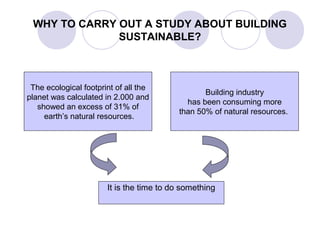
 The ecological footprint of all the
                                                 Building industry
planet was calculated in 2.000 and
                                            has been consuming more
   showed an excess of 31% of
                                          than 50% of natural resources.
     earth’s natural resources.


                       It is the time to do something
THE AIM OF THE STUDY.


        What is the purpose of the assessment?

This assessment is intended to be a guide for every professional who desires to build a
       sustainable edifice.


        What do we pretend to know?
The study will seek to answer some questions as:
          Is it possible to build in a sustainable way today?

            Obviously, nowadays, in general, we are not building in a sustainable way,
            so then, we must ask ourselves, why don’t we do that?

            Finally, it is very interesting to wonder which changes we should make to
            build in a sustainable manner .
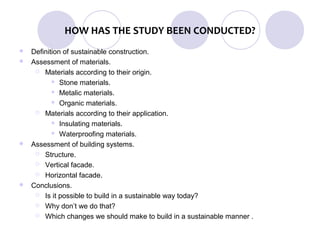
HOW HAS THE STUDY BEEN CONDUCTED?
 Definition of sustainable construction.
 Assessment of materials.
    Materials according to their origin.

          Stone materials.

          Metalic materials.

          Organic materials.

    Materials according to their application.

          Insulating materials.

          Waterproofing materials.

 Assessment of building systems.
    Structure.

    Vertical facade.

    Horizontal facade.

 Conclusions.
    Is it possible to build in a sustainable way today?

    Why don’t we do that?

    Which changes we should make to build in a sustainable manner .
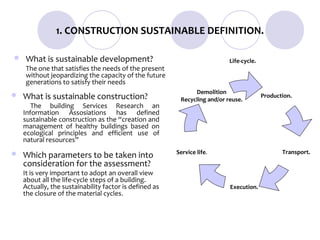
1. CONSTRUCTION SUSTAINABLE DEFINITION.

   What is sustainable development?                                       Life-cycle.
    The one that satisfies the needs of the present
    without jeopardizing the capacity of the future
    generations to satisfy their needs
                                                              Demolition
   What is sustainable construction?                    Recycling and/or reuse.
                                                                                         Production.
       The building Services Research an
    Information Assosiations has defined
    sustainable construction as the “creation and
    management of healthy buildings based on
    ecological principles and efficient use of
    natural resources”
                                                        Service life.                           Transport.
   Which parameters to be taken into
    consideration for the assessment?
    It is very important to adopt an overall view
    about all the life-cycle steps of a building.
    Actually, the sustainability factor is defined as                      Execution.
    the closure of the material cycles.
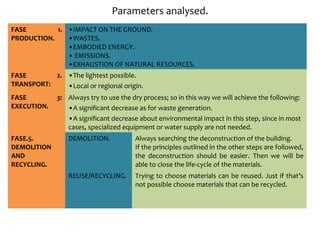
Parameters analysed.
FASE        1. •IMPACT ON THE GROUND.
PRODUCTION.    •WASTES.
               •EMBODIED ENERGY.
               • EMISSIONS.
               •EXHAUSTION OF NATURAL RESOURCES.
FASE       2. •The lightest possible.
TRANSPORT:    •Local or regional origin.
FASE         3: Always try to use the dry process; so in this way we will achieve the following:
EXECUTION.      •A significant decrease as for waste generation.
                •A significant decrease about environmental impact in this step, since in most
                cases, specialized equipment or water supply are not needed.
FASE.5.          DEMOLITION.           Always searching the deconstruction of the building.
DEMOLITION                             If the principles outlined in the other steps are followed,
AND                                    the deconstruction should be easier. Then we will be
RECYCLING.                             able to close the life-cycle of the materials.
                 REUSE/RECYCLING.      Trying to choose materials can be reused. Just if that’s
                                       not possible choose materials that can be recycled.
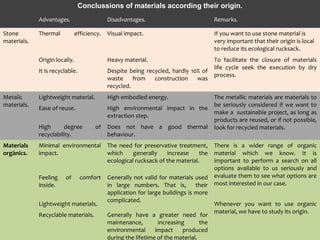
Conclussions of materials according their origin.
             Advantages.                   Disadvantages.                             Remarks.

Stone Conclusionsefficiency. Visual impact. materials segons el seuuse stone material is
         Thermal  avaluació dels                          If you want to origen.
materials.                                                                            very important that their origin is local
                                                                                      to reduce its ecological rucksack.
             Origin locally.               Heavy material.                            To facilitate the closure of materials
                                                                                      life cycle seek the execution by dry
             It is recyclable.             Despite being recycled, hardly 10% of
                                                                                      process.
                                           waste from       construction    was
                                           recycled.
Metalic      Lightweight material.         High embodied energy.                      The metallic materials are materials to
materials.                                                                            be seriously considered if we want to
             Ease of reuse.                High environmental impact in the
                                                                                      make a sustainable project, as long as
                                           extraction step.
                                                                                      products are reused, or if not possible,
             High      degree         of   Does not have a good thermal               look for recycled materials.
             recyclability.                behaviour.
Materials    Minimal environmental         The need for preservative treatment,       There is a wider range of organic
orgànics.    impact.                       which     generally    increase     the    material which we know. It is
                                           ecological rucksack of the material.       important to perform a search on all
                                                                                      options available to us seriously and
             Feeling    of       comfort   Generally not valid for materials used     evaluate them to see what options are
             inside.                       in large numbers. That is,         their   most interested in our case.
                                           application for large buildings is more
                                           complicated.
             Lightweight materials.                                                   Whenever you want to use organic
                                                                                      material, we have to study its origin.
             Recyclable materials.         Generally have a greater need for
                                           maintenance,        increasing       the
                                           environmental      impact    produced
                                           during the lifetime of the material.
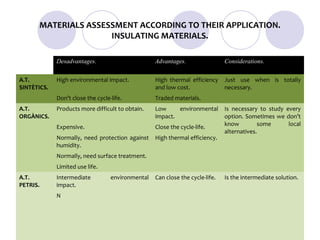
MATERIALS ASSESSMENT ACCORDING TO THEIR APPLICATION.
                     INSULATING MATERIALS.

             Desadvantages.                        Advantages.                 Considerations.

A.T.         High environmental impact.            High thermal efficiency     Just use when is totally
SINTÈTICS.                                         and low cost.               necessary.
             Don’t close the cycle-life.           Traded materials.
A.T.         Products more difficult to obtain.    Low     environmental       Is necessary to study every
ORGÀNICS.                                          impact.                     option. Sometimes we don’t
             Expensive.                            Close the cycle-life.       know         some      local
                                                                               alternatives.
             Normally, need protection against     High thermal efficiency.
             humidity.
             Normally, need surface treatment.
             Limited use life.
A.T.         Intermediate          environmental   Can close the cycle-life.   Is the intermediate solution.
PETRIS.      impact.
             N
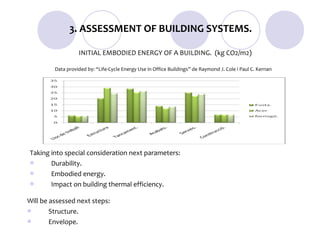
3. ASSESSMENT OF BUILDING SYSTEMS.

                   INITIAL EMBODIED ENERGY OF A BUILDING. (kg CO2/m2)

         Data provided by: “Life-Cycle Energy Use in Office Buildings” de Raymond J. Cole i Paul C. Kernan


Taking into special consideration next parameters:
      Durability.
      Embodied energy.
      Impact on building thermal efficiency.

Will be assessed next steps:
       Structure.
       Envelope.
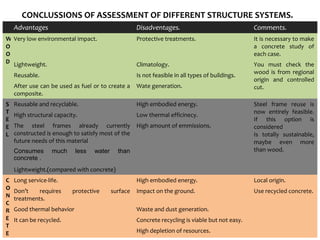
CONCLUSSIONS OF ASSESSMENT OF DIFFERENT STRUCTURE SYSTEMS.
    Advantages                                       Disadventages.                               Comments.
W Very low environmental impact.                     Protective treatments.                       It is necessary to make
O                                                                                                 a concrete study of
O                                                                                                 each case.
D Lightweight.                                       Climatology.                                 You must check the
                                                                                                  wood is from regional
    Reusable.                                        Is not feasible in all types of buildings.
                                                                                                  origin and controlled
    After use can be used as fuel or to create a     Wate generation.                             cut.
    composite.
S   Reusable and recyclable.                         High embodied energy.                        Steel frame reuse is
T                                                                                                 now entirely feasible.
    High structural capacity.                        Low thermal efficinecy.
E                                                                                                 If this option is
E   The steel frames already currently               High amount of emmissions.                   considered
L   constructed is enough to satisfy most of the                                                  Is totally sustainable,
    future needs of this material                                                                 maybe even more
    Consumes       much     less   water     than                                                 than wood.
    concrete .
    Lightweight.(compared with concrete)
C   Long service-life.                               High embodied energy.                        Local origin.
O
    Don’t    requires      protective      surface   Impact on the ground.                        Use recycled concrete.
N
    treatments.
C
R   Good thermal behavior                            Waste and dust generation.
E   It can be recycled.                              Concrete recycling is viable but not easy.
T
E                                                    High depletion of resources.
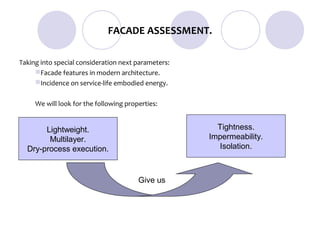
FACADE ASSESSMENT.

Taking into special consideration next parameters:
     Facade features in modern architecture.
     Incidence on service-life embodied energy.


     We will look for the following properties:


       Lightweight.                                    Tightness.
        Multilayer.                                  Impermeability.
  Dry-process execution.                               Isolation.


                                        Give us
FACADE ASSESSMENT.

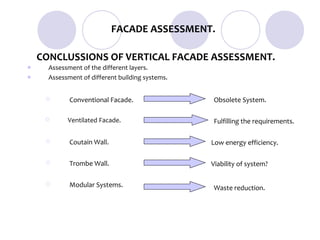
    CONCLUSSIONS OF VERTICAL FACADE ASSESSMENT.
     Assessment of the different layers.
     Assessment of different building systems.


            Conventional Facade.                 Obsolete System.

           Ventilated Facade.                    Fulfilling the requirements.

            Coutain Wall.                        Low energy efficiency.

            Trombe Wall.                         Viability of system?

            Modular Systems.                     Waste reduction.
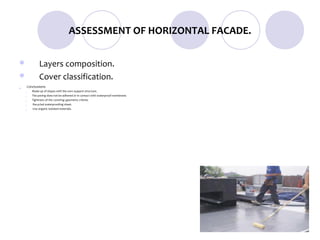
ASSESSMENT OF HORIZONTAL FACADE.

            Layers composition.
            Cover classification.

    Conclussions:
    
        Made up of slopes with the own support structure.
    
        The paving does not be adhered or in contact with waterproof membrane.
    
        Tightness of the covering: geometry criteria.
    
        Recycled waterproofing sheet.
    
        Use organic isolated materials.
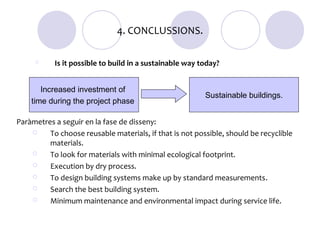
4. CONCLUSSIONS.

          Is it possible to build in a sustainable way today?


       Increased investment of
                                                         Sustainable buildings.
    time during the project phase

Paràmetres a seguir en la fase de disseny:
        To choose reusable materials, if that is not possible, should be recyclible
         materials.
        To look for materials with minimal ecological footprint.
        Execution by dry process.
        To design building systems make up by standard measurements.
        Search the best building system.
        Minimum maintenance and environmental impact during service life.
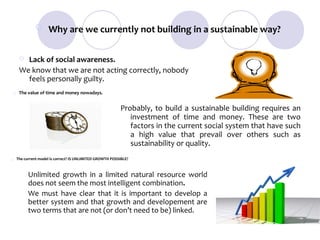
 Why are we currently not building in a sustainable way?


      Lack of social awareness.
     We know that we are not acting correctly, nobody
       feels personally guilty.
    The value of time and money nowadays.


                                                          Probably, to build a sustainable building requires an
                                                             investment of time and money. These are two
                                                             factors in the current social system that have such
                                                             a high value that prevail over others such as
                                                             sustainability or quality.
   The current model is correct? IS UNLIMITED GROWTH POSSIBLE?


          Unlimited growth in a limited natural resource world
          does not seem the most intelligent combination.
          We must have clear that it is important to develop a
          better system and that growth and developement are
          two terms that are not (or don’t need to be) linked.
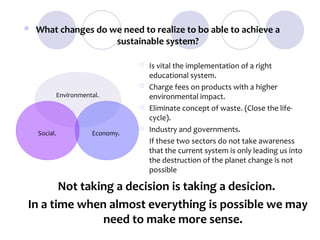
   What changes do we need to realize to bo able to achieve a
                     sustainable system?

                                    Is vital the implementation of a right
                                     educational system.
                                    Charge fees on products with a higher
          Environmental..            environmental impact.
                                    Eliminate concept of waste. (Close the life-
                                     cycle).
    Social.           Economy.
                                    Industry and governments.
                                     If these two sectors do not take awareness
                                     that the current system is only leading us into
                                     the destruction of the planet change is not
                                     possible

       Not taking a decision is taking a desicion.
In a time when almost everything is possible we may
               need to make more sense.

Presentacióp.f.c

  • 1.
    ASSESMENT OF BUILDINGSYSTEMS AND MATERIALS USED IN SUSTAINABLE CONSTRUCTION. Author: Maria Matamoros Lafont. Director: Mireia Bosch Prat.
  • 2.
    WHY TO CARRYOUT A STUDY ABOUT BUILDING SUSTAINABLE? The ecological footprint of all the Building industry planet was calculated in 2.000 and has been consuming more showed an excess of 31% of than 50% of natural resources. earth’s natural resources. It is the time to do something
  • 3.
    THE AIM OFTHE STUDY.  What is the purpose of the assessment? This assessment is intended to be a guide for every professional who desires to build a sustainable edifice.  What do we pretend to know? The study will seek to answer some questions as:  Is it possible to build in a sustainable way today?  Obviously, nowadays, in general, we are not building in a sustainable way, so then, we must ask ourselves, why don’t we do that?  Finally, it is very interesting to wonder which changes we should make to build in a sustainable manner .
  • 4.
    HOW HAS THESTUDY BEEN CONDUCTED?  Definition of sustainable construction.  Assessment of materials.  Materials according to their origin.  Stone materials.  Metalic materials.  Organic materials.  Materials according to their application.  Insulating materials.  Waterproofing materials.  Assessment of building systems.  Structure.  Vertical facade.  Horizontal facade.  Conclusions.  Is it possible to build in a sustainable way today?  Why don’t we do that?  Which changes we should make to build in a sustainable manner .
  • 5.
    1. CONSTRUCTION SUSTAINABLEDEFINITION.  What is sustainable development? Life-cycle. The one that satisfies the needs of the present without jeopardizing the capacity of the future generations to satisfy their needs Demolition  What is sustainable construction? Recycling and/or reuse. Production. The building Services Research an Information Assosiations has defined sustainable construction as the “creation and management of healthy buildings based on ecological principles and efficient use of natural resources” Service life. Transport.  Which parameters to be taken into consideration for the assessment? It is very important to adopt an overall view about all the life-cycle steps of a building. Actually, the sustainability factor is defined as Execution. the closure of the material cycles.
  • 6.
    Parameters analysed. FASE 1. •IMPACT ON THE GROUND. PRODUCTION. •WASTES. •EMBODIED ENERGY. • EMISSIONS. •EXHAUSTION OF NATURAL RESOURCES. FASE 2. •The lightest possible. TRANSPORT: •Local or regional origin. FASE 3: Always try to use the dry process; so in this way we will achieve the following: EXECUTION. •A significant decrease as for waste generation. •A significant decrease about environmental impact in this step, since in most cases, specialized equipment or water supply are not needed. FASE.5. DEMOLITION. Always searching the deconstruction of the building. DEMOLITION If the principles outlined in the other steps are followed, AND the deconstruction should be easier. Then we will be RECYCLING. able to close the life-cycle of the materials. REUSE/RECYCLING. Trying to choose materials can be reused. Just if that’s not possible choose materials that can be recycled.
  • 7.
    Conclussions of materialsaccording their origin. Advantages. Disadvantages. Remarks. Stone Conclusionsefficiency. Visual impact. materials segons el seuuse stone material is Thermal avaluació dels If you want to origen. materials. very important that their origin is local to reduce its ecological rucksack. Origin locally. Heavy material. To facilitate the closure of materials life cycle seek the execution by dry It is recyclable. Despite being recycled, hardly 10% of process. waste from construction was recycled. Metalic Lightweight material. High embodied energy. The metallic materials are materials to materials. be seriously considered if we want to Ease of reuse. High environmental impact in the make a sustainable project, as long as extraction step. products are reused, or if not possible, High degree of Does not have a good thermal look for recycled materials. recyclability. behaviour. Materials Minimal environmental The need for preservative treatment, There is a wider range of organic orgànics. impact. which generally increase the material which we know. It is ecological rucksack of the material. important to perform a search on all options available to us seriously and Feeling of comfort Generally not valid for materials used evaluate them to see what options are inside. in large numbers. That is, their most interested in our case. application for large buildings is more complicated. Lightweight materials. Whenever you want to use organic material, we have to study its origin. Recyclable materials. Generally have a greater need for maintenance, increasing the environmental impact produced during the lifetime of the material.
  • 8.
    MATERIALS ASSESSMENT ACCORDINGTO THEIR APPLICATION. INSULATING MATERIALS. Desadvantages. Advantages. Considerations. A.T. High environmental impact. High thermal efficiency Just use when is totally SINTÈTICS. and low cost. necessary. Don’t close the cycle-life. Traded materials. A.T. Products more difficult to obtain. Low environmental Is necessary to study every ORGÀNICS. impact. option. Sometimes we don’t Expensive. Close the cycle-life. know some local alternatives. Normally, need protection against High thermal efficiency. humidity. Normally, need surface treatment. Limited use life. A.T. Intermediate environmental Can close the cycle-life. Is the intermediate solution. PETRIS. impact. N
  • 9.
    3. ASSESSMENT OFBUILDING SYSTEMS. INITIAL EMBODIED ENERGY OF A BUILDING. (kg CO2/m2) Data provided by: “Life-Cycle Energy Use in Office Buildings” de Raymond J. Cole i Paul C. Kernan Taking into special consideration next parameters:  Durability.  Embodied energy.  Impact on building thermal efficiency. Will be assessed next steps:  Structure.  Envelope.
  • 10.
    CONCLUSSIONS OF ASSESSMENTOF DIFFERENT STRUCTURE SYSTEMS. Advantages Disadventages. Comments. W Very low environmental impact. Protective treatments. It is necessary to make O a concrete study of O each case. D Lightweight. Climatology. You must check the wood is from regional Reusable. Is not feasible in all types of buildings. origin and controlled After use can be used as fuel or to create a Wate generation. cut. composite. S Reusable and recyclable. High embodied energy. Steel frame reuse is T now entirely feasible. High structural capacity. Low thermal efficinecy. E If this option is E The steel frames already currently High amount of emmissions. considered L constructed is enough to satisfy most of the Is totally sustainable, future needs of this material maybe even more Consumes much less water than than wood. concrete . Lightweight.(compared with concrete) C Long service-life. High embodied energy. Local origin. O Don’t requires protective surface Impact on the ground. Use recycled concrete. N treatments. C R Good thermal behavior Waste and dust generation. E It can be recycled. Concrete recycling is viable but not easy. T E High depletion of resources.
  • 11.
    FACADE ASSESSMENT. Taking intospecial consideration next parameters: Facade features in modern architecture. Incidence on service-life embodied energy. We will look for the following properties: Lightweight. Tightness. Multilayer. Impermeability. Dry-process execution. Isolation. Give us
  • 12.
    FACADE ASSESSMENT. CONCLUSSIONS OF VERTICAL FACADE ASSESSMENT.  Assessment of the different layers.  Assessment of different building systems.  Conventional Facade. Obsolete System.  Ventilated Facade. Fulfilling the requirements.  Coutain Wall. Low energy efficiency.  Trombe Wall. Viability of system?  Modular Systems. Waste reduction.
  • 13.
    ASSESSMENT OF HORIZONTALFACADE.  Layers composition.  Cover classification.  Conclussions:  Made up of slopes with the own support structure.  The paving does not be adhered or in contact with waterproof membrane.  Tightness of the covering: geometry criteria.  Recycled waterproofing sheet.  Use organic isolated materials.
  • 14.
    4. CONCLUSSIONS.  Is it possible to build in a sustainable way today? Increased investment of Sustainable buildings. time during the project phase Paràmetres a seguir en la fase de disseny:  To choose reusable materials, if that is not possible, should be recyclible materials.  To look for materials with minimal ecological footprint.  Execution by dry process.  To design building systems make up by standard measurements.  Search the best building system.  Minimum maintenance and environmental impact during service life.
  • 15.
     Why arewe currently not building in a sustainable way?  Lack of social awareness. We know that we are not acting correctly, nobody feels personally guilty.  The value of time and money nowadays. Probably, to build a sustainable building requires an investment of time and money. These are two factors in the current social system that have such a high value that prevail over others such as sustainability or quality.  The current model is correct? IS UNLIMITED GROWTH POSSIBLE? Unlimited growth in a limited natural resource world does not seem the most intelligent combination. We must have clear that it is important to develop a better system and that growth and developement are two terms that are not (or don’t need to be) linked.
  • 16.
    What changes do we need to realize to bo able to achieve a sustainable system?  Is vital the implementation of a right educational system.  Charge fees on products with a higher Environmental.. environmental impact.  Eliminate concept of waste. (Close the life- cycle). Social. Economy.  Industry and governments. If these two sectors do not take awareness that the current system is only leading us into the destruction of the planet change is not possible Not taking a decision is taking a desicion. In a time when almost everything is possible we may need to make more sense.

Editor's Notes

  • #4 Que volem saber?
  • #6 És a dir, que a l’hora de pensar i aplicar mesures de construcció sostenible és fonamental adoptar una visió integrada de totes les etapes del cicle de vida de l’edifici, des de l’extracció de les matèries primeres fins a la gestió dels seus residus un cop enderrocat. Una avaluació objectiva dels materials no serà correcta si se centra amb només uns paràmetres concrets, o només s’avaluen algunes de les fases del seu cicle de vida.
  • #7 Elevada despesa energètica. Impacte sobre el terreny. Es produeix una degradació pràcticament irreversible del paisatge, ja que es produeixen entre 1 i 2 tones de fangs rojos per tona d’alumini produït. Emissions de gasos perjudicials per a l’efecte hivernacle, i grans emissions de pols, porjudicials per a la salut.Elevada despesa energètica.
  • #10 Estructura. representa una proporció significant, però no dominant de l’energia incorporada de l’edifici. Es pot dir que al voltant del 15-25% depenent de la tipologia escollida. ENVOLVENT. , és la que representa inequívocament, la proporció més elevada (entre un 26 i un 30%). L’elecció de l’envolvent, està lligada al tipus d’estructura utilitzat també. Per tant pot ser afirmat que, la combinació d’estructura i tancaments representa entre un 48 i uns 51 % de l’energia incorporada d’un edifici. SERVEIS. la següent part amb més pes en l’energia incorporada d’un edifici és la de serveis (transport, instal·lacions...). Aquest component és el més difícil d’avaluar amb algun grau de confiança. A més, si durant la fase de projecte, són aplicats els principis establerts al punt 1. Definició de construcció sostenible, l’energia incorporada d’aquest element disminuirà considerablement. ACABATS. La part d’acabats interns, representa entre un 12 i un 15% de l’energia incorporada. Tot i així, els acabats interns, són els elements més reparats i reemplaçats durant la vida útil d’un edifici, i a la llarga, generalment, superen l’energia incorporada estructural.
  • #12 L’energia incorporada durant la fase d’ús d’un edifici. autoportant. Lleugera. Multicapa. Posta en obra per via seca. Estanquitat. Impermeabilitat. Aïllament tèrmic i acústic.