SUSTAINABLE/ENVIROLMENT
DESIGN.
Name SANJAY b k
USN 1MS16AT051
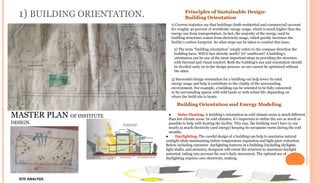
1) BUILDING ORIENTATION.
MASTER PLAN OF INSTITUTE
DESIGN.
SITE ANALYSIS
Principles of Sustainable Design:
Building Orientation
1) Current statistics say that buildings (both residential and commercial) account
for roughly 40 percent of worldwide energy usage, which is much higher than the
energy use from transportation. In fact, the majority of the energy used by
building structures comes from electricity usage, which greatly increases the
facility’s carbon footprint. So what steps can be taken to combat this issue.
2) The term “building orientation” simply refers to the compass direction the
building faces. Will it face directly north? 70° southwest? A building’s
orientation can be one of the most important steps in providing the structure
with thermal and visual comfort. Both the building’s size and orientation should
be decided early on in the design process, as one cannot be optimized without
the other.
3) Successful design orientation for a building can help lower its total
energy usage and help it contribute to the vitality of the surrounding
environment. For example, a building can be oriented to be fully connected
to its surrounding spaces with wild lands or with urban life, depending on
where the build site is locate.
Building Orientation and Energy Modeling
● Solar Heating. A building’s orientation in cold climate areas is much different
than hot climate areas. In cold climates, it’s important to utilize the sun as much as
possible to help with heating the facility. This way, the building won’t have to use
nearly as much electricity (and energy) keeping its occupants warm during the cold
months.
● Daylighting. The careful design of a building can help to maximize natural
sunlight while maintaining indoor temperature regulation and light glare reduction.
Before including extensive daylighting features in a building (including skylights,
light shafts, and atriums), designers will orient the structure to maximize daylight
potential, taking into account the sun’s daily movement. The optimal use of
daylighting requires zero electricity, making.
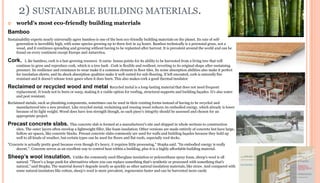
2) SUSTAINABLE BUILDING MATERIALS.
 world's most eco-friendly building materials
Bamboo
Sustainability experts nearly universally agree bamboo is one of the best eco-friendly building materials on the planet. Its rate of self-
generation is incredibly high, with some species growing up to three feet in 24 hours. Bamboo technically is a perennial grass, not a
wood, and it continues spreading and growing without having to be replanted after harvest. It is prevalent around the world and can be
found on every continent except Europe and Antarctica.
Cork. L ike bamboo, cork is a fast-growing resource. It earns bonus points for its ability to be harvested from a living tree that will
continue to grow and reproduce cork, which is a tree bark . Cork is flexible and resilient, reverting to its original shape after sustaining
pressure. Its resilience and resistance to wear make it a common element in floor tiles. Its noise absorption abilities also make it perfect
for insulation sheets, and its shock absorption qualities make it well-suited for sub-flooring. If left uncoated, cork is naturally fire
resistant and it doesn't release toxic gases when it does burn. This also makes cork a good thermal insulator
Reclaimed or recycled wood and metal Recycled metal is a long-lasting material that does not need frequent
replacement. It tends not to burn or warp, making it a viable option for roofing, structural supports and building façades. It's also water
and pest resistant.
Reclaimed metals, such as plumbing components, sometimes can be used in their existing forms instead of having to be recycled and
manufactured into a new product. Like recycled metal, reclaiming and reusing wood reduces its embodied energy, which already is lower
because of its light weight. Wood does have less strength though, so each piece's integrity should be assessed and chosen for an
appropriate project.
Precast concrete slabs. This concrete slab is formed at a manufacturer's site and shipped in whole sections to construction
sites. The outer layers often envelop a lightweight filler, like foam insulation. Other versions are made entirely of concrete but have large,
hollow air spaces, like concrete blocks. Precast concrete slabs commonly are used for walls and building façades because they hold up
well to all kinds of weather, but certain types can be used for floors and flat roofs, especially roof decks.
"Concrete is actually pretty good because even though it's heavy, it requires little processing," Stopka said. "Its embodied energy is really
decent.“. Concrete serves as an excellent way to control heat within a building, plus it is a highly affordable building material.
Sheep’s wool insulation. Unlike the commonly used fiberglass insulation or polyurethane spray foam, sheep’s wool is all
natural. "There's a huge push for alternatives where you can replace something that's synthetic or processed with something that's
natural," said Stopka. The material doesn't degrade nearly as quickly as other natural insulation materials, like straw. And compared with
some natural insulators like cotton, sheep’s wool is more prevalent, regenerates faster and can be harvested more easily
3 WATER.
 The importance of water The water in our bodies is essential for life. Without water, we can’t
survive. Since the water in our bodies is continually being used or lost, it needs to be continually replaced, and
the best fluid to replace it with is water
 Reasons why we must Save Water.
 We need water for recreational purposes
 Water is directly linked to energy
 Water is required to maintain sewage system
 We need water to wash everything
 We need water to stay clean ourselves
 Everybody needs water
 We need water to grow food and crops
 We need water to cook food
 We need water to drink
Plumbing System Sustainability:
 Pipe and Fitting Material Selection
When evaluating pipes and fittings, material selection is critical for a variety of reasons, including
durability, embodied energy and the overall carbon footprint in product manufacturing. Water
quality can also be affected by the materials, so the health and welfare of the occupants is also a
concern. While there are a variety of materials available, and each has pros and cons. It’s difficult
to find a comprehensive, comparative life cycle analysis of plumbing materials that would allow
for an apples-to-apples comparison. Ultimately though, newer, lighter and more efficiently
produced materials will carry less of an energy and environmental burden than heavier, more
manufacturing-intensive materials. However, corrosion resistance and leaching are a concern in
some products.
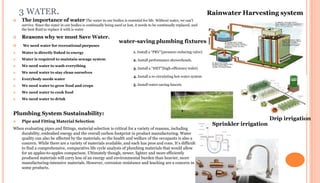
Rainwater Harvesting system
water-saving plumbing fixtures
1. Install a “PRV”(pressure-reducing valve)
2. Install performance showerheads.
3. Install a “HET”(high-efficiency toilet)
4. Install a re-circulating hot-water system
5. Install water-saving faucets
Drip irrigation
Sprinkler irrigation
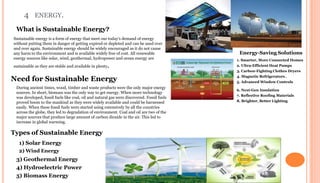
4 ENERGY.
What is Sustainable Energy?
Sustainable energy is a form of energy that meet our today’s demand of energy
without putting them in danger of getting expired or depleted and can be used over
and over again. Sustainable energy should be widely encouraged as it do not cause
any harm to the environment and is available widely free of cost. All renewable
energy sources like solar, wind, geothermal, hydropower and ocean energy are
sustainable as they are stable and available in plenty.
Need for Sustainable Energy
During ancient times, wood, timber and waste products were the only major energy
sources. In short, biomass was the only way to get energy. When more technology
was developed, fossil fuels like coal, oil and natural gas were discovered. Fossil fuels
proved boom to the mankind as they were widely available and could be harnessed
easily. When these fossil fuels were started using extensively by all the countries
across the globe, they led to degradation of environment. Coal and oil are two of the
major sources that produce large amount of carbon dioxide in the air. This led to
increase in global warming.
Types of Sustainable Energy
1) Solar Energy
2) Wind Energy
3) Geothermal Energy
4) Hydroelectric Power
5) Biomass Energy
Energy-Saving Solutions
1. Smarter, More Connected Homes
2. Ultra-Efficient Heat Pumps
3. Carbon-Fighting Clothes Dryers
4. Magnetic Refrigerators .
5. Advanced Window Controls
6. Next-Gen Insulation
7. Reflective Roofing Materials
8. Brighter, Better Lighting
LANDSCAPE.
 Principles of Sustainable Landscaping
 Principle #1 - Treat Water as a Resource
 A sustainable landscaping approach would be to treat water as a valuable resource. With proper design and plant
selection, the need for irrigation can be reduced or eliminated. Furthermore, rainwater harvesting can be to capture
stormwater on site and use it for irrigation.
 Principle #2 - Value Your Soil
 It's likely that your garden's soil is compacted. Compacted soil leads to problems such as restricted plant growth,
erosion, runoff and flooding. Runoff caused by compacted soils is one of the main sources of water pollution.
 Principle #3 - Preserve Existing Plants.
 Many homeowners want to remove all the plants from their property so that they can start with a clean slate. Often
this ends up doing harm because it disrupts the natural processes occurring in the yard.
 A sustainable landscaping approach would be to assess the existing plant material and preserve native plants.
Invasive, non-native plants should be removed and replaced with a more appropriate choice. Right plant, right
place is a popular saying that should guide your plant selection.
 Principle #4 - Conserve Material Resources.
 A sustainable landscaping approach would be to reduce yard waste by selecting appropriately sized plants and
reusing and recycling construction waste. Furthermore, building materials should be carefully selected, using
locally sourced materials whenever possible.
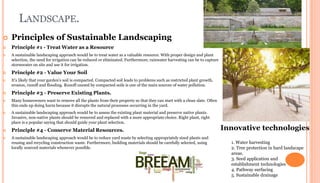
Innovative technologies
1. Water harvesting
2. Tree protection in hard landscape
areas.
3. Seed application and
establishment technologies
4. Pathway surfacing
5. Sustainable drainage

Sustainability

  • 1.
  • 2.
    1) BUILDING ORIENTATION. MASTERPLAN OF INSTITUTE DESIGN. SITE ANALYSIS Principles of Sustainable Design: Building Orientation 1) Current statistics say that buildings (both residential and commercial) account for roughly 40 percent of worldwide energy usage, which is much higher than the energy use from transportation. In fact, the majority of the energy used by building structures comes from electricity usage, which greatly increases the facility’s carbon footprint. So what steps can be taken to combat this issue. 2) The term “building orientation” simply refers to the compass direction the building faces. Will it face directly north? 70° southwest? A building’s orientation can be one of the most important steps in providing the structure with thermal and visual comfort. Both the building’s size and orientation should be decided early on in the design process, as one cannot be optimized without the other. 3) Successful design orientation for a building can help lower its total energy usage and help it contribute to the vitality of the surrounding environment. For example, a building can be oriented to be fully connected to its surrounding spaces with wild lands or with urban life, depending on where the build site is locate. Building Orientation and Energy Modeling ● Solar Heating. A building’s orientation in cold climate areas is much different than hot climate areas. In cold climates, it’s important to utilize the sun as much as possible to help with heating the facility. This way, the building won’t have to use nearly as much electricity (and energy) keeping its occupants warm during the cold months. ● Daylighting. The careful design of a building can help to maximize natural sunlight while maintaining indoor temperature regulation and light glare reduction. Before including extensive daylighting features in a building (including skylights, light shafts, and atriums), designers will orient the structure to maximize daylight potential, taking into account the sun’s daily movement. The optimal use of daylighting requires zero electricity, making.
  • 3.
    2) SUSTAINABLE BUILDINGMATERIALS.  world's most eco-friendly building materials Bamboo Sustainability experts nearly universally agree bamboo is one of the best eco-friendly building materials on the planet. Its rate of self- generation is incredibly high, with some species growing up to three feet in 24 hours. Bamboo technically is a perennial grass, not a wood, and it continues spreading and growing without having to be replanted after harvest. It is prevalent around the world and can be found on every continent except Europe and Antarctica. Cork. L ike bamboo, cork is a fast-growing resource. It earns bonus points for its ability to be harvested from a living tree that will continue to grow and reproduce cork, which is a tree bark . Cork is flexible and resilient, reverting to its original shape after sustaining pressure. Its resilience and resistance to wear make it a common element in floor tiles. Its noise absorption abilities also make it perfect for insulation sheets, and its shock absorption qualities make it well-suited for sub-flooring. If left uncoated, cork is naturally fire resistant and it doesn't release toxic gases when it does burn. This also makes cork a good thermal insulator Reclaimed or recycled wood and metal Recycled metal is a long-lasting material that does not need frequent replacement. It tends not to burn or warp, making it a viable option for roofing, structural supports and building façades. It's also water and pest resistant. Reclaimed metals, such as plumbing components, sometimes can be used in their existing forms instead of having to be recycled and manufactured into a new product. Like recycled metal, reclaiming and reusing wood reduces its embodied energy, which already is lower because of its light weight. Wood does have less strength though, so each piece's integrity should be assessed and chosen for an appropriate project. Precast concrete slabs. This concrete slab is formed at a manufacturer's site and shipped in whole sections to construction sites. The outer layers often envelop a lightweight filler, like foam insulation. Other versions are made entirely of concrete but have large, hollow air spaces, like concrete blocks. Precast concrete slabs commonly are used for walls and building façades because they hold up well to all kinds of weather, but certain types can be used for floors and flat roofs, especially roof decks. "Concrete is actually pretty good because even though it's heavy, it requires little processing," Stopka said. "Its embodied energy is really decent.“. Concrete serves as an excellent way to control heat within a building, plus it is a highly affordable building material. Sheep’s wool insulation. Unlike the commonly used fiberglass insulation or polyurethane spray foam, sheep’s wool is all natural. "There's a huge push for alternatives where you can replace something that's synthetic or processed with something that's natural," said Stopka. The material doesn't degrade nearly as quickly as other natural insulation materials, like straw. And compared with some natural insulators like cotton, sheep’s wool is more prevalent, regenerates faster and can be harvested more easily
  • 4.
    3 WATER.  Theimportance of water The water in our bodies is essential for life. Without water, we can’t survive. Since the water in our bodies is continually being used or lost, it needs to be continually replaced, and the best fluid to replace it with is water  Reasons why we must Save Water.  We need water for recreational purposes  Water is directly linked to energy  Water is required to maintain sewage system  We need water to wash everything  We need water to stay clean ourselves  Everybody needs water  We need water to grow food and crops  We need water to cook food  We need water to drink Plumbing System Sustainability:  Pipe and Fitting Material Selection When evaluating pipes and fittings, material selection is critical for a variety of reasons, including durability, embodied energy and the overall carbon footprint in product manufacturing. Water quality can also be affected by the materials, so the health and welfare of the occupants is also a concern. While there are a variety of materials available, and each has pros and cons. It’s difficult to find a comprehensive, comparative life cycle analysis of plumbing materials that would allow for an apples-to-apples comparison. Ultimately though, newer, lighter and more efficiently produced materials will carry less of an energy and environmental burden than heavier, more manufacturing-intensive materials. However, corrosion resistance and leaching are a concern in some products. Rainwater Harvesting system water-saving plumbing fixtures 1. Install a “PRV”(pressure-reducing valve) 2. Install performance showerheads. 3. Install a “HET”(high-efficiency toilet) 4. Install a re-circulating hot-water system 5. Install water-saving faucets Drip irrigation Sprinkler irrigation
  • 5.
    4 ENERGY. What isSustainable Energy? Sustainable energy is a form of energy that meet our today’s demand of energy without putting them in danger of getting expired or depleted and can be used over and over again. Sustainable energy should be widely encouraged as it do not cause any harm to the environment and is available widely free of cost. All renewable energy sources like solar, wind, geothermal, hydropower and ocean energy are sustainable as they are stable and available in plenty. Need for Sustainable Energy During ancient times, wood, timber and waste products were the only major energy sources. In short, biomass was the only way to get energy. When more technology was developed, fossil fuels like coal, oil and natural gas were discovered. Fossil fuels proved boom to the mankind as they were widely available and could be harnessed easily. When these fossil fuels were started using extensively by all the countries across the globe, they led to degradation of environment. Coal and oil are two of the major sources that produce large amount of carbon dioxide in the air. This led to increase in global warming. Types of Sustainable Energy 1) Solar Energy 2) Wind Energy 3) Geothermal Energy 4) Hydroelectric Power 5) Biomass Energy Energy-Saving Solutions 1. Smarter, More Connected Homes 2. Ultra-Efficient Heat Pumps 3. Carbon-Fighting Clothes Dryers 4. Magnetic Refrigerators . 5. Advanced Window Controls 6. Next-Gen Insulation 7. Reflective Roofing Materials 8. Brighter, Better Lighting
  • 6.
    LANDSCAPE.  Principles ofSustainable Landscaping  Principle #1 - Treat Water as a Resource  A sustainable landscaping approach would be to treat water as a valuable resource. With proper design and plant selection, the need for irrigation can be reduced or eliminated. Furthermore, rainwater harvesting can be to capture stormwater on site and use it for irrigation.  Principle #2 - Value Your Soil  It's likely that your garden's soil is compacted. Compacted soil leads to problems such as restricted plant growth, erosion, runoff and flooding. Runoff caused by compacted soils is one of the main sources of water pollution.  Principle #3 - Preserve Existing Plants.  Many homeowners want to remove all the plants from their property so that they can start with a clean slate. Often this ends up doing harm because it disrupts the natural processes occurring in the yard.  A sustainable landscaping approach would be to assess the existing plant material and preserve native plants. Invasive, non-native plants should be removed and replaced with a more appropriate choice. Right plant, right place is a popular saying that should guide your plant selection.  Principle #4 - Conserve Material Resources.  A sustainable landscaping approach would be to reduce yard waste by selecting appropriately sized plants and reusing and recycling construction waste. Furthermore, building materials should be carefully selected, using locally sourced materials whenever possible. Innovative technologies 1. Water harvesting 2. Tree protection in hard landscape areas. 3. Seed application and establishment technologies 4. Pathway surfacing 5. Sustainable drainage