Present SimplePresent Simple
Present ContinuousPresent Continuous
I teach English.
This is my job.
I am teaching English.
This is what I am doing at
the moment. I am
teaching you English.
Let’s continue with some
more examples.....
They live in the USA.
I am studying for the exams these
days.
What’s the difference?
They live in the USA.
It means that they live in the USA all
the time. It is a permanent state.
What’s the difference?
I am studying for the exams these
days.
It means that I am studying only these
several days. The action is taking
place only for a short period of time.
PRESENT SIMPLE:
affirmative
I
YOU HE
WE live but SHE lives
THEY IT
I live in the USA.
She studies architecture.
PRESENT SIMPLE:
Negative
For all verbs (EXCEPT BE) use:
I / you / we/ they + don’t + verb
He / she / it + doesn’t + verb
I live in the USA.  I don’t live in the USA.
(do not)
She studies architecture.  She doesn’t study
architecture. (does not)
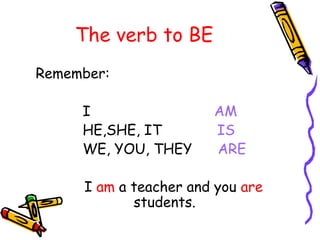
The verb to BE
Remember:
I AM
HE,SHE, IT IS
WE, YOU, THEY ARE
I am a teacher and you are
students.
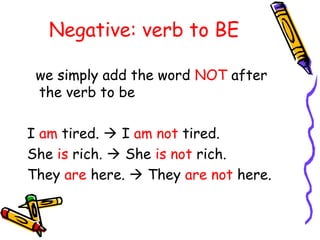
Negative: verb to BE
we simply add the word NOT after
the verb to be
I am tired.  I am not tired.
She is rich.  She is not rich.
They are here.  They are not here.
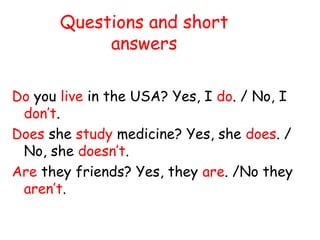
Questions and short
answers
Do you live in the USA? Yes, I do. / No, I
don’t.
Does she study medicine? Yes, she does. /
No, she doesn’t.
Are they friends? Yes, they are. /No they
aren’t.
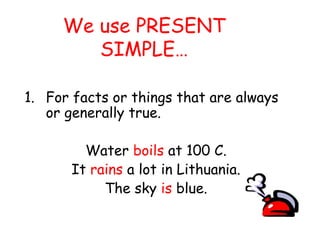
We use PRESENT
SIMPLE…
1. For facts or things that are always
or generally true.
Water boils at 100 C.
It rains a lot in Lithuania.
The sky is blue.
We use PRESENT
SIMPLE…
2. For situations that are (more or
less) permanent.
I live in New York.
John works in a bank.
Lisa studies architecture.
We use PRESENT
SIMPLE…
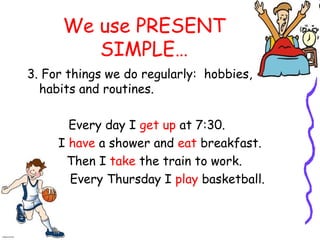
3. For things we do regularly: hobbies,
habits and routines.
Every day I get up at 7:30.
I have a shower and eat breakfast.
Then I take the train to work.
Every Thursday I play basketball.
We use PRESENT
SIMPLE…
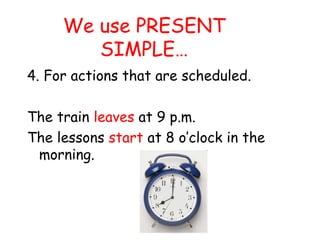
4. For actions that are scheduled.
The train leaves at 9 p.m.
The lessons start at 8 o’clock in the
morning.
Adverbs of frequency
and time phrases
Always Once a week
Often Twice a month
Usually Every day
Sometimes Four times a year
Rarely Every Tuesday
Never
I never go to the cinema alone.
My grandmother sees her doctor twice a month.
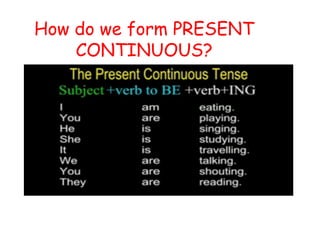
How do we form PRESENT
CONTINUOUS?
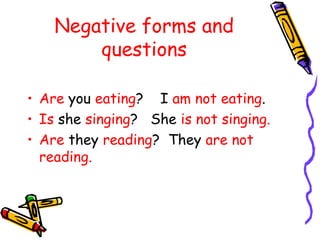
Negative forms and
questions
• Are you eating? I am not eating.
• Is she singing? She is not singing.
• Are they reading? They are not
reading.
We use PRESENT
CONTINUOUS…
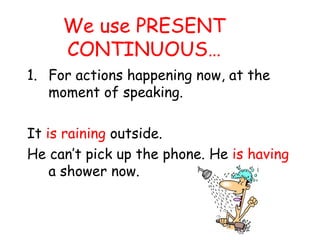
1. For actions happening now, at the
moment of speaking.
It is raining outside.
He can’t pick up the phone. He is having
a shower now.
We use PRESENT
CONTINUOUS…
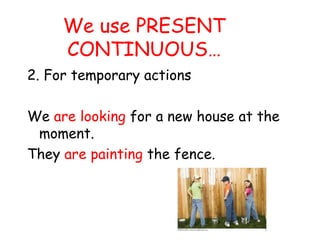
2. For temporary actions
We are looking for a new house at the
moment.
They are painting the fence.
We use PRESENT
CONTINUOUS…
3. For currently changing and
developing situations.
The Earth is getting hotter and hotter.
The winters in Lithuania are becoming
warmer and warmer.
The prices are increasing all the time.
Time expressions we use with
PRESENT CONTINUOUS
now, at the moment, at present,
these days, nowadays, today, tonight
My mother is cooking at the moment.
I am going dancing tonight.
Thank you for yourThank you for your
attention!attention!

Present simple_vs_present_continuous2016

  • 1.
    Present SimplePresent Simple PresentContinuousPresent Continuous
  • 2.
    I teach English. Thisis my job. I am teaching English. This is what I am doing at the moment. I am teaching you English.
  • 3.
    Let’s continue withsome more examples..... They live in the USA. I am studying for the exams these days.
  • 4.
    What’s the difference? Theylive in the USA. It means that they live in the USA all the time. It is a permanent state.
  • 5.
    What’s the difference? Iam studying for the exams these days. It means that I am studying only these several days. The action is taking place only for a short period of time.
  • 6.
    PRESENT SIMPLE: affirmative I YOU HE WElive but SHE lives THEY IT I live in the USA. She studies architecture.
  • 7.
    PRESENT SIMPLE: Negative For allverbs (EXCEPT BE) use: I / you / we/ they + don’t + verb He / she / it + doesn’t + verb I live in the USA.  I don’t live in the USA. (do not) She studies architecture.  She doesn’t study architecture. (does not)
  • 8.
    The verb toBE Remember: I AM HE,SHE, IT IS WE, YOU, THEY ARE I am a teacher and you are students.
  • 9.
    Negative: verb toBE we simply add the word NOT after the verb to be I am tired.  I am not tired. She is rich.  She is not rich. They are here.  They are not here.
  • 10.
    Questions and short answers Doyou live in the USA? Yes, I do. / No, I don’t. Does she study medicine? Yes, she does. / No, she doesn’t. Are they friends? Yes, they are. /No they aren’t.
  • 11.
    We use PRESENT SIMPLE… 1.For facts or things that are always or generally true. Water boils at 100 C. It rains a lot in Lithuania. The sky is blue.
  • 12.
    We use PRESENT SIMPLE… 2.For situations that are (more or less) permanent. I live in New York. John works in a bank. Lisa studies architecture.
  • 13.
    We use PRESENT SIMPLE… 3.For things we do regularly: hobbies, habits and routines. Every day I get up at 7:30. I have a shower and eat breakfast. Then I take the train to work. Every Thursday I play basketball.
  • 14.
    We use PRESENT SIMPLE… 4.For actions that are scheduled. The train leaves at 9 p.m. The lessons start at 8 o’clock in the morning.
  • 15.
    Adverbs of frequency andtime phrases Always Once a week Often Twice a month Usually Every day Sometimes Four times a year Rarely Every Tuesday Never I never go to the cinema alone. My grandmother sees her doctor twice a month.
  • 16.
    How do weform PRESENT CONTINUOUS?
  • 17.
    Negative forms and questions •Are you eating? I am not eating. • Is she singing? She is not singing. • Are they reading? They are not reading.
  • 18.
    We use PRESENT CONTINUOUS… 1.For actions happening now, at the moment of speaking. It is raining outside. He can’t pick up the phone. He is having a shower now.
  • 19.
    We use PRESENT CONTINUOUS… 2.For temporary actions We are looking for a new house at the moment. They are painting the fence.
  • 20.
    We use PRESENT CONTINUOUS… 3.For currently changing and developing situations. The Earth is getting hotter and hotter. The winters in Lithuania are becoming warmer and warmer. The prices are increasing all the time.
  • 21.
    Time expressions weuse with PRESENT CONTINUOUS now, at the moment, at present, these days, nowadays, today, tonight My mother is cooking at the moment. I am going dancing tonight.
  • 22.
    Thank you foryourThank you for your attention!attention!