LEVEL 3
TEACHER: CHRISTIAN MARTINEZ
TRIVIA TIME!
https://create.kahoot.it/share/trivia-3-4/8063b9a9-f0be-4ee1-8711-
d1fc38bf5ec5
Introduction template
https://es.liveworksheets.com/worksheets/en/English_as_a_Second_Language_%
28ESL%29/Introducing_yourself/Introduce_yourself_il1195023mo
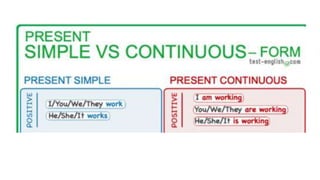
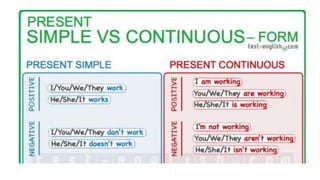
Simple present and
Present continuous
https://quizizz.com/join/quiz/5b51cf51a030d70019966e8f/start?studentShare=true
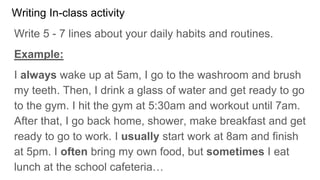
Writing In-class activity
Write 5 - 7 lines about your daily habits and routines.
Example:
I always wake up at 5am, I go to the washroom and brush
my teeth. Then, I drink a glass of water and get ready to go
to the gym. I hit the gym at 5:30am and workout until 7am.
After that, I go back home, shower, make breakfast and get
ready to go to work. I usually start work at 8am and finish
at 5pm. I often bring my own food, but sometimes I eat
lunch at the school cafeteria…
PRESENT SIMPLE
We use the present simple for habits or permanent
situations.
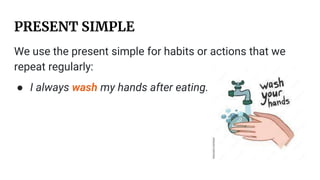
PRESENT SIMPLE
We use the present simple for habits or actions that we
repeat regularly:
● I always wash my hands after eating.
PRESENT SIMPLE
We use the present simple for habits or actions that we repeat regularly:
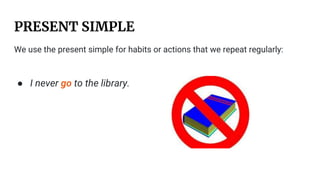
● I never go to the library.
PRESENT SIMPLE
We use the present simple for habits or actions that we repeat regularly:
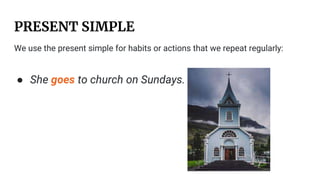
● She goes to church on Sundays.
PRESENT SIMPLE
We use the Present Simple for Permanent situations or
things that are always or often true.
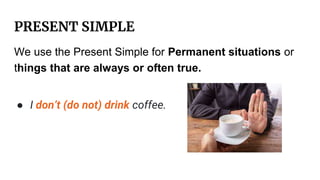
● I don’t (do not) drink coffee.
PRESENT SIMPLE
We use the Present Simple for Permanent situations or
things that are always or often true.
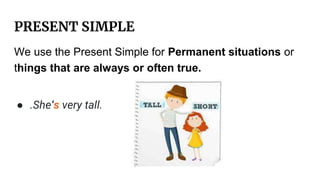
● .She’s very tall.
PRESENT SIMPLE
We use the Present Simple for Permanent situations or
things that are always or often true.
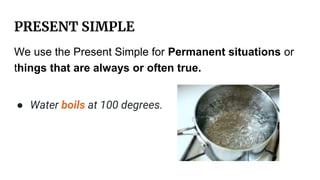
● Water boils at 100 degrees.
ADVERBS OF FREQUENCY
.
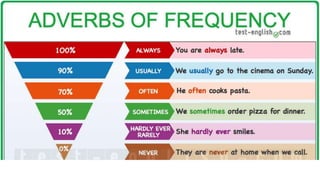
We often use the present simple with adverbs of
frequency (always, sometimes, etc.) and expressions of
frequency (once every three months, twice a week, every
other day, etc.).
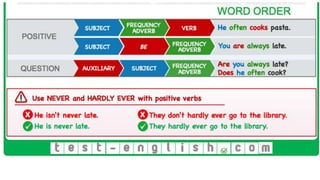
Adverbs of frequency go in mid position (before the main
verb or after be).
● She doesn’t often eat hamburgers / She never eats
hamburgers.
● He usually gets up very early.
● I am never late.
Expressions of frequency go at the end of the sentence
● We go to the cinema once a month. ( CORRECT)
● We once a month go to the cinema (INCORRECT)
Expressions of frequency go at the end of the sentence
● I buy new clothes once a year. (CORRECT).
● I once a year buy new clothes (INCORRECT).
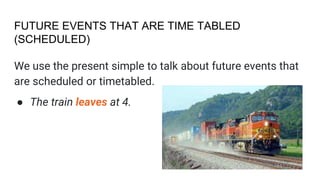
FUTURE EVENTS THAT ARE TIME TABLED
(SCHEDULED)
We use the present simple to talk about future events that
are scheduled or timetabled.
● The train leaves at 4.
FUTURE EVENTS THAT ARE TIME TABLED
(SCHEDULED)
We use the present simple to talk about future events that
are scheduled or timetabled.
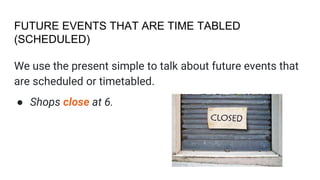
● Shops close at 6.
FUTURE EVENTS THAT ARE TIME TABLED
(SCHEDULED)
We use the present simple to talk about future events that
are scheduled or timetabled.
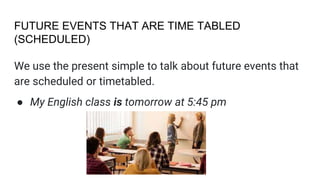
● My English class is tomorrow at 5:45 pm
PRESENT CONTINUOUS
We use the present continuous to talk about things that are
happening now or ‘around now’ (a time around this
moment, such as these days, weeks or months).
PRESENT CONTINUOUS
Example:
● I can’t talk know. I’m brushing my teeth.
Subject + verb to be + verb ing + complement.
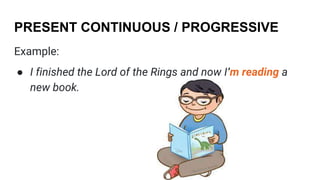
PRESENT CONTINUOUS / PROGRESSIVE
Example:
● I finished the Lord of the Rings and now I’m reading a
new book.
What are you doing right
now?
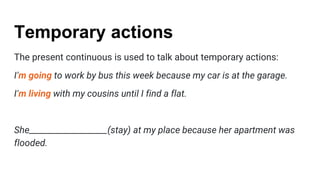
Temporary actions
The present continuous is used to talk about temporary actions:
I’m going to work by bus this week because my car is at the garage.
I’m living with my cousins until I find a flat.
She___________________(stay) at my place because her apartment was
flooded.
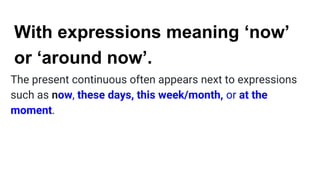
With expressions meaning ‘now’
or ‘around now’.
The present continuous often appears next to expressions
such as now, these days, this week/month, or at the
moment.
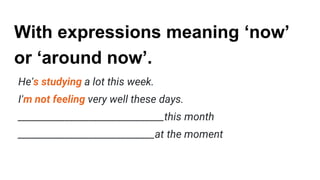
With expressions meaning ‘now’
or ‘around now’.
He’s studying a lot this week.
I’m not feeling very well these days.
_______________________________this month
_____________________________at the moment
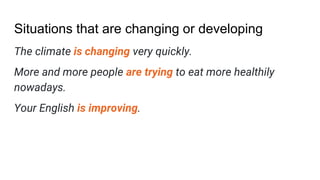
Situations that are changing or developing
The climate is changing very quickly.
More and more people are trying to eat more healthily
nowadays.
Your English is improving.
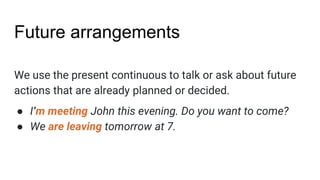
Future arrangements
We use the present continuous to talk or ask about future
actions that are already planned or decided.
● I‘m meeting John this evening. Do you want to come?
● We are leaving tomorrow at 7.
Simple present and
Present continuous
PRACTICE
https://test-english.com/grammar-points/a1/present-simple-present-continuous/
CLASS OBJECTIVE
Students will be able to identify different
kinds of questions including indirect
questions and use them in real life
conversations.
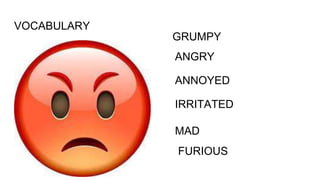
VOCABULARY
ANGRY
ANNOYED
IRRITATED
MAD
FURIOUS
GRUMPY
Do you think anger/angry is a good thing?
VOCABULARY
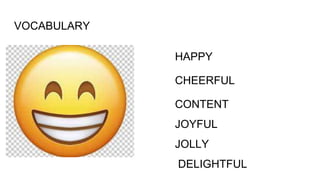
HAPPY
CHEERFUL
CONTENT
JOYFUL
JOLLY
DELIGHTFUL
What are TWO things that make you
happy/happiness?
VOCABULARY
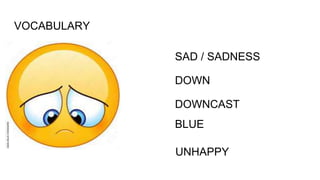
SAD / SADNESS
DOWN
DOWNCAST
BLUE
UNHAPPY
VOCABULARY
FORTUNATE
BLESSED
FAVORED
PROSPEROUS
SUCCESSFUL
When was the last time you had good
lucky/luck?
Who do you think is the most power/
powerful person in the world?
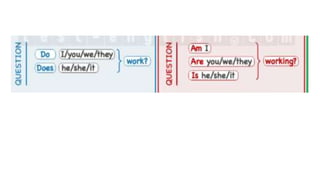
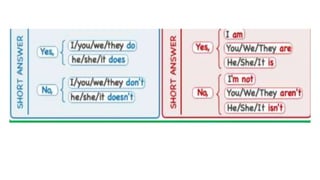
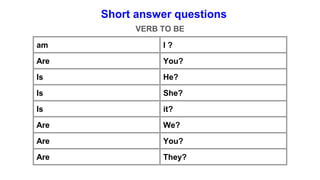
Short answer questions
VERB TO BE
am I ?
Are You?
Is He?
Is She?
Is it?
Are We?
Are You?
Are They?
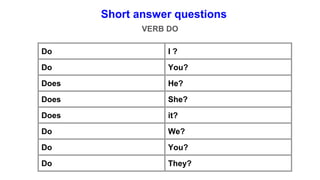
Short answer questions
VERB DO
Do I ?
Do You?
Does He?
Does She?
Does it?
Do We?
Do You?
Do They?
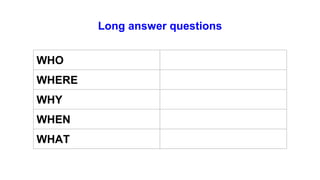
Long answer questions
WHO
WHERE
WHY
WHEN
WHAT
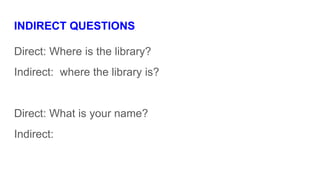
INDIRECT QUESTIONS
Direct: Where is the library?
Indirect: where the library is?
Direct: What is your name?
Indirect:
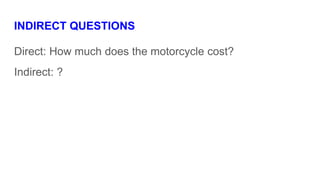
INDIRECT QUESTIONS
Direct: How much does the motorcycle cost?
Indirect: ?
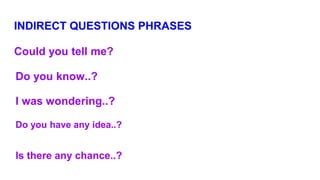
INDIRECT QUESTIONS PHRASES
Could you tell me?
Do you know..?
I was wondering..?
Do you have any idea..?
Is there any chance..?
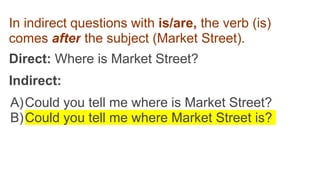
In indirect questions with is/are, the verb (is)
comes after the subject (Market Street).
Direct: Where is Market Street?
Indirect:
A)Could you tell me where is Market Street?
B)Could you tell me where Market Street is?
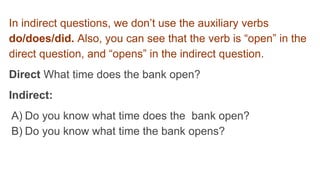
In indirect questions, we don’t use the auxiliary verbs
do/does/did. Also, you can see that the verb is “open” in the
direct question, and “opens” in the indirect question.
Direct What time does the bank open?
Indirect:
A) Do you know what time does the bank open?
B) Do you know what time the bank opens?
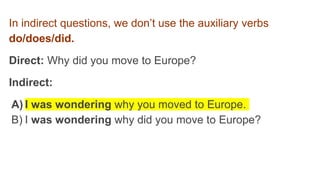
In indirect questions, we don’t use the auxiliary verbs
do/does/did.
Direct: Why did you move to Europe?
Indirect:
A) I was wondering why you moved to Europe.
B) I was wondering why did you move to Europe?
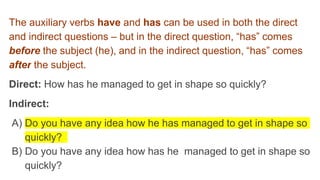
The auxiliary verbs have and has can be used in both the direct
and indirect questions – but in the direct question, “has” comes
before the subject (he), and in the indirect question, “has” comes
after the subject.
Direct: How has he managed to get in shape so quickly?
Indirect:
A) Do you have any idea how he has managed to get in shape so
quickly?
B) Do you have any idea how has he managed to get in shape so
quickly?
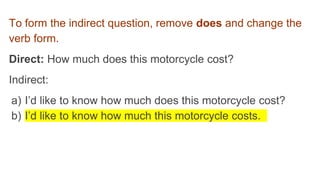
To form the indirect question, remove does and change the
verb form.
Direct: How much does this motorcycle cost?
Indirect:
a) I’d like to know how much does this motorcycle cost?
b) I’d like to know how much this motorcycle costs.
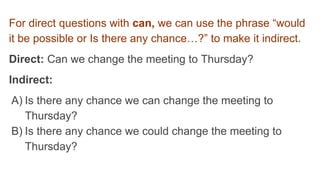
For direct questions with can, we can use the phrase “would
it be possible or Is there any chance…?” to make it indirect.
Direct: Can we change the meeting to Thursday?
Indirect:
A) Is there any chance we can change the meeting to
Thursday?
B) Is there any chance we could change the meeting to
Thursday?

Present simple and continuous

  • 1.
  • 2.
  • 3.
  • 4.
    Simple present and Presentcontinuous https://quizizz.com/join/quiz/5b51cf51a030d70019966e8f/start?studentShare=true
  • 5.
    Writing In-class activity Write5 - 7 lines about your daily habits and routines. Example: I always wake up at 5am, I go to the washroom and brush my teeth. Then, I drink a glass of water and get ready to go to the gym. I hit the gym at 5:30am and workout until 7am. After that, I go back home, shower, make breakfast and get ready to go to work. I usually start work at 8am and finish at 5pm. I often bring my own food, but sometimes I eat lunch at the school cafeteria…
  • 6.
    PRESENT SIMPLE We usethe present simple for habits or permanent situations.
  • 7.
    PRESENT SIMPLE We usethe present simple for habits or actions that we repeat regularly: ● I always wash my hands after eating.
  • 8.
    PRESENT SIMPLE We usethe present simple for habits or actions that we repeat regularly: ● I never go to the library.
  • 9.
    PRESENT SIMPLE We usethe present simple for habits or actions that we repeat regularly: ● She goes to church on Sundays.
  • 10.
    PRESENT SIMPLE We usethe Present Simple for Permanent situations or things that are always or often true. ● I don’t (do not) drink coffee.
  • 11.
    PRESENT SIMPLE We usethe Present Simple for Permanent situations or things that are always or often true. ● .She’s very tall.
  • 12.
    PRESENT SIMPLE We usethe Present Simple for Permanent situations or things that are always or often true. ● Water boils at 100 degrees.
  • 13.
    ADVERBS OF FREQUENCY . Weoften use the present simple with adverbs of frequency (always, sometimes, etc.) and expressions of frequency (once every three months, twice a week, every other day, etc.).
  • 16.
    Adverbs of frequencygo in mid position (before the main verb or after be). ● She doesn’t often eat hamburgers / She never eats hamburgers. ● He usually gets up very early. ● I am never late.
  • 17.
    Expressions of frequencygo at the end of the sentence ● We go to the cinema once a month. ( CORRECT) ● We once a month go to the cinema (INCORRECT)
  • 18.
    Expressions of frequencygo at the end of the sentence ● I buy new clothes once a year. (CORRECT). ● I once a year buy new clothes (INCORRECT).
  • 20.
    FUTURE EVENTS THATARE TIME TABLED (SCHEDULED) We use the present simple to talk about future events that are scheduled or timetabled. ● The train leaves at 4.
  • 21.
    FUTURE EVENTS THATARE TIME TABLED (SCHEDULED) We use the present simple to talk about future events that are scheduled or timetabled. ● Shops close at 6.
  • 22.
    FUTURE EVENTS THATARE TIME TABLED (SCHEDULED) We use the present simple to talk about future events that are scheduled or timetabled. ● My English class is tomorrow at 5:45 pm
  • 23.
    PRESENT CONTINUOUS We usethe present continuous to talk about things that are happening now or ‘around now’ (a time around this moment, such as these days, weeks or months).
  • 24.
    PRESENT CONTINUOUS Example: ● Ican’t talk know. I’m brushing my teeth. Subject + verb to be + verb ing + complement.
  • 25.
    PRESENT CONTINUOUS /PROGRESSIVE Example: ● I finished the Lord of the Rings and now I’m reading a new book.
  • 26.
    What are youdoing right now?
  • 27.
    Temporary actions The presentcontinuous is used to talk about temporary actions: I’m going to work by bus this week because my car is at the garage. I’m living with my cousins until I find a flat. She___________________(stay) at my place because her apartment was flooded.
  • 28.
    With expressions meaning‘now’ or ‘around now’. The present continuous often appears next to expressions such as now, these days, this week/month, or at the moment.
  • 29.
    With expressions meaning‘now’ or ‘around now’. He’s studying a lot this week. I’m not feeling very well these days. _______________________________this month _____________________________at the moment
  • 30.
    Situations that arechanging or developing The climate is changing very quickly. More and more people are trying to eat more healthily nowadays. Your English is improving.
  • 31.
    Future arrangements We usethe present continuous to talk or ask about future actions that are already planned or decided. ● I‘m meeting John this evening. Do you want to come? ● We are leaving tomorrow at 7.
  • 36.
    Simple present and Presentcontinuous PRACTICE https://test-english.com/grammar-points/a1/present-simple-present-continuous/
  • 37.
    CLASS OBJECTIVE Students willbe able to identify different kinds of questions including indirect questions and use them in real life conversations.
  • 38.
  • 39.
    Do you thinkanger/angry is a good thing?
  • 40.
  • 41.
    What are TWOthings that make you happy/happiness?
  • 42.
  • 43.
  • 44.
    When was thelast time you had good lucky/luck?
  • 45.
    Who do youthink is the most power/ powerful person in the world?
  • 46.
    Short answer questions VERBTO BE am I ? Are You? Is He? Is She? Is it? Are We? Are You? Are They?
  • 47.
    Short answer questions VERBDO Do I ? Do You? Does He? Does She? Does it? Do We? Do You? Do They?
  • 48.
  • 49.
    INDIRECT QUESTIONS Direct: Whereis the library? Indirect: where the library is? Direct: What is your name? Indirect:
  • 50.
    INDIRECT QUESTIONS Direct: Howmuch does the motorcycle cost? Indirect: ?
  • 51.
    INDIRECT QUESTIONS PHRASES Couldyou tell me? Do you know..? I was wondering..? Do you have any idea..? Is there any chance..?
  • 52.
    In indirect questionswith is/are, the verb (is) comes after the subject (Market Street). Direct: Where is Market Street? Indirect: A)Could you tell me where is Market Street? B)Could you tell me where Market Street is?
  • 53.
    In indirect questions,we don’t use the auxiliary verbs do/does/did. Also, you can see that the verb is “open” in the direct question, and “opens” in the indirect question. Direct What time does the bank open? Indirect: A) Do you know what time does the bank open? B) Do you know what time the bank opens?
  • 54.
    In indirect questions,we don’t use the auxiliary verbs do/does/did. Direct: Why did you move to Europe? Indirect: A) I was wondering why you moved to Europe. B) I was wondering why did you move to Europe?
  • 55.
    The auxiliary verbshave and has can be used in both the direct and indirect questions – but in the direct question, “has” comes before the subject (he), and in the indirect question, “has” comes after the subject. Direct: How has he managed to get in shape so quickly? Indirect: A) Do you have any idea how he has managed to get in shape so quickly? B) Do you have any idea how has he managed to get in shape so quickly?
  • 56.
    To form theindirect question, remove does and change the verb form. Direct: How much does this motorcycle cost? Indirect: a) I’d like to know how much does this motorcycle cost? b) I’d like to know how much this motorcycle costs.
  • 57.
    For direct questionswith can, we can use the phrase “would it be possible or Is there any chance…?” to make it indirect. Direct: Can we change the meeting to Thursday? Indirect: A) Is there any chance we can change the meeting to Thursday? B) Is there any chance we could change the meeting to Thursday?