PAST SIMPLE or PAST
CONTINUOUS
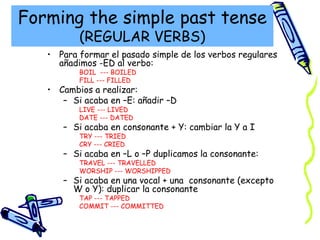
Forming the simple past tense
(REGULAR VERBS)
• Para formar el pasado simple de los verbos regulares
añadimos -ED al verbo:
BOIL --- BOILED
FILL --- FILLED
• Cambios a realizar:
– Si acaba en –E: añadir –D
LIVE --- LIVED
DATE --- DATED
– Si acaba en consonante + Y: cambiar la Y a I
TRY --- TRIED
CRY --- CRIED
– Si acaba en –L o –P duplicamos la consonante:
TRAVEL --- TRAVELLED
WORSHIP --- WORSHIPPED
– Si acaba en una vocal + una consonante (excepto
W o Y): duplicar la consonante
TAP --- TAPPED
COMMIT --- COMMITTED
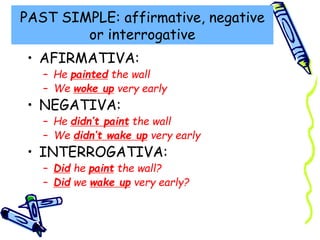
PAST SIMPLE: affirmative, negative
or interrogative
• AFIRMATIVA:
– He painted the wall
– We woke up very early
• NEGATIVA:
– He didn’t paint the wall
– We didn’t wake up very early
• INTERROGATIVA:
– Did he paint the wall?
– Did we wake up very early?
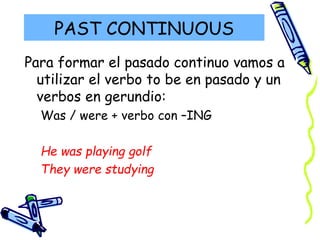
PAST CONTINUOUS
Para formar el pasado continuo vamos a
utilizar el verbo to be en pasado y un
verbos en gerundio:
Was / were + verbo con –ING
He was playing golf
They were studying
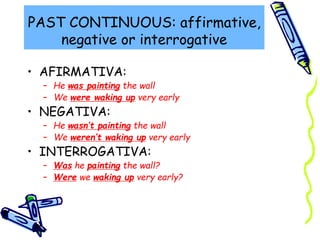
PAST CONTINUOUS: affirmative,
negative or interrogative
• AFIRMATIVA:
– He was painting the wall
– We were waking up very early
• NEGATIVA:
– He wasn’t painting the wall
– We weren’t waking up very early
• INTERROGATIVA:
– Was he painting the wall?
– Were we waking up very early?
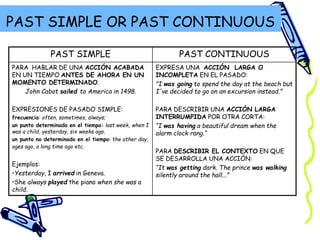
PAST SIMPLE OR PAST CONTINUOUS
PAST SIMPLE PAST CONTINUOUS
PARA HABLAR DE UNA ACCIÓN ACABADA
EN UN TIEMPO ANTES DE AHORA EN UN
MOMENTO DETERMINADO.
John Cabot sailed to America in 1498.
EXPRESIONES DE PASADO SIMPLE:
frecuencia: often, sometimes, always;
un punto determinado en el tiempo: last week, when I
was a child, yesterday, six weeks ago.
un punto no determinado en el tiempo: the other day,
ages ago, a long time ago etc.
Ejemplos:
•Yesterday, I arrived in Geneva.
•She always played the piano when she was a
child.
EXPRESA UNA ACCIÓN LARGA O
INCOMPLETA EN EL PASADO:
"I was going to spend the day at the beach but
I've decided to go on an excursion instead.”
PARA DESCRIBIR UNA ACCIÓN LARGA
INTERRUMPIDA POR OTRA CORTA:
“I was having a beautiful dream when the
alarm clock rang.“
PARA DESCRIBIR EL CONTEXTO EN QUE
SE DESARROLLA UNA ACCIÓN:
“It was getting dark. The prince was walking
silently around the hall...”
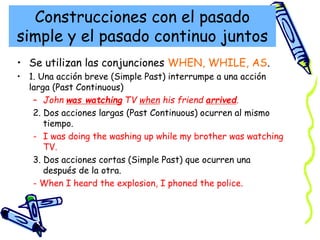
Construcciones con el pasado
simple y el pasado continuo juntos
• Se utilizan las conjunciones WHEN, WHILE, AS.
• 1. Una acción breve (Simple Past) interrumpe a una acción
larga (Past Continuous)
– John was watching TV when his friend arrived.
2. Dos acciones largas (Past Continuous) ocurren al mismo
tiempo.
- I was doing the washing up while my brother was watching
TV.
3. Dos acciones cortas (Simple Past) que ocurren una
después de la otra.
- When I heard the explosion, I phoned the police.

Past simple vs. Past Continuous

  • 1.
    PAST SIMPLE orPAST CONTINUOUS
  • 2.
    Forming the simplepast tense (REGULAR VERBS) • Para formar el pasado simple de los verbos regulares añadimos -ED al verbo: BOIL --- BOILED FILL --- FILLED • Cambios a realizar: – Si acaba en –E: añadir –D LIVE --- LIVED DATE --- DATED – Si acaba en consonante + Y: cambiar la Y a I TRY --- TRIED CRY --- CRIED – Si acaba en –L o –P duplicamos la consonante: TRAVEL --- TRAVELLED WORSHIP --- WORSHIPPED – Si acaba en una vocal + una consonante (excepto W o Y): duplicar la consonante TAP --- TAPPED COMMIT --- COMMITTED
  • 3.
    PAST SIMPLE: affirmative,negative or interrogative • AFIRMATIVA: – He painted the wall – We woke up very early • NEGATIVA: – He didn’t paint the wall – We didn’t wake up very early • INTERROGATIVA: – Did he paint the wall? – Did we wake up very early?
  • 4.
    PAST CONTINUOUS Para formarel pasado continuo vamos a utilizar el verbo to be en pasado y un verbos en gerundio: Was / were + verbo con –ING He was playing golf They were studying
  • 5.
    PAST CONTINUOUS: affirmative, negativeor interrogative • AFIRMATIVA: – He was painting the wall – We were waking up very early • NEGATIVA: – He wasn’t painting the wall – We weren’t waking up very early • INTERROGATIVA: – Was he painting the wall? – Were we waking up very early?
  • 6.
    PAST SIMPLE ORPAST CONTINUOUS PAST SIMPLE PAST CONTINUOUS PARA HABLAR DE UNA ACCIÓN ACABADA EN UN TIEMPO ANTES DE AHORA EN UN MOMENTO DETERMINADO. John Cabot sailed to America in 1498. EXPRESIONES DE PASADO SIMPLE: frecuencia: often, sometimes, always; un punto determinado en el tiempo: last week, when I was a child, yesterday, six weeks ago. un punto no determinado en el tiempo: the other day, ages ago, a long time ago etc. Ejemplos: •Yesterday, I arrived in Geneva. •She always played the piano when she was a child. EXPRESA UNA ACCIÓN LARGA O INCOMPLETA EN EL PASADO: "I was going to spend the day at the beach but I've decided to go on an excursion instead.” PARA DESCRIBIR UNA ACCIÓN LARGA INTERRUMPIDA POR OTRA CORTA: “I was having a beautiful dream when the alarm clock rang.“ PARA DESCRIBIR EL CONTEXTO EN QUE SE DESARROLLA UNA ACCIÓN: “It was getting dark. The prince was walking silently around the hall...”
  • 7.
    Construcciones con elpasado simple y el pasado continuo juntos • Se utilizan las conjunciones WHEN, WHILE, AS. • 1. Una acción breve (Simple Past) interrumpe a una acción larga (Past Continuous) – John was watching TV when his friend arrived. 2. Dos acciones largas (Past Continuous) ocurren al mismo tiempo. - I was doing the washing up while my brother was watching TV. 3. Dos acciones cortas (Simple Past) que ocurren una después de la otra. - When I heard the explosion, I phoned the police.