Simple Present
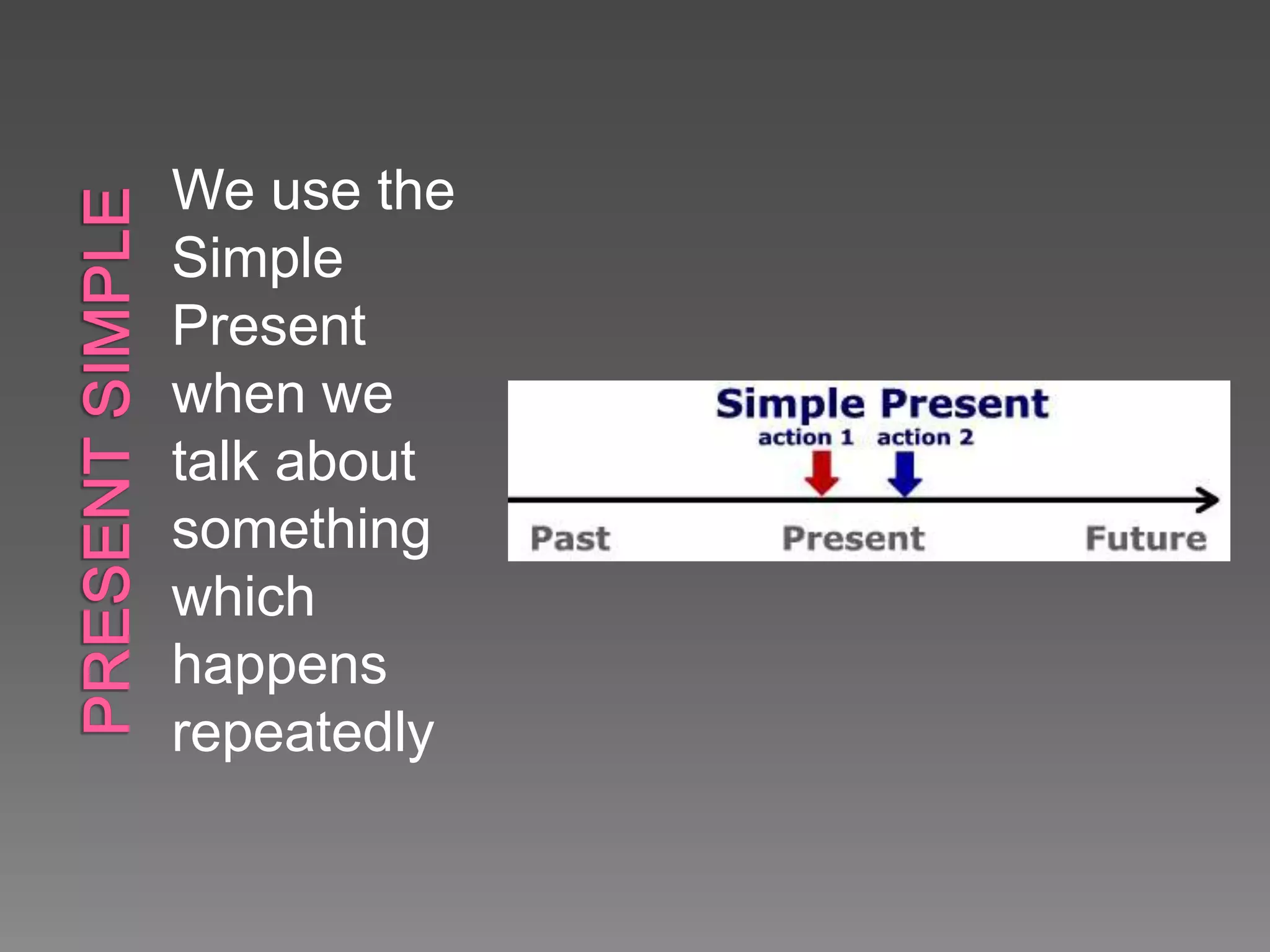
We use the
Simple
Present
when we
talk about
something
which
happens
repeatedly
   Repeated actions (every day, always, often, sometimes or never)
          My friend often draws nice posters.
          I never drink milk.
    Things in general
          The sun rises in the East.
    Fixed arrangements, scheduled events (e.g. timetable)
          The plane flies to London every Monday.
   Actions in the present - one follows after the other (first - then, after that)
          First I get up, then I have breakfast.
    Instructions
          Open your books at page 34.
    With special verbs - which are normally not used with the Present
    Progressive (These verbs express states, possessions, feelings etc.)
    be, believe, belong, hate, hear, like, love, mean, prefer, remain, realize,
    see, seem, smell, think, understand, want, wish
          I understand English.
          He doesn't like fish.
   These words tell you what tense you have to use. For
    the Simple Present these are adverbs of frequency:
    always
    often
    usually
    sometimes
    seldom
    never
   Other phrases of time can occur, like:
    every day
    every week
    every year
    on Mondays
    after school

Present simple

  • 1.
  • 2.
    We use the Simple Present whenwe talk about something which happens repeatedly
  • 3.
    Repeated actions (every day, always, often, sometimes or never) My friend often draws nice posters. I never drink milk.  Things in general The sun rises in the East.  Fixed arrangements, scheduled events (e.g. timetable) The plane flies to London every Monday.  Actions in the present - one follows after the other (first - then, after that) First I get up, then I have breakfast.  Instructions Open your books at page 34.  With special verbs - which are normally not used with the Present Progressive (These verbs express states, possessions, feelings etc.) be, believe, belong, hate, hear, like, love, mean, prefer, remain, realize, see, seem, smell, think, understand, want, wish I understand English. He doesn't like fish.
  • 4.
    These words tell you what tense you have to use. For the Simple Present these are adverbs of frequency: always often usually sometimes seldom never  Other phrases of time can occur, like: every day every week every year on Mondays after school