Simple past
Polytechnic University Institute Santigo Mariño
Inglish 1 section: 1C
Made by :
Albert José Farías Serra
CI: 28.166.432
Career : ING electronics
Teacher: Cesar Velasquez
What is simple present?
The simple past (also called past simple, past indefinite or preterite) is a verb tense which
is used to show that a completed action took place at a specific time in the past. The
simple past is also frequently used to talk about past habits and generalizations
Characteristics
1) It can be conjugated in three ways: affirmative, negative and questioning
2) It is used to talk about a concrete action that started and ended in the past
Example: Tom stayed at home last night
3) It is used for narrations or actions of long periods in the past
Example: i worked for many years in a museum
4) is used to talk about generalities or past events
Example: the aztec lived in mexico
When do we use the Simple Past tense?
The simple past is normally used to refer to events that happened in
a specific moment in the past
Regular and irregular verbs
There are regular verbs, to which is added -ed in the past, as work (worked in the past) and
other irregular ones, which it is necessary to learn are said, as go (went) in the past
Regular Verb : “ Work”
I worked
You worked
He/she/it worked
We worked
You worked
Spelling of regular past forms
verbs finished in "consonant + y"⇒ied:
study →studied Carry →carried
Monosyllabic verbs ending in "vowel + consonant" ⇒
duplicate the consonant (except "y" or "w")
stop →stopped
shop → shopped
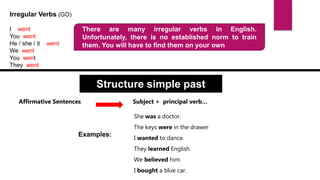
Irregular Verbs (GO)
I went
You went
He / she / it went
We went
You went
They went
There are many irregular verbs in English.
Unfortunately, there is no established norm to train
them. You will have to find them on your own
Structure simple past
Affirmative Sentences Subject + principal verb…
She was a doctor.
The keys were in the drawer
I wanted to dance.
They learned English
We believed him.
I bought a blue car.
Examples:
Negative Sentences Subject + “to be” + “not”…
She wasn’t a doctor.
The keys weren’t in the drawer.
Examples:
I didn’t want to dance.
They didn’t learn English.
We didn’t believe him.
I didn’t buy a blue car.
All other verbs Subject + auxiliar verb (to do) + “not” + principal verb (infinitive)…
We didn’t believe him.
Examples:
Was she a doctor?.
Were the keys in the drawer?
Interrogative Sentences “To be” + subject…?
Examples:
Did you want to dance?
Did they learn English?
Did you believe him?
Did you buy a blue car?
All other verbs auxiliar verb (to do) + subject + principal verb ( infinitive)…?
Examples:
Simple past

Simple past

  • 1.
    Simple past Polytechnic UniversityInstitute Santigo Mariño Inglish 1 section: 1C Made by : Albert José Farías Serra CI: 28.166.432 Career : ING electronics Teacher: Cesar Velasquez
  • 2.
    What is simplepresent? The simple past (also called past simple, past indefinite or preterite) is a verb tense which is used to show that a completed action took place at a specific time in the past. The simple past is also frequently used to talk about past habits and generalizations Characteristics 1) It can be conjugated in three ways: affirmative, negative and questioning 2) It is used to talk about a concrete action that started and ended in the past Example: Tom stayed at home last night 3) It is used for narrations or actions of long periods in the past Example: i worked for many years in a museum 4) is used to talk about generalities or past events Example: the aztec lived in mexico
  • 3.
    When do weuse the Simple Past tense? The simple past is normally used to refer to events that happened in a specific moment in the past Regular and irregular verbs There are regular verbs, to which is added -ed in the past, as work (worked in the past) and other irregular ones, which it is necessary to learn are said, as go (went) in the past Regular Verb : “ Work” I worked You worked He/she/it worked We worked You worked Spelling of regular past forms verbs finished in "consonant + y"⇒ied: study →studied Carry →carried Monosyllabic verbs ending in "vowel + consonant" ⇒ duplicate the consonant (except "y" or "w") stop →stopped shop → shopped
  • 4.
    Irregular Verbs (GO) Iwent You went He / she / it went We went You went They went There are many irregular verbs in English. Unfortunately, there is no established norm to train them. You will have to find them on your own Structure simple past Affirmative Sentences Subject + principal verb… She was a doctor. The keys were in the drawer I wanted to dance. They learned English We believed him. I bought a blue car. Examples:
  • 5.
    Negative Sentences Subject+ “to be” + “not”… She wasn’t a doctor. The keys weren’t in the drawer. Examples: I didn’t want to dance. They didn’t learn English. We didn’t believe him. I didn’t buy a blue car. All other verbs Subject + auxiliar verb (to do) + “not” + principal verb (infinitive)… We didn’t believe him. Examples:
  • 6.
    Was she adoctor?. Were the keys in the drawer? Interrogative Sentences “To be” + subject…? Examples: Did you want to dance? Did they learn English? Did you believe him? Did you buy a blue car? All other verbs auxiliar verb (to do) + subject + principal verb ( infinitive)…? Examples: