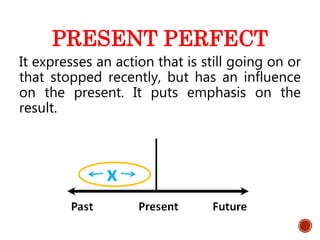
PRESENT PERFECT
It expresses an action that is still going on or
that stopped recently, but has an influence
on the present. It puts emphasis on the
result.
• Puts emphasis on the result
Example: She has written five letters.
• Action that is still going on
Example: School has not started yet.
• Action that stopped recently
Example: She has cooked dinner.
• Finished action that has an influence on the
present
Example: I have lost my key.
• Action that has taken place once, never or
several times before the moment of
speaking
Example: I have never been to Australia.
already, ever, just,
never, not yet, so
far, till now, up to
now
PRESENT PERFECT
AFFIRMATIVE
I
You
We HAVE done the homework.
They
He
She HAS done the homework
It
PRESENT PERFECT
NEGATIVE
I
You HAVEN’T done the homework.
We
They
He
She HASN’T done the homework
It
PRESENT PERFECT
INTERROGATIVE
I
you
HAVE we done the homework?
they
he
HAS she done the homework?
it
FOR/SINCE
We use them in sentences
where we want to talk about
something that started in the
past and continues into the
present.
FOR
It is used when specifying the amount of time
(how long).
• I've had this watch for more than 40 years.
• I've only known her for a few weeks.
• He's been here for 6 months and still can't
speak a word of German.
• She's been doing her homework for a long
time.
SINCE
It is used when specifying the starting point.
• I've had this watch since 1965.
• I've only known her since the beginning of
last week.
• We’ve lived here since April.
• She's been studying since this morning.
IMPORTANT!
The present perfect or present perfect
continuous are needed in such sentences.
It is wrong to say:
I know her for two years.
I know her since 2006.
Present perfect
Present perfect
Present perfect
Present perfect
Present perfect

Present perfect

  • 1.
    PRESENT PERFECT It expressesan action that is still going on or that stopped recently, but has an influence on the present. It puts emphasis on the result.
  • 2.
    • Puts emphasison the result Example: She has written five letters. • Action that is still going on Example: School has not started yet. • Action that stopped recently Example: She has cooked dinner.
  • 3.
    • Finished actionthat has an influence on the present Example: I have lost my key. • Action that has taken place once, never or several times before the moment of speaking Example: I have never been to Australia.
  • 4.
    already, ever, just, never,not yet, so far, till now, up to now
  • 5.
    PRESENT PERFECT AFFIRMATIVE I You We HAVEdone the homework. They He She HAS done the homework It
  • 6.
    PRESENT PERFECT NEGATIVE I You HAVEN’Tdone the homework. We They He She HASN’T done the homework It
  • 7.
    PRESENT PERFECT INTERROGATIVE I you HAVE wedone the homework? they he HAS she done the homework? it
  • 8.
    FOR/SINCE We use themin sentences where we want to talk about something that started in the past and continues into the present.
  • 10.
    FOR It is usedwhen specifying the amount of time (how long). • I've had this watch for more than 40 years. • I've only known her for a few weeks. • He's been here for 6 months and still can't speak a word of German. • She's been doing her homework for a long time.
  • 11.
    SINCE It is usedwhen specifying the starting point. • I've had this watch since 1965. • I've only known her since the beginning of last week. • We’ve lived here since April. • She's been studying since this morning.
  • 12.
    IMPORTANT! The present perfector present perfect continuous are needed in such sentences. It is wrong to say: I know her for two years. I know her since 2006.