THE PRESENT SIMPLE VS THE PRESENT CONTINUOUS SANDRA MILENA FRANCO
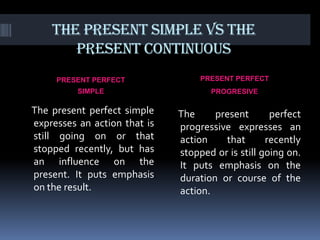
THE PRESENT SIMPLE VS THE PRESENT CONTINUOUS PRESENT PERFECT PROGRESIVEPRESENT PERFECT SIMPLE    The present perfect simple expresses an action that is still going on or that stopped recently, but has an influence on the present. It puts emphasis on the result.     The present perfect progressive expresses an action that recently stopped or is still going on. It puts emphasis on the duration or course of the action.
USESUse of Present Perfect SimpleUse of Present Perfect progresiveputs emphasis on the resultExample: She has written five letters.action that is still going onExample: School has not started yet.action that stopped recentlyExample: She has cooked dinner.puts emphasis on the duration or course of an action (not the result)Example: She has been writing for two hours.action that recently stopped or is still going on Example: I have been living here since 2001.finished action that influenced the presentExample: I have been working all afternoon
Do you want to express what has happened so far or how long an action has been going on yetRESULT (what / how much / how often).     -I have written  five  letters.    - I have been to London twice.DURATION (how/ long)- I have been writing for an hour.
STRUCTUREAFIRMATIVE:   Subject + has/have+  PAST PARTICIPLE + complement.    NEGATIVE:   Subject + has/have + NOT +  PAST PARTICIPLE + complement.    QUESTIONS:has/have + Subject + PAST PARTICIPLE + complement ?AFIRMATIVE:Subject + has/have + BEEN +  PRESENT PARTICIPLE + complement NEGATIVE:Subject + has/have + NOT +  BEEN +  PRESENT PARTICIPLE + complement QUESTIONS:has/have + Subject + BEEN +  PRESENT PARTICIPLE + complement?
Emphasis on completion or duration?EMPHASIS ON COMPLETIONEMPHASIS on duration have done my homework. (Meaning: My homework is completed now.)I have been doing my homework. (Meaning: That's how I have spent my time. It does not matter whether the homework is completed now.)
Result or side effect?DESIRED RESULTUNWANTED SIDE EFFECTI have washed the car. (Result: The car is clean now.)I have been washing the car. (side effect: I became wet when I was washing the car. It does not matter whether the car is clean now.)
Time + negation: last time or beginning of an action?SINCE THE LAST TIMESINCE THE BEGINNINGI haven't played that game for years. (Meaning: It's years ago that I last played that game.)I haven't been playing that game for an hour, only for 10 minutes. (Meaning: It's not even an hour ago that I started to play that game.)
PERMANENT OR TEMPORARY?PERMANENTTEMPORARYJames has lived in this town for 10 years. (Meaning: He is a permanent resident of this town.)James has been living here for a year. (Meaning: This situation is only temporary. Maybe he is an exchange student and only here for one or two years.)

The present simple vs the present continuous

  • 1.
    THE PRESENT SIMPLEVS THE PRESENT CONTINUOUS SANDRA MILENA FRANCO
  • 2.
    THE PRESENT SIMPLEVS THE PRESENT CONTINUOUS PRESENT PERFECT PROGRESIVEPRESENT PERFECT SIMPLE The present perfect simple expresses an action that is still going on or that stopped recently, but has an influence on the present. It puts emphasis on the result. The present perfect progressive expresses an action that recently stopped or is still going on. It puts emphasis on the duration or course of the action.
  • 3.
    USESUse of PresentPerfect SimpleUse of Present Perfect progresiveputs emphasis on the resultExample: She has written five letters.action that is still going onExample: School has not started yet.action that stopped recentlyExample: She has cooked dinner.puts emphasis on the duration or course of an action (not the result)Example: She has been writing for two hours.action that recently stopped or is still going on Example: I have been living here since 2001.finished action that influenced the presentExample: I have been working all afternoon
  • 4.
    Do you wantto express what has happened so far or how long an action has been going on yetRESULT (what / how much / how often). -I have written five letters. - I have been to London twice.DURATION (how/ long)- I have been writing for an hour.
  • 5.
    STRUCTUREAFIRMATIVE: Subject + has/have+ PAST PARTICIPLE + complement. NEGATIVE: Subject + has/have + NOT + PAST PARTICIPLE + complement. QUESTIONS:has/have + Subject + PAST PARTICIPLE + complement ?AFIRMATIVE:Subject + has/have + BEEN + PRESENT PARTICIPLE + complement NEGATIVE:Subject + has/have + NOT + BEEN + PRESENT PARTICIPLE + complement QUESTIONS:has/have + Subject + BEEN + PRESENT PARTICIPLE + complement?
  • 6.
    Emphasis on completionor duration?EMPHASIS ON COMPLETIONEMPHASIS on duration have done my homework. (Meaning: My homework is completed now.)I have been doing my homework. (Meaning: That's how I have spent my time. It does not matter whether the homework is completed now.)
  • 7.
    Result or sideeffect?DESIRED RESULTUNWANTED SIDE EFFECTI have washed the car. (Result: The car is clean now.)I have been washing the car. (side effect: I became wet when I was washing the car. It does not matter whether the car is clean now.)
  • 8.
    Time + negation:last time or beginning of an action?SINCE THE LAST TIMESINCE THE BEGINNINGI haven't played that game for years. (Meaning: It's years ago that I last played that game.)I haven't been playing that game for an hour, only for 10 minutes. (Meaning: It's not even an hour ago that I started to play that game.)
  • 9.
    PERMANENT OR TEMPORARY?PERMANENTTEMPORARYJameshas lived in this town for 10 years. (Meaning: He is a permanent resident of this town.)James has been living here for a year. (Meaning: This situation is only temporary. Maybe he is an exchange student and only here for one or two years.)