The present  perfect  :)
What is the present perfect? We use the present perfect to describe an action that happened just before now. You cannot use the present perfect to say things like: yesterday, one year ago, when I lived in japan, that day, one day, etc.
How do we make the present perfect? To make the present perfect you have to add a auxility verb and a verb  in past principle, together with a subject. For example:  -You have seen that movie many times. -I think i have met him once before. -People have traveled  to the moon. -Have you read the book yet?
For an easy way to remember how to make the present perfect is to remember this table: SUBJECT+ AUXILITY VERB+ VERB IN PAST PARTICIPLE.
The present perfect in positive form I/YOU/WE/THEY HAVE SPOKEN HAS SPOKEN HE/SHE/IT
The present perfect in negative form I/YOU/WE/THEY HE/SHE/IT HAVEN'T SPOKEN HASN'T  SPOKEN
Present perfect of the verb “go” I have gone.  I haven't gone.  You have gone.  You haven't gone. He/She/It has gone.  He/she/it hasn't gone. They have gone.  They haven't gone. We have gone.  We haven't gone. POSITIVE  NEGATIVE
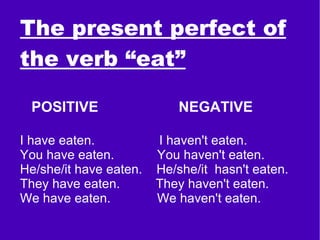
The present perfect of the verb “eat” I have eaten.  I haven't eaten.  You have eaten.  You haven't eaten. He/she/it have eaten.  He/she/it  hasn't eaten. They have eaten.  They haven't eaten. We have eaten.  We haven't eaten. POSITIVE  NEGATIVE
The present perfect of the verb “see” POSITIVE  NEGATIVE I have seen.  I haven't seen.  You have seen.  You haven't seen. He/she/it has seen.  He/she/it hasn't seen. They have seen.  They haven't seen. We have seen.  We haven't seen.
The present perfect of the verb “meet” I have met.  I haven't met. You have met.  You haven't met. He/she/it has met.  He/she/it hasn't met. They have met.  They have met. We have met.  We have met. POSITIVE  NEGATIVE
The present perfect of the verb “walk” POSITIVE  NEGATIVE I have walked.  I haven't walked. You have walked.  You haven't walked. He/she/it have walked.  He/she/it hasn't walked. They have walked.  They haven't walked. We have walked.  We haven't walked.
THE END!   Hayley Duckering 2B Oliver Deadman 2B

Present perfect

  • 1.
    The present perfect :)
  • 2.
    What is thepresent perfect? We use the present perfect to describe an action that happened just before now. You cannot use the present perfect to say things like: yesterday, one year ago, when I lived in japan, that day, one day, etc.
  • 3.
    How do wemake the present perfect? To make the present perfect you have to add a auxility verb and a verb in past principle, together with a subject. For example: -You have seen that movie many times. -I think i have met him once before. -People have traveled to the moon. -Have you read the book yet?
  • 4.
    For an easyway to remember how to make the present perfect is to remember this table: SUBJECT+ AUXILITY VERB+ VERB IN PAST PARTICIPLE.
  • 5.
    The present perfectin positive form I/YOU/WE/THEY HAVE SPOKEN HAS SPOKEN HE/SHE/IT
  • 6.
    The present perfectin negative form I/YOU/WE/THEY HE/SHE/IT HAVEN'T SPOKEN HASN'T SPOKEN
  • 7.
    Present perfect ofthe verb “go” I have gone. I haven't gone. You have gone. You haven't gone. He/She/It has gone. He/she/it hasn't gone. They have gone. They haven't gone. We have gone. We haven't gone. POSITIVE NEGATIVE
  • 8.
    The present perfectof the verb “eat” I have eaten. I haven't eaten. You have eaten. You haven't eaten. He/she/it have eaten. He/she/it hasn't eaten. They have eaten. They haven't eaten. We have eaten. We haven't eaten. POSITIVE NEGATIVE
  • 9.
    The present perfectof the verb “see” POSITIVE NEGATIVE I have seen. I haven't seen. You have seen. You haven't seen. He/she/it has seen. He/she/it hasn't seen. They have seen. They haven't seen. We have seen. We haven't seen.
  • 10.
    The present perfectof the verb “meet” I have met. I haven't met. You have met. You haven't met. He/she/it has met. He/she/it hasn't met. They have met. They have met. We have met. We have met. POSITIVE NEGATIVE
  • 11.
    The present perfectof the verb “walk” POSITIVE NEGATIVE I have walked. I haven't walked. You have walked. You haven't walked. He/she/it have walked. He/she/it hasn't walked. They have walked. They haven't walked. We have walked. We haven't walked.
  • 12.
    THE END! Hayley Duckering 2B Oliver Deadman 2B