

Data-Driven Analysis of
Batch Processing Inefficiencies
in Business Processes
Katsiaryna Lashkevich, Fredrik Milani,
David Chapela-Campa, and Marlon Dumas
University of Tartu,
Narva mnt 18, 51009 Tartu, Estonia
16th International Conference on Research Challenges
in Information Science (RCIS 2022)
2
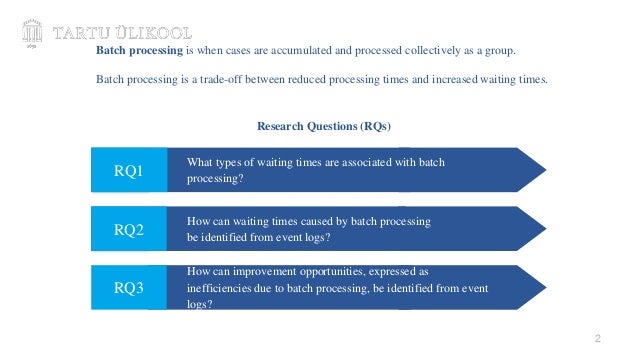
How can waiting times caused by batch processing
be identified from event logs?
RQ3
What types of waiting times are associated with batch
processing?
RQ2
How can improvement opportunities, expressed as
inefficiencies due to batch processing, be identified from event
logs?
RQ1
Research Questions (RQs)
Batch processing is when cases are accumulated and processed collectively as a group.
Batch processing is a trade-off between reduced processing times and increased waiting times.
3
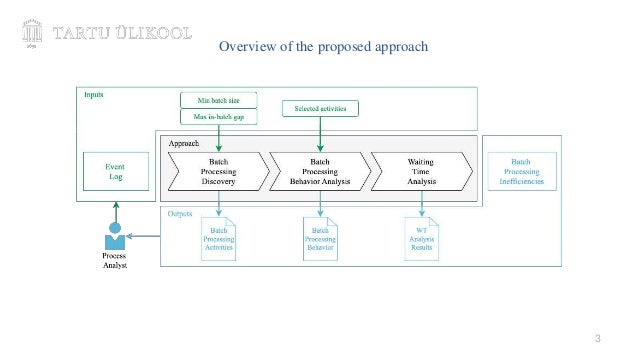
Overview of the proposed approach
4
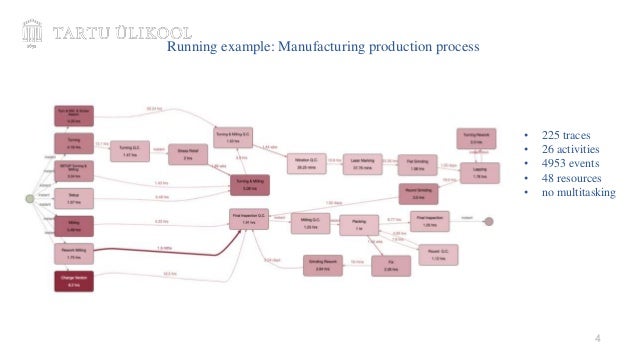
Running example: Manufacturing production process
• 225 traces
• 26 activities
• 4953 events
• 48 resources
• no multitasking
5
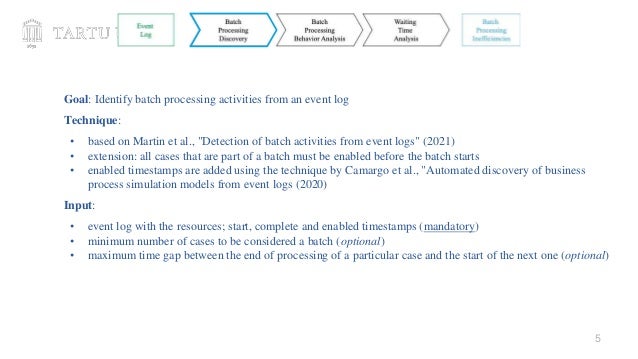
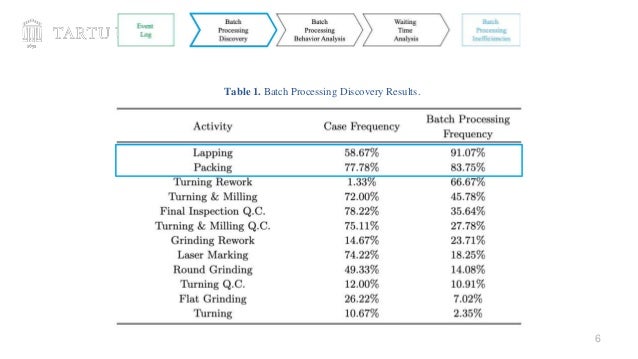
Goal: Identify batch processing activities from an event log
Technique:
• based on Martin et al., "Detection of batch activities from event logs" (2021)
• extension: all cases that are part of a batch must be enabled before the batch starts
• enabled timestamps are added using the technique by Camargo et al., "Automated discovery of business
process simulation models from event logs (2020)
Input:
• event log with the resources; start, complete and enabled timestamps (mandatory)
• minimum number of cases to be considered a batch (optional)
• maximum time gap between the end of processing of a particular case and the start of the next one (optional)
6
Table 1. Batch Processing Discovery Results.
7
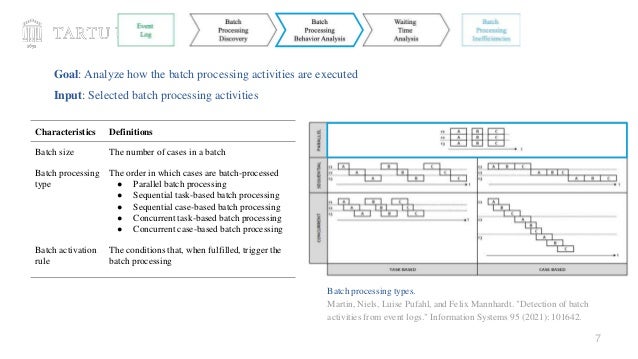
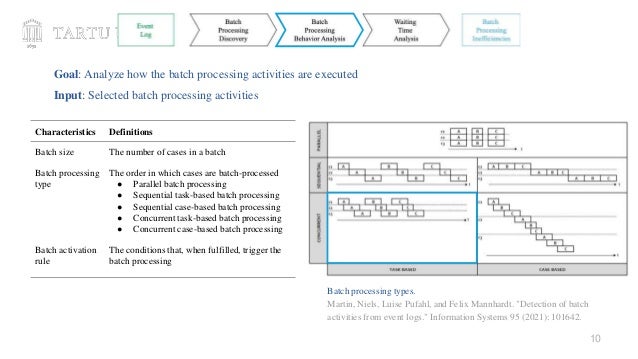
Characteristics Definitions
Batch size The number of cases in a batch
Batch processing
type
The order in which cases are batch-processed
● Parallel batch processing
● Sequential task-based batch processing
● Sequential case-based batch processing
● Concurrent task-based batch processing
● Concurrent case-based batch processing
Batch activation
rule
The conditions that, when fulfilled, trigger the
batch processing
Goal: Analyze how the batch processing activities are executed
Input: Selected batch processing activities
Batch processing types.
Martin, Niels, Luise Pufahl, and Felix Mannhardt. "Detection of batch
activities from event logs." Information Systems 95 (2021): 101642.
8
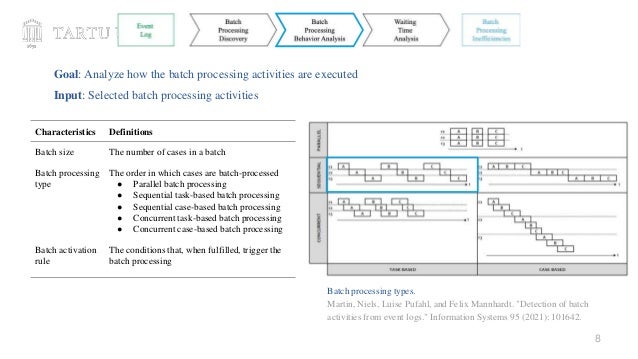
Characteristics Definitions
Batch size The number of cases in a batch
Batch processing
type
The order in which cases are batch-processed
● Parallel batch processing
● Sequential task-based batch processing
● Sequential case-based batch processing
● Concurrent task-based batch processing
● Concurrent case-based batch processing
Batch activation
rule
The conditions that, when fulfilled, trigger the
batch processing
Goal: Analyze how the batch processing activities are executed
Input: Selected batch processing activities
Batch processing types.
Martin, Niels, Luise Pufahl, and Felix Mannhardt. "Detection of batch
activities from event logs." Information Systems 95 (2021): 101642.
9
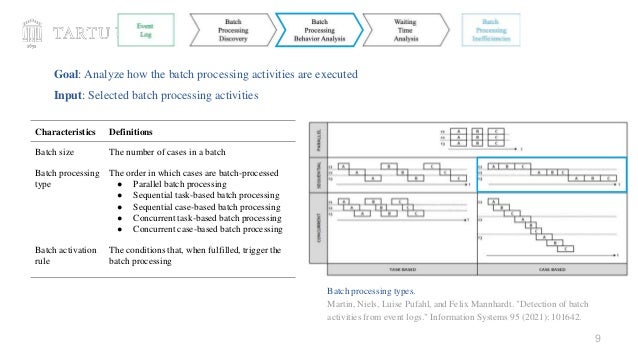
Characteristics Definitions
Batch size The number of cases in a batch
Batch processing
type
The order in which cases are batch-processed
● Parallel batch processing
● Sequential task-based batch processing
● Sequential case-based batch processing
● Concurrent task-based batch processing
● Concurrent case-based batch processing
Batch activation
rule
The conditions that, when fulfilled, trigger the
batch processing
Goal: Analyze how the batch processing activities are executed
Input: Selected batch processing activities
Batch processing types.
Martin, Niels, Luise Pufahl, and Felix Mannhardt. "Detection of batch
activities from event logs." Information Systems 95 (2021): 101642.
10
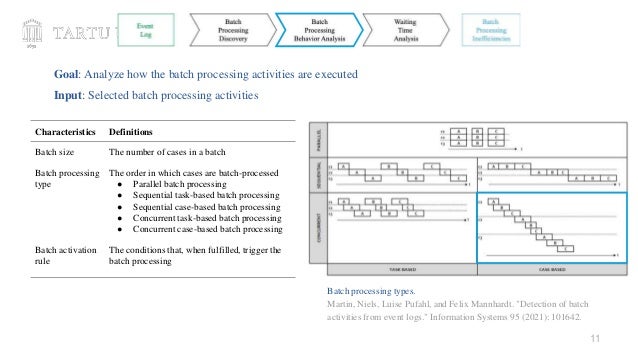
Characteristics Definitions
Batch size The number of cases in a batch
Batch processing
type
The order in which cases are batch-processed
● Parallel batch processing
● Sequential task-based batch processing
● Sequential case-based batch processing
● Concurrent task-based batch processing
● Concurrent case-based batch processing
Batch activation
rule
The conditions that, when fulfilled, trigger the
batch processing
Goal: Analyze how the batch processing activities are executed
Input: Selected batch processing activities
Batch processing types.
Martin, Niels, Luise Pufahl, and Felix Mannhardt. "Detection of batch
activities from event logs." Information Systems 95 (2021): 101642.
11
Characteristics Definitions
Batch size The number of cases in a batch
Batch processing
type
The order in which cases are batch-processed
● Parallel batch processing
● Sequential task-based batch processing
● Sequential case-based batch processing
● Concurrent task-based batch processing
● Concurrent case-based batch processing
Batch activation
rule
The conditions that, when fulfilled, trigger the
batch processing
Goal: Analyze how the batch processing activities are executed
Input: Selected batch processing activities
Batch processing types.
Martin, Niels, Luise Pufahl, and Felix Mannhardt. "Detection of batch
activities from event logs." Information Systems 95 (2021): 101642.
12
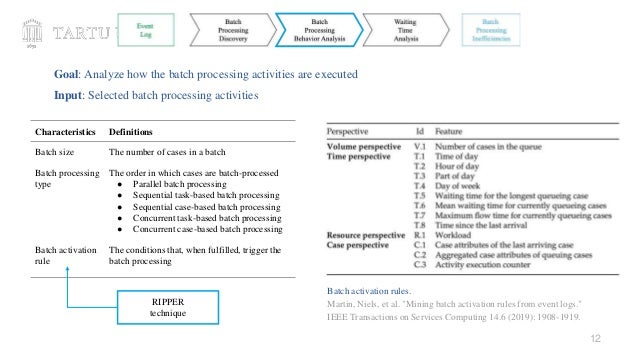
Characteristics Definitions
Batch size The number of cases in a batch
Batch processing
type
The order in which cases are batch-processed
● Parallel batch processing
● Sequential task-based batch processing
● Sequential case-based batch processing
● Concurrent task-based batch processing
● Concurrent case-based batch processing
Batch activation
rule
The conditions that, when fulfilled, trigger the
batch processing
Goal: Analyze how the batch processing activities are executed
Input: Selected batch processing activities
Batch activation rules.
Martin, Niels, et al. "Mining batch activation rules from event logs."
IEEE Transactions on Services Computing 14.6 (2019): 1908-1919.
RIPPER
technique
13
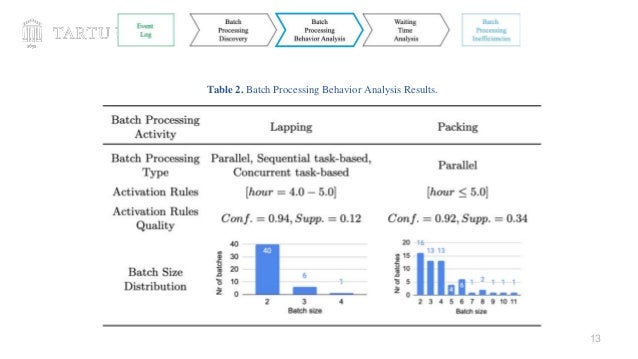
Table 2. Batch Processing Behavior Analysis Results.
14
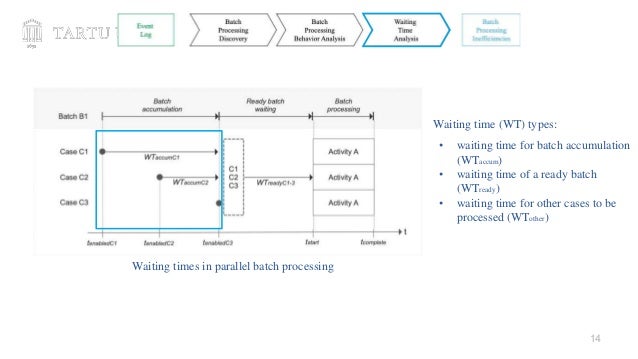
Waiting times in parallel batch processing
Waiting time (WT) types:
• waiting time for batch accumulation
(WTaccum)
• waiting time of a ready batch
(WTready)
• waiting time for other cases to be
processed (WTother)
15
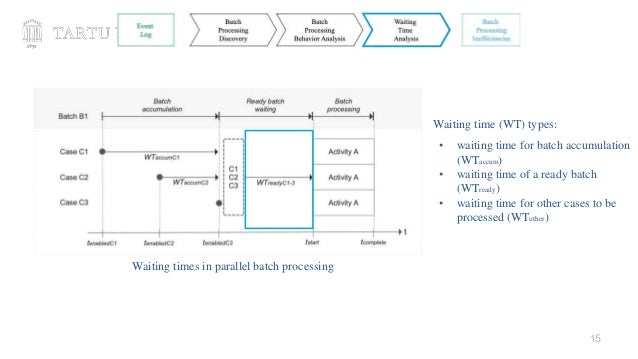
Waiting times in parallel batch processing
Waiting time (WT) types:
• waiting time for batch accumulation
(WTaccum)
• waiting time of a ready batch
(WTready)
• waiting time for other cases to be
processed (WTother)
16
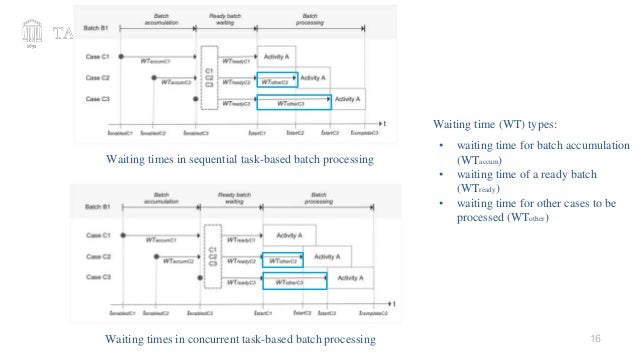
Waiting times in sequential task-based batch processing
Waiting times in concurrent task-based batch processing
Waiting time (WT) types:
• waiting time for batch accumulation
(WTaccum)
• waiting time of a ready batch
(WTready)
• waiting time for other cases to be
processed (WTother)
17
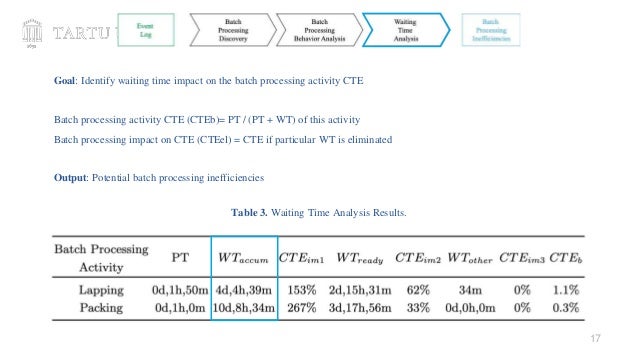
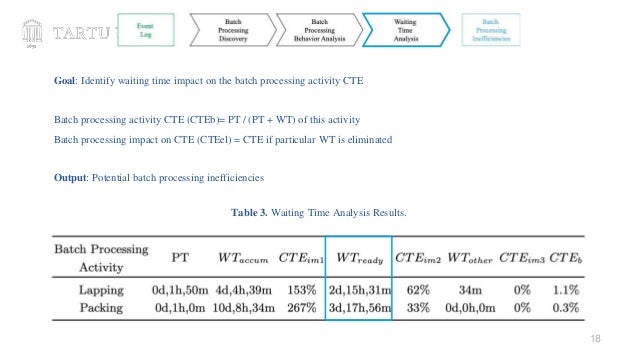
Goal: Identify waiting time impact on the batch processing activity CTE
Batch processing activity CTE (CTEb)= PT / (PT + WT) of this activity
Batch processing impact on CTE (CTEel) = CTE if particular WT is eliminated
Output: Potential batch processing inefficiencies
Table 3. Waiting Time Analysis Results.
18
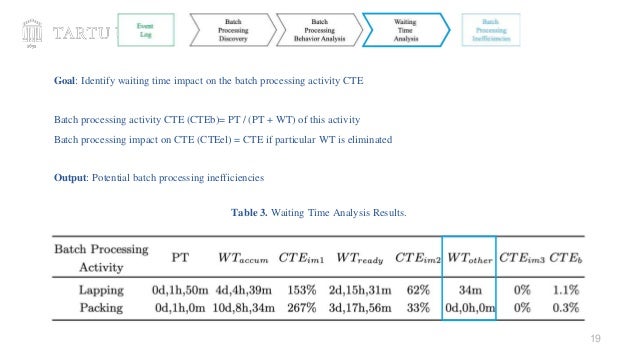
Goal: Identify waiting time impact on the batch processing activity CTE
Batch processing activity CTE (CTEb)= PT / (PT + WT) of this activity
Batch processing impact on CTE (CTEel) = CTE if particular WT is eliminated
Output: Potential batch processing inefficiencies
Table 3. Waiting Time Analysis Results.
19
Goal: Identify waiting time impact on the batch processing activity CTE
Batch processing activity CTE (CTEb)= PT / (PT + WT) of this activity
Batch processing impact on CTE (CTEel) = CTE if particular WT is eliminated
Output: Potential batch processing inefficiencies
Table 3. Waiting Time Analysis Results.
20
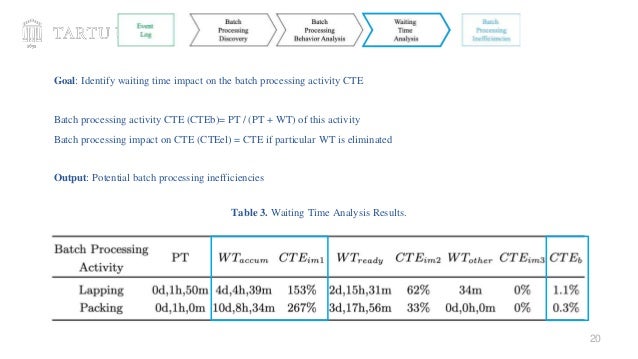
Goal: Identify waiting time impact on the batch processing activity CTE
Batch processing activity CTE (CTEb)= PT / (PT + WT) of this activity
Batch processing impact on CTE (CTEel) = CTE if particular WT is eliminated
Output: Potential batch processing inefficiencies
Table 3. Waiting Time Analysis Results.
21
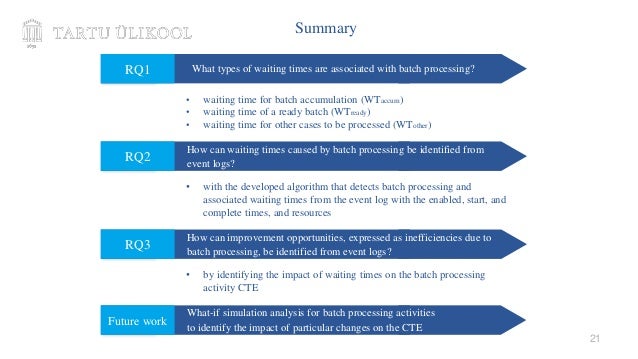
What types of waiting times are associated with batch processing?
RQ1
Summary
• waiting time for batch accumulation (WTaccum)
• waiting time of a ready batch (WTready)
• waiting time for other cases to be processed (WTother)
How can waiting times caused by batch processing be identified from
event logs?
RQ2
• with the developed algorithm that detects batch processing and
associated waiting times from the event log with the enabled, start, and
complete times, and resources
How can improvement opportunities, expressed as inefficiencies due to
batch processing, be identified from event logs?
RQ3
• by identifying the impact of waiting times on the batch processing
activity CTE
What-if simulation analysis for batch processing activities
to identify the impact of particular changes on the CTE
Future work
Katsiaryna Lashkevich
katsiaryna.lashkevich@ut.ee
PhD Student,
Junior Research Fellow
22
Thank you!
Katsiaryna Lashkevich
katsiaryna.lashkevich@ut.ee
PhD Student,
Junior Research Fellow
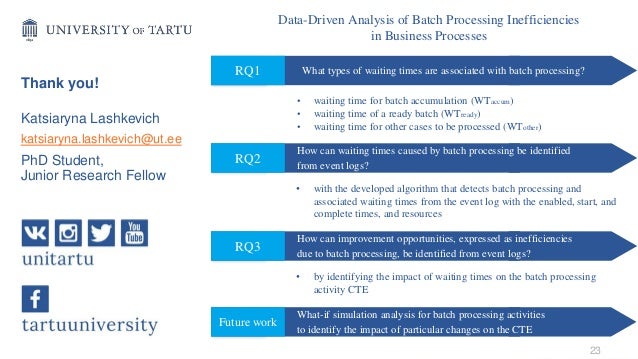
23
Data-Driven Analysis of Batch Processing Inefficiencies
in Business Processes
What types of waiting times are associated with batch processing?
RQ1
• waiting time for batch accumulation (WTaccum)
• waiting time of a ready batch (WTready)
• waiting time for other cases to be processed (WTother)
How can waiting times caused by batch processing be identified
from event logs?
RQ2
• with the developed algorithm that detects batch processing and
associated waiting times from the event log with the enabled, start, and
complete times, and resources
How can improvement opportunities, expressed as inefficiencies
due to batch processing, be identified from event logs?
RQ3
• by identifying the impact of waiting times on the batch processing
activity CTE
What-if simulation analysis for batch processing activities
to identify the impact of particular changes on the CTE
Future work
Thank you!

Data-Driven Analysis of Batch Processing Inefficiencies in Business Processes

  • 1.
    Data-Driven Analysis of BatchProcessing Inefficiencies in Business Processes Katsiaryna Lashkevich, Fredrik Milani, David Chapela-Campa, and Marlon Dumas University of Tartu, Narva mnt 18, 51009 Tartu, Estonia 16th International Conference on Research Challenges in Information Science (RCIS 2022)
  • 2.
    2 How can waitingtimes caused by batch processing be identified from event logs? RQ3 What types of waiting times are associated with batch processing? RQ2 How can improvement opportunities, expressed as inefficiencies due to batch processing, be identified from event logs? RQ1 Research Questions (RQs) Batch processing is when cases are accumulated and processed collectively as a group. Batch processing is a trade-off between reduced processing times and increased waiting times.
  • 3.
    3 Overview of theproposed approach
  • 4.
    4 Running example: Manufacturingproduction process • 225 traces • 26 activities • 4953 events • 48 resources • no multitasking
  • 5.
    5 Goal: Identify batchprocessing activities from an event log Technique: • based on Martin et al., "Detection of batch activities from event logs" (2021) • extension: all cases that are part of a batch must be enabled before the batch starts • enabled timestamps are added using the technique by Camargo et al., "Automated discovery of business process simulation models from event logs (2020) Input: • event log with the resources; start, complete and enabled timestamps (mandatory) • minimum number of cases to be considered a batch (optional) • maximum time gap between the end of processing of a particular case and the start of the next one (optional)
  • 6.
    6 Table 1. BatchProcessing Discovery Results.
  • 7.
    7 Characteristics Definitions Batch sizeThe number of cases in a batch Batch processing type The order in which cases are batch-processed ● Parallel batch processing ● Sequential task-based batch processing ● Sequential case-based batch processing ● Concurrent task-based batch processing ● Concurrent case-based batch processing Batch activation rule The conditions that, when fulfilled, trigger the batch processing Goal: Analyze how the batch processing activities are executed Input: Selected batch processing activities Batch processing types. Martin, Niels, Luise Pufahl, and Felix Mannhardt. "Detection of batch activities from event logs." Information Systems 95 (2021): 101642.
  • 8.
    8 Characteristics Definitions Batch sizeThe number of cases in a batch Batch processing type The order in which cases are batch-processed ● Parallel batch processing ● Sequential task-based batch processing ● Sequential case-based batch processing ● Concurrent task-based batch processing ● Concurrent case-based batch processing Batch activation rule The conditions that, when fulfilled, trigger the batch processing Goal: Analyze how the batch processing activities are executed Input: Selected batch processing activities Batch processing types. Martin, Niels, Luise Pufahl, and Felix Mannhardt. "Detection of batch activities from event logs." Information Systems 95 (2021): 101642.
  • 9.
    9 Characteristics Definitions Batch sizeThe number of cases in a batch Batch processing type The order in which cases are batch-processed ● Parallel batch processing ● Sequential task-based batch processing ● Sequential case-based batch processing ● Concurrent task-based batch processing ● Concurrent case-based batch processing Batch activation rule The conditions that, when fulfilled, trigger the batch processing Goal: Analyze how the batch processing activities are executed Input: Selected batch processing activities Batch processing types. Martin, Niels, Luise Pufahl, and Felix Mannhardt. "Detection of batch activities from event logs." Information Systems 95 (2021): 101642.
  • 10.
    10 Characteristics Definitions Batch sizeThe number of cases in a batch Batch processing type The order in which cases are batch-processed ● Parallel batch processing ● Sequential task-based batch processing ● Sequential case-based batch processing ● Concurrent task-based batch processing ● Concurrent case-based batch processing Batch activation rule The conditions that, when fulfilled, trigger the batch processing Goal: Analyze how the batch processing activities are executed Input: Selected batch processing activities Batch processing types. Martin, Niels, Luise Pufahl, and Felix Mannhardt. "Detection of batch activities from event logs." Information Systems 95 (2021): 101642.
  • 11.
    11 Characteristics Definitions Batch sizeThe number of cases in a batch Batch processing type The order in which cases are batch-processed ● Parallel batch processing ● Sequential task-based batch processing ● Sequential case-based batch processing ● Concurrent task-based batch processing ● Concurrent case-based batch processing Batch activation rule The conditions that, when fulfilled, trigger the batch processing Goal: Analyze how the batch processing activities are executed Input: Selected batch processing activities Batch processing types. Martin, Niels, Luise Pufahl, and Felix Mannhardt. "Detection of batch activities from event logs." Information Systems 95 (2021): 101642.
  • 12.
    12 Characteristics Definitions Batch sizeThe number of cases in a batch Batch processing type The order in which cases are batch-processed ● Parallel batch processing ● Sequential task-based batch processing ● Sequential case-based batch processing ● Concurrent task-based batch processing ● Concurrent case-based batch processing Batch activation rule The conditions that, when fulfilled, trigger the batch processing Goal: Analyze how the batch processing activities are executed Input: Selected batch processing activities Batch activation rules. Martin, Niels, et al. "Mining batch activation rules from event logs." IEEE Transactions on Services Computing 14.6 (2019): 1908-1919. RIPPER technique
  • 13.
    13 Table 2. BatchProcessing Behavior Analysis Results.
  • 14.
    14 Waiting times inparallel batch processing Waiting time (WT) types: • waiting time for batch accumulation (WTaccum) • waiting time of a ready batch (WTready) • waiting time for other cases to be processed (WTother)
  • 15.
    15 Waiting times inparallel batch processing Waiting time (WT) types: • waiting time for batch accumulation (WTaccum) • waiting time of a ready batch (WTready) • waiting time for other cases to be processed (WTother)
  • 16.
    16 Waiting times insequential task-based batch processing Waiting times in concurrent task-based batch processing Waiting time (WT) types: • waiting time for batch accumulation (WTaccum) • waiting time of a ready batch (WTready) • waiting time for other cases to be processed (WTother)
  • 17.
    17 Goal: Identify waitingtime impact on the batch processing activity CTE Batch processing activity CTE (CTEb)= PT / (PT + WT) of this activity Batch processing impact on CTE (CTEel) = CTE if particular WT is eliminated Output: Potential batch processing inefficiencies Table 3. Waiting Time Analysis Results.
  • 18.
    18 Goal: Identify waitingtime impact on the batch processing activity CTE Batch processing activity CTE (CTEb)= PT / (PT + WT) of this activity Batch processing impact on CTE (CTEel) = CTE if particular WT is eliminated Output: Potential batch processing inefficiencies Table 3. Waiting Time Analysis Results.
  • 19.
    19 Goal: Identify waitingtime impact on the batch processing activity CTE Batch processing activity CTE (CTEb)= PT / (PT + WT) of this activity Batch processing impact on CTE (CTEel) = CTE if particular WT is eliminated Output: Potential batch processing inefficiencies Table 3. Waiting Time Analysis Results.
  • 20.
    20 Goal: Identify waitingtime impact on the batch processing activity CTE Batch processing activity CTE (CTEb)= PT / (PT + WT) of this activity Batch processing impact on CTE (CTEel) = CTE if particular WT is eliminated Output: Potential batch processing inefficiencies Table 3. Waiting Time Analysis Results.
  • 21.
    21 What types ofwaiting times are associated with batch processing? RQ1 Summary • waiting time for batch accumulation (WTaccum) • waiting time of a ready batch (WTready) • waiting time for other cases to be processed (WTother) How can waiting times caused by batch processing be identified from event logs? RQ2 • with the developed algorithm that detects batch processing and associated waiting times from the event log with the enabled, start, and complete times, and resources How can improvement opportunities, expressed as inefficiencies due to batch processing, be identified from event logs? RQ3 • by identifying the impact of waiting times on the batch processing activity CTE What-if simulation analysis for batch processing activities to identify the impact of particular changes on the CTE Future work
  • 22.
  • 23.
    Katsiaryna Lashkevich katsiaryna.lashkevich@ut.ee PhD Student, JuniorResearch Fellow 23 Data-Driven Analysis of Batch Processing Inefficiencies in Business Processes What types of waiting times are associated with batch processing? RQ1 • waiting time for batch accumulation (WTaccum) • waiting time of a ready batch (WTready) • waiting time for other cases to be processed (WTother) How can waiting times caused by batch processing be identified from event logs? RQ2 • with the developed algorithm that detects batch processing and associated waiting times from the event log with the enabled, start, and complete times, and resources How can improvement opportunities, expressed as inefficiencies due to batch processing, be identified from event logs? RQ3 • by identifying the impact of waiting times on the batch processing activity CTE What-if simulation analysis for batch processing activities to identify the impact of particular changes on the CTE Future work Thank you!