Presented by Ducatus
AI USES IN
FINTECH
In order to understand the far reaches of
artificial intelligence (AI), we must first
understand what AI is. AI is the science of
computer systems imitating human thinking.
There are two forms of AI: weak and strong.
INTRODUCTION
Weak AI
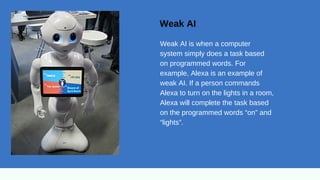
Weak AI is when a computer
system simply does a task based
on programmed words. For
example, Alexa is an example of
weak AI. If a person commands
Alexa to turn on the lights in a room,
Alexa will complete the task based
on the programmed words “on” and
“lights”.
There is more “thinking” involved when it
comes to strong AI. It will complete tasks
or anticipate human responses based on
data. A great example is a robot in a
factory. The robot will learn a task and after
a set amount of repetitions, the robot will
learn new ways to perform the task faster
and more efficiently.
Preparing and Handling Fish | Group 1A
STRONG AI
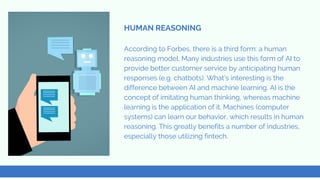
According to Forbes, there is a third form: a human
reasoning model. Many industries use this form of AI to
provide better customer service by anticipating human
responses (e.g. chatbots). What’s interesting is the
difference between AI and machine learning. AI is the
concept of imitating human thinking, whereas machine
learning is the application of it. Machines (computer
systems) can learn our behavior, which results in human
reasoning. This greatly benefits a number of industries,
especially those utilizing fintech.
HUMAN REASONING
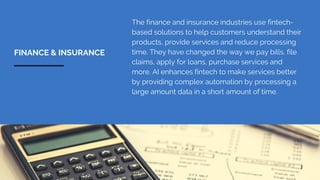
The finance and insurance industries use fintech-
based solutions to help customers understand their
products, provide services and reduce processing
time. They have changed the way we pay bills, file
claims, apply for loans, purchase services and
more. AI enhances fintech to make services better
by providing complex automation by processing a
large amount data in a short amount of time.
FINANCE & INSURANCE
By processing a customer’s data, computer
systems learn behavior patterns (e.g. spending)
to determine what services are needed and
provide financial (or insurance) guidance. AI
programs reduce time in reading and recording
data as well as processing claims and assessing
risk. Also, their services add layer of protection.
AI tools enable companies to detect fraud and
money laundering in progress as well as predict
incidences.
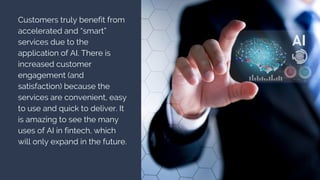
Customers truly benefit from
accelerated and “smart”
services due to the
application of AI. There is
increased customer
engagement (and
satisfaction) because the
services are convenient, easy
to use and quick to deliver. It
is amazing to see the many
uses of AI in fintech, which
will only expand in the future.
THANK YOU

AI USES IN FINTECH

  • 1.
    Presented by Ducatus AIUSES IN FINTECH
  • 2.
    In order tounderstand the far reaches of artificial intelligence (AI), we must first understand what AI is. AI is the science of computer systems imitating human thinking. There are two forms of AI: weak and strong. INTRODUCTION
  • 3.
    Weak AI Weak AIis when a computer system simply does a task based on programmed words. For example, Alexa is an example of weak AI. If a person commands Alexa to turn on the lights in a room, Alexa will complete the task based on the programmed words “on” and “lights”.
  • 4.
    There is more“thinking” involved when it comes to strong AI. It will complete tasks or anticipate human responses based on data. A great example is a robot in a factory. The robot will learn a task and after a set amount of repetitions, the robot will learn new ways to perform the task faster and more efficiently. Preparing and Handling Fish | Group 1A STRONG AI
  • 5.
    According to Forbes,there is a third form: a human reasoning model. Many industries use this form of AI to provide better customer service by anticipating human responses (e.g. chatbots). What’s interesting is the difference between AI and machine learning. AI is the concept of imitating human thinking, whereas machine learning is the application of it. Machines (computer systems) can learn our behavior, which results in human reasoning. This greatly benefits a number of industries, especially those utilizing fintech. HUMAN REASONING
  • 6.
    The finance andinsurance industries use fintech- based solutions to help customers understand their products, provide services and reduce processing time. They have changed the way we pay bills, file claims, apply for loans, purchase services and more. AI enhances fintech to make services better by providing complex automation by processing a large amount data in a short amount of time. FINANCE & INSURANCE
  • 7.
    By processing acustomer’s data, computer systems learn behavior patterns (e.g. spending) to determine what services are needed and provide financial (or insurance) guidance. AI programs reduce time in reading and recording data as well as processing claims and assessing risk. Also, their services add layer of protection. AI tools enable companies to detect fraud and money laundering in progress as well as predict incidences.
  • 8.
    Customers truly benefitfrom accelerated and “smart” services due to the application of AI. There is increased customer engagement (and satisfaction) because the services are convenient, easy to use and quick to deliver. It is amazing to see the many uses of AI in fintech, which will only expand in the future.
  • 9.