Process Mining for Process
Improvement - An Evaluation of
Analysis Practices
Kateryna Kubrak, Fredrik Milani, Alexander Nolte
University of Tartu,
Narva mnt 18, 51009 Tartu, Estonia
16th International Conference on Research Challenges
in Information Science (RCIS 2022)
2
Anna
Process Analyst at ABC
I need to schedule a
meeting to get the
inputs from manager X.
I still have those
50 pages of
documentation
left to read.
The presentation of the
diagrams is due Monday
so I better get to it.
A day in Anna's life
before process mining …
Introduction
3
Introduction
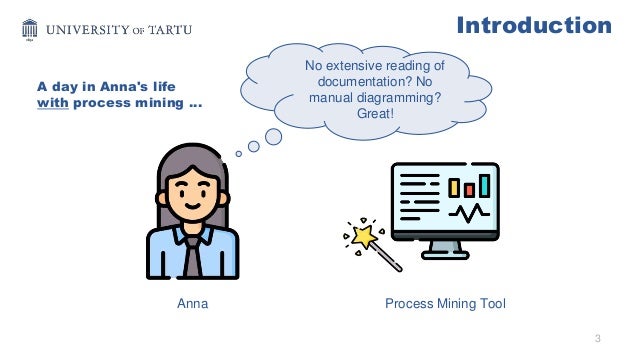
Anna Process Mining Tool
No extensive reading of
documentation? No
manual diagramming?
Great!
A day in Anna's life
with process mining …
4
Introduction
Anna Process Mining Tool
A day in Anna's life
with process mining …
5
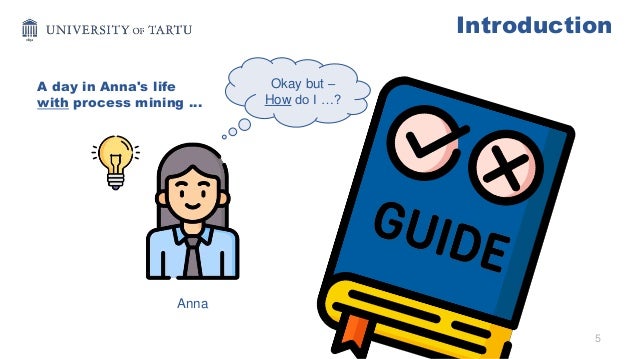
Introduction
Anna Process Mining Tool
A day in Anna's life
with process mining …
Okay but –
How do I …?
Problem Statement
Previous work
● Studies on practical aspects of process mining, such as process
managers’ perception of adopting, using, and managing process
mining1
● Studies on how process mining is used by organizations2
● The need to research teams and skills needed for successful
process mining projects has been highlighted3
1Grisold,T.,Mendling,J.,Otto,M.,vom Brocke,J.:Adoption, use and management of process mining in practice. Bus. Process. Manag. J. 27(2), 369–387 (2021)
2Thiede, M., Fuerstenau, D., Barquet, A.P.B.: How is process mining technology used by organizations? A systematic literature review of empirical studies. Bus.
Process. Manag. J. 24(4), 900–922 (2018)
3Martin, N., Fischer, D.A., Kerpedzhiev, G.D., Goel, K.,Leemans, S.J.J., Röglinger, M., van der Aalst, W.M.P., Dumas, M., Rosa, M.L., Wynn, M.T.: Opportunities and
challenges for process mining in organizations: Results of a delphi study. Bus. Inf. Syst. Eng. 63(5), 511–527 (2021)
Problem Statement
Research objective
How do process analysts work with process mining when engaged in
process improvement initiatives?
● RQ1 How do process analysts use process mining to identify
improvement opportunities?
● RQ2 How do process analysts use process mining to select
improvement opportunities to address?
● RQ3 How do process analysts use process mining to communicate
their findings?
Method - Study Setup
Exploratory interview study
with 7 participants
Selected based on …
… their role (working internally in
the company or as a consultant)
… and their experience as a
process analyst
Semi-structured
online interviews
Method - Study Setup
Code Domain Project Study role (experience)
I-01 Electrical
Engineering
Improving order-to-fulfillment process Internal process analyst
(2 years)
I-02 Insurance Improving claim-to-resolution process Internal process analyst
(1 year)
I-03 Public Services Improving application-to-approval
process for immigration
Internal process analyst
(1 year)
I-04 Data Science Improving application-to-approval
process
Consultant
(4 years)
I-05 Auditing Analyzing claim-to-resolution process
at a regional paying agency
Consultant
(2 years)
I-06 Process Mining Analyzing standardization and
harmonization of processes
Consultant
(5 years)
I-07 E-Commerce Improving order-to-cash process Internal process analyst
(1 year)
Method - Data Collection
Interview guide based on RQs (sample questions):
RQ1 – Improvement opportunity identification
● "Were any visualizations used to help identify the improvement opportunity?"
● "What challenges did you have when you tried to analyze the process?"
RQ2 – Improvement opportunity prioritization
● "How was it decided which improvement opportunity to address?"
● "Who made this decision?"
RQ3 – Improvement opportunity communication
● "Who were the results presented to?"
● "How did you present your results?"
11
Results
RQ1 – Finding 1
Identify improvement opportunities
using structured methods. Develop
own methods based on experience.
12
Results
RQ1 – Finding 2
Divide the problem into sub-
problems to investigate them
separately.
13
Results
RQ1 – Finding 3
Visually analyze discovered
process models in process mining
tools. Use other tools for advanced
view into the analyzed data and
visualizations.
14
Results
RQ1 – Finding 4
Find a compromise between the
domain knowledge and process
mining outlook of the problem.
15
Results
RQ2 – Finding 1
Assess the impact of the finding on
the process in terms of its location
and number of cases and variants
involved.
16
Results
RQ2 – Finding 2
Analyze the dependency on entities
outside of the process or the
organization.
17
Results
RQ2 – Finding 3
Assess the financial gain of
addressing the improvement
opportunity.
18
Results
RQ3 – Finding 1
Use storytelling to present the
improvement opportunities and
select visual representations
according to the story.
19
Results
RQ3 – Finding 2
Adjust the communication to the client's
needs (i.e. including more technical or
business details).
Discussion
To identify improvement opportunities
(RQ1)
● Take structured approach and consider adjusting
an existing method to own projects.
● Decompose the big problem into separate
problems and investigate them separately.
● Apply business-driven rationale when using
process mining for analysis.
● Consult other tools for deeper insight into data,
where required.
Discussion
To select improvement opportunities (RQ2)
● Analyze the improvement opportunity wrt its
location and proportion of cases/variants affected.
● Consider improvement opportunity's dependency
on outside entities.
● Estimate potential savings and costs.
Discussion
To communicate improvement opportunities
(RQ3)
● Consider structuring the communication using
storytelling.
● Adjust the story wrt to the audience's knowledge of
process mining and the domain.
23
Implications
For developers of process mining
tools
Process mining tools can be enhanced to use
visualization and patterns to:
● facilitate analysis of dependencies of a
process with other processes,
● improve visualizations for communication
purposes,
● and incorporate support for financial
implications of the processes.
24
Implications
For researchers
Directions for further research to facilitate
process analysts' work with improvement
opportunities:
● process mining templates to help identify
common improvement opportunities,
● algorithms for data-driven discovery of
improvement opportunities.
Conclusion
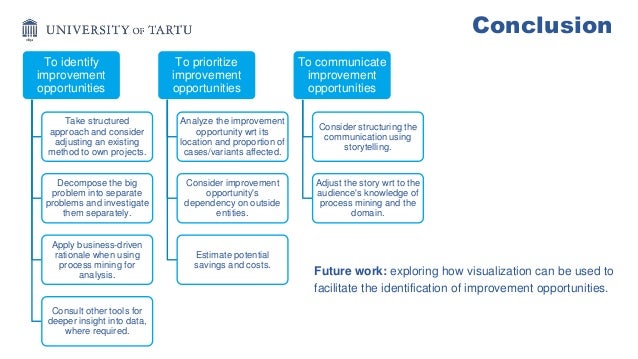
To identify
improvement
opportunities
Take structured
approach and consider
adjusting an existing
method to own projects.
Decompose the big
problem into separate
problems and investigate
them separately.
Apply business-driven
rationale when using
process mining for
analysis.
Consult other tools for
deeper insight into data,
where required.
To prioritize
improvement
opportunities
Analyze the improvement
opportunity wrt its
location and proportion of
cases/variants affected.
Consider improvement
opportunity's
dependency on outside
entities.
Estimate potential
savings and costs.
To communicate
improvement
opportunities
Consider structuring the
communication using
storytelling.
Adjust the story wrt to the
audience's knowledge of
process mining and the
domain.
Future work: exploring how visualization can be used to
facilitate the identification of improvement opportunities.
Thank you!
Kateryna Kubrak
kateryna.kubrak@ut.ee
PhD Student
Institute of Computer Science
University of Tartu
26
Icons by Freepik on flaticon.com
To identify
improvement
opportunities
Take structured
approach and consider
adjusting an existing
method to own projects.
Decompose the big
problem into separate
problems and investigate
them separately.
Apply business-driven
rationale when using
process mining for
analysis.
Consult other tools for
deeper insight into data,
where required.
To prioritize
improvement
opportunities
Analyze the improvement
opportunity wrt its
location and proportion of
cases/variants affected.
Consider improvement
opportunity's
dependency on outside
entities.
Estimate potential
savings and costs.
To communicate
improvement
opportunities
Consider structuring the
communication using
storytelling.
Adjust the story wrt to the
audience's knowledge of
process mining and the
domain.
Link to paper:

Process Mining for Process Improvement.pptx

  • 1.
    Process Mining forProcess Improvement - An Evaluation of Analysis Practices Kateryna Kubrak, Fredrik Milani, Alexander Nolte University of Tartu, Narva mnt 18, 51009 Tartu, Estonia 16th International Conference on Research Challenges in Information Science (RCIS 2022)
  • 2.
    2 Anna Process Analyst atABC I need to schedule a meeting to get the inputs from manager X. I still have those 50 pages of documentation left to read. The presentation of the diagrams is due Monday so I better get to it. A day in Anna's life before process mining … Introduction
  • 3.
    3 Introduction Anna Process MiningTool No extensive reading of documentation? No manual diagramming? Great! A day in Anna's life with process mining …
  • 4.
    4 Introduction Anna Process MiningTool A day in Anna's life with process mining …
  • 5.
    5 Introduction Anna Process MiningTool A day in Anna's life with process mining … Okay but – How do I …?
  • 6.
    Problem Statement Previous work ●Studies on practical aspects of process mining, such as process managers’ perception of adopting, using, and managing process mining1 ● Studies on how process mining is used by organizations2 ● The need to research teams and skills needed for successful process mining projects has been highlighted3 1Grisold,T.,Mendling,J.,Otto,M.,vom Brocke,J.:Adoption, use and management of process mining in practice. Bus. Process. Manag. J. 27(2), 369–387 (2021) 2Thiede, M., Fuerstenau, D., Barquet, A.P.B.: How is process mining technology used by organizations? A systematic literature review of empirical studies. Bus. Process. Manag. J. 24(4), 900–922 (2018) 3Martin, N., Fischer, D.A., Kerpedzhiev, G.D., Goel, K.,Leemans, S.J.J., Röglinger, M., van der Aalst, W.M.P., Dumas, M., Rosa, M.L., Wynn, M.T.: Opportunities and challenges for process mining in organizations: Results of a delphi study. Bus. Inf. Syst. Eng. 63(5), 511–527 (2021)
  • 7.
    Problem Statement Research objective Howdo process analysts work with process mining when engaged in process improvement initiatives? ● RQ1 How do process analysts use process mining to identify improvement opportunities? ● RQ2 How do process analysts use process mining to select improvement opportunities to address? ● RQ3 How do process analysts use process mining to communicate their findings?
  • 8.
    Method - StudySetup Exploratory interview study with 7 participants Selected based on … … their role (working internally in the company or as a consultant) … and their experience as a process analyst Semi-structured online interviews
  • 9.
    Method - StudySetup Code Domain Project Study role (experience) I-01 Electrical Engineering Improving order-to-fulfillment process Internal process analyst (2 years) I-02 Insurance Improving claim-to-resolution process Internal process analyst (1 year) I-03 Public Services Improving application-to-approval process for immigration Internal process analyst (1 year) I-04 Data Science Improving application-to-approval process Consultant (4 years) I-05 Auditing Analyzing claim-to-resolution process at a regional paying agency Consultant (2 years) I-06 Process Mining Analyzing standardization and harmonization of processes Consultant (5 years) I-07 E-Commerce Improving order-to-cash process Internal process analyst (1 year)
  • 10.
    Method - DataCollection Interview guide based on RQs (sample questions): RQ1 – Improvement opportunity identification ● "Were any visualizations used to help identify the improvement opportunity?" ● "What challenges did you have when you tried to analyze the process?" RQ2 – Improvement opportunity prioritization ● "How was it decided which improvement opportunity to address?" ● "Who made this decision?" RQ3 – Improvement opportunity communication ● "Who were the results presented to?" ● "How did you present your results?"
  • 11.
    11 Results RQ1 – Finding1 Identify improvement opportunities using structured methods. Develop own methods based on experience.
  • 12.
    12 Results RQ1 – Finding2 Divide the problem into sub- problems to investigate them separately.
  • 13.
    13 Results RQ1 – Finding3 Visually analyze discovered process models in process mining tools. Use other tools for advanced view into the analyzed data and visualizations.
  • 14.
    14 Results RQ1 – Finding4 Find a compromise between the domain knowledge and process mining outlook of the problem.
  • 15.
    15 Results RQ2 – Finding1 Assess the impact of the finding on the process in terms of its location and number of cases and variants involved.
  • 16.
    16 Results RQ2 – Finding2 Analyze the dependency on entities outside of the process or the organization.
  • 17.
    17 Results RQ2 – Finding3 Assess the financial gain of addressing the improvement opportunity.
  • 18.
    18 Results RQ3 – Finding1 Use storytelling to present the improvement opportunities and select visual representations according to the story.
  • 19.
    19 Results RQ3 – Finding2 Adjust the communication to the client's needs (i.e. including more technical or business details).
  • 20.
    Discussion To identify improvementopportunities (RQ1) ● Take structured approach and consider adjusting an existing method to own projects. ● Decompose the big problem into separate problems and investigate them separately. ● Apply business-driven rationale when using process mining for analysis. ● Consult other tools for deeper insight into data, where required.
  • 21.
    Discussion To select improvementopportunities (RQ2) ● Analyze the improvement opportunity wrt its location and proportion of cases/variants affected. ● Consider improvement opportunity's dependency on outside entities. ● Estimate potential savings and costs.
  • 22.
    Discussion To communicate improvementopportunities (RQ3) ● Consider structuring the communication using storytelling. ● Adjust the story wrt to the audience's knowledge of process mining and the domain.
  • 23.
    23 Implications For developers ofprocess mining tools Process mining tools can be enhanced to use visualization and patterns to: ● facilitate analysis of dependencies of a process with other processes, ● improve visualizations for communication purposes, ● and incorporate support for financial implications of the processes.
  • 24.
    24 Implications For researchers Directions forfurther research to facilitate process analysts' work with improvement opportunities: ● process mining templates to help identify common improvement opportunities, ● algorithms for data-driven discovery of improvement opportunities.
  • 25.
    Conclusion To identify improvement opportunities Take structured approachand consider adjusting an existing method to own projects. Decompose the big problem into separate problems and investigate them separately. Apply business-driven rationale when using process mining for analysis. Consult other tools for deeper insight into data, where required. To prioritize improvement opportunities Analyze the improvement opportunity wrt its location and proportion of cases/variants affected. Consider improvement opportunity's dependency on outside entities. Estimate potential savings and costs. To communicate improvement opportunities Consider structuring the communication using storytelling. Adjust the story wrt to the audience's knowledge of process mining and the domain. Future work: exploring how visualization can be used to facilitate the identification of improvement opportunities.
  • 26.
    Thank you! Kateryna Kubrak kateryna.kubrak@ut.ee PhDStudent Institute of Computer Science University of Tartu 26 Icons by Freepik on flaticon.com To identify improvement opportunities Take structured approach and consider adjusting an existing method to own projects. Decompose the big problem into separate problems and investigate them separately. Apply business-driven rationale when using process mining for analysis. Consult other tools for deeper insight into data, where required. To prioritize improvement opportunities Analyze the improvement opportunity wrt its location and proportion of cases/variants affected. Consider improvement opportunity's dependency on outside entities. Estimate potential savings and costs. To communicate improvement opportunities Consider structuring the communication using storytelling. Adjust the story wrt to the audience's knowledge of process mining and the domain. Link to paper: