Insurance Markets Under Different
                       State Scenarios
Lynn Blewett, Director
State Health Access Data Assistance Center (SHADAC)
University of Minnesota

Health Care: Decision Points for States
National Governors Association
July 19, 2012


                  Funded by a grant from the Robert Wood Johnson Foundation   1
Overview
1.   Overview of Changes Post-SCOTUS
2.   Cost of doing nothing
3.   New state questions
4.   Estimates by new Income Categories
5.   Data Resources


                                          2
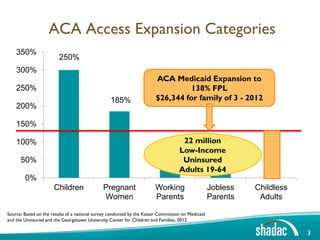
ACA Access Expansion Categories
    350%
                         250%
    300%
                                                                        ACA Medicaid Expansion to
    250%                                                                          138% FPL
                                                  185%                  $26,344 for family of 3 - 2012
    200%

    150%

    100%                                                                       22 million
                                                                          63% Low-Income
      50%                                                                              37%
                                                                               Uninsured
                                                                              Adults 19-64                      0
        0%
                      Children                Pregnant                 Working                     Jobless   Childless
                                              Women                    Parents                     Parents    Adults

Source: Based on the results of a national survey conducted by the Kaiser Commission on Medicaid
and the Uninsured and the Georgetown University Center for Children and Families, 2012.

                                                                                                                         3
Key Supreme Court Decision

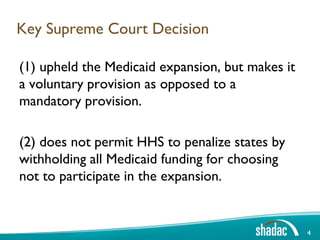
(1) upheld the Medicaid expansion, but makes it
a voluntary provision as opposed to a
mandatory provision.

(2) does not permit HHS to penalize states by
withholding all Medicaid funding for choosing
not to participate in the expansion.


                                                  4
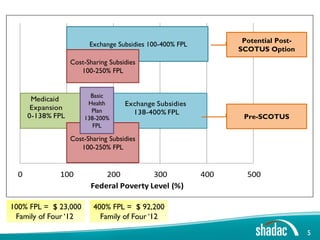
Potential Post-
                         Exchange Subsidies 100-400% FPL
                                                                 SCOTUS Option
                   Cost-Sharing Subsidies
                      100-250% FPL


                         Basic
       Medicaid
                        Health       Exchange Subsidies
       Expansion         Plan
      0-138% FPL                       138-400% FPL
                       138-200%                                   Pre-SCOTUS
                          FPL

                   Cost-Sharing Subsidies
                      100-250% FPL


  0           100            200          300              400     500
                         Federal Poverty Level (%)

100% FPL = $ 23,000       400% FPL = $ 92,200
 Family of Four ‘12         Family of Four ‘12

                                                                                    5
Cost of not Participating
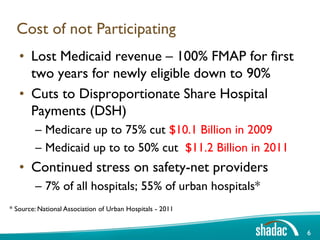
   • Lost Medicaid revenue – 100% FMAP for first
     two years for newly eligible down to 90%
   • Cuts to Disproportionate Share Hospital
     Payments (DSH)
        – Medicare up to 75% cut $10.1 Billion in 2009
        – Medicaid up to to 50% cut $11.2 Billion in 2011
   • Continued stress on safety-net providers
        – 7% of all hospitals; 55% of urban hospitals*
* Source: National Association of Urban Hospitals - 2011


                                                            6
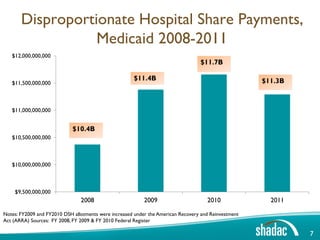
Disproportionate Hospital Share Payments,
                  Medicaid 2008-2011
   $12,000,000,000
                                                                                   $11.7B

                                                      $11.4B                                          $11.3B
   $11,500,000,000


   $11,000,000,000


                             $10.4B
   $10,500,000,000


   $10,000,000,000


    $9,500,000,000
                                2008                       2009                      2010               2011

Notes: FY2009 and FY2010 DSH allotments were increased under the American Recovery and Reinvestment
Act (ARRA) Sources: FY 2008, FY 2009 & FY 2010 Federal Register

                                                                                                               7
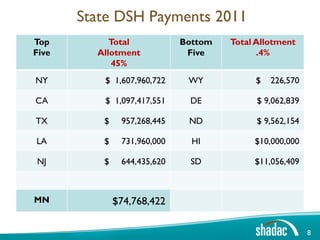
State DSH Payments 2011
Top         Total            Bottom   Total Allotment
Five     Allotment            Five          .4%
            45%
NY        $ 1,607,960,722     WY           $   226,570

CA        $ 1,097,417,551     DE            $ 9,062,839

TX        $    957,268,445    ND            $ 9,562,154

LA        $    731,960,000     HI          $10,000,000

NJ        $    644,435,620     SD          $11,056,409


MN            $74,768,422

                                                          8
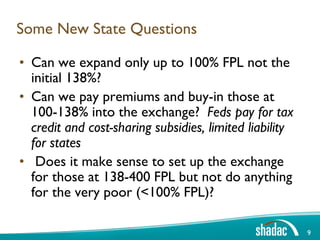
Some New State Questions

• Can we expand only up to 100% FPL not the
  initial 138%?
• Can we pay premiums and buy-in those at
  100-138% into the exchange? Feds pay for tax
  credit and cost-sharing subsidies, limited liability
  for states
• Does it make sense to set up the exchange
  for those at 138-400 FPL but not do anything
  for the very poor (<100% FPL)?

                                                         9
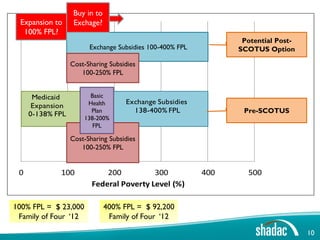
Buy in to
 Expansion to      Exchage?
  100% FPL?
                                                                 Potential Post-
                        Exchange Subsidies 100-400% FPL         SCOTUS Option

                  Cost-Sharing Subsidies
                     100-250% FPL


      Medicaid          Basic
                       Health        Exchange Subsidies
      Expansion
     0-138% FPL         Plan           138-400% FPL              Pre-SCOTUS
                      138-200%
                         FPL

                  Cost-Sharing Subsidies
                     100-250% FPL


 0           100             200          300             400     500
                         Federal Poverty Level (%)

100% FPL = $ 23,000            400% FPL = $ 92,200
 Family of Four ‘12             Family of Four ‘12

                                                                                   10
Subsidy Amount by FPL                                    Average 2011 US Premium for
                                                               Single Coverage $5,429
               Possible State
      $6,000      Buy-in?

      $5,000
                                                                              $1,184
      $4,000                                                        $2,246
                                                         $3,055
      $3,000
                                                $4,022
      $2,000

                                 $4,759
      $1,000
                 $5,320

         $-

                  133%            150%            200%    250%       300%       400%

Source: Employer Health Benefits 2011 Annual Survey
                                                                                           11
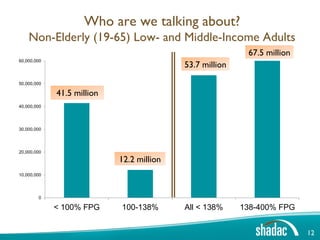
Who are we talking about?
    Non-Elderly (19-65) Low- and Middle-Income Adults
                                                           67.5 million
60,000,000
                                           53.7 million
50,000,000

             41.5 million
40,000,000


30,000,000


20,000,000
                            12.2 million
10,000,000


        0

             < 100% FPG     100-138%       All < 138%     138-400% FPG


                                                                          12
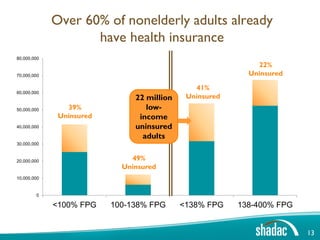
Over 60% of nonelderly adults already
                    have health insurance
80,000,000
                                                             22%
70,000,000                                                 Uninsured

                                               41%
60,000,000
                               22 million    Uninsured
50,000,000      39%               low-
              Uninsured         income
40,000,000                     uninsured
                                 adults
30,000,000


20,000,000                    49%
                            Uninsured
10,000,000


        0

             <100% FPG    100-138% FPG      <138% FPG    138-400% FPG


                                                                        13
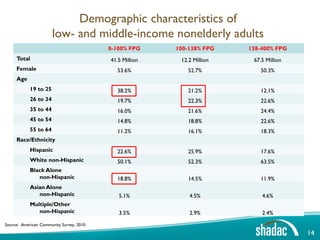
Demographic characteristics of
                       low- and middle-income nonelderly adults
                                          0-100% FPG     100-138% FPG    138-400% FPG
     Total                                41.5 Million    12.2 Million    67.5 Million
     Female                                 53.6%           52.7%           50.3%
     Age
            19 to 25                        38.2%           21.2%           12.1%
            26 to 34                        19.7%           22.3%           22.6%
            35 to 44                        16.0%           21.6%           24.4%
            45 to 54                        14.8%           18.8%           22.6%
            55 to 64                        11.2%           16.1%           18.3%
     Race/Ethnicity
            Hispanic                        22.6%           25.9%           17.6%
            White non-Hispanic              50.1%           52.3%           63.5%
            Black Alone
               non-Hispanic                 18.8%           14.5%           11.9%
            Asian Alone
               non-Hispanic                  5.1%            4.5%            4.6%
            Multiple/Other
               non-Hispanic                  3.5%            2.9%            2.4%
Source: American Community Survey, 2010

                                                                                         14
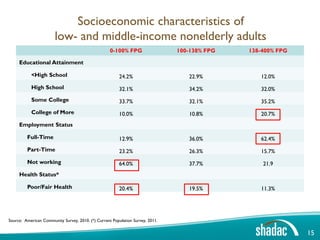
Socioeconomic characteristics of
                       low- and middle-income nonelderly adults
                                                    0-100% FPG                  100-138% FPG   138-400% FPG

     Educational Attainment

           <High School                                  24.2%                     22.9%          12.0%
           High School                                   32.1%                     34.2%          32.0%
           Some College                                  33.7%                     32.1%          35.2%
           College of More                               10.0%                     10.8%          20.7%
     Employment Status

         Full-Time                                       12.9%                     36.0%          62.4%
         Part-Time                                       23.2%                     26.3%          15.7%
         Not working                                     64.0%                     37.7%           21.9
     Health Status*

         Poor/Fair Health                                20.4%                     19.5%          11.3%


Source: American Community Survey, 2010. (*) Current Population Survey, 2011.

                                                                                                              15
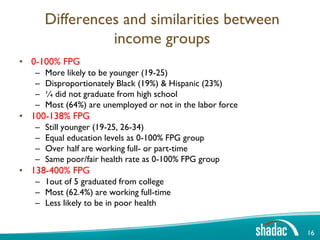
Differences and similarities between
                 income groups
• 0-100% FPG
   –   More likely to be younger (19-25)
   –   Disproportionately Black (19%) & Hispanic (23%)
   –   ¼ did not graduate from high school
   –   Most (64%) are unemployed or not in the labor force
• 100-138% FPG
   –   Still younger (19-25, 26-34)
   –   Equal education levels as 0-100% FPG group
   –   Over half are working full- or part-time
   –   Same poor/fair health rate as 0-100% FPG group
• 138-400% FPG
   – 1out of 5 graduated from college
   – Most (62.4%) are working full-time
   – Less likely to be in poor health


                                                             16
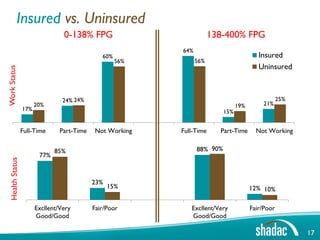
Insured vs. Uninsured
                                  0-138% FPG                            138-400% FPG
                                                            64%
                                                60%                                        Insured
                                                      56%         56%
                                                                                           Uninsured
Work Status


                                  24% 24%                                                           25%
                        20%                                                       19%       21%
                  17%                                                       15%


                  Full-Time      Part-Time   Not Working    Full-Time     Part-Time       Not Working


                               85%                                88% 90%
                         77%
  Health Status


                                             23%
                                                   15%                                  12% 10%

                        Excllent/Very        Fair/Poor         Excllent/Very            Fair/Poor
                        Good/Good                              Good/Good

                                                                                                          17
Other Issues to Consider
• Woodwork effect
   – How many “old eligibles” will come in with “new
     eligibiles”
   – Depends on outreach strategy and current
     eligibility levels
   – Will have different FMAP rates
• Movement across income/eligibility categories
   – Different plans/benefits
   – Ease of transition
   – Bridge plans
                                                       18
Estimating Churn and Transitions
• Measuring churn in and out of Medicaid has
  always been a challenge
• After the ACA is fully implemented, it gets
  even harder:
   – More people are eligible for Medicaid
     (<138% FPL)
   – Addition of premium subsidies
     administered as tax benefits
   – New dynamic of churn—from Medicaid
     into premium subsidies and back
   – No minimum enrollment period
                                                19
Why Churn Matters
• Reflects change in individuals’ financial situations
• Frequently represents an interruption in health
  services or a change in insurance plan
   – Disruption in care
   – Change in benefits/providers
   – Change in out-of-pocket costs
• Estimating churn may help health plans ease
  transition for those whose coverage is
  changing and conduct outreach to the newly
  eligible
                                                         20
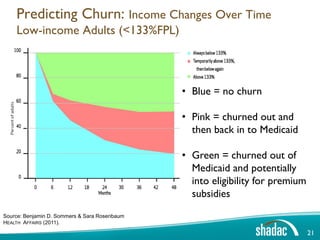
Predicting Churn: Income Changes Over Time
    Low-income Adults (<133%FPL)


                                               • Blue = no churn

                                               • Pink = churned out and
                                                 then back in to Medicaid

                                               • Green = churned out of
                                                 Medicaid and potentially
                                                 into eligibility for premium
                                                 subsidies
Source: Benjamin D. Sommers & Sara Rosenbaum
HEALTH AFFAIRS (2011).

                                                                                21
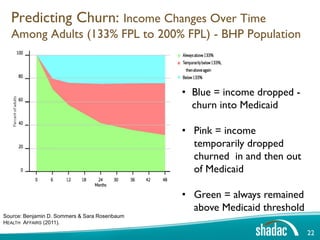
Predicting Churn: Income Changes Over Time
  Among Adults (133% FPL to 200% FPL) - BHP Population


                                               • Blue = income dropped -
                                                 churn into Medicaid

                                               • Pink = income
                                                 temporarily dropped
                                                 churned in and then out
                                                 of Medicaid

                                               • Green = always remained
                                                 above Medicaid threshold
Source: Benjamin D. Sommers & Sara Rosenbaum
HEALTH AFFAIRS (2011).

                                                                            22
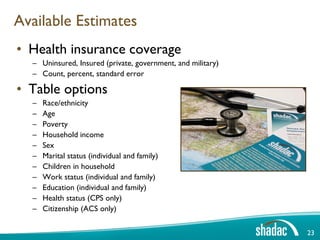
Available Estimates
• Health insurance coverage
  – Uninsured, Insured (private, government, and military)
  – Count, percent, standard error

• Table options
  –   Race/ethnicity
  –   Age
  –   Poverty
  –   Household income
  –   Sex
  –   Marital status (individual and family)
  –   Children in household
  –   Work status (individual and family)
  –   Education (individual and family)
  –   Health status (CPS only)
  –   Citizenship (ACS only)


                                                             23
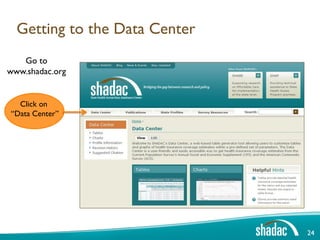
Getting to the Data Center
   Go to
www.shadac.org


  Click on
“Data Center”


                               24
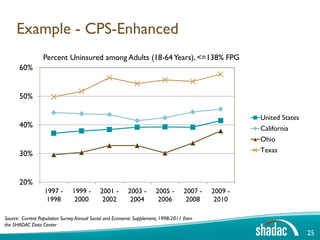
Example - CPS-Enhanced
                 Percent Uninsured among Adults (18-64 Years), <=138% FPG
      60%


      50%

                                                                                                    United States
      40%                                                                                           California
                                                                                                    Ohio
                                                                                                    Texas
      30%


      20%
                  1997 -       1999 -       2001 -       2003 -       2005 -      2007 -   2009 -
                   1998         2000         2002         2004         2006        2008     2010

Source: Current Population Survey Annual Social and Economic Supplement, 1998-2011 from
the SHADAC Data Center
                                                                                                                    25
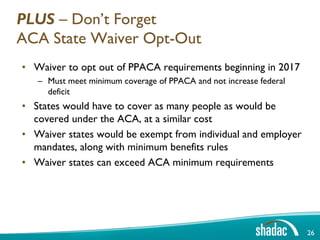
PLUS – Don’t Forget
ACA State Waiver Opt-Out
• Waiver to opt out of PPACA requirements beginning in 2017
   – Must meet minimum coverage of PPACA and not increase federal
     deficit
• States would have to cover as many people as would be
  covered under the ACA, at a similar cost
• Waiver states would be exempt from individual and employer
  mandates, along with minimum benefits rules
• Waiver states can exceed ACA minimum requirements


                                                                    26
Lynn A. Blewett, PhD
State Health Access Data Assistance Center
            blewe001@umn.edu
               612-624-4802
               @lynnblewett


     Sign up to receive our newsletter and updates at
                    www.shadac.org
                          @shadac

Pres nga jul19_blewett

  • 1.
    Insurance Markets UnderDifferent State Scenarios Lynn Blewett, Director State Health Access Data Assistance Center (SHADAC) University of Minnesota Health Care: Decision Points for States National Governors Association July 19, 2012 Funded by a grant from the Robert Wood Johnson Foundation 1
  • 2.
    Overview 1. Overview of Changes Post-SCOTUS 2. Cost of doing nothing 3. New state questions 4. Estimates by new Income Categories 5. Data Resources 2
  • 3.
    ACA Access ExpansionCategories 350% 250% 300% ACA Medicaid Expansion to 250% 138% FPL 185% $26,344 for family of 3 - 2012 200% 150% 100% 22 million 63% Low-Income 50% 37% Uninsured Adults 19-64 0 0% Children Pregnant Working Jobless Childless Women Parents Parents Adults Source: Based on the results of a national survey conducted by the Kaiser Commission on Medicaid and the Uninsured and the Georgetown University Center for Children and Families, 2012. 3
  • 4.
    Key Supreme CourtDecision (1) upheld the Medicaid expansion, but makes it a voluntary provision as opposed to a mandatory provision. (2) does not permit HHS to penalize states by withholding all Medicaid funding for choosing not to participate in the expansion. 4
  • 5.
    Potential Post- Exchange Subsidies 100-400% FPL SCOTUS Option Cost-Sharing Subsidies 100-250% FPL Basic Medicaid Health Exchange Subsidies Expansion Plan 0-138% FPL 138-400% FPL 138-200% Pre-SCOTUS FPL Cost-Sharing Subsidies 100-250% FPL 0 100 200 300 400 500 Federal Poverty Level (%) 100% FPL = $ 23,000 400% FPL = $ 92,200 Family of Four ‘12 Family of Four ‘12 5
  • 6.
    Cost of notParticipating • Lost Medicaid revenue – 100% FMAP for first two years for newly eligible down to 90% • Cuts to Disproportionate Share Hospital Payments (DSH) – Medicare up to 75% cut $10.1 Billion in 2009 – Medicaid up to to 50% cut $11.2 Billion in 2011 • Continued stress on safety-net providers – 7% of all hospitals; 55% of urban hospitals* * Source: National Association of Urban Hospitals - 2011 6
  • 7.
    Disproportionate Hospital SharePayments, Medicaid 2008-2011 $12,000,000,000 $11.7B $11.4B $11.3B $11,500,000,000 $11,000,000,000 $10.4B $10,500,000,000 $10,000,000,000 $9,500,000,000 2008 2009 2010 2011 Notes: FY2009 and FY2010 DSH allotments were increased under the American Recovery and Reinvestment Act (ARRA) Sources: FY 2008, FY 2009 & FY 2010 Federal Register 7
  • 8.
    State DSH Payments2011 Top Total Bottom Total Allotment Five Allotment Five .4% 45% NY $ 1,607,960,722 WY $ 226,570 CA $ 1,097,417,551 DE $ 9,062,839 TX $ 957,268,445 ND $ 9,562,154 LA $ 731,960,000 HI $10,000,000 NJ $ 644,435,620 SD $11,056,409 MN $74,768,422 8
  • 9.
    Some New StateQuestions • Can we expand only up to 100% FPL not the initial 138%? • Can we pay premiums and buy-in those at 100-138% into the exchange? Feds pay for tax credit and cost-sharing subsidies, limited liability for states • Does it make sense to set up the exchange for those at 138-400 FPL but not do anything for the very poor (<100% FPL)? 9
  • 10.
    Buy in to Expansion to Exchage? 100% FPL? Potential Post- Exchange Subsidies 100-400% FPL SCOTUS Option Cost-Sharing Subsidies 100-250% FPL Medicaid Basic Health Exchange Subsidies Expansion 0-138% FPL Plan 138-400% FPL Pre-SCOTUS 138-200% FPL Cost-Sharing Subsidies 100-250% FPL 0 100 200 300 400 500 Federal Poverty Level (%) 100% FPL = $ 23,000 400% FPL = $ 92,200 Family of Four ‘12 Family of Four ‘12 10
  • 11.
    Subsidy Amount byFPL Average 2011 US Premium for Single Coverage $5,429 Possible State $6,000 Buy-in? $5,000 $1,184 $4,000 $2,246 $3,055 $3,000 $4,022 $2,000 $4,759 $1,000 $5,320 $- 133% 150% 200% 250% 300% 400% Source: Employer Health Benefits 2011 Annual Survey 11
  • 12.
    Who are wetalking about? Non-Elderly (19-65) Low- and Middle-Income Adults 67.5 million 60,000,000 53.7 million 50,000,000 41.5 million 40,000,000 30,000,000 20,000,000 12.2 million 10,000,000 0 < 100% FPG 100-138% All < 138% 138-400% FPG 12
  • 13.
    Over 60% ofnonelderly adults already have health insurance 80,000,000 22% 70,000,000 Uninsured 41% 60,000,000 22 million Uninsured 50,000,000 39% low- Uninsured income 40,000,000 uninsured adults 30,000,000 20,000,000 49% Uninsured 10,000,000 0 <100% FPG 100-138% FPG <138% FPG 138-400% FPG 13
  • 14.
    Demographic characteristics of low- and middle-income nonelderly adults 0-100% FPG 100-138% FPG 138-400% FPG Total 41.5 Million 12.2 Million 67.5 Million Female 53.6% 52.7% 50.3% Age 19 to 25 38.2% 21.2% 12.1% 26 to 34 19.7% 22.3% 22.6% 35 to 44 16.0% 21.6% 24.4% 45 to 54 14.8% 18.8% 22.6% 55 to 64 11.2% 16.1% 18.3% Race/Ethnicity Hispanic 22.6% 25.9% 17.6% White non-Hispanic 50.1% 52.3% 63.5% Black Alone non-Hispanic 18.8% 14.5% 11.9% Asian Alone non-Hispanic 5.1% 4.5% 4.6% Multiple/Other non-Hispanic 3.5% 2.9% 2.4% Source: American Community Survey, 2010 14
  • 15.
    Socioeconomic characteristics of low- and middle-income nonelderly adults 0-100% FPG 100-138% FPG 138-400% FPG Educational Attainment <High School 24.2% 22.9% 12.0% High School 32.1% 34.2% 32.0% Some College 33.7% 32.1% 35.2% College of More 10.0% 10.8% 20.7% Employment Status Full-Time 12.9% 36.0% 62.4% Part-Time 23.2% 26.3% 15.7% Not working 64.0% 37.7% 21.9 Health Status* Poor/Fair Health 20.4% 19.5% 11.3% Source: American Community Survey, 2010. (*) Current Population Survey, 2011. 15
  • 16.
    Differences and similaritiesbetween income groups • 0-100% FPG – More likely to be younger (19-25) – Disproportionately Black (19%) & Hispanic (23%) – ¼ did not graduate from high school – Most (64%) are unemployed or not in the labor force • 100-138% FPG – Still younger (19-25, 26-34) – Equal education levels as 0-100% FPG group – Over half are working full- or part-time – Same poor/fair health rate as 0-100% FPG group • 138-400% FPG – 1out of 5 graduated from college – Most (62.4%) are working full-time – Less likely to be in poor health 16
  • 17.
    Insured vs. Uninsured 0-138% FPG 138-400% FPG 64% 60% Insured 56% 56% Uninsured Work Status 24% 24% 25% 20% 19% 21% 17% 15% Full-Time Part-Time Not Working Full-Time Part-Time Not Working 85% 88% 90% 77% Health Status 23% 15% 12% 10% Excllent/Very Fair/Poor Excllent/Very Fair/Poor Good/Good Good/Good 17
  • 18.
    Other Issues toConsider • Woodwork effect – How many “old eligibles” will come in with “new eligibiles” – Depends on outreach strategy and current eligibility levels – Will have different FMAP rates • Movement across income/eligibility categories – Different plans/benefits – Ease of transition – Bridge plans 18
  • 19.
    Estimating Churn andTransitions • Measuring churn in and out of Medicaid has always been a challenge • After the ACA is fully implemented, it gets even harder: – More people are eligible for Medicaid (<138% FPL) – Addition of premium subsidies administered as tax benefits – New dynamic of churn—from Medicaid into premium subsidies and back – No minimum enrollment period 19
  • 20.
    Why Churn Matters •Reflects change in individuals’ financial situations • Frequently represents an interruption in health services or a change in insurance plan – Disruption in care – Change in benefits/providers – Change in out-of-pocket costs • Estimating churn may help health plans ease transition for those whose coverage is changing and conduct outreach to the newly eligible 20
  • 21.
    Predicting Churn: IncomeChanges Over Time Low-income Adults (<133%FPL) • Blue = no churn • Pink = churned out and then back in to Medicaid • Green = churned out of Medicaid and potentially into eligibility for premium subsidies Source: Benjamin D. Sommers & Sara Rosenbaum HEALTH AFFAIRS (2011). 21
  • 22.
    Predicting Churn: IncomeChanges Over Time Among Adults (133% FPL to 200% FPL) - BHP Population • Blue = income dropped - churn into Medicaid • Pink = income temporarily dropped churned in and then out of Medicaid • Green = always remained above Medicaid threshold Source: Benjamin D. Sommers & Sara Rosenbaum HEALTH AFFAIRS (2011). 22
  • 23.
    Available Estimates • Healthinsurance coverage – Uninsured, Insured (private, government, and military) – Count, percent, standard error • Table options – Race/ethnicity – Age – Poverty – Household income – Sex – Marital status (individual and family) – Children in household – Work status (individual and family) – Education (individual and family) – Health status (CPS only) – Citizenship (ACS only) 23
  • 24.
    Getting to theData Center Go to www.shadac.org Click on “Data Center” 24
  • 25.
    Example - CPS-Enhanced Percent Uninsured among Adults (18-64 Years), <=138% FPG 60% 50% United States 40% California Ohio Texas 30% 20% 1997 - 1999 - 2001 - 2003 - 2005 - 2007 - 2009 - 1998 2000 2002 2004 2006 2008 2010 Source: Current Population Survey Annual Social and Economic Supplement, 1998-2011 from the SHADAC Data Center 25
  • 26.
    PLUS – Don’tForget ACA State Waiver Opt-Out • Waiver to opt out of PPACA requirements beginning in 2017 – Must meet minimum coverage of PPACA and not increase federal deficit • States would have to cover as many people as would be covered under the ACA, at a similar cost • Waiver states would be exempt from individual and employer mandates, along with minimum benefits rules • Waiver states can exceed ACA minimum requirements 26
  • 27.
    Lynn A. Blewett,PhD State Health Access Data Assistance Center blewe001@umn.edu 612-624-4802 @lynnblewett Sign up to receive our newsletter and updates at www.shadac.org @shadac