MALARIA IN PREGNANCY
DR. DEEPA AGGRAWAL
MBBS DGO
• Malaria is the second most common cause of infectious disease
related death in the world after tuberculosis.
• It affects 350-500 million people per anum
• One to three million death per year
• 25 million pregnant women are currently at risk for
malaria(WHO)
• Ten thousand maternal and two lakh neonatal deaths per year
• The states most affected in India are UP , Bihar , Karnataka , Orrisha
, Rajshthan , MP and Pondicherry
• P.falciperum predominantly found in Africa .
• P.vivax- central America
• Prevalence of both species are equal in south America, Indian
subcontinent, eastern Asia
• P.malariae found in most endemic areas specially throughout sub
Saharan Africa
Introduction
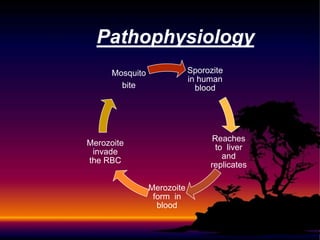
Sporozite
in human
blood
Reaches
to liver
and
replicates
Merozoite
form in
blood
Merozoite
invade
the RBC
Mosquito
bite
Pathophysiology
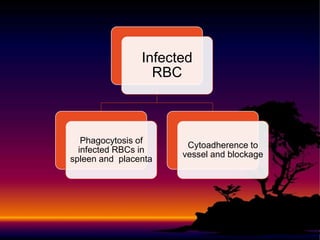
Infected
RBC
Phagocytosis of
infected RBCs in
spleen and placenta
Cytoadherence to
vessel and blockage
• Bite of infected mosquito
• Congenital acquired disease
• Blood transfusion
• Contaminated needle
• Organ transplantation
Transmission
It is of two types -
• Uncomplicated – less than 2% parasitised RBC
with no complicating factor
• Complicated/severe- more than 2% parasitised
RBC . It is generally caused by P.falciperum and
characterized by organ damage or blood
abnormalities including cerebral malaria,
hemolysis,severe anemia(Hb<8gm%),low
platelate,hypoglycemia(<40mg%) ,acidosis(ph
<7.3),pulmonary edema , renal impairment.
Diagnosis of Malaria
• Diagnosis of malaria is difficult as there are no
specific symptoms and signs and it may present as
flu like illness
• A history of travel to endemic area should be
sought in pregnant woman with pyrexia of unknown
origin .
• Microscopy and rapid diagnostic test are standard
tools
• Microscopic diagnosis allows species
identification and estimation of parasitimia so that
appropriate anti malarial can be given
• Rapid detection test may miss low parasitimia
specially in pregnant females
• In a febrile patient 3 negative smears 12-24 hrs
apart rules out diagnosis of malaria
• Women with malaria in pregnancy should be
assessed for the severity of the condition .
• Severity determines the treatment and
predicts the case fatality rates
• In uncomplicated malaria fatality rates are
0.1%
• In severe malaria specially in pregnancy
fatality rates are high .
• Currently available rapid diagnotic tests are as
follows-
• Histidine rich protein two (HRP 2) – asexual
stages & young gametocyte of Pfalciparum
• Parasite lactate dehydrogenas – for all 4 types
• Plasmodium aldolase – for all four types
• Preterm labour , fetal growth restriction and fetal heart
rate abnormalities can occur.
• Still birth and premature delivery in malaria in
pregnancy are best prevented with prompt and
effective anti malarial treatment.
• Uncomplicated malaria in pregnancy is not a reason for
induction of labour.
• Peripartum malaria is an indication for placental
histology , cord and baby blood film to detect
congenital malaria at early stage .
• All neonates whose mother develop malaria in
pregnancy should be screned for malaria by microscopic
films at birth and weekly blood films for 28 days.
Obstetric complication of Malaria in
pregnancy
• Regular antenatal care , including
assesment of Hb , platelate ,glucose and
fetal growth scan is advised
• Regular fetal growth assesment is advised
• Inform the woman about the risk of relapse
Antenatal care of pregnant female
after an episode of malaria
• It should be treated as emergency
• I/V artesunate(2.4mg/kg at 0,12 and 24 hrs
then daily till patient is well to take oral
medication.Oral artesunate 2mg/kg OD) is the
Tt of severe falciparum malaria. Use I/V
quinine if artesunate is not available .
• Uncomplicated malaria (P.falciparum-quinine
600mg TDS x 7 days or clindamycin 450mg
TDS x 7 days)
Treatment of malaria in
pregnancy
• Non falciparum malaria (chloroquine 600mg
stat then 300 mg 48 hrs later then 300mg
daily for 2 days)
• Resistant P.vivax-as treatment of
P.falciparum(uncomplicated)
• Prevention of relapse during pregnancy –
chloroquine 300 mg per week till delivery
• Primaquine contraindicated during pregnancy
• With hold oral therapy and switch over to I/V
if vomiting are persisting treat fever with
antipyretics
1. Awareness of risk
2. Bite prevention
3. chemoprophylaxis
Prevention of malaria in
pregnancy
• Pregnant female should consider the risk of travel to
malaria endemic countries and consider postponing
of trips
• Risk of malaria dependes upon various factor like
level of transmission in the area of travel,time of year
(rainy or dry),presence of drug resistant strain, length
of stay.
Awareness
Bite Preventions
•Repellents -20% DEET
•Knock down mosquito sprays – permethrin ,
pyrethroids
•Insecticide treated bed nets
•Cloth that covers the body completely
•Room protection by electrical beated mats
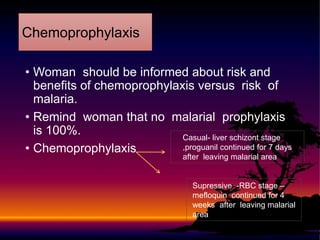
• Woman should be informed about risk and
benefits of chemoprophylaxis versus risk of
malaria.
• Remind woman that no malarial prophylaxis
is 100%.
• Chemoprophylaxis
Chemoprophylaxis
Casual- liver schizont stage
,proguanil continued for 7 days
after leaving malarial area
Supressive -RBC stage –
mefloquin continued for 4
weeks after leaving malarial
area
• Mefloquine 5mg /kg /week that is 250mg
/week is recommended drug of choice for
prophylaxis in chloroquine resistant areas
• Proguanila plus chloroquine when there is no
chloroquine resistance.
• Doxycycline and primaquine are
contraindicated for hemoprofilaxes
Thank you !!

Malaria in pregnancy edited

  • 1.
    MALARIA IN PREGNANCY DR.DEEPA AGGRAWAL MBBS DGO
  • 2.
    • Malaria isthe second most common cause of infectious disease related death in the world after tuberculosis. • It affects 350-500 million people per anum • One to three million death per year • 25 million pregnant women are currently at risk for malaria(WHO) • Ten thousand maternal and two lakh neonatal deaths per year • The states most affected in India are UP , Bihar , Karnataka , Orrisha , Rajshthan , MP and Pondicherry • P.falciperum predominantly found in Africa . • P.vivax- central America • Prevalence of both species are equal in south America, Indian subcontinent, eastern Asia • P.malariae found in most endemic areas specially throughout sub Saharan Africa Introduction
  • 3.
    Sporozite in human blood Reaches to liver and replicates Merozoite formin blood Merozoite invade the RBC Mosquito bite Pathophysiology
  • 4.
    Infected RBC Phagocytosis of infected RBCsin spleen and placenta Cytoadherence to vessel and blockage
  • 5.
    • Bite ofinfected mosquito • Congenital acquired disease • Blood transfusion • Contaminated needle • Organ transplantation Transmission
  • 6.
    It is oftwo types - • Uncomplicated – less than 2% parasitised RBC with no complicating factor • Complicated/severe- more than 2% parasitised RBC . It is generally caused by P.falciperum and characterized by organ damage or blood abnormalities including cerebral malaria, hemolysis,severe anemia(Hb<8gm%),low platelate,hypoglycemia(<40mg%) ,acidosis(ph <7.3),pulmonary edema , renal impairment. Diagnosis of Malaria
  • 7.
    • Diagnosis ofmalaria is difficult as there are no specific symptoms and signs and it may present as flu like illness • A history of travel to endemic area should be sought in pregnant woman with pyrexia of unknown origin . • Microscopy and rapid diagnostic test are standard tools • Microscopic diagnosis allows species identification and estimation of parasitimia so that appropriate anti malarial can be given • Rapid detection test may miss low parasitimia specially in pregnant females • In a febrile patient 3 negative smears 12-24 hrs apart rules out diagnosis of malaria
  • 8.
    • Women withmalaria in pregnancy should be assessed for the severity of the condition . • Severity determines the treatment and predicts the case fatality rates • In uncomplicated malaria fatality rates are 0.1% • In severe malaria specially in pregnancy fatality rates are high .
  • 9.
    • Currently availablerapid diagnotic tests are as follows- • Histidine rich protein two (HRP 2) – asexual stages & young gametocyte of Pfalciparum • Parasite lactate dehydrogenas – for all 4 types • Plasmodium aldolase – for all four types
  • 10.
    • Preterm labour, fetal growth restriction and fetal heart rate abnormalities can occur. • Still birth and premature delivery in malaria in pregnancy are best prevented with prompt and effective anti malarial treatment. • Uncomplicated malaria in pregnancy is not a reason for induction of labour. • Peripartum malaria is an indication for placental histology , cord and baby blood film to detect congenital malaria at early stage . • All neonates whose mother develop malaria in pregnancy should be screned for malaria by microscopic films at birth and weekly blood films for 28 days. Obstetric complication of Malaria in pregnancy
  • 11.
    • Regular antenatalcare , including assesment of Hb , platelate ,glucose and fetal growth scan is advised • Regular fetal growth assesment is advised • Inform the woman about the risk of relapse Antenatal care of pregnant female after an episode of malaria
  • 12.
    • It shouldbe treated as emergency • I/V artesunate(2.4mg/kg at 0,12 and 24 hrs then daily till patient is well to take oral medication.Oral artesunate 2mg/kg OD) is the Tt of severe falciparum malaria. Use I/V quinine if artesunate is not available . • Uncomplicated malaria (P.falciparum-quinine 600mg TDS x 7 days or clindamycin 450mg TDS x 7 days) Treatment of malaria in pregnancy
  • 13.
    • Non falciparummalaria (chloroquine 600mg stat then 300 mg 48 hrs later then 300mg daily for 2 days) • Resistant P.vivax-as treatment of P.falciparum(uncomplicated) • Prevention of relapse during pregnancy – chloroquine 300 mg per week till delivery • Primaquine contraindicated during pregnancy • With hold oral therapy and switch over to I/V if vomiting are persisting treat fever with antipyretics
  • 14.
    1. Awareness ofrisk 2. Bite prevention 3. chemoprophylaxis Prevention of malaria in pregnancy
  • 15.
    • Pregnant femaleshould consider the risk of travel to malaria endemic countries and consider postponing of trips • Risk of malaria dependes upon various factor like level of transmission in the area of travel,time of year (rainy or dry),presence of drug resistant strain, length of stay. Awareness Bite Preventions •Repellents -20% DEET •Knock down mosquito sprays – permethrin , pyrethroids •Insecticide treated bed nets •Cloth that covers the body completely •Room protection by electrical beated mats
  • 16.
    • Woman shouldbe informed about risk and benefits of chemoprophylaxis versus risk of malaria. • Remind woman that no malarial prophylaxis is 100%. • Chemoprophylaxis Chemoprophylaxis Casual- liver schizont stage ,proguanil continued for 7 days after leaving malarial area Supressive -RBC stage – mefloquin continued for 4 weeks after leaving malarial area
  • 17.
    • Mefloquine 5mg/kg /week that is 250mg /week is recommended drug of choice for prophylaxis in chloroquine resistant areas • Proguanila plus chloroquine when there is no chloroquine resistance. • Doxycycline and primaquine are contraindicated for hemoprofilaxes
  • 18.