AS Coursework

Foundation Portfolio

PRELIMINARY TASK
Video
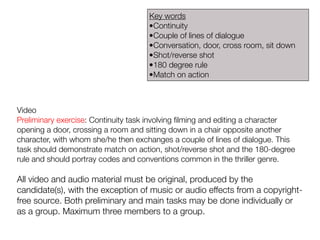
Preliminary exercise: Continuity task involving filming and editing a character
opening a door, crossing a room and sitting down in a chair opposite another
character, with whom she/he then exchanges a couple of lines of dialogue. This
task should demonstrate match on action, shot/reverse shot and the 180-degree
rule and should portray codes and conventions common in the thriller genre.
All video and audio material must be original, produced by the
candidate(s), with the exception of music or audio effects from a copyright-
free source. Both preliminary and main tasks may be done individually or
as a group. Maximum three members to a group.
Key words
•Continuity
•Couple of lines of dialogue
•Conversation, door, cross room, sit down
•Shot/reverse shot
•180 degree rule
•Match on action
https://gilbertmediastudies.wordpress.com/category/preliminary-task/
Examples on prelim videos
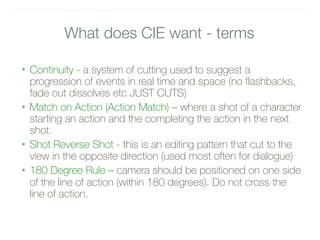
What does CIE want - terms
• Continuity - a system of cutting used to suggest a
progression of events in real time and space (no flashbacks,
fade out dissolves etc JUST CUTS)
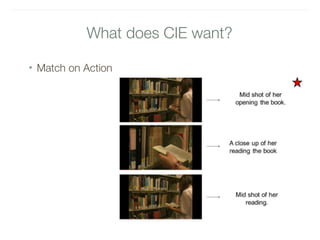
• Match on Action (Action Match) – where a shot of a character
starting an action and the completing the action in the next
shot.
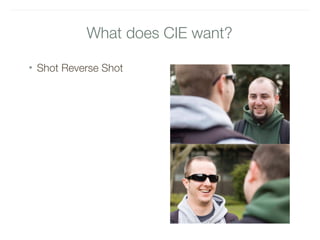
• Shot Reverse Shot - this is an editing pattern that cut to the
view in the opposite direction (used most often for dialogue)
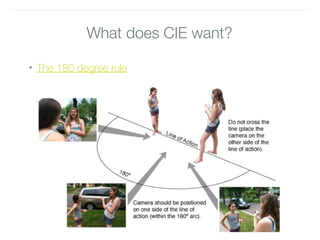
• 180 Degree Rule – camera should be positioned on one side
of the line of action (within 180 degrees). Do not cross the
line of action.
What does CIE want?
• The 180 degree rule
What does CIE want?
• Shot Reverse Shot
What does CIE want?
• Match on Action
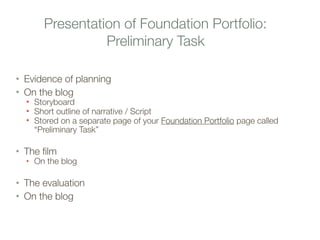
Presentation of Foundation Portfolio:
Preliminary Task
• Evidence of planning
• On the blog
• Storyboard
• Short outline of narrative / Script
• Stored on a separate page of your Foundation Portfolio page called
“Preliminary Task”
• The film
• On the blog
• The evaluation
• On the blog
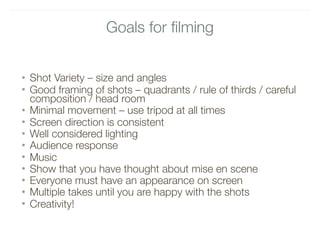
Goals for filming
• Shot Variety – size and angles
• Good framing of shots – quadrants / rule of thirds / careful
composition / head room
• Minimal movement – use tripod at all times
• Screen direction is consistent
• Well considered lighting
• Audience response
• Music
• Show that you have thought about mise en scene
• Everyone must have an appearance on screen
• Multiple takes until you are happy with the shots
• Creativity!
K I S S
• Keep
• It
• Simple
• Stupid
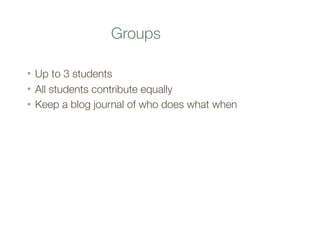
Groups
• Up to 3 students
• All students contribute equally
• Keep a blog journal of who does what when
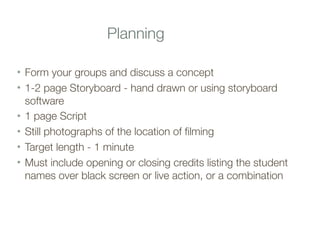
Planning
• Form your groups and discuss a concept
• 1-2 page Storyboard - hand drawn or using storyboard
software
• 1 page Script
• Still photographs of the location of filming
• Target length - 1 minute
• Must include opening or closing credits listing the student
names over black screen or live action, or a combination
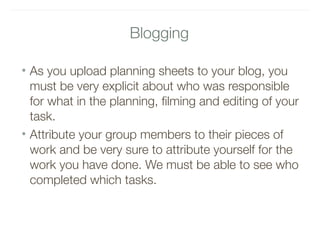
Blogging
• As you upload planning sheets to your blog, you
must be very explicit about who was responsible
for what in the planning, filming and editing of your
task.
• Attribute your group members to their pieces of
work and be very sure to attribute yourself for the
work you have done. We must be able to see who
completed which tasks.
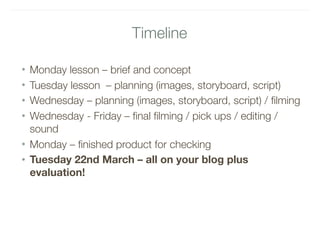
Timeline
• Monday lesson – brief and concept
• Tuesday lesson – planning (images, storyboard, script)
• Wednesday – planning (images, storyboard, script) / filming
• Wednesday - Friday – final filming / pick ups / editing /
sound
• Monday – finished product for checking
• Tuesday 22nd March – all on your blog plus
evaluation!
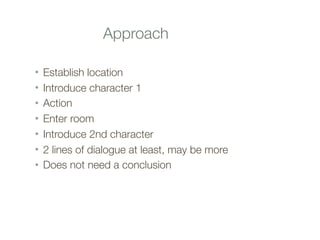
Approach
• Establish location
• Introduce character 1
• Action
• Enter room
• Introduce 2nd character
• 2 lines of dialogue at least, may be more
• Does not need a conclusion
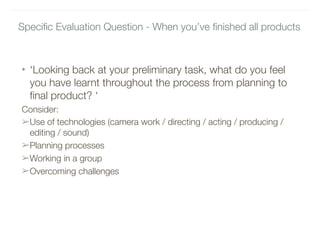
Specific Evaluation Question - When you’ve finished all products

• ‘Looking back at your preliminary task, what do you feel
you have learnt throughout the process from planning to
final product? ‘
Consider:
➢Use of technologies (camera work / directing / acting / producing /
editing / sound)
➢Planning processes
➢Working in a group
➢Overcoming challenges

Preliminary Task

  • 1.
  • 2.
    Video Preliminary exercise: Continuitytask involving filming and editing a character opening a door, crossing a room and sitting down in a chair opposite another character, with whom she/he then exchanges a couple of lines of dialogue. This task should demonstrate match on action, shot/reverse shot and the 180-degree rule and should portray codes and conventions common in the thriller genre. All video and audio material must be original, produced by the candidate(s), with the exception of music or audio effects from a copyright- free source. Both preliminary and main tasks may be done individually or as a group. Maximum three members to a group. Key words •Continuity •Couple of lines of dialogue •Conversation, door, cross room, sit down •Shot/reverse shot •180 degree rule •Match on action
  • 3.
  • 4.
    What does CIEwant - terms • Continuity - a system of cutting used to suggest a progression of events in real time and space (no flashbacks, fade out dissolves etc JUST CUTS) • Match on Action (Action Match) – where a shot of a character starting an action and the completing the action in the next shot. • Shot Reverse Shot - this is an editing pattern that cut to the view in the opposite direction (used most often for dialogue) • 180 Degree Rule – camera should be positioned on one side of the line of action (within 180 degrees). Do not cross the line of action.
  • 5.
    What does CIEwant? • The 180 degree rule
  • 6.
    What does CIEwant? • Shot Reverse Shot
  • 7.
    What does CIEwant? • Match on Action
  • 8.
    Presentation of FoundationPortfolio: Preliminary Task • Evidence of planning • On the blog • Storyboard • Short outline of narrative / Script • Stored on a separate page of your Foundation Portfolio page called “Preliminary Task” • The film • On the blog • The evaluation • On the blog
  • 9.
    Goals for filming •Shot Variety – size and angles • Good framing of shots – quadrants / rule of thirds / careful composition / head room • Minimal movement – use tripod at all times • Screen direction is consistent • Well considered lighting • Audience response • Music • Show that you have thought about mise en scene • Everyone must have an appearance on screen • Multiple takes until you are happy with the shots • Creativity!
  • 10.
    K I SS • Keep • It • Simple • Stupid
  • 11.
    Groups • Up to3 students • All students contribute equally • Keep a blog journal of who does what when
  • 12.
    Planning • Form yourgroups and discuss a concept • 1-2 page Storyboard - hand drawn or using storyboard software • 1 page Script • Still photographs of the location of filming • Target length - 1 minute • Must include opening or closing credits listing the student names over black screen or live action, or a combination
  • 13.
    Blogging • As youupload planning sheets to your blog, you must be very explicit about who was responsible for what in the planning, filming and editing of your task. • Attribute your group members to their pieces of work and be very sure to attribute yourself for the work you have done. We must be able to see who completed which tasks.
  • 14.
    Timeline • Monday lesson– brief and concept • Tuesday lesson – planning (images, storyboard, script) • Wednesday – planning (images, storyboard, script) / filming • Wednesday - Friday – final filming / pick ups / editing / sound • Monday – finished product for checking • Tuesday 22nd March – all on your blog plus evaluation!
  • 15.
    Approach • Establish location •Introduce character 1 • Action • Enter room • Introduce 2nd character • 2 lines of dialogue at least, may be more • Does not need a conclusion
  • 16.
    Specific Evaluation Question- When you’ve finished all products
 • ‘Looking back at your preliminary task, what do you feel you have learnt throughout the process from planning to final product? ‘ Consider: ➢Use of technologies (camera work / directing / acting / producing / editing / sound) ➢Planning processes ➢Working in a group ➢Overcoming challenges