Physiology of Pregnancy &
Reproduction
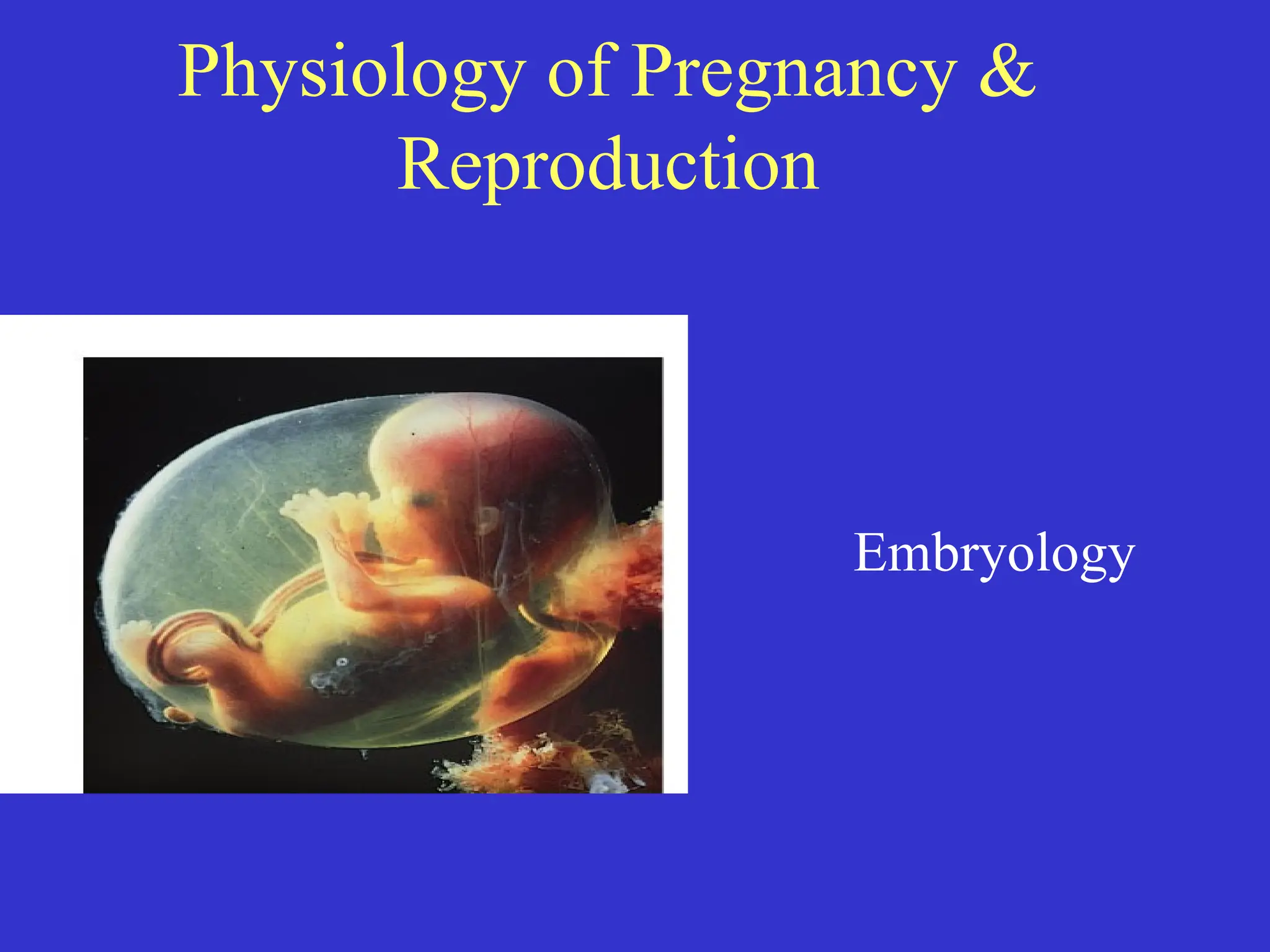
Embryology
Embryology
• Definition: the study of the origin and
development of an organism
• Prenatal period: before birth
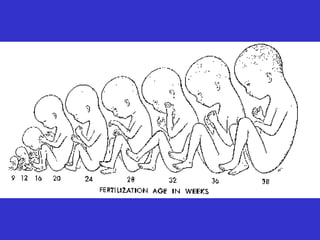
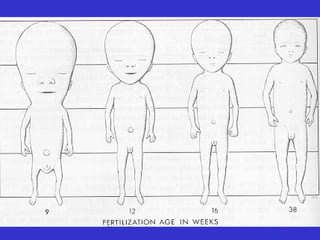
– 38 weeks from conception to birth (average) “fetal”
age
Traditional (artificial) division:
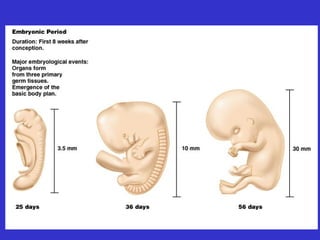
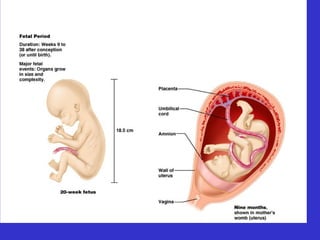
• “Embryonic” period: first 8 weeks
– All major organs formed
• “Fetal” period: remaining 30 weeks
– Organs grow larger and become more complex
Stage 1
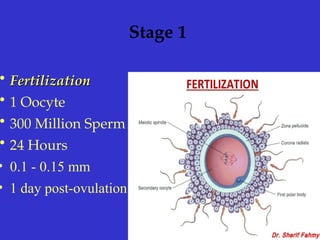
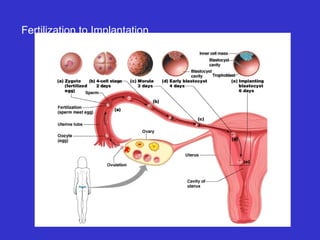
• Fertilization
Fertilization
• 1 Oocyte
• 300 Million Sperm
• 24 Hours
• 0.1 - 0.15 mm
• 1 day post-ovulation
Fertilization
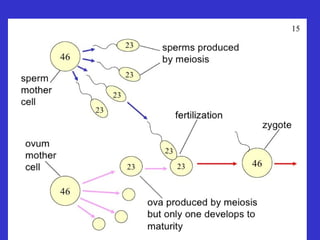
• SPERM + EGG(OOCYTE) = ZYGOTE
• The fertilization process takes about 24
hours.
• Sperm life = 48 hours
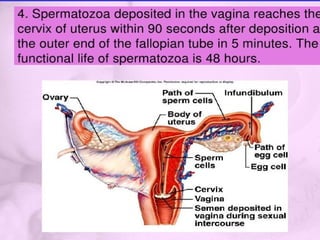
– It takes about ten hours to navigate the female
productive track, moving up the vaginal canal,
through the cervix, and into the fallopian tube
where fertilization begins.
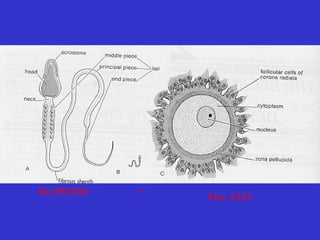
Mr.SPERM +
Mrs. EGG
Fertilization
• 300 million sperm enter the the vagina...
only 1%, 3 million, enter the uterus
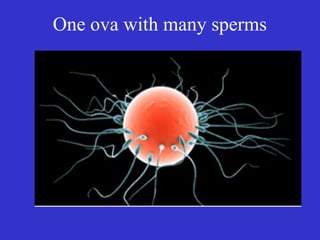
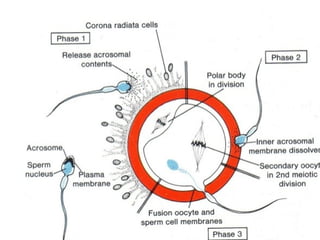
• The next step is the penetration of the zona
pellucida, a tough membrane surrounding
the oocyte.
• Penetration of the zona pellucida takes
about twenty minutes.
One ova with many sperms
Fertilization
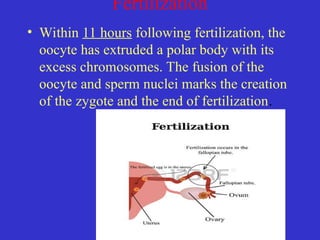
• Within 11 hours following fertilization, the
oocyte has extruded a polar body with its
excess chromosomes. The fusion of the
oocyte and sperm nuclei marks the creation
of the zygote and the end of fertilization.
Stage 2
Cleavage
• First Cell Division, Blastomeres,
• Mitotic division
• 0.1 - 0.2 mm
• 1.5 - 3 days post-ovulation
Cleavage
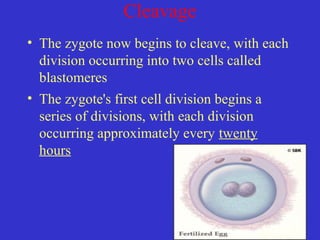
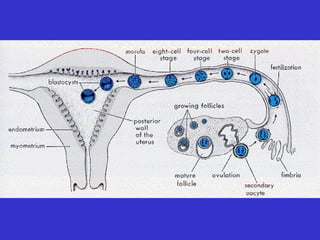
• The zygote now begins to cleave, with each
division occurring into two cells called
blastomeres
• The zygote's first cell division begins a
series of divisions, with each division
occurring approximately every twenty
hours
Cleavage
• When cell division ungenerated about
sixteen cells, the zygote becomes a morula
(mulberry shaped)
• It leaves the fallopian tube and enters the
uterine cavity three to four days after
fertilization.
Stage 4
Implantation Begins
• HCG Levels Rise
• 0.1 - 0.2 mm
• 5 - 6 days post-ovulation
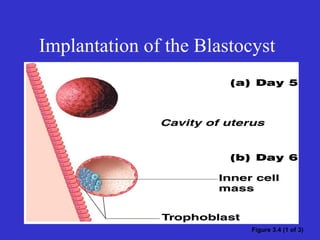
• The trophoblast cells secretes an enzyme
which erodes the epithelial uterine lining
and creates an implantation site for the
blastocyst.
Stage 4
Implantation Begins
• ovary continues producing progesterone
• trophoblast cells continue releasing human
chorionic gonadotropin (hCG)
• Endometrial glands in the uterus enlarge in
response to the blastocyst and the
implantation site becomes swollen with new
capillaries. Circulation begins, a process
needed for the continuation of pregnancy.
Fertilization to Implantation
Stage 5
Implantation Complete
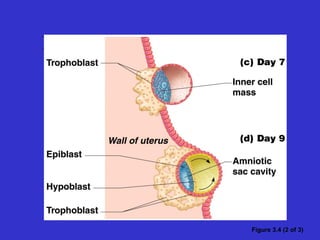
• The inner cell mass divides, rapidly forming a
two-layered disc
• The top layer of cells...
– will become the embryo and amniotic cavity
– the lower cells will become the yolk sac.
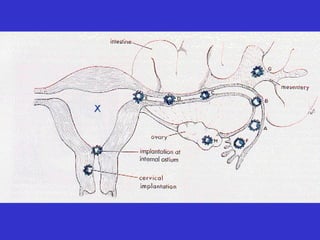
• Ectopic pregnancies can occur at this time and
sometimes continue for up to 16 weeks of
pregnancy before being noticed
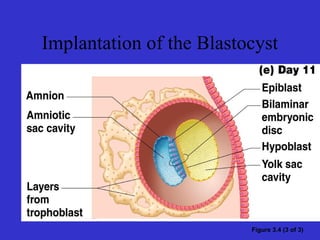
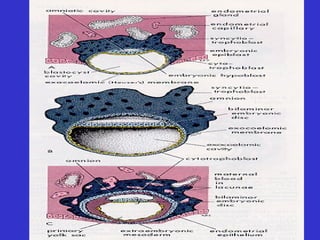
Implantation of the Blastocyst
Figure 3.4 (1 of 3)
Implantation of the Blastocyst
Figure 3.4 (2 of 3)
Implantation of the Blastocyst
Figure 3.4 (3 of 3)
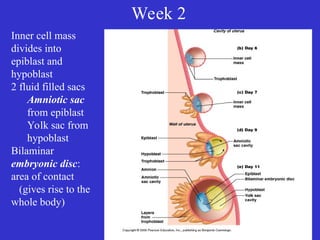
Week 2
Inner cell mass
divides into
epiblast and
hypoblast
2 fluid filled sacs
Amniotic sac
from epiblast
Yolk sac from
hypoblast
Bilaminar
embryonic disc:
area of contact
(gives rise to the
whole body)
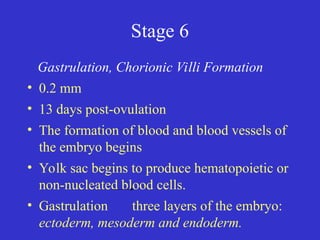
Stage 6
Gastrulation, Chorionic Villi Formation
• 0.2 mm
• 13 days post-ovulation
• The formation of blood and blood vessels of
the embryo begins
• Yolk sac begins to produce hematopoietic or
non-nucleated blood cells.
• Gastrulation three layers of the embryo:
ectoderm, mesoderm and endoderm.
• Bilaminar to trilaminar disc
• Three primary “germ” layers: all body tissues develop
from these
• Ectoderm
• Endoderm
• Mesoderm
Week 3
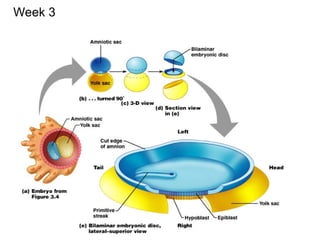
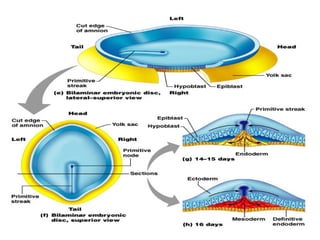
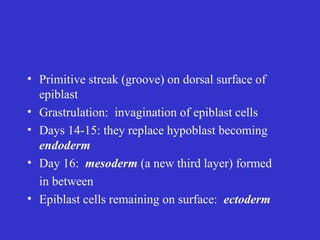
• Primitive streak (groove) on dorsal surface of
epiblast
• Grastrulation: invagination of epiblast cells
• Days 14-15: they replace hypoblast becoming
endoderm
• Day 16: mesoderm (a new third layer) formed
in between
• Epiblast cells remaining on surface: ectoderm
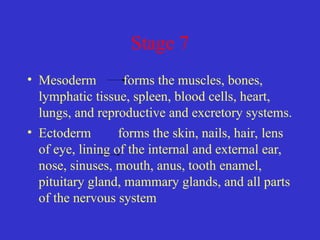
Stage 7
• Neurulation and Notochordal Process
• 0.4 mm
• 16 days post-ovulation
• Endoderm forms the lining of lungs,
tongue, tonsils, urethra and associated
glands, bladder and digestive tract.
Stage 7
• Mesoderm forms the muscles, bones,
lymphatic tissue, spleen, blood cells, heart,
lungs, and reproductive and excretory systems.
• Ectoderm forms the skin, nails, hair, lens
of eye, lining of the internal and external ear,
nose, sinuses, mouth, anus, tooth enamel,
pituitary gland, mammary glands, and all parts
of the nervous system
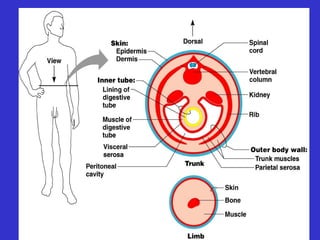
The Basic Body Plan
Figure 3.2
Stage 8
• Notochordal Canal and Neurenteric Canals
• 1.0 - 1.5 mm
• 17-19 days post-ovulation
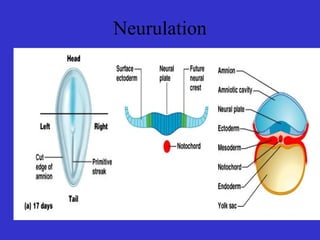
• Neural plate with a neural groove
• The blood cells of the embryo are already
developed and they begin to form channels
along the epithelial cells which form
consecutively with the blood cells.
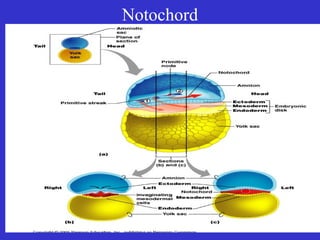
Notochord
Neurulation
Stage 9
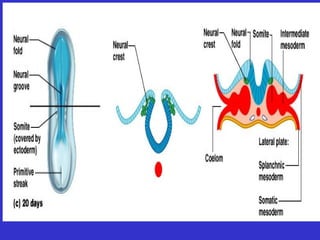
• Appearance of Somites(condensations of
mesoderm, appear on either side of the neural
groove
• 1.5 - 2.5 mm
• 19 - 21 days post-ovulation
• Primitive streak
• Endocardial (muscle) cells begin to fuse
and form into the early embryo's two heart
tubes.
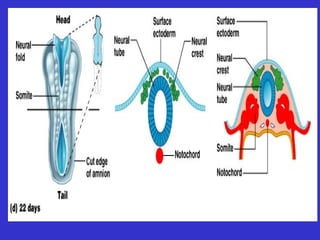
Stage 10
• Neural Folds Begin to Fuse, Heart Tube
fuses
• 1.5 - 3.0 mm
• 21 - 23 days post-ovulation
• Cardiac muscle contraction begins
• Eye & ear cells are present
• Neural tube starts closing
Stage 11
• Optic Vesicle Appears, Two Pharyngeal Arches
Appear
• 2.5 - 3.0 mm
• 23 - 25 days post-ovulation
• A primitive S-shaped tubal heart is beating and
peristalsis, the rhythmic flow propelling fluids
throughout the body, begins.
• At this stage, the neural tube determines the form
of the embryo
•
Stage 12
• Caudal Neuropore Closes, Three to
Four Pharyngeal Arches Appear, Upper
Limb Buds Appear
• 3.0 - 5.0 mm
• 25 - 27 days post-ovulation
• The brain and spinal cord together are the
largest and most compact tissue of the
embryo.
Stage 12
• Valve & septa appear in the heart
• The digestive epithelium layer begins to
differentiate into the future locations of the
liver, lung, stomach and pancreas.
• The beginning cells of the liver form before
the rest of the digestive system.
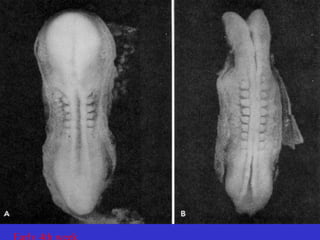
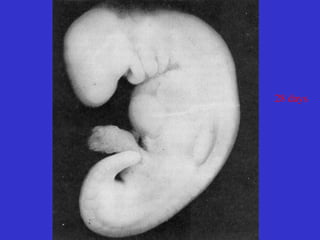
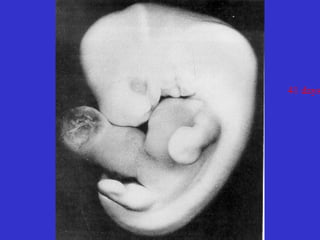
Stage 13 (approximately 27-29
postovulatory days)
• Forebrain, midbrain and hindbrain. forms
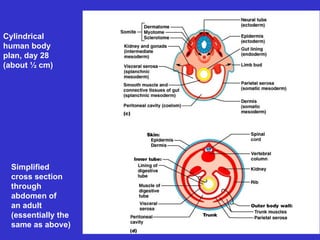
Cylindrical
human body
plan, day 28
(about ½ cm)
Simplified
cross section
through
abdomen of
an adult
(essentially the
same as above)
Stage 13
• Lymphatic & thyroid start to develop
• Limb buds
• First thin layer of skin
• Liver & heart, etc.
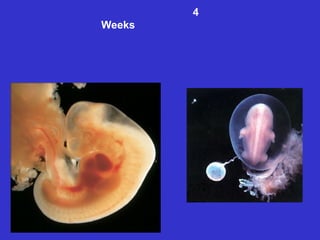
28 days
4
Weeks
Stage 14
(4 to 8 weeks post
fertilization)
• Nervous sys developing further
• 4 chamber heart
• lung sacs
• Ureteric bud appear
• Nerve distribution process, innervation,
begins in the upper limbs.
41 days
Stage 15
• 6 to 8 weeks post fertilization
• Further development of nervous system,
heart.
• Innervation, the distribution of nerves,
begins in the lower limb buds.
Stage 17
• approximately 41 postovulatory days
• A Four Chambered Heart and a Sense of
Smell
• Primitive germ cells arrive at the genital
area and will respond to genetic instructions
to develop into either female or male
genitals.
Stage 19
• approximately 47-48 post ovulatory days
• Brain Waves and Muscles
• The trunk elongates and straightens and the
bone cartilage begins to form a more solid
structure. Muscles develop and get stronger.
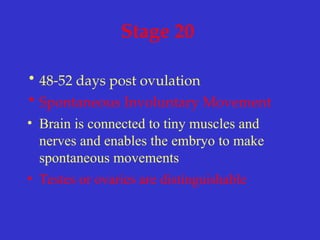
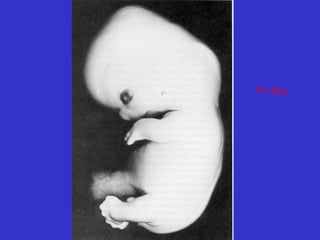
Stage 20
• 48-52 days post ovulation
• Spontaneous Involuntary Movement
• Brain is connected to tiny muscles and
nerves and enables the embryo to make
spontaneous movements
• Testes or ovaries are distinguishable
51 days
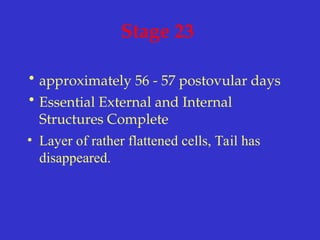
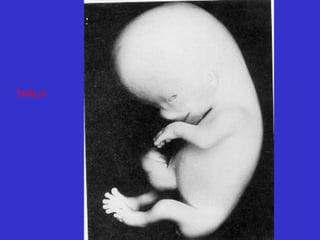
Stage 23
• approximately 56 - 57 postovular days
• Essential External and Internal
Structures Complete
• Layer of rather flattened cells, Tail has
disappeared.
56days
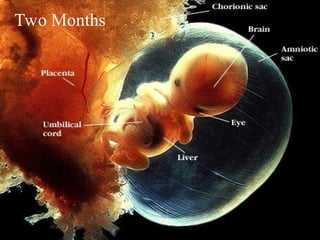
Two Months
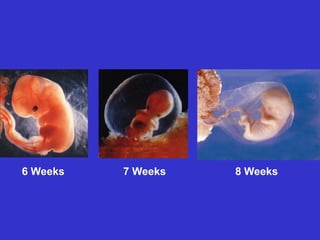
6 Weeks 7 Weeks 8 Weeks
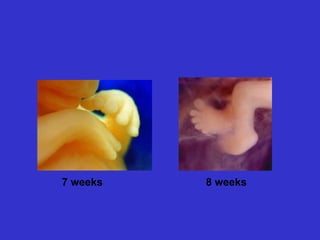
7 weeks 8 weeks
9weeks
Week 10 - 11
• Vocal cords formed
• Liver secretes bile, stored in the GB
• Pancreas produces insulin
• Reflexes present
• Male/female differentiate
Week 12 - 13
• Fetus begins to move
• Heartbeat can be found with doppler
• Fetal sex now clearly distinguished
• Body begins to grow hair
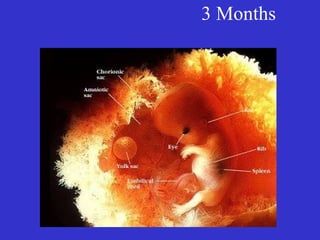
3 Months
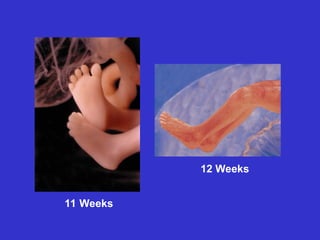
11 Weeks
12 Weeks
Week 16 Post Fertilization...
• Growth continues, but no new
structures form after this point
• Meconium begins to accumulate in the
bowels. Meconium is the product of cell
loss, digestive secretion and swallowed
amniotic fluid.
• Placenta equal in size to fetus
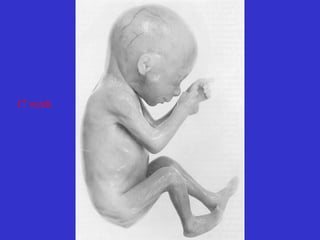
17 week
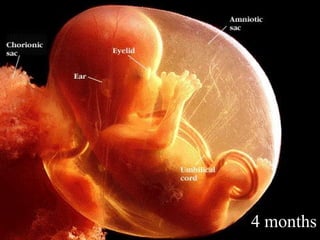
The Fetus—Month 4
• Fetus is 3 inches long and weights 5 oz.
• Your baby is covered with a layer of thick, downy
hair called lanugo.
• His heartbeat can be heard clearly.
• This may be when you feel your baby's first kick.
• The baby can such thumb, swallow and hiccup.
4 months
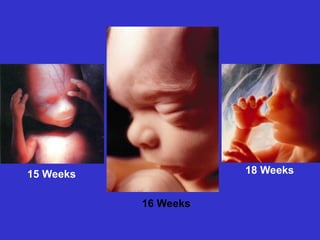
15 Weeks
16 Weeks
18 Weeks
Week 18 Post Fertilization...
• A dramatic growth period for the fetus.
• Fetus has phases of sleep and waking and
may prefer a favorite sleep position.
• Ovaries containing primitive egg cells &
uterus present
• Brown fat & vernix
• Placenta is fully formed and grows in
diameter though not in thickness.
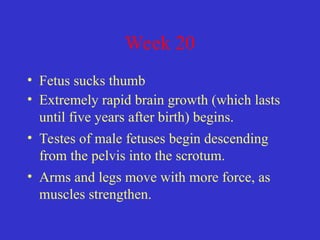
Week 20
• Fetus sucks thumb
• Extremely rapid brain growth (which lasts
until five years after birth) begins.
• Testes of male fetuses begin descending
from the pelvis into the scrotum.
• Arms and legs move with more force, as
muscles strengthen.
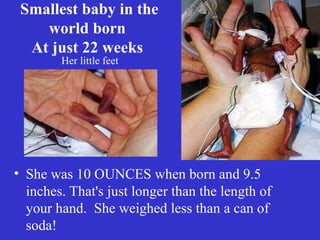
Smallest baby in the
world born
At just 22 weeks
• She was 10 OUNCES when born and 9.5
inches. That's just longer than the length of
your hand. She weighed less than a can of
soda!
Her little feet
The Fetus—Month 6
• The fetus is 8-10 inches long and weighs 4-
5 oz.
• Your baby's lungs are filled with amniotic
fluid, and he has started breathing motions.
• If you talk or sing, he can hear you.
• Fat is starting to deposit under the skin
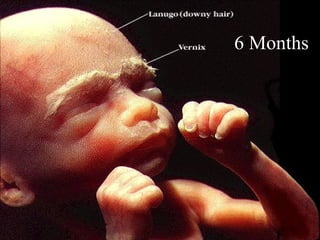
6 Months
Week 26
• Lungs may be mature enough to breath air!
• Fetal body is two to three percent body fat.
• Eyes are partially open and eyelashes
present.
• Sucking and swallowing improves.
The Fetus—Month 7
• Fetus is 10-12 inches long and weighs about
1-2 pounds.
• Fetus is active and then rests.
• The baby now uses the four senses of
vision, hearing, taste and touch
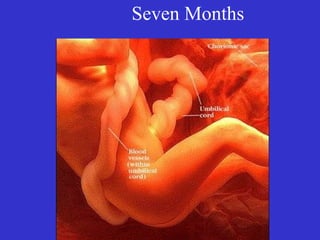
Seven Months
Week 30
• Body growth slows down
• The iris is colored and the pupil reflexes
responding to light.
Week 32
• Fetus rests on uterus - no longer floating.
• Eyes open during alert times and close
during sleep. Eye color is usually blue,
regardless of the permanent color as
pigmentation is not fully developed
The Fetus—Month 8
• The fetus is 14-16 inches long and weighs
2-3 pounds
• Layers of fat are piling on.
• Fetus has probably turned head-down in
preparation for birth.
• Fetus may react to noises with a jerking
action
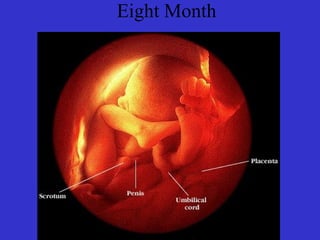
Eight Month
Week 34
• Head may now position (head-down) into
pelvis before labor.
• Gastrointestinal system is very immature
and will stay that way until three or fourth
years after birth.
• Fetus stores about 15% of weight in fat to
keep temperature of body warm
The Fetus—Month 9
• Fetus is about 17-18 inches long and weighs 5-6
pounds
• Skin is smooth because of the fat
• Baby’s movement slows down due to lack of room
• “Lightening” occurs when the baby drops in the
pelvis
• Disease fighting antibodies are taken from the
mother’s blood
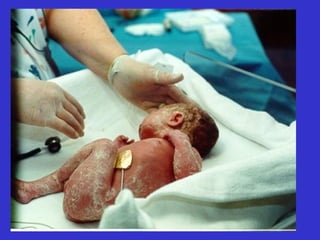
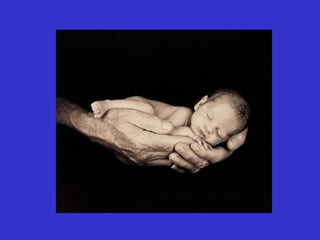
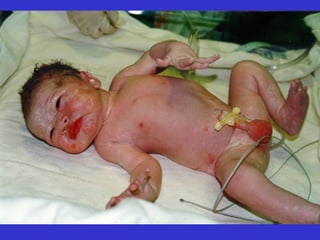
40 weeks
• Fullterm
• Fifteen percent of body is fat, eighty
percent of which is underneath the skin, the
other twenty percent around the organs.
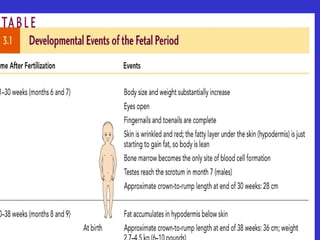
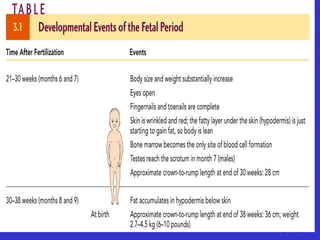
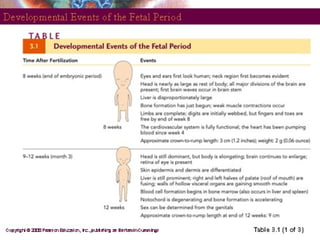
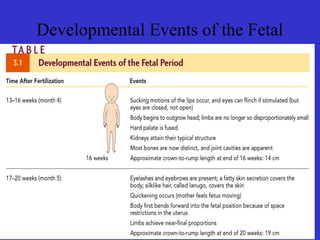
Developmental Events of the Fetal
Period
Table 3.1 (2 of 3)
Table 3.1 (3 of 3)
Table 3.1 (3 of 3)
embryology -2017.ppt f or Basic Bsc nursing students

embryology -2017.ppt f or Basic Bsc nursing students

  • 1.
    Physiology of Pregnancy& Reproduction Embryology
  • 2.
    Embryology • Definition: thestudy of the origin and development of an organism • Prenatal period: before birth – 38 weeks from conception to birth (average) “fetal” age
  • 3.
    Traditional (artificial) division: •“Embryonic” period: first 8 weeks – All major organs formed • “Fetal” period: remaining 30 weeks – Organs grow larger and become more complex
  • 7.
    Stage 1 • Fertilization Fertilization •1 Oocyte • 300 Million Sperm • 24 Hours • 0.1 - 0.15 mm • 1 day post-ovulation
  • 8.
    Fertilization • SPERM +EGG(OOCYTE) = ZYGOTE • The fertilization process takes about 24 hours. • Sperm life = 48 hours – It takes about ten hours to navigate the female productive track, moving up the vaginal canal, through the cervix, and into the fallopian tube where fertilization begins.
  • 9.
  • 11.
    Fertilization • 300 millionsperm enter the the vagina... only 1%, 3 million, enter the uterus • The next step is the penetration of the zona pellucida, a tough membrane surrounding the oocyte. • Penetration of the zona pellucida takes about twenty minutes.
  • 12.
    One ova withmany sperms
  • 14.
    Fertilization • Within 11hours following fertilization, the oocyte has extruded a polar body with its excess chromosomes. The fusion of the oocyte and sperm nuclei marks the creation of the zygote and the end of fertilization.
  • 15.
    Stage 2 Cleavage • FirstCell Division, Blastomeres, • Mitotic division • 0.1 - 0.2 mm • 1.5 - 3 days post-ovulation
  • 17.
    Cleavage • The zygotenow begins to cleave, with each division occurring into two cells called blastomeres • The zygote's first cell division begins a series of divisions, with each division occurring approximately every twenty hours
  • 19.
    Cleavage • When celldivision ungenerated about sixteen cells, the zygote becomes a morula (mulberry shaped) • It leaves the fallopian tube and enters the uterine cavity three to four days after fertilization.
  • 20.
    Stage 4 Implantation Begins •HCG Levels Rise • 0.1 - 0.2 mm • 5 - 6 days post-ovulation • The trophoblast cells secretes an enzyme which erodes the epithelial uterine lining and creates an implantation site for the blastocyst.
  • 21.
    Stage 4 Implantation Begins •ovary continues producing progesterone • trophoblast cells continue releasing human chorionic gonadotropin (hCG) • Endometrial glands in the uterus enlarge in response to the blastocyst and the implantation site becomes swollen with new capillaries. Circulation begins, a process needed for the continuation of pregnancy.
  • 22.
  • 23.
    Stage 5 Implantation Complete •The inner cell mass divides, rapidly forming a two-layered disc • The top layer of cells... – will become the embryo and amniotic cavity – the lower cells will become the yolk sac. • Ectopic pregnancies can occur at this time and sometimes continue for up to 16 weeks of pregnancy before being noticed
  • 25.
    Implantation of theBlastocyst Figure 3.4 (1 of 3)
  • 26.
    Implantation of theBlastocyst Figure 3.4 (2 of 3)
  • 27.
    Implantation of theBlastocyst Figure 3.4 (3 of 3)
  • 28.
    Week 2 Inner cellmass divides into epiblast and hypoblast 2 fluid filled sacs Amniotic sac from epiblast Yolk sac from hypoblast Bilaminar embryonic disc: area of contact (gives rise to the whole body)
  • 29.
    Stage 6 Gastrulation, ChorionicVilli Formation • 0.2 mm • 13 days post-ovulation • The formation of blood and blood vessels of the embryo begins • Yolk sac begins to produce hematopoietic or non-nucleated blood cells. • Gastrulation three layers of the embryo: ectoderm, mesoderm and endoderm.
  • 31.
    • Bilaminar totrilaminar disc • Three primary “germ” layers: all body tissues develop from these • Ectoderm • Endoderm • Mesoderm
  • 32.
  • 34.
    • Primitive streak(groove) on dorsal surface of epiblast • Grastrulation: invagination of epiblast cells • Days 14-15: they replace hypoblast becoming endoderm • Day 16: mesoderm (a new third layer) formed in between • Epiblast cells remaining on surface: ectoderm
  • 35.
    Stage 7 • Neurulationand Notochordal Process • 0.4 mm • 16 days post-ovulation • Endoderm forms the lining of lungs, tongue, tonsils, urethra and associated glands, bladder and digestive tract.
  • 36.
    Stage 7 • Mesodermforms the muscles, bones, lymphatic tissue, spleen, blood cells, heart, lungs, and reproductive and excretory systems. • Ectoderm forms the skin, nails, hair, lens of eye, lining of the internal and external ear, nose, sinuses, mouth, anus, tooth enamel, pituitary gland, mammary glands, and all parts of the nervous system
  • 37.
    The Basic BodyPlan Figure 3.2
  • 38.
    Stage 8 • NotochordalCanal and Neurenteric Canals • 1.0 - 1.5 mm • 17-19 days post-ovulation • Neural plate with a neural groove • The blood cells of the embryo are already developed and they begin to form channels along the epithelial cells which form consecutively with the blood cells.
  • 39.
  • 40.
  • 41.
    Stage 9 • Appearanceof Somites(condensations of mesoderm, appear on either side of the neural groove • 1.5 - 2.5 mm • 19 - 21 days post-ovulation • Primitive streak • Endocardial (muscle) cells begin to fuse and form into the early embryo's two heart tubes.
  • 43.
    Stage 10 • NeuralFolds Begin to Fuse, Heart Tube fuses • 1.5 - 3.0 mm • 21 - 23 days post-ovulation • Cardiac muscle contraction begins • Eye & ear cells are present • Neural tube starts closing
  • 45.
    Stage 11 • OpticVesicle Appears, Two Pharyngeal Arches Appear • 2.5 - 3.0 mm • 23 - 25 days post-ovulation • A primitive S-shaped tubal heart is beating and peristalsis, the rhythmic flow propelling fluids throughout the body, begins. • At this stage, the neural tube determines the form of the embryo •
  • 46.
    Stage 12 • CaudalNeuropore Closes, Three to Four Pharyngeal Arches Appear, Upper Limb Buds Appear • 3.0 - 5.0 mm • 25 - 27 days post-ovulation • The brain and spinal cord together are the largest and most compact tissue of the embryo.
  • 47.
    Stage 12 • Valve& septa appear in the heart • The digestive epithelium layer begins to differentiate into the future locations of the liver, lung, stomach and pancreas. • The beginning cells of the liver form before the rest of the digestive system.
  • 48.
    Stage 13 (approximately27-29 postovulatory days) • Forebrain, midbrain and hindbrain. forms
  • 49.
    Cylindrical human body plan, day28 (about ½ cm) Simplified cross section through abdomen of an adult (essentially the same as above)
  • 51.
    Stage 13 • Lymphatic& thyroid start to develop • Limb buds • First thin layer of skin • Liver & heart, etc.
  • 52.
  • 53.
  • 54.
    Stage 14 (4 to8 weeks post fertilization) • Nervous sys developing further • 4 chamber heart • lung sacs • Ureteric bud appear • Nerve distribution process, innervation, begins in the upper limbs.
  • 55.
  • 56.
    Stage 15 • 6to 8 weeks post fertilization • Further development of nervous system, heart. • Innervation, the distribution of nerves, begins in the lower limb buds.
  • 57.
    Stage 17 • approximately41 postovulatory days • A Four Chambered Heart and a Sense of Smell • Primitive germ cells arrive at the genital area and will respond to genetic instructions to develop into either female or male genitals.
  • 58.
    Stage 19 • approximately47-48 post ovulatory days • Brain Waves and Muscles • The trunk elongates and straightens and the bone cartilage begins to form a more solid structure. Muscles develop and get stronger.
  • 59.
    Stage 20 • 48-52days post ovulation • Spontaneous Involuntary Movement • Brain is connected to tiny muscles and nerves and enables the embryo to make spontaneous movements • Testes or ovaries are distinguishable
  • 60.
  • 61.
    Stage 23 • approximately56 - 57 postovular days • Essential External and Internal Structures Complete • Layer of rather flattened cells, Tail has disappeared.
  • 62.
  • 63.
  • 64.
    6 Weeks 7Weeks 8 Weeks
  • 65.
    7 weeks 8weeks
  • 66.
  • 68.
    Week 10 -11 • Vocal cords formed • Liver secretes bile, stored in the GB • Pancreas produces insulin • Reflexes present • Male/female differentiate
  • 69.
    Week 12 -13 • Fetus begins to move • Heartbeat can be found with doppler • Fetal sex now clearly distinguished • Body begins to grow hair
  • 70.
  • 71.
  • 73.
    Week 16 PostFertilization... • Growth continues, but no new structures form after this point • Meconium begins to accumulate in the bowels. Meconium is the product of cell loss, digestive secretion and swallowed amniotic fluid. • Placenta equal in size to fetus
  • 74.
  • 75.
    The Fetus—Month 4 •Fetus is 3 inches long and weights 5 oz. • Your baby is covered with a layer of thick, downy hair called lanugo. • His heartbeat can be heard clearly. • This may be when you feel your baby's first kick. • The baby can such thumb, swallow and hiccup.
  • 76.
  • 77.
  • 78.
    Week 18 PostFertilization... • A dramatic growth period for the fetus. • Fetus has phases of sleep and waking and may prefer a favorite sleep position. • Ovaries containing primitive egg cells & uterus present • Brown fat & vernix • Placenta is fully formed and grows in diameter though not in thickness.
  • 80.
    Week 20 • Fetussucks thumb • Extremely rapid brain growth (which lasts until five years after birth) begins. • Testes of male fetuses begin descending from the pelvis into the scrotum. • Arms and legs move with more force, as muscles strengthen.
  • 81.
    Smallest baby inthe world born At just 22 weeks • She was 10 OUNCES when born and 9.5 inches. That's just longer than the length of your hand. She weighed less than a can of soda! Her little feet
  • 82.
    The Fetus—Month 6 •The fetus is 8-10 inches long and weighs 4- 5 oz. • Your baby's lungs are filled with amniotic fluid, and he has started breathing motions. • If you talk or sing, he can hear you. • Fat is starting to deposit under the skin
  • 83.
  • 84.
    Week 26 • Lungsmay be mature enough to breath air! • Fetal body is two to three percent body fat. • Eyes are partially open and eyelashes present. • Sucking and swallowing improves.
  • 85.
    The Fetus—Month 7 •Fetus is 10-12 inches long and weighs about 1-2 pounds. • Fetus is active and then rests. • The baby now uses the four senses of vision, hearing, taste and touch
  • 86.
  • 87.
    Week 30 • Bodygrowth slows down • The iris is colored and the pupil reflexes responding to light.
  • 88.
    Week 32 • Fetusrests on uterus - no longer floating. • Eyes open during alert times and close during sleep. Eye color is usually blue, regardless of the permanent color as pigmentation is not fully developed
  • 90.
    The Fetus—Month 8 •The fetus is 14-16 inches long and weighs 2-3 pounds • Layers of fat are piling on. • Fetus has probably turned head-down in preparation for birth. • Fetus may react to noises with a jerking action
  • 91.
  • 92.
    Week 34 • Headmay now position (head-down) into pelvis before labor. • Gastrointestinal system is very immature and will stay that way until three or fourth years after birth. • Fetus stores about 15% of weight in fat to keep temperature of body warm
  • 93.
    The Fetus—Month 9 •Fetus is about 17-18 inches long and weighs 5-6 pounds • Skin is smooth because of the fat • Baby’s movement slows down due to lack of room • “Lightening” occurs when the baby drops in the pelvis • Disease fighting antibodies are taken from the mother’s blood
  • 94.
    40 weeks • Fullterm •Fifteen percent of body is fat, eighty percent of which is underneath the skin, the other twenty percent around the organs.
  • 98.
    Developmental Events ofthe Fetal Period Table 3.1 (2 of 3)
  • 99.
  • 100.

Editor's Notes

  • #40 Notochord signals overlying ectoderm Formation begins of spinal cord and brain (neurulation) Neural plate to neural groove to neural tube: pinched off into body
  • #42 Mesoderm begins to differentiate Lateral to notochord, week 3 Extends cranially and caudally (from head to tail or crown to rump) Division of mesoderm into three regions Somites: 40 pairs of body segments (repeating units, like building blocks) by end week 4 Intermediate mesoderm: just lateral to somites Lateral plate: splits to form coelom (“cavity”)
  • #44 Closure of neural tube: begins at end of week 3; complete by end of week 4 (folic acid important for this step) Extends cranially (eventually brain) and caudally (spinal cord) Neural crest, lateral ectodermal cells, pulled along and form sensory nerve cells and other structures