Diagrid
Systems
Additive
Manufacturing
(3D-Printed
Structures)
Adaptive/Kinetic
Systems
Tensile
and
Membrane
Structures
Parametric
Space
Frames/Gridshells
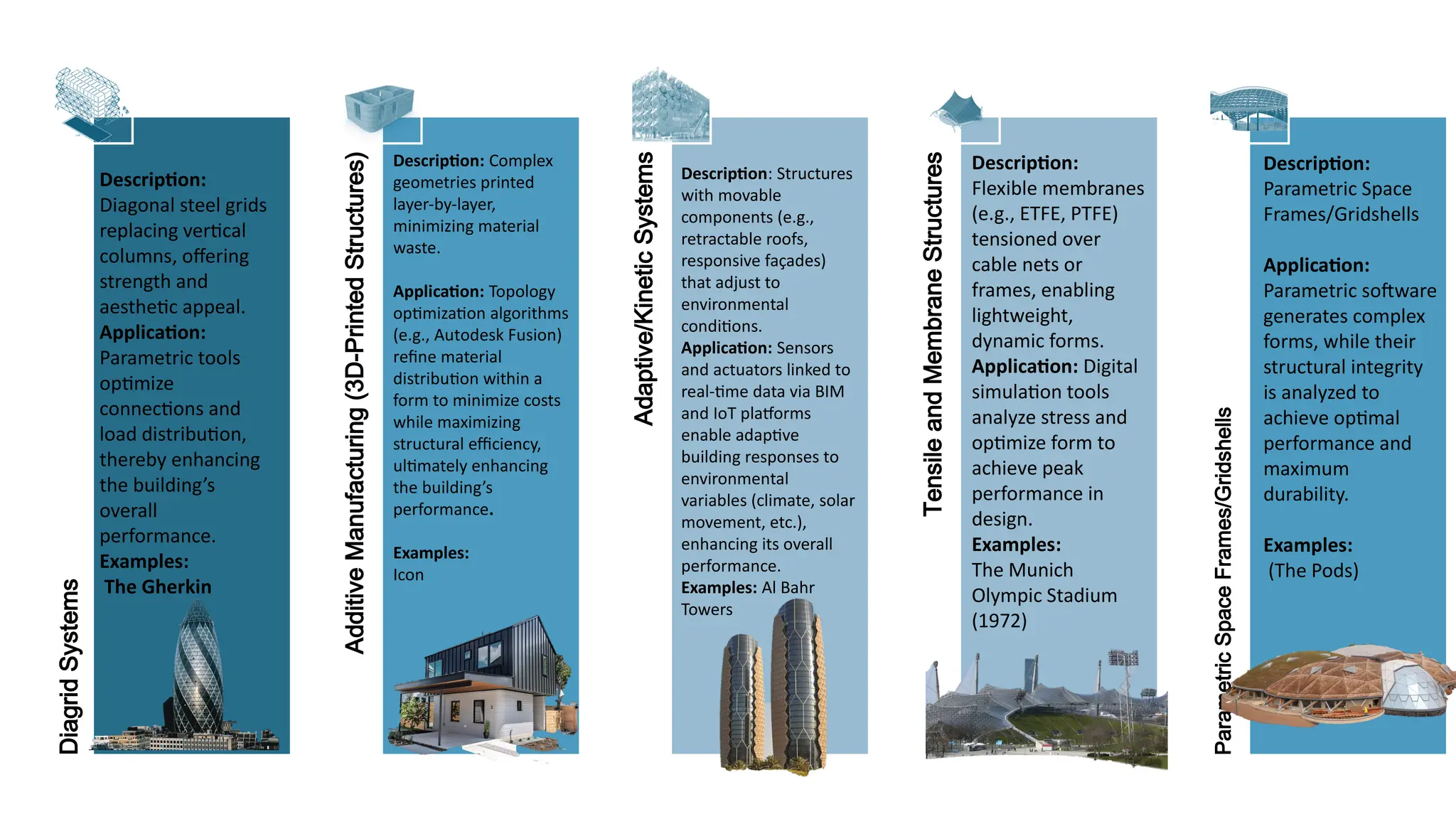
Description:
Parametric Space
Frames/Gridshells
Application:
Parametric software
generatescomplex
forms, while their
structural integrity
is analyzed to
achieve optimal
performance and
maximum
durability.
Examples:
(The Pods)
Description:
Flexible membranes
(e.g., ETFE, PTFE)
tensioned over
cable nets or
frames, enabling
lightweight,
dynamic forms.
Application: Digital
simulation tools
analyze stress and
optimize form to
achieve peak
performance in
design.
Examples:
The Munich
Olympic Stadium
(1972)
Description: Structures
with movable
components (e.g.,
retractable roofs,
responsive façades)
that adjust to
environmental
conditions.
Application: Sensors
and actuators linked to
real-time data via BIM
and IoT platforms
enable adaptive
building responses to
environmental
variables (climate, solar
movement, etc.),
enhancing its overall
performance.
Examples: Al Bahr
Towers
Description: Complex
geometries printed
layer-by-layer,
minimizing material
waste.
Application: Topology
optimization algorithms
(e.g., Autodesk Fusion)
refine material
distribution within a
form to minimize costs
while maximizing
structural efficiency,
ultimately enhancing
the building’s
performance.
Examples:
Icon
Description:
Diagonal steel grids
replacing vertical
columns, offering
strength and
aesthetic appeal.
Application:
Parametric tools
optimize
connections and
load distribution,
thereby enhancing
the building’s
overall
performance.
Examples:
The Gherkin
2.
Composite
Material
Systems
Thin-Shell
and
Curved
Surfaces
Biomimetic
Structures
Modular/Prefabricated
Components
Hybrid
Structural
Systems
Description:
Combinations (e.g.,
tensile +rigid
frames, concrete +
timber) for
balanced
performance.
Application: BIM
platforms (e.g.,
Revit) facilitate
multi-material
system simulations
to ensure precision
and achieve peak
building
performance.
Examples:
(Shanghai Tower)
Description:
Factory-made
modules assembled
on-site, reducing
waste and time.
Application: CNC
machining ensures
precision in
fabrication and
performance.
Examples:
MAD’s Harbin
Opera House.)
Description:
Nature-inspired
designs (e.g., tree-
like columns,
honeycomb cores).
Application:
Genetic algorithms
simulate natural
evolution to
generate forms
while optimizing
the building’s
performance.
Examples:
The Eden Project’s
biome domes
Description:
Minimal-material
curved forms
(concrete,
composites) for
strength.
Application:
Software (e.g.,
Rhino) resolves
geometric
complexity and
optimizes building
performance.
Examples:
Eladio Dieste’s
Gaussian vaults
Description:
Advanced materials
(carbon fiber, smart
alloys) enabling
novel forms.
Application:
Material databases
in BIM are utilized
to achieve the
building’s optimal
performance.
Examples:
The Beijing
National Stadium