INDIAN POLITY
www.nipunalambayan.com
Nipun Alambayan
The method of
operating system of
India known as Indian
polity
and it is operated
through government.
INDIAN POLITY
www.nipunalambayan.com
legislature Executive Judiciary
Government
There are three parts of government- legislature,
executive, judiciary
Legislature – the main role of legislature is to
formation of law.
Executive- the main role of executive is
implementation of law which has been made by
legislature.
Judiciary – the major work of judiciary is to check law
which has made by legislature and work of executive.
www.nipunalambayan.com
Parliament - P , L.S, R.S
Legislative– G , V.S , V.P ( UK2 MBA T )
legislature
Local government
House of the People
Council of States
Legislative Assembly
Legislative Council
www.nipunalambayan.com
CENTRE
P, VP,PM,COUNCIL
OF MINISTER,
Attorney general &
Administrative body
STATE
Governor, chief minister, minister
of council, Advocate general &
Administrative body
Local
government
Executive
Sarpanch & member, mayor /
chairmen & member www.nipunalambayan.com
Judiciary
HC
SC
LC
www.nipunalambayan.com
Constitution is a charter Which
provide Powers to all parts of state
( legislature, Executive, Judiciary)
Constitution
Constitution is a charter which determines powers in
between parts of government and also states that
which type of relation will be established between
states and civilians. (System of the country or polity
which operates through which rule and law. The
collection of these rule and law called constitution).
www.nipunalambayan.com
Article - 395
Part 22
Schedules. 12
Part
CHAPTER
Article
Close
Preamble
Schedules
Constitution
www.nipunalambayan.com
Schedules
1 (Articles 1 and 4) — States and Union Territories
2 (Articles 59, 65, 75, 97, 125, 148, 158, 164, 186 and 221) — Emoluments/Salary
3 (Articles 75, 99, 124, 148, 164, 188 and 219) — Forms of Oaths
4 (Articles 4 and 80) – This details the allocation of seats in the Rajya Sabha
5 (Article 244) – This provides for administration -Scheduled Areas Tribes
6 (Articles 244 and 275)—ATMM Assam, Meghalaya, Tripura, and Mizoram.
7 (Article 246) — the union97 , state66, and concurrent47 lists of responsibilities.
8 (Articles 344 and 351) — the official languages.
9 (Article 31-B) - Articles mentioned here are immune from judicial review. 1st1951
10 (Articles 102 and 191) — "Anti-defection“ 52th1985
11 (Article 243-G) — Panchayat Raj 73th 1992
12 (Article 243-W) — Municipalities 74th1992
www.nipunalambayan.com
•Preamble
•Part I – Union and its Territory
•Part II – Citizenship.
•Part III – Fundamental Rights
•Part IV] – Directive Principles of State
Policy
•Part IVA – Fundamental Duties
•Part V – The Union
•Part VI – The States
•Part VII – States in the B part of
the First schedule (repealed)
•Part VIII – The Union Territories
•Part IX – The Panchayats
•Part IXA– The Municipalities
•Part IXB – The Co-operative
Societies.
•Part X – The scheduled and Tribal Areas
•Part XI – Relations between the
Union and the States
•Part XlI– Finance, Property,
Contracts and Suits
•Part XIII – Trade and Commerce
within the territory of India
•Part XIV – Services Under the
Union, the States
•Part XIVA – Tribunals
•Part XV – Elections
•Part XVI – Special Provisions
Relating to certain Classes
•Part XVII – Languages
•Part XVIII – Emergency Provisions
•Part XIX – Miscellaneous
•Part XX – Amendment of the Constitution
•Part XXI – Temporary, Transitional
and Special Provisions
•Part XXII – Short title, date of
commencement, Authoritative text
in Hindi and Repeals
Part
www.nipunalambayan.com
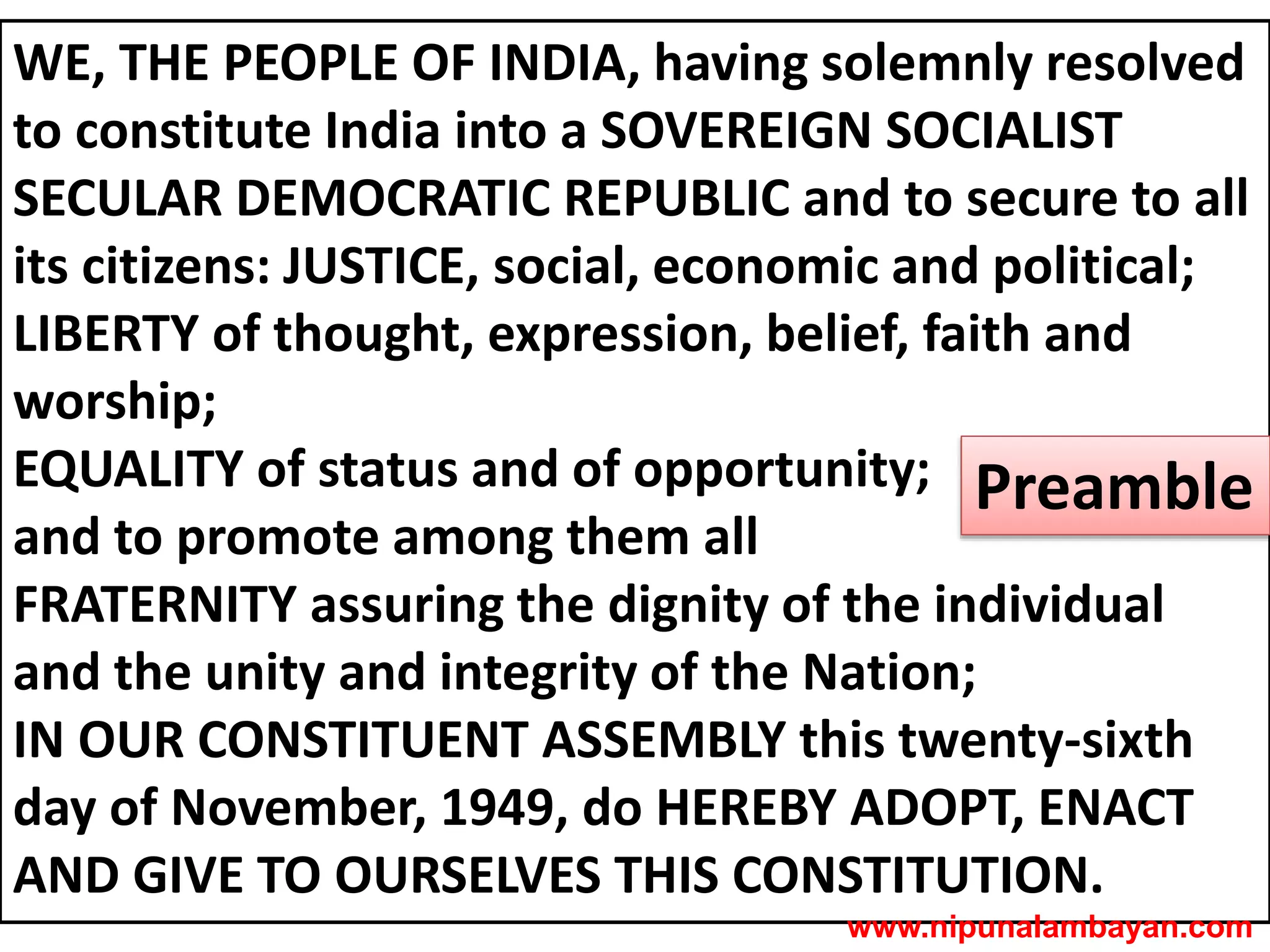
WE, THE PEOPLE OF INDIA, having solemnly resolved
to constitute India into a SOVEREIGN SOCIALIST
SECULAR DEMOCRATIC REPUBLIC and to secure to all
its citizens: JUSTICE, social, economic and political;
LIBERTY of thought, expression, belief, faith and
worship;
EQUALITY of status and of opportunity;
and to promote among them all
FRATERNITY assuring the dignity of the individual
and the unity and integrity of the Nation;
IN OUR CONSTITUENT ASSEMBLY this twenty-sixth
day of November, 1949, do HEREBY ADOPT, ENACT
AND GIVE TO OURSELVES THIS CONSTITUTION.
Preamble
www.nipunalambayan.com
Preamble
Preamble is philosophy of Indian constitution.
After the study of preamble four elements are
arises which are as follow –
Source of Authority
Type of government
Aim of the political system
Date (date of enactment)
www.nipunalambayan.com
Source of Authority - people
It was cleared from the first and last line of preamble that,
WE, THE PEOPLE OF INDIA, this constitution do HEREBY ADOPT,
ENACT AND GIVE TO OURSELVES.
www.nipunalambayan.com
'kklu dk izdkj
(Type of Government)
lizliyx
l & laiw.kZ
iz & izHkqRo&laiUu
l & lektoknh
i & iaFkfujis{k
y & yksdra=k
x & x.kjkT;
S dr
S
S
S
D
r
sovereign
socialism
secularism
democratic
republic
3
www.nipunalambayan.com
objectives of the Political
System – welfare
ULl,c
U & U;k;
L & Lora=krk
l & lerk
, & ,drk o v[k.Mrk
c & ca/qRo
J FE UF
J
F
E
U
F
JUSTICS
FREEDOM
EQUALITY
UNITY
fraternity
www.nipunalambayan.com
frfFk
(Date of Enactment)
• 26 november ]1949
• (fefr ekxZ'kh"kZ 'kqDy lIreh lEor~ nks gtkj
N% foØeh)
www.nipunalambayan.com
Type of government
Lack OF CONTROL INTERNAL & EXTERNAL
Sovereignty-
freedom of taking decision in both internal &
external issues and lack of internal & external
control.
www.nipunalambayan.com
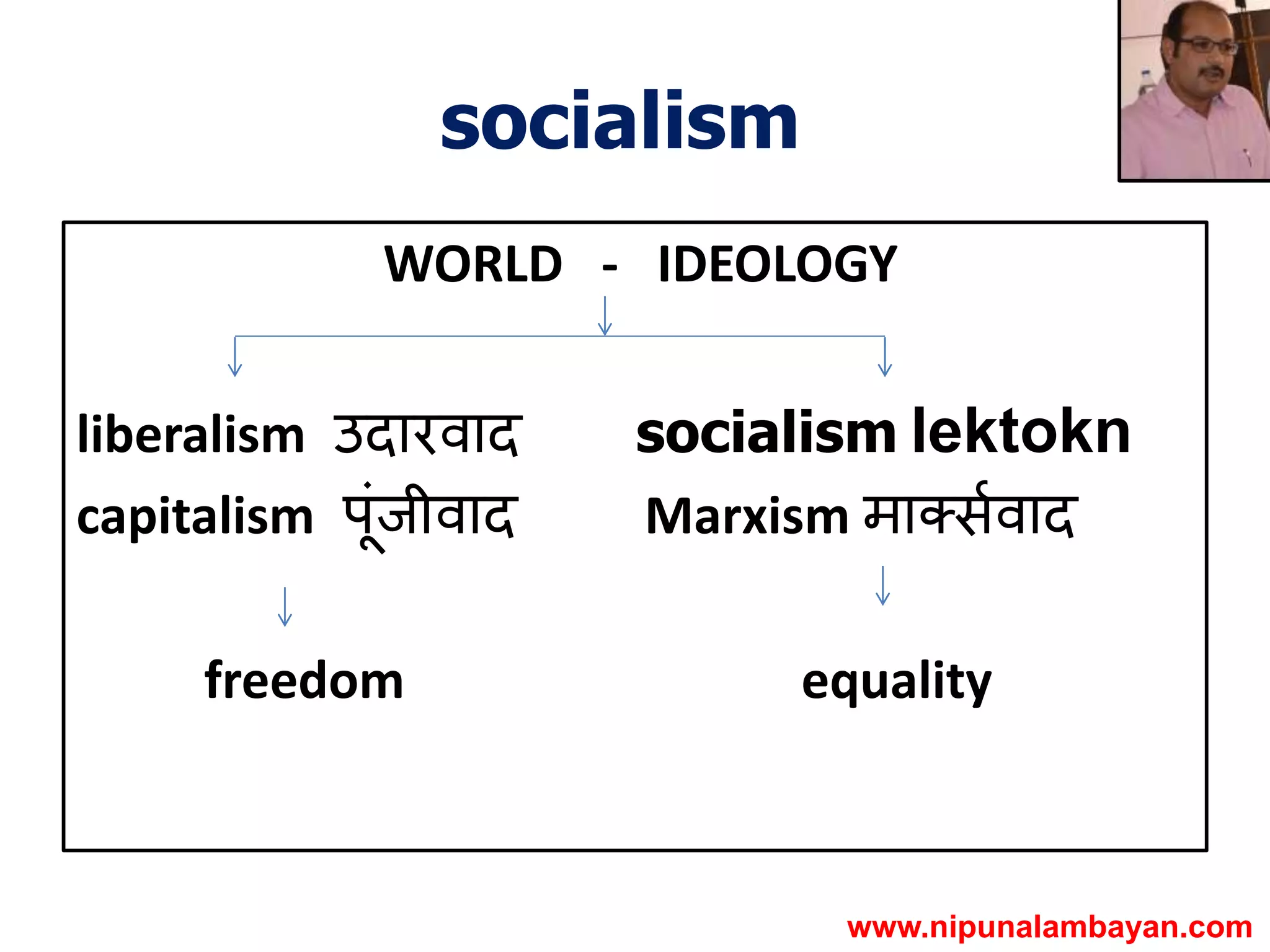
socialism
WORLD - IDEOLOGY
liberalism उदारवाद socialism lektokn
capitalism पूंजीवाद Marxism मार्क्सवाद
freedom equality
www.nipunalambayan.com
Laissez-faire policy
Police state
SEQURITY
INTERNAL & EXTERNAL
Capitalism- it advocates Laissez-faire policy capitalism
accepts police state and reduces the work of government. In
this the work of government only provide security in both
internal & external issues and leave its people free for do all
the rest of work.
www.nipunalambayan.com
Philosophy based on Equality
Completely nationalization / finished of private property
There is Big role of state – family issue alsowww.nipunalambayan.com
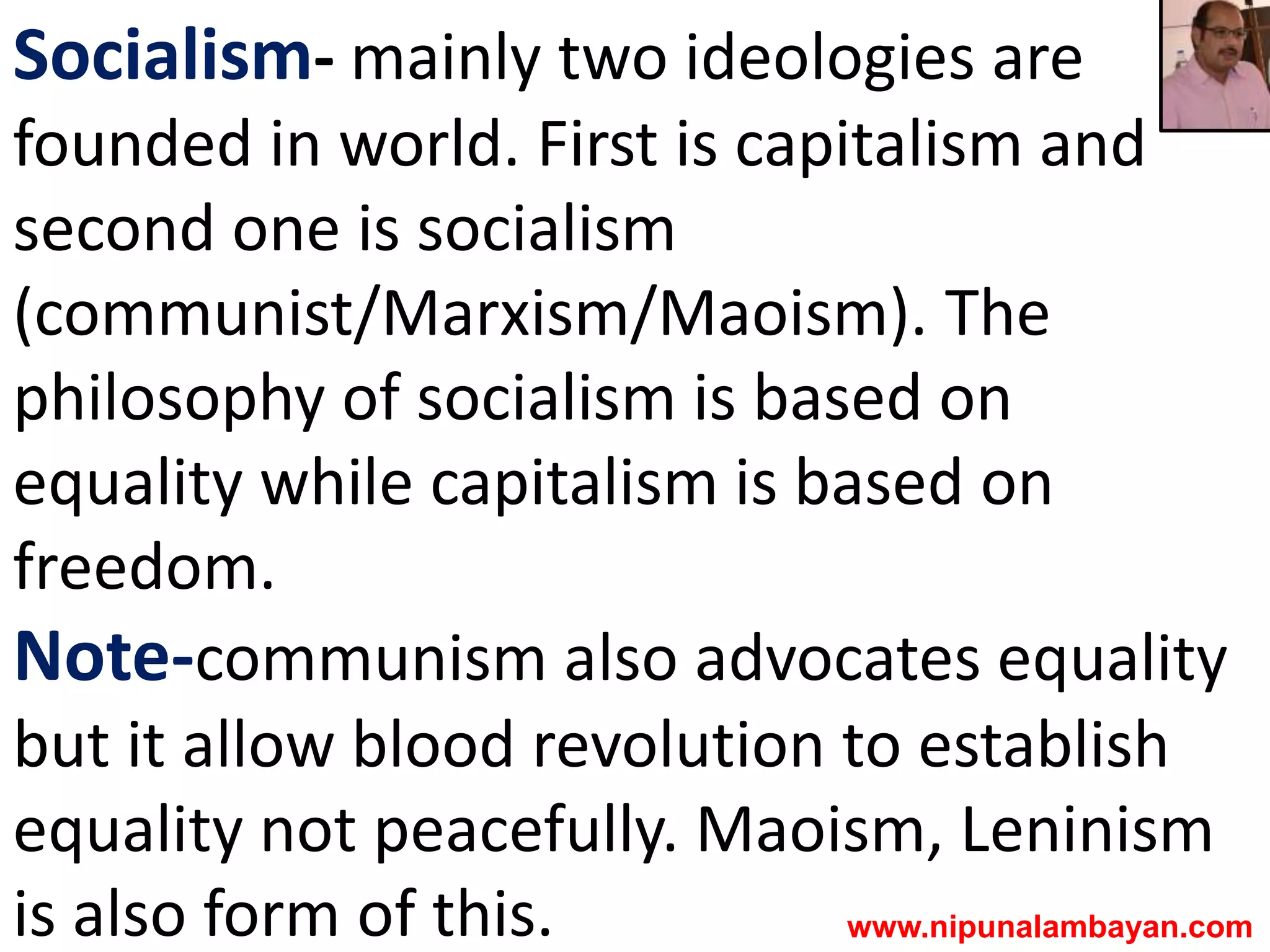
Socialism- mainly two ideologies are
founded in world. First is capitalism and
second one is socialism
(communist/Marxism/Maoism). The
philosophy of socialism is based on
equality while capitalism is based on
freedom.
Note-communism also advocates equality
but it allow blood revolution to establish
equality not peacefully. Maoism, Leninism
is also form of this. www.nipunalambayan.com
Indian socialism
Democratic Socialism
Mixed Economy
ACCEPT THE CAPITALISM &
nationalization, According to
REQUIREMENT
Tilted to Gandhi's Socialism
Indian socialism accepts democratic socialism
which advocates also capitalism and
nationalization according to needed thus Indian
socialism is tilted towards Gandhi socialism.
www.nipunalambayan.com
secularism
iaFk/laiznk; Creed/ Secular
Group of the follower of a particular religion.
Means a group of people which follow a special religion
Indian secularism does not accept western
secularism. It gives equal value to religion.
Part3 Art 25-28
loZ/eZ leHkk
www.nipunalambayan.com
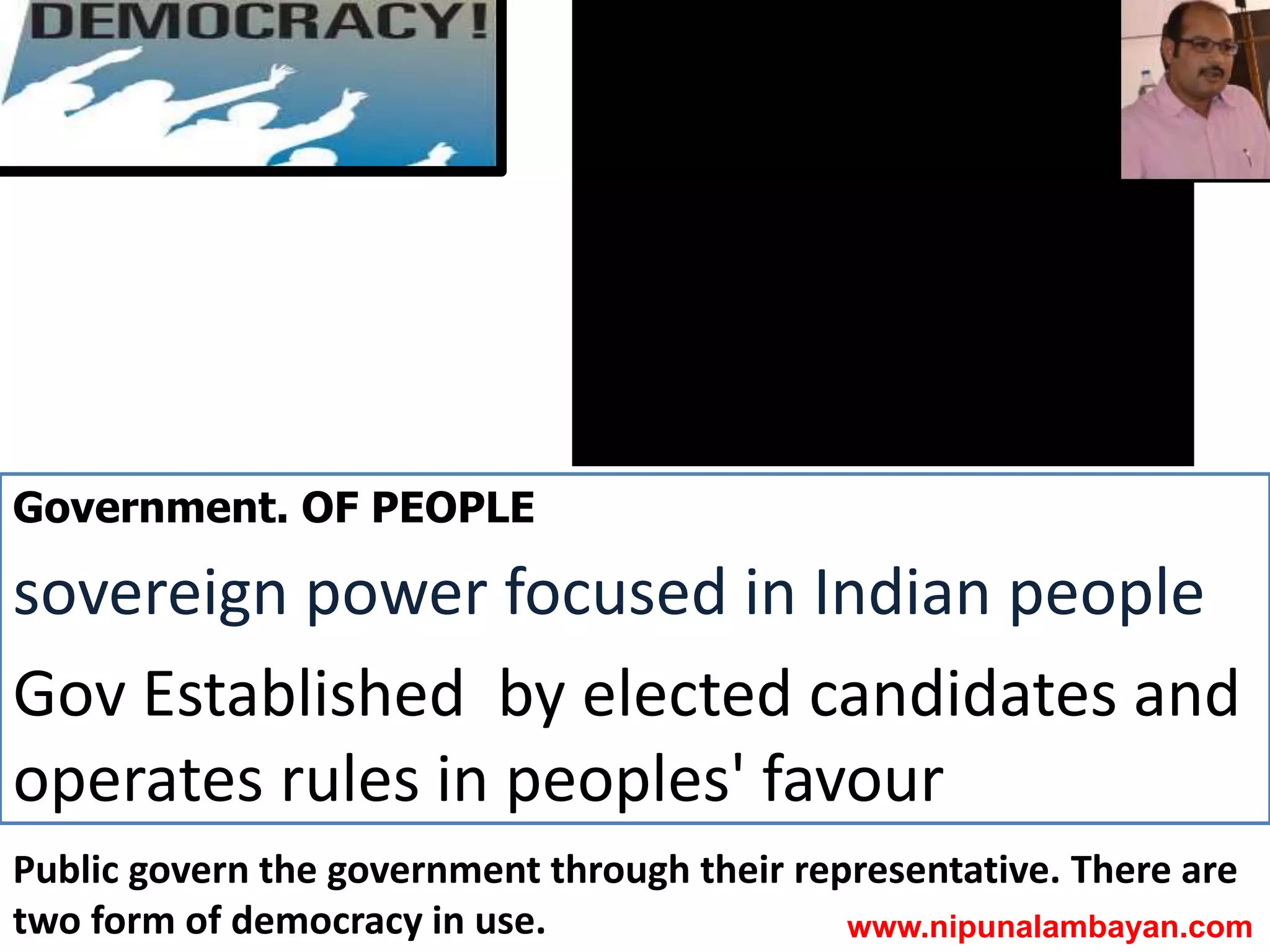
Government. OF PEOPLE
sovereign power focused in Indian people
Gov Established by elected candidates and
operates rules in peoples' favour
Public govern the government through their representative. There are
two form of democracy in use. www.nipunalambayan.com
Types of democracy
Direct
CANDIDATE ELECTED by PEOPLE
CONDIDATE CONTROLLED by PEOPLE
Initiative, Plebiscite Referendum, Recall
INDIRECT
CANDIDATE ELECTED by PEOPLE
CONDIDATE CONTROLLED by CONDIDATE
no confidence motion
www.nipunalambayan.com
Direct democracy – in this type of democracy public elects his
representative and keeps control over them.
People control his representative by four tools which are as
follow –
Initiative – public could say to government for make any law.
Plebiscite (international)- government take decision after the
public opinion over International issues.
Referendum (National)- Government takes public opinion in
national issues.
Recall- public can recall his representative before completing
certain time duration this means has been used in some
states of India in panchayati system e.g-u.p,raj etc.
Note- very good example of direct democracy is Switzerland
in world.
Indirect democracy – in this democracy public elects his
representative and control over them through representative.
Republic Two types of Democratic System
Monarchy Republic
First person of State
/ President/king
based on heredity
First person of State /president is
Elected not based on heredity
This Election have two Types
Direct or Indirect
Republic- there are two type of political found in democracy- Monarchy & Republic
Monarchy – in this, the head of state, king or president is not elected it is based on
hereditary e.g; Britain.
Republic- the system where head of state, king or president is not genetically it is
based on election and this election could be either direct or indirect.
In India president elected through indirect election and in USA through direct
election.
It has mentioned in Indian constitutional head of state or any post would not be
based on genetically tradition.
www.nipunalambayan.com
ULl,c
U & U;k;
L & Lora=krk
l & lerk
, & ,drk o v[k.Mrk
c & ca/qRo
J FE UF
J
F
E
U
F
JUSTICS
FREEDOM
EQUALITY
UNITY
fraternity
Objectives of the Political System
Welfare
www.nipunalambayan.com
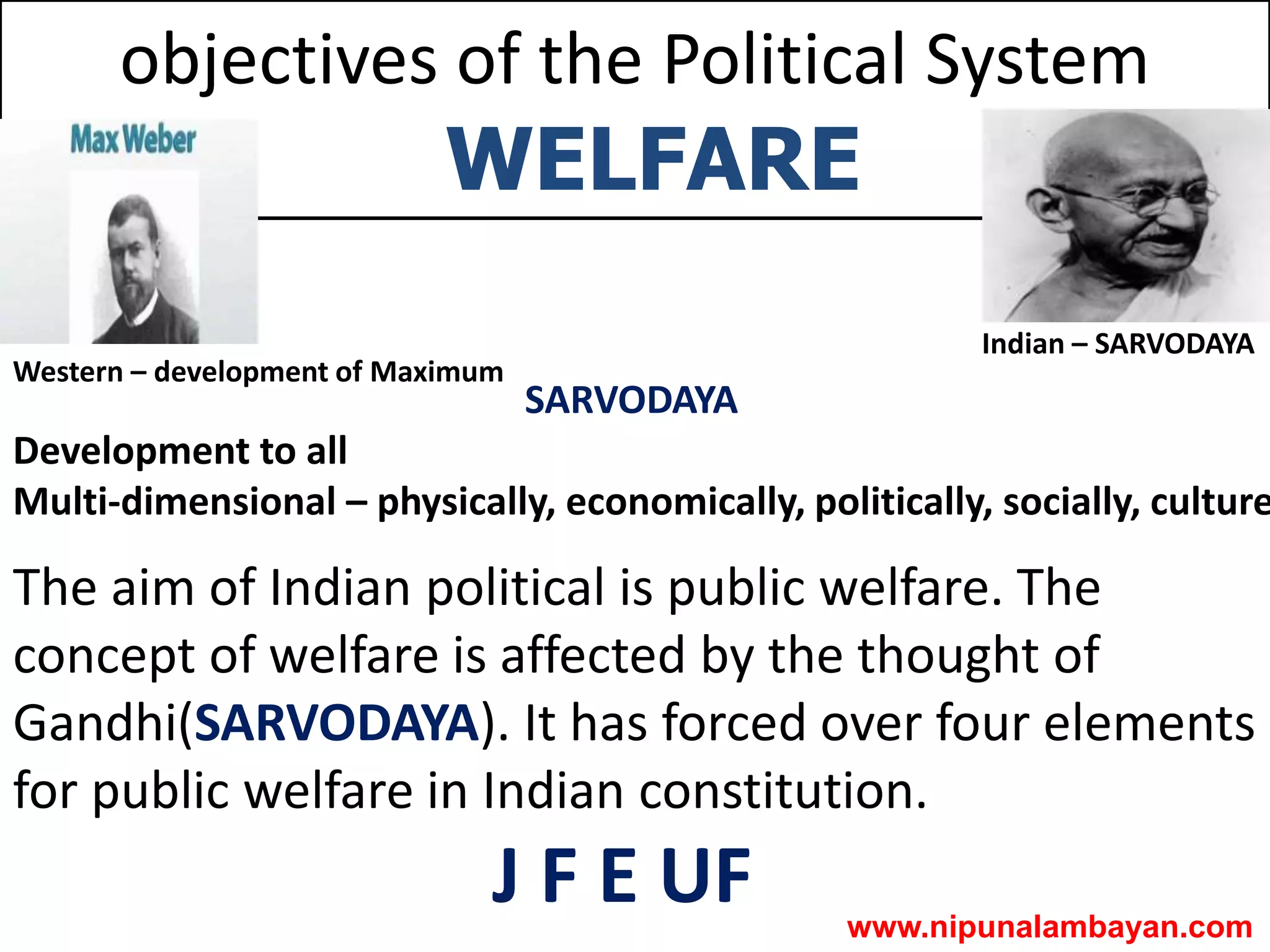
objectives of the Political System
WELFARE
The aim of Indian political is public welfare. The
concept of welfare is affected by the thought of
Gandhi(SARVODAYA). It has forced over four elements
for public welfare in Indian constitution.
J F E UF
SARVODAYA
Development to all
Multi-dimensional – physically, economically, politically, socially, culture
Indian – SARVODAYA
Western – development of Maximum
www.nipunalambayan.com
Social - be no discrimination on the
basis of Religion, race, caste, sex,
place of birth (R S BC) Art-15 - 18
Economical – distribution justice
Art-39
Political – all rights are available to
all. Art.19,326
Justice
Justice- there are three type of justice like social,
economical and political have been provided in
Indian constitution and security of these justice have
been assured through part – 3 ( fundamental right)
and part-4 (DPSP) of Indian constitution.
2
www.nipunalambayan.com
The security of social justice assured through Article
15 -18 in which it has stated that there will not be
any discrimination on the basis of r2 s bc religion,
race, caste, sex, place of birth.
Security for economical justice has been provide by
article-39 in which it has stated that distributional
justice will be available for all people or every
resources will available for everyone(article 39).
Political justice has been provided through the
provisions of article 19 and article 326 in which right
to speak, right to taking part in election, right to vote
etc. have been provided for everyone.www.nipunalambayan.com
freedom
Right to speech Art -19
Believe, Religion, Worship Art -25-28
Ethics
idea
www.nipunalambayan.com
FREEDOM-: with the freedom of speech, freedom of
believe in particular religion and the freedom of worship
have also given in Indian constitution. In the freedom of
speech it has stated that anyone could delivered his thought
but with the assumed limitations. Mixed provision of these
limitations have given in article 19(1)(a) it has stated that
everyone have freedom of speech but article 19(2) could
restricted it on the basis of misbehavior, morality and public
order etc.
Believe, religion, and worship-: the freedom of believe,
religion and worship have given in Indian constitution in
which it has stated that anyone could believe on particular
religion on the basis of soul and also could do religious
activity corresponding to this which mentioned in
Article 25-28
www.nipunalambayan.com
Equality
ukxfjd lerk
Citizens Equality jktuhfrd lerk
Political Equality vkfFkZd lerk
Economic Equality
Art- 14&18 Art19,325,326 Art& 39
Equality-: three type of equality has mentioned in Indian
constitution provision of civilian equality. It is mentioned in
article 14 to 18, political equality has mentioned in article
325- 326 and economical equality is mentioned in article 39.
www.nipunalambayan.com
Fraternity
Equality
Self Respect
Feelings of Brotherhood
Unity - Heartily
Integrity- Physically
v;a fut% ijks osfr x.kuk y?kqpsrlke~ , mnkjpfjrkuka rq olq|So
oqQVqEcde~A
Fraternity-: due to establishment of equality the emotions of self
respect will create in everyone and this emotion will bound everyone
in thread of unity and when. We will bind in tread of unity then
integrity would be established for ever. www.nipunalambayan.com
Disputes related to preamble
There are two main disputes
Preamble is the part of constitution or not
Preamble is Amendment able or not
www.nipunalambayan.com
Preamble is the part of constitution or not
Beru - bari case 1960 - S.C in Beru - bari case, 1960 held
that the preamble is not a part of constitution of India.
Supreme court said that it is key to know the thought of
constitution maker preamble indicates
General provisions which mentioned in constitution
Kesavananda Bharati v. State of Kerala 1973- in this case s.c says
preamble is the part of constitution. when we have confusion then the
preamble show the way.
SC has changed his previous decision and said that when we lose way
then preamble given way similar to Beam of light or we not able to
understand what exactly mentioned in constitution that time we make
base to philosophy of constitution
www.nipunalambayan.com
Preamble is Amendment able or not
This dispute first time came in keswanand bharti case -1973
Petitioner Preamble can't be Amendment under Art 368 because
preamble have basic structure
S.C- Preamble is part of constitution so it can be change but there is
condition that basic structure is not INFRACT
This matter firstly came in keswanand bharti v/s union of
india. In which the logic of petitioner that preamble could
not be amended under the article 368 because basic
element of constitution present in preamble. If it being
disturbed then the spirit of constitution it could be affected.
Supreme Court told that preamble is part of constitution it
could be amended in limitations of basic structure.
www.nipunalambayan.com
Basic structure
The provision which prevalent in basic structure is
excessive compulsory for any nation by the change in
these elements basics of constitution could be
ended.
SC has told that basic structure could not be defined
but SC it also told that basic structure is situational
and Dynamic which would being changed according
to time and situation and according to time it would
be defined by SC that which element would included
in basic structure.
www.nipunalambayan.com
Main Points of basic structure
Supremacy of Constitution
Parliamentary System
Unity and Integrity of State
Theory of equality
Freedom and Self respect of Person
Federal form of Constitution
Secularism
Structure of Democratic Republic
Concept of social and economic justice
Coordination between FR and DPSP
Distribution of powers in legislature, executive and judiciary
www.nipunalambayan.com

Preamble

  • 1.
  • 2.
    The method of operatingsystem of India known as Indian polity and it is operated through government. INDIAN POLITY www.nipunalambayan.com
  • 3.
    legislature Executive Judiciary Government Thereare three parts of government- legislature, executive, judiciary Legislature – the main role of legislature is to formation of law. Executive- the main role of executive is implementation of law which has been made by legislature. Judiciary – the major work of judiciary is to check law which has made by legislature and work of executive. www.nipunalambayan.com
  • 4.
    Parliament - P, L.S, R.S Legislative– G , V.S , V.P ( UK2 MBA T ) legislature Local government House of the People Council of States Legislative Assembly Legislative Council www.nipunalambayan.com
  • 5.
    CENTRE P, VP,PM,COUNCIL OF MINISTER, Attorneygeneral & Administrative body STATE Governor, chief minister, minister of council, Advocate general & Administrative body Local government Executive Sarpanch & member, mayor / chairmen & member www.nipunalambayan.com
  • 6.
  • 7.
    Constitution is acharter Which provide Powers to all parts of state ( legislature, Executive, Judiciary) Constitution Constitution is a charter which determines powers in between parts of government and also states that which type of relation will be established between states and civilians. (System of the country or polity which operates through which rule and law. The collection of these rule and law called constitution). www.nipunalambayan.com
  • 8.
    Article - 395 Part22 Schedules. 12 Part CHAPTER Article Close Preamble Schedules Constitution www.nipunalambayan.com
  • 9.
    Schedules 1 (Articles 1and 4) — States and Union Territories 2 (Articles 59, 65, 75, 97, 125, 148, 158, 164, 186 and 221) — Emoluments/Salary 3 (Articles 75, 99, 124, 148, 164, 188 and 219) — Forms of Oaths 4 (Articles 4 and 80) – This details the allocation of seats in the Rajya Sabha 5 (Article 244) – This provides for administration -Scheduled Areas Tribes 6 (Articles 244 and 275)—ATMM Assam, Meghalaya, Tripura, and Mizoram. 7 (Article 246) — the union97 , state66, and concurrent47 lists of responsibilities. 8 (Articles 344 and 351) — the official languages. 9 (Article 31-B) - Articles mentioned here are immune from judicial review. 1st1951 10 (Articles 102 and 191) — "Anti-defection“ 52th1985 11 (Article 243-G) — Panchayat Raj 73th 1992 12 (Article 243-W) — Municipalities 74th1992 www.nipunalambayan.com
  • 10.
    •Preamble •Part I –Union and its Territory •Part II – Citizenship. •Part III – Fundamental Rights •Part IV] – Directive Principles of State Policy •Part IVA – Fundamental Duties •Part V – The Union •Part VI – The States •Part VII – States in the B part of the First schedule (repealed) •Part VIII – The Union Territories •Part IX – The Panchayats •Part IXA– The Municipalities •Part IXB – The Co-operative Societies. •Part X – The scheduled and Tribal Areas •Part XI – Relations between the Union and the States •Part XlI– Finance, Property, Contracts and Suits •Part XIII – Trade and Commerce within the territory of India •Part XIV – Services Under the Union, the States •Part XIVA – Tribunals •Part XV – Elections •Part XVI – Special Provisions Relating to certain Classes •Part XVII – Languages •Part XVIII – Emergency Provisions •Part XIX – Miscellaneous •Part XX – Amendment of the Constitution •Part XXI – Temporary, Transitional and Special Provisions •Part XXII – Short title, date of commencement, Authoritative text in Hindi and Repeals Part www.nipunalambayan.com
  • 11.
    WE, THE PEOPLEOF INDIA, having solemnly resolved to constitute India into a SOVEREIGN SOCIALIST SECULAR DEMOCRATIC REPUBLIC and to secure to all its citizens: JUSTICE, social, economic and political; LIBERTY of thought, expression, belief, faith and worship; EQUALITY of status and of opportunity; and to promote among them all FRATERNITY assuring the dignity of the individual and the unity and integrity of the Nation; IN OUR CONSTITUENT ASSEMBLY this twenty-sixth day of November, 1949, do HEREBY ADOPT, ENACT AND GIVE TO OURSELVES THIS CONSTITUTION. Preamble www.nipunalambayan.com
  • 12.
    Preamble Preamble is philosophyof Indian constitution. After the study of preamble four elements are arises which are as follow – Source of Authority Type of government Aim of the political system Date (date of enactment) www.nipunalambayan.com
  • 13.
    Source of Authority- people It was cleared from the first and last line of preamble that, WE, THE PEOPLE OF INDIA, this constitution do HEREBY ADOPT, ENACT AND GIVE TO OURSELVES. www.nipunalambayan.com
  • 14.
    'kklu dk izdkj (Typeof Government) lizliyx l & laiw.kZ iz & izHkqRo&laiUu l & lektoknh i & iaFkfujis{k y & yksdra=k x & x.kjkT; S dr S S S D r sovereign socialism secularism democratic republic 3 www.nipunalambayan.com
  • 15.
    objectives of thePolitical System – welfare ULl,c U & U;k; L & Lora=krk l & lerk , & ,drk o v[k.Mrk c & ca/qRo J FE UF J F E U F JUSTICS FREEDOM EQUALITY UNITY fraternity www.nipunalambayan.com
  • 16.
    frfFk (Date of Enactment) •26 november ]1949 • (fefr ekxZ'kh"kZ 'kqDy lIreh lEor~ nks gtkj N% foØeh) www.nipunalambayan.com
  • 17.
    Type of government LackOF CONTROL INTERNAL & EXTERNAL Sovereignty- freedom of taking decision in both internal & external issues and lack of internal & external control. www.nipunalambayan.com
  • 18.
    socialism WORLD - IDEOLOGY liberalismउदारवाद socialism lektokn capitalism पूंजीवाद Marxism मार्क्सवाद freedom equality www.nipunalambayan.com
  • 19.
    Laissez-faire policy Police state SEQURITY INTERNAL& EXTERNAL Capitalism- it advocates Laissez-faire policy capitalism accepts police state and reduces the work of government. In this the work of government only provide security in both internal & external issues and leave its people free for do all the rest of work. www.nipunalambayan.com
  • 20.
    Philosophy based onEquality Completely nationalization / finished of private property There is Big role of state – family issue alsowww.nipunalambayan.com
  • 21.
    Socialism- mainly twoideologies are founded in world. First is capitalism and second one is socialism (communist/Marxism/Maoism). The philosophy of socialism is based on equality while capitalism is based on freedom. Note-communism also advocates equality but it allow blood revolution to establish equality not peacefully. Maoism, Leninism is also form of this. www.nipunalambayan.com
  • 22.
    Indian socialism Democratic Socialism MixedEconomy ACCEPT THE CAPITALISM & nationalization, According to REQUIREMENT Tilted to Gandhi's Socialism Indian socialism accepts democratic socialism which advocates also capitalism and nationalization according to needed thus Indian socialism is tilted towards Gandhi socialism. www.nipunalambayan.com
  • 23.
    secularism iaFk/laiznk; Creed/ Secular Groupof the follower of a particular religion. Means a group of people which follow a special religion Indian secularism does not accept western secularism. It gives equal value to religion. Part3 Art 25-28 loZ/eZ leHkk www.nipunalambayan.com
  • 24.
    Government. OF PEOPLE sovereignpower focused in Indian people Gov Established by elected candidates and operates rules in peoples' favour Public govern the government through their representative. There are two form of democracy in use. www.nipunalambayan.com
  • 25.
    Types of democracy Direct CANDIDATEELECTED by PEOPLE CONDIDATE CONTROLLED by PEOPLE Initiative, Plebiscite Referendum, Recall INDIRECT CANDIDATE ELECTED by PEOPLE CONDIDATE CONTROLLED by CONDIDATE no confidence motion www.nipunalambayan.com
  • 26.
    Direct democracy –in this type of democracy public elects his representative and keeps control over them. People control his representative by four tools which are as follow – Initiative – public could say to government for make any law. Plebiscite (international)- government take decision after the public opinion over International issues. Referendum (National)- Government takes public opinion in national issues. Recall- public can recall his representative before completing certain time duration this means has been used in some states of India in panchayati system e.g-u.p,raj etc. Note- very good example of direct democracy is Switzerland in world. Indirect democracy – in this democracy public elects his representative and control over them through representative.
  • 27.
    Republic Two typesof Democratic System Monarchy Republic First person of State / President/king based on heredity First person of State /president is Elected not based on heredity This Election have two Types Direct or Indirect Republic- there are two type of political found in democracy- Monarchy & Republic Monarchy – in this, the head of state, king or president is not elected it is based on hereditary e.g; Britain. Republic- the system where head of state, king or president is not genetically it is based on election and this election could be either direct or indirect. In India president elected through indirect election and in USA through direct election. It has mentioned in Indian constitutional head of state or any post would not be based on genetically tradition. www.nipunalambayan.com
  • 28.
    ULl,c U & U;k; L& Lora=krk l & lerk , & ,drk o v[k.Mrk c & ca/qRo J FE UF J F E U F JUSTICS FREEDOM EQUALITY UNITY fraternity Objectives of the Political System Welfare www.nipunalambayan.com
  • 29.
    objectives of thePolitical System WELFARE The aim of Indian political is public welfare. The concept of welfare is affected by the thought of Gandhi(SARVODAYA). It has forced over four elements for public welfare in Indian constitution. J F E UF SARVODAYA Development to all Multi-dimensional – physically, economically, politically, socially, culture Indian – SARVODAYA Western – development of Maximum www.nipunalambayan.com
  • 30.
    Social - beno discrimination on the basis of Religion, race, caste, sex, place of birth (R S BC) Art-15 - 18 Economical – distribution justice Art-39 Political – all rights are available to all. Art.19,326 Justice Justice- there are three type of justice like social, economical and political have been provided in Indian constitution and security of these justice have been assured through part – 3 ( fundamental right) and part-4 (DPSP) of Indian constitution. 2 www.nipunalambayan.com
  • 31.
    The security ofsocial justice assured through Article 15 -18 in which it has stated that there will not be any discrimination on the basis of r2 s bc religion, race, caste, sex, place of birth. Security for economical justice has been provide by article-39 in which it has stated that distributional justice will be available for all people or every resources will available for everyone(article 39). Political justice has been provided through the provisions of article 19 and article 326 in which right to speak, right to taking part in election, right to vote etc. have been provided for everyone.www.nipunalambayan.com
  • 32.
    freedom Right to speechArt -19 Believe, Religion, Worship Art -25-28 Ethics idea www.nipunalambayan.com
  • 33.
    FREEDOM-: with thefreedom of speech, freedom of believe in particular religion and the freedom of worship have also given in Indian constitution. In the freedom of speech it has stated that anyone could delivered his thought but with the assumed limitations. Mixed provision of these limitations have given in article 19(1)(a) it has stated that everyone have freedom of speech but article 19(2) could restricted it on the basis of misbehavior, morality and public order etc. Believe, religion, and worship-: the freedom of believe, religion and worship have given in Indian constitution in which it has stated that anyone could believe on particular religion on the basis of soul and also could do religious activity corresponding to this which mentioned in Article 25-28 www.nipunalambayan.com
  • 34.
    Equality ukxfjd lerk Citizens Equalityjktuhfrd lerk Political Equality vkfFkZd lerk Economic Equality Art- 14&18 Art19,325,326 Art& 39 Equality-: three type of equality has mentioned in Indian constitution provision of civilian equality. It is mentioned in article 14 to 18, political equality has mentioned in article 325- 326 and economical equality is mentioned in article 39. www.nipunalambayan.com
  • 35.
    Fraternity Equality Self Respect Feelings ofBrotherhood Unity - Heartily Integrity- Physically v;a fut% ijks osfr x.kuk y?kqpsrlke~ , mnkjpfjrkuka rq olq|So oqQVqEcde~A Fraternity-: due to establishment of equality the emotions of self respect will create in everyone and this emotion will bound everyone in thread of unity and when. We will bind in tread of unity then integrity would be established for ever. www.nipunalambayan.com
  • 36.
    Disputes related topreamble There are two main disputes Preamble is the part of constitution or not Preamble is Amendment able or not www.nipunalambayan.com
  • 37.
    Preamble is thepart of constitution or not Beru - bari case 1960 - S.C in Beru - bari case, 1960 held that the preamble is not a part of constitution of India. Supreme court said that it is key to know the thought of constitution maker preamble indicates General provisions which mentioned in constitution Kesavananda Bharati v. State of Kerala 1973- in this case s.c says preamble is the part of constitution. when we have confusion then the preamble show the way. SC has changed his previous decision and said that when we lose way then preamble given way similar to Beam of light or we not able to understand what exactly mentioned in constitution that time we make base to philosophy of constitution www.nipunalambayan.com
  • 38.
    Preamble is Amendmentable or not This dispute first time came in keswanand bharti case -1973 Petitioner Preamble can't be Amendment under Art 368 because preamble have basic structure S.C- Preamble is part of constitution so it can be change but there is condition that basic structure is not INFRACT This matter firstly came in keswanand bharti v/s union of india. In which the logic of petitioner that preamble could not be amended under the article 368 because basic element of constitution present in preamble. If it being disturbed then the spirit of constitution it could be affected. Supreme Court told that preamble is part of constitution it could be amended in limitations of basic structure. www.nipunalambayan.com
  • 39.
    Basic structure The provisionwhich prevalent in basic structure is excessive compulsory for any nation by the change in these elements basics of constitution could be ended. SC has told that basic structure could not be defined but SC it also told that basic structure is situational and Dynamic which would being changed according to time and situation and according to time it would be defined by SC that which element would included in basic structure. www.nipunalambayan.com
  • 40.
    Main Points ofbasic structure Supremacy of Constitution Parliamentary System Unity and Integrity of State Theory of equality Freedom and Self respect of Person Federal form of Constitution Secularism Structure of Democratic Republic Concept of social and economic justice Coordination between FR and DPSP Distribution of powers in legislature, executive and judiciary www.nipunalambayan.com