

Cómo crear un producto innovador /
     Creating innovative products


             Dr. Katia L. Sidali


13.04.2013
                                       1
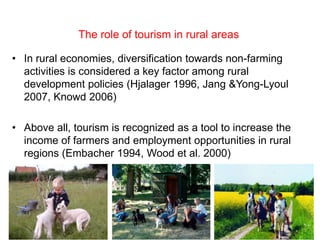
The role of tourism in rural areas

• In rural economies, diversification towards non-farming
  activities is considered a key factor among rural
  development policies (Hjalager 1996, Jang &Yong-Lyoul
  2007, Knowd 2006)

• Above all, tourism is recognized as a tool to increase the
  income of farmers and employment opportunities in rural
  regions (Embacher 1994, Wood et al. 2000)


                 Farm tourism: a cross-country empirical study in   2
                               Germany and Italy
Image of rural areas has changed!

• Shift from an undifferentiated space for food
  production (Lowe et al., 1993) to a diversified
  space performing multiple functions!
• Increasing demand looking for alternatives to
  mass tourism

• Opening of new economic opportunities!
...However, rural operators are faced to several challenges:

• ... have limited financial capabilities due to deteriorating agricultural
  subsidies
• ... lack of entrepreneurship skills

• ... are overtaxed by flexibility of “new“ customers

• ... are territorially isolated (e.g. infrastructural digital divide)

• ... lack of information technology skills (e.g. cultural digital divide)


     • Rural operators require counselling with respect
       to implementation of successful strategies!
                       Farm tourism: a cross-country empirical sudy           4
                                  in Germany and Italy
DIFFERENTIATION
Research
project!    Farm tourism in Germany


• Almost 25 000 farm operations
• Turn over 943 million euros
• 1.6 million guests

• 1997 farm tourism reached a peak of almost
  3.9 million guests!


6
Reasons for the decreasing trend


• Decrease of the birth rate of the German
  population
• New appealing tourist destinations (i.e. new
  European countries, Turkey)
• Rapid increase of low-cost airlines (Ryanair,
  Tuifly etc.)
• Lack of awareness of German farm tourism
  among the population?


7
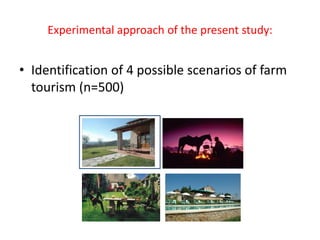
Experimental approach of the present study:


• Identification of 4 possible scenarios of farm
  tourism (n=500)


8
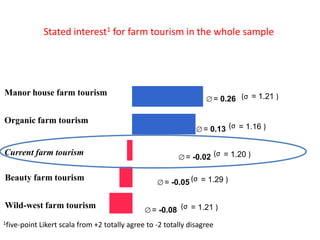
Stated interest1 for farm tourism in the whole sample


Manor house farm tourism
                                                                          = 0.26 (σ = 1.21 )

Organic farm tourism
                                                                   = 0.13 (σ = 1.16 )

Current farm tourism
                                                             = -0.02 (σ = 1.20 )

Beauty farm tourism
                                                       = -0.05 (σ = 1.29 )

Wild-west farm tourism
                                                  = -0.08 (σ = 1.21 )
1five-point   Likert scala from +2 totally agree to -2 totally disagree
      9
Interesting niches

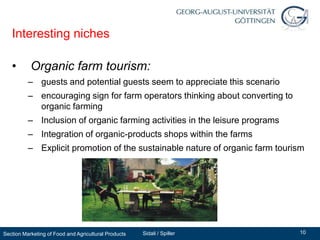
   •       Organic farm tourism:
          – guests and potential guests seem to appreciate this scenario
          – encouraging sign for farm operators thinking about converting to
            organic farming
          – Inclusion of organic farming activities in the leisure programs
          – Integration of organic-products shops within the farms
          – Explicit promotion of the sustainable nature of organic farm tourism


Section Marketing of Food and Agricultural Products   Sidali / Spiller         10
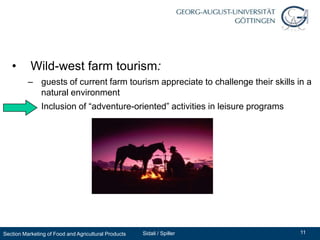
•       Wild-west farm tourism:
          – guests of current farm tourism appreciate to challenge their skills in a
            natural environment
          – Inclusion of “adventure-oriented” activities in leisure programs


Section Marketing of Food and Agricultural Products   Sidali / Spiller           11
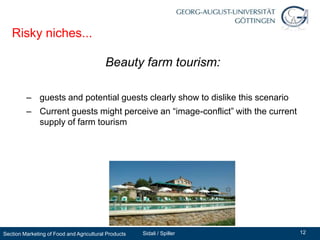
Risky niches...

                                          Beauty farm tourism:

         – guests and potential guests clearly show to dislike this scenario
         – Current guests might perceive an “image-conflict” with the current
           supply of farm tourism


Section Marketing of Food and Agricultural Products   Sidali / Spiller          12
Managerial implications:

                                           Beauty farm tourism:
   •       Do not invest if you want to retain the current
           customers segment

          – Image-correction techniques would be too expensive and little
            efficient


Section Marketing of Food and Agricultural Products   Sidali / Spiller      13
Preliminary conclusions

   • Farmers greatest power of attraction is their „mediating role“ between
        nature and individuals

          – Farmers as teachers (e.g. organic farming)

          – Farmers as entertainers (e.g. re-inventation of tradition)

          – Farmers as backstage providers for rural-tourism activities (e.g. sole
              accommodation)


                Differentiation is the right strategy to orient the farm
                        business towards customers‘ needs

Section Marketing of Food and Agricultural Products a cross-country empirical study in
                                      Farm tourism:       Sidali / Spiller               14
                                                    Germany and Italy
GOVERNANCE
Community-type destinations (Franch, 2010)


• A territorially differentiated supply
  succeeds to attract tourists!
• However this implies a creative and
  innovative governance of rural areas:
      – Actors’ involvement and coordination
      – Valorisation of all actors (empowerment)
     • The symbolic capital of a region needs
       community-based strategies
16
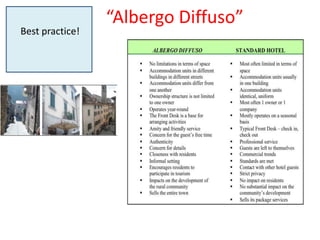
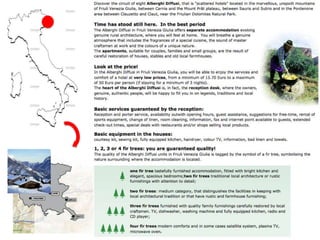
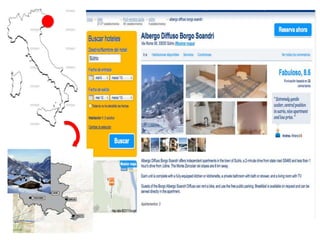
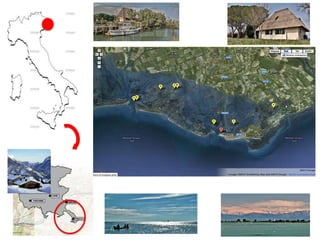
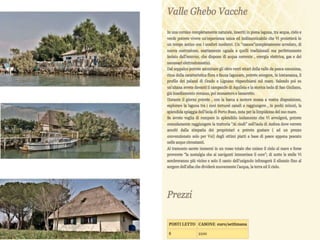
“Albergo Diffuso”
Best practice!
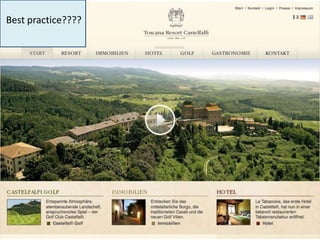
Best practice????
PERSONAL TOUCH
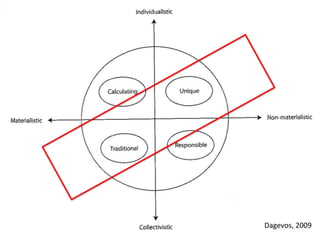
Dagevos, 2009
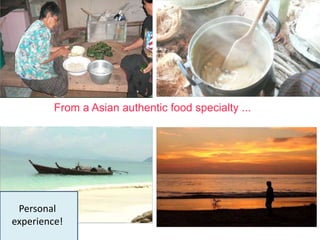
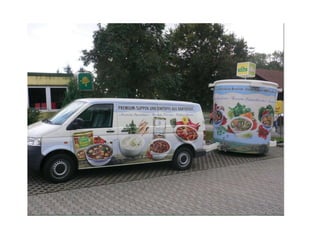
From a Asian authentic food specialty ...


 Personal
experience!
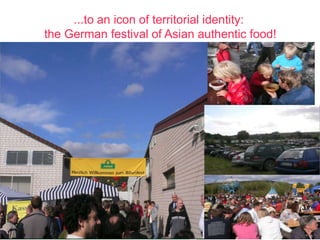
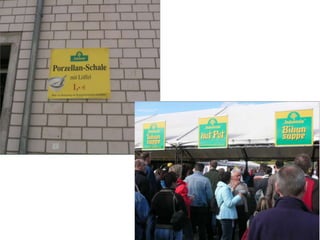
...to an icon of territorial identity:
the German festival of Asian authentic food!
What do all these examples have in
               common?
• Strong support of governmental body

• Interdisciplinary and pluralistic approach (e.g.,
  inventory of food specialty or artistic objects
  are commonly created by marketers,
  historians, anthropologists, citizens, etc.)
What do all these examples have in
               common?
• Bottom-up approach!
• Supply: each farmer, each retailer counts
• Demand: development of innovative practices
  in the field of adult education (e.g. Grundtvig
  and Leonardo Da Vinci European projects!)
Thank you for your kind attention!


                  Contact: Dr. Katia Laura Sidali
                      University of Göttingen
     Dpt. of Agricultural Economics and Rural Development
                              Göttingen
                     E-Mail: ksidali@gwdg.de
                     Tel: + 49 (0) 551 39 78 38

33
Challenges posed by changing consumer behaviour

Nowadays, tourists...

•   ... travel more frequently but stay shorter
•   ... need flexible tourist products (e.g. „glamping“)

•   ... want to be independent on holiday

•   ... prefer to directly search and book their holidays (Web 2.0)

•   ... value real, authentic experiences (e.g. favela tourism)

•   ... are more environmentally conscious

•   ... have new cultural horizons (cultural context vs single attraction)


                         Farm tourism: a cross-country empirical sudy        34
                                    in Germany and Italy

Cómo crear un producto innovador en turismo rural

  • 1.
    Cómo crear unproducto innovador / Creating innovative products Dr. Katia L. Sidali 13.04.2013 1
  • 2.
    The role oftourism in rural areas • In rural economies, diversification towards non-farming activities is considered a key factor among rural development policies (Hjalager 1996, Jang &Yong-Lyoul 2007, Knowd 2006) • Above all, tourism is recognized as a tool to increase the income of farmers and employment opportunities in rural regions (Embacher 1994, Wood et al. 2000) Farm tourism: a cross-country empirical study in 2 Germany and Italy
  • 3.
    Image of ruralareas has changed! • Shift from an undifferentiated space for food production (Lowe et al., 1993) to a diversified space performing multiple functions! • Increasing demand looking for alternatives to mass tourism • Opening of new economic opportunities!
  • 4.
    ...However, rural operatorsare faced to several challenges: • ... have limited financial capabilities due to deteriorating agricultural subsidies • ... lack of entrepreneurship skills • ... are overtaxed by flexibility of “new“ customers • ... are territorially isolated (e.g. infrastructural digital divide) • ... lack of information technology skills (e.g. cultural digital divide) • Rural operators require counselling with respect to implementation of successful strategies! Farm tourism: a cross-country empirical sudy 4 in Germany and Italy
  • 5.
  • 6.
    Research project! Farm tourism in Germany • Almost 25 000 farm operations • Turn over 943 million euros • 1.6 million guests • 1997 farm tourism reached a peak of almost 3.9 million guests! 6
  • 7.
    Reasons for thedecreasing trend • Decrease of the birth rate of the German population • New appealing tourist destinations (i.e. new European countries, Turkey) • Rapid increase of low-cost airlines (Ryanair, Tuifly etc.) • Lack of awareness of German farm tourism among the population? 7
  • 8.
    Experimental approach ofthe present study: • Identification of 4 possible scenarios of farm tourism (n=500) 8
  • 9.
    Stated interest1 forfarm tourism in the whole sample Manor house farm tourism = 0.26 (σ = 1.21 ) Organic farm tourism = 0.13 (σ = 1.16 ) Current farm tourism = -0.02 (σ = 1.20 ) Beauty farm tourism = -0.05 (σ = 1.29 ) Wild-west farm tourism = -0.08 (σ = 1.21 ) 1five-point Likert scala from +2 totally agree to -2 totally disagree 9
  • 10.
    Interesting niches • Organic farm tourism: – guests and potential guests seem to appreciate this scenario – encouraging sign for farm operators thinking about converting to organic farming – Inclusion of organic farming activities in the leisure programs – Integration of organic-products shops within the farms – Explicit promotion of the sustainable nature of organic farm tourism Section Marketing of Food and Agricultural Products Sidali / Spiller 10
  • 11.
    Wild-west farm tourism: – guests of current farm tourism appreciate to challenge their skills in a natural environment – Inclusion of “adventure-oriented” activities in leisure programs Section Marketing of Food and Agricultural Products Sidali / Spiller 11
  • 12.
    Risky niches... Beauty farm tourism: – guests and potential guests clearly show to dislike this scenario – Current guests might perceive an “image-conflict” with the current supply of farm tourism Section Marketing of Food and Agricultural Products Sidali / Spiller 12
  • 13.
    Managerial implications: Beauty farm tourism: • Do not invest if you want to retain the current customers segment – Image-correction techniques would be too expensive and little efficient Section Marketing of Food and Agricultural Products Sidali / Spiller 13
  • 14.
    Preliminary conclusions • Farmers greatest power of attraction is their „mediating role“ between nature and individuals – Farmers as teachers (e.g. organic farming) – Farmers as entertainers (e.g. re-inventation of tradition) – Farmers as backstage providers for rural-tourism activities (e.g. sole accommodation) Differentiation is the right strategy to orient the farm business towards customers‘ needs Section Marketing of Food and Agricultural Products a cross-country empirical study in Farm tourism: Sidali / Spiller 14 Germany and Italy
  • 15.
  • 16.
    Community-type destinations (Franch,2010) • A territorially differentiated supply succeeds to attract tourists! • However this implies a creative and innovative governance of rural areas: – Actors’ involvement and coordination – Valorisation of all actors (empowerment) • The symbolic capital of a region needs community-based strategies 16
  • 17.
  • 22.
  • 25.
  • 26.
  • 27.
    From a Asianauthentic food specialty ... Personal experience!
  • 28.
    ...to an iconof territorial identity: the German festival of Asian authentic food!
  • 31.
    What do allthese examples have in common? • Strong support of governmental body • Interdisciplinary and pluralistic approach (e.g., inventory of food specialty or artistic objects are commonly created by marketers, historians, anthropologists, citizens, etc.)
  • 32.
    What do allthese examples have in common? • Bottom-up approach! • Supply: each farmer, each retailer counts • Demand: development of innovative practices in the field of adult education (e.g. Grundtvig and Leonardo Da Vinci European projects!)
  • 33.
    Thank you foryour kind attention! Contact: Dr. Katia Laura Sidali University of Göttingen Dpt. of Agricultural Economics and Rural Development Göttingen E-Mail: ksidali@gwdg.de Tel: + 49 (0) 551 39 78 38 33
  • 34.
    Challenges posed bychanging consumer behaviour Nowadays, tourists... • ... travel more frequently but stay shorter • ... need flexible tourist products (e.g. „glamping“) • ... want to be independent on holiday • ... prefer to directly search and book their holidays (Web 2.0) • ... value real, authentic experiences (e.g. favela tourism) • ... are more environmentally conscious • ... have new cultural horizons (cultural context vs single attraction) Farm tourism: a cross-country empirical sudy 34 in Germany and Italy