Practical Security Testing for LTE Networks
BlackHat Abu Dhabi
December 2012
Martyn Ruks & Nils
106/11/2012
Today’s Talk
• Intro to LTE Networks
• Technical Details
• Attacks and Testing
• Defences
• Conclusions
06/11/2012 2
06/11/2012 3
Intro to LTE Networks
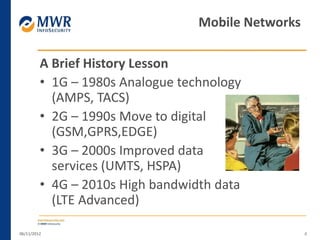
A Brief History Lesson
• 1G – 1980s Analogue technology
(AMPS, TACS)
• 2G – 1990s Move to digital
(GSM,GPRS,EDGE)
• 3G – 2000s Improved data
services (UMTS, HSPA)
• 4G – 2010s High bandwidth data
(LTE Advanced)
06/11/2012 4
Mobile Networks
Historic Vulnerabilities
• Older networks have been the subject of
practical and theoretical attacks
• Examples include:
• Ability to man in the middle
• No perfect forward secrecy
• No encryption on the back-end
• LTE Advanced addresses previous attacks
06/11/2012 5
Mobile Networks
Why is LTE Important?
• We have lived with 3G for a long
time
• 4G provides high speed mobile data
services for customers
• High level of scalability on the back-
end for operators
06/11/2012 6
Mobile Networks
06/11/2012 7
Technical Details
06/11/2012 8
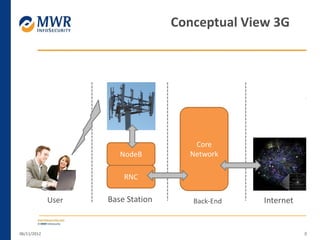
NodeB
Core
Network
InternetBase StationUser Back-End
Conceptual View 3G
RNC
06/11/2012 9
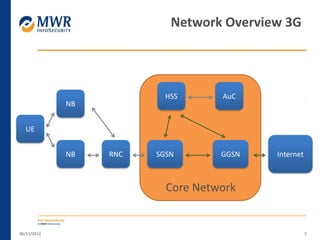
Network Overview 3G
UE
NB
NB SGSN GGSN Internet
HSS AuC
Core Network
RNC
06/11/2012 10
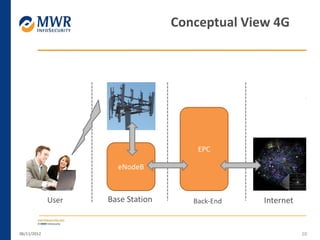
eNodeB
EPC
InternetBase StationUser Back-End
Conceptual View 4G
06/11/2012 11
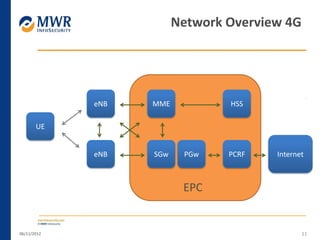
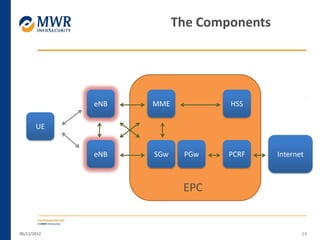
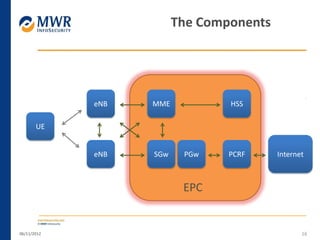
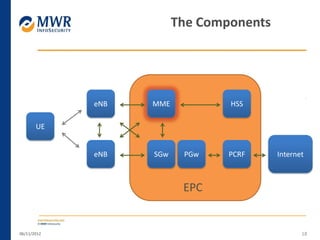
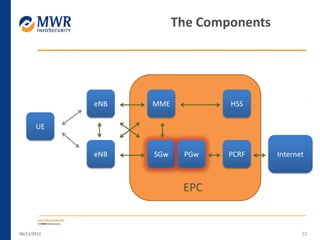
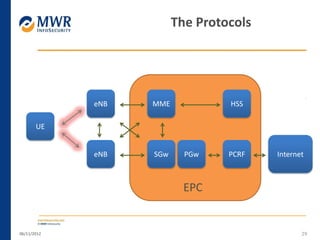
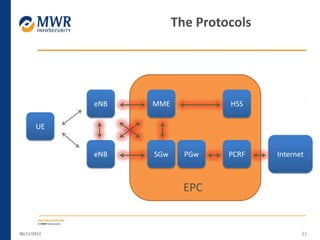
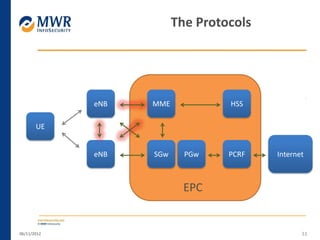
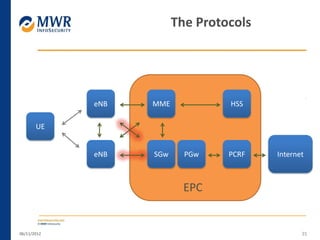
Network Overview 4G
UE
eNB
eNB
MME
SGw PGw PCRF Internet
HSS
EPC
06/11/2012 12
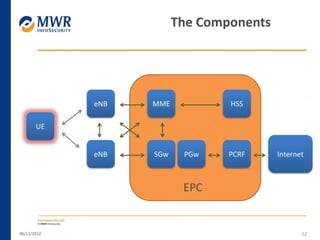
The Components
UE
eNB
eNB
MME
SGw PGw PCRF Internet
HSS
EPC
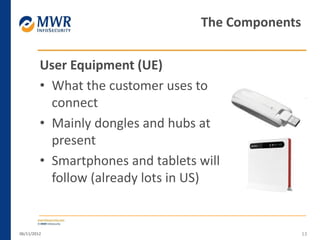
User Equipment (UE)
• What the customer uses to
connect
• Mainly dongles and hubs at
present
• Smartphones and tablets will
follow (already lots in US)
06/11/2012 13
The Components
06/11/2012 14
The Components
UE
eNB
eNB
MME
SGw PGw PCRF Internet
HSS
EPC
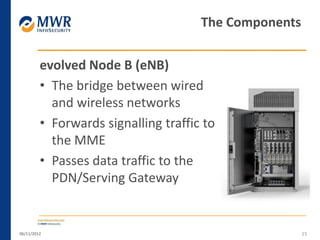
evolved Node B (eNB)
• The bridge between wired
and wireless networks
• Forwards signalling traffic to
the MME
• Passes data traffic to the
PDN/Serving Gateway
06/11/2012 15
The Components
06/11/2012 16
The Components
UE
eNB
eNB
MME
SGw PGw PCRF Internet
HSS
EPC
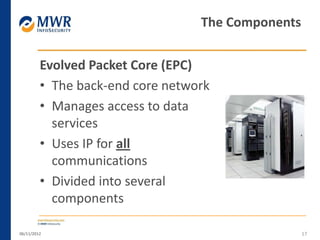
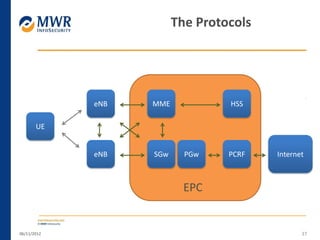
Evolved Packet Core (EPC)
• The back-end core network
• Manages access to data
services
• Uses IP for all
communications
• Divided into several
components
06/11/2012 17
The Components
06/11/2012 18
The Components
UE
eNB
eNB
MME
SGw PGw PCRF Internet
HSS
EPC
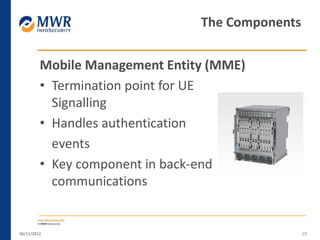
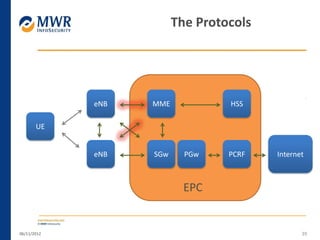
Mobile Management Entity (MME)
• Termination point for UE
Signalling
• Handles authentication
events
• Key component in back-end
communications
06/11/2012 19
The Components
06/11/2012 20
The Components
UE
eNB
eNB
MME
SGw PGw PCRF Internet
HSS
EPC
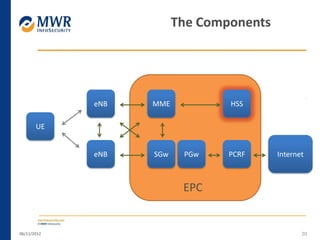
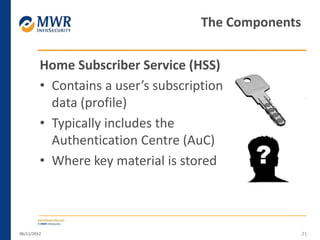
Home Subscriber Service (HSS)
• Contains a user’s subscription
data (profile)
• Typically includes the
Authentication Centre (AuC)
• Where key material is stored
06/11/2012 21
The Components
06/11/2012 22
The Components
UE
eNB
eNB
MME
SGw PGw PCRF Internet
HSS
EPC
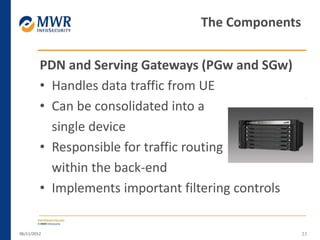
PDN and Serving Gateways (PGw and SGw)
• Handles data traffic from UE
• Can be consolidated into a
single device
• Responsible for traffic routing
within the back-end
• Implements important filtering controls
06/11/2012 23
The Components
06/11/2012 24
The Components
UE
eNB
eNB
MME
SGw PGw PCRF Internet
HSS
EPC
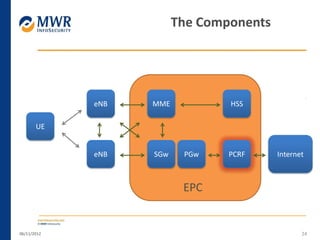
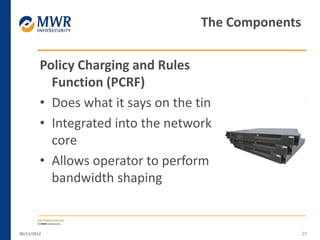
Policy Charging and Rules
Function (PCRF)
• Does what it says on the tin
• Integrated into the network
core
• Allows operator to perform
bandwidth shaping
06/11/2012 25
The Components
06/11/2012 26
The Components
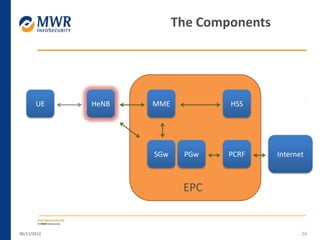
UE HeNB MME
SGw PGw PCRF Internet
HSS
EPC
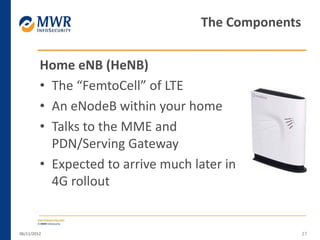
Home eNB (HeNB)
• The “FemtoCell” of LTE
• An eNodeB within your home
• Talks to the MME and
PDN/Serving Gateway
• Expected to arrive much later in
4G rollout
06/11/2012 27
The Components
06/11/2012 28
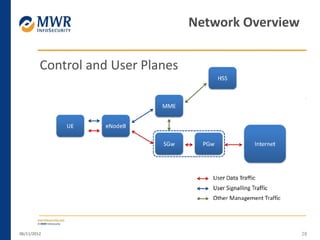
Control and User Planes
Network Overview
06/11/2012 29
The Protocols
UE
eNB
eNB
MME
SGw PGw PCRF Internet
HSS
EPC
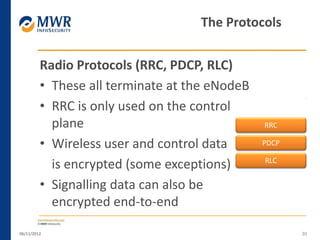
Radio Protocols (RRC, PDCP, RLC)
• These all terminate at the eNodeB
• RRC is only used on the control
plane
• Wireless user and control data
is encrypted (some exceptions)
• Signalling data can also be
encrypted end-to-end
06/11/2012 30
RRC
PDCP
RLC
The Protocols
06/11/2012 31
The Protocols
UE
eNB
eNB
MME
SGw PGw PCRF Internet
HSS
EPC
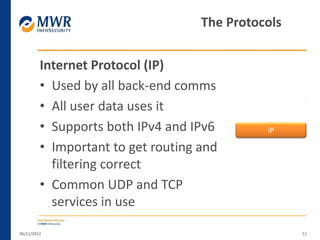
Internet Protocol (IP)
• Used by all back-end comms
• All user data uses it
• Supports both IPv4 and IPv6
• Important to get routing and
filtering correct
• Common UDP and TCP
services in use
06/11/2012 32
The Protocols
IP
06/11/2012 33
The Protocols
UE
eNB
eNB
MME
SGw PGw PCRF Internet
HSS
EPC
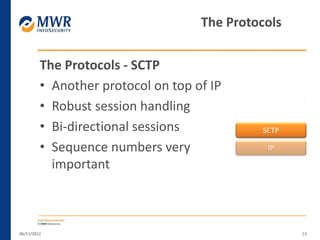
The Protocols - SCTP
• Another protocol on top of IP
• Robust session handling
• Bi-directional sessions
• Sequence numbers very
important
06/11/2012 34
The Protocols
IP
SCTP
06/11/2012 35
The Protocols
UE
eNB
eNB
MME
SGw PGw PCRF Internet
HSS
EPC
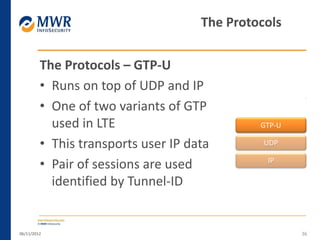
The Protocols – GTP-U
• Runs on top of UDP and IP
• One of two variants of GTP
used in LTE
• This transports user IP data
• Pair of sessions are used
identified by Tunnel-ID
06/11/2012 36
The Protocols
IP
GTP-U
UDP
06/11/2012 37
The Protocols
UE
eNB
eNB
MME
SGw PGw PCRF Internet
HSS
EPC
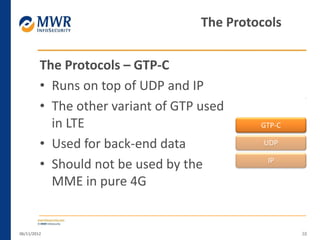
The Protocols – GTP-C
• Runs on top of UDP and IP
• The other variant of GTP used
in LTE
• Used for back-end data
• Should not be used by the
MME in pure 4G
06/11/2012 38
The Protocols
IP
GTP-C
UDP
06/11/2012 39
The Protocols
UE
eNB
eNB
MME
SGw PGw PCRF Internet
HSS
EPC
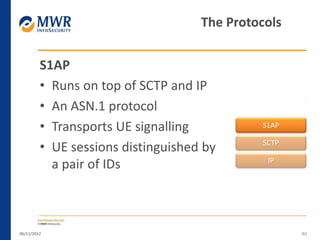
S1AP
• Runs on top of SCTP and IP
• An ASN.1 protocol
• Transports UE signalling
• UE sessions distinguished by
a pair of IDs
06/11/2012 40
The Protocols
IP
S1AP
SCTP
06/11/2012 41
The Protocols
UE
eNB
eNB
MME
SGw PGw PCRF Internet
HSS
EPC
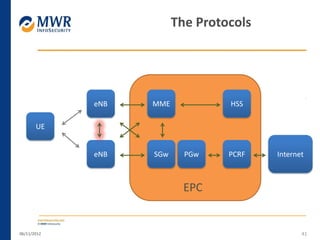
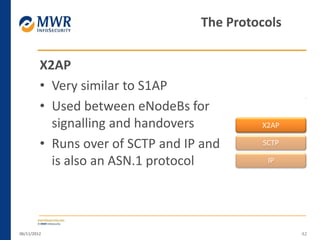
X2AP
• Very similar to S1AP
• Used between eNodeBs for
signalling and handovers
• Runs over of SCTP and IP and
is also an ASN.1 protocol
06/11/2012 42
The Protocols
IP
X2AP
SCTP
06/11/2012 43
Potential Attacks
What Attacks are Possible
• Wireless attacks and the baseband
• Attacking the EPC from UE
• Attacking other UE
• Plugging into the Back-end
• Physical attacks (HeNB)
06/11/2012 44
Targets for Testing
Wireless Attacks and the Baseband
• A DIY kit for attacking wireless
protocols is now closer (USRP
based)
• Best chance is using commercial
kit to get a head-start
• Not the easiest thing to attack
06/11/2012 45
Targets for Testing
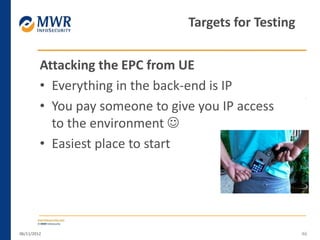
Attacking the EPC from UE
• Everything in the back-end is IP
• You pay someone to give you IP access
to the environment 
• Easiest place to start
06/11/2012 46
Targets for Testing
Attacking other UE
• Other wirelessly connected
devices are close
• May be less protection if seen
as a local network
• The gateway may enforce
segregation between UE
06/11/2012 47
Targets for Testing
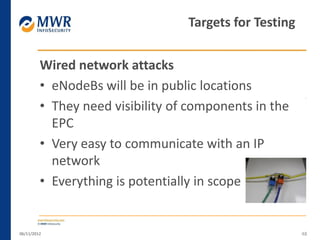
Wired network attacks
• eNodeBs will be in public locations
• They need visibility of components in the
EPC
• Very easy to communicate with an IP
network
• Everything is potentially in scope
06/11/2012 48
Targets for Testing
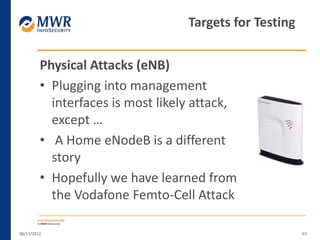
Physical Attacks (eNB)
• Plugging into management
interfaces is most likely attack,
except …
• A Home eNodeB is a different
story
• Hopefully we have learned from
the Vodafone Femto-Cell Attack
06/11/2012 49
Targets for Testing
06/11/2012 50
What you can Test
As a Wirelessly Connected User
• Visibility of the back-end from UE
• Visibility of other UEs
• Testing controls enforced by Gateway
• Spoofed source addresses
• GTP Encapsulation (Control and User)
06/11/2012 51
Tests to Run
From the Back-End
• Ability to attack MME (signalling)
• Robustness of stacks (eg SCTP)
• Fuzzing
• Sequence number generation
• Testing management interfaces
• Web consoles
• SSH
• Proprietary protocols
06/11/2012 52
Tests to Run
Challenges
• Spoofing UE authentication is difficult
• Messing with radio layers is hard
• ASN.1 protocols are a pain
• Injecting into SCTP is tough
• Easy to break back-end communications
06/11/2012 53
Tests to Run
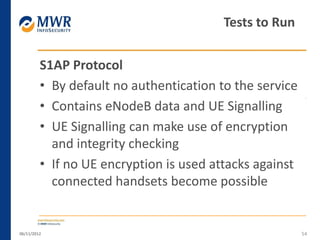
S1AP Protocol
• By default no authentication to the service
• Contains eNodeB data and UE Signalling
• UE Signalling can make use of encryption
and integrity checking
• If no UE encryption is used attacks against
connected handsets become possible
06/11/2012 54
Tests to Run
06/11/2012 55
Tests to Run
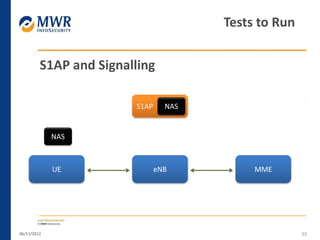
eNBUE MME
S1AP NAS
NAS
S1AP and Signalling
06/11/2012 56
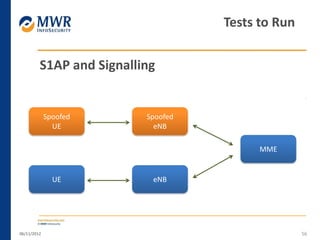
Tests to Run
eNBUE
MME
S1AP and Signalling
Spoofed
UE
Spoofed
eNB
06/11/2012 57
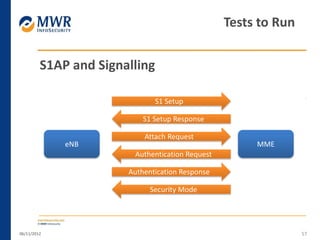
Tests to Run
eNB MME
S1AP and Signalling
S1 Setup
S1 Setup Response
Attach Request
Authentication Request
Authentication Response
Security Mode
GTP Protocol
• Gateway can handle multiple
encapsulations
• It uses UDP so easy to have fun with
• The gateway needs to enforce a number of
controls that stop attacks
06/11/2012 58
Tests to Run
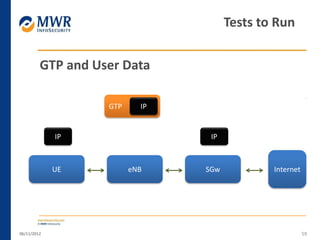
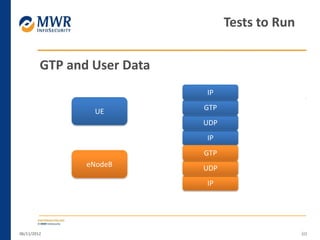
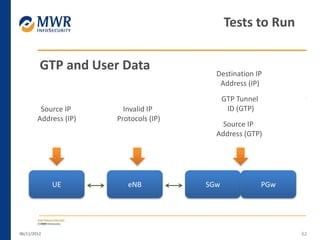
GTP and User Data
06/11/2012 59
Tests to Run
eNBUE SGw
GTP IP
IP
Internet
IP
GTP and User Data
06/11/2012 60
Tests to Run
UE
IP
UDP
GTP
IP
IP
UDP
GTP
eNodeB
GTP and User Data
06/11/2012 61
Tests to Run
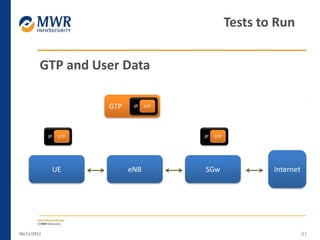
eNBUE SGw Internet
IP GTP
GTP IP GTP
IP GTP
GTP and User Data
06/11/2012 62
Tests to Run
eNBUE SGw
Source IP
Address (IP)
Invalid IP
Protocols (IP)
GTP Tunnel
ID (GTP)
Source IP
Address (GTP)
Destination IP
Address (IP)
PGw
Old Skool
• Everything you already know can be
applied to testing the back-end
• Its an IP network and has routers and
switches
• There are management services running
06/11/2012 63
Tests to Run
06/11/2012 64
Defences
The Multi-Layered Approach
• Get the IP network design right
• Protect the IP traffic in transit
• Enforce controls in the Gateway
• Ensure UE and HeNBs are secure
• Monitoring and Response
• Testing
06/11/2012 65
Defences
Unified/Consolidated Gateway
• The “Gateway” enforces some very
important controls:
• Anti-spoofing
• Encapsulation protection
• Device to device Routing
• Billing and charging of users
06/11/2012 66
Defences
IP Routing
• Architecture design and routing in the core
is complex
• Getting it right is critical to security
• We have seen issues with this
• This must be tested before an environment
is deployed
06/11/2012 67
Defences
IPSec
• If correctly implemented will provide
Confidentiality and Integrity protection
• Can also provide authentication between
components
• Keeping the keys secure is not trivial and
not tested
06/11/2012 68
Defences
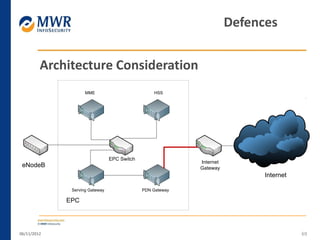
Architecture Consideration
06/11/2012 69
EPC
Internet
eNodeB
MME HSS
Serving Gateway PDN Gateway
Internet
Gateway
EPC Switch
Defences
06/11/2012 70
Conclusions
• There are 3 key protective controls that
should be tested within LTE environments
• Policies and rules in the Unified/Consolidated
Gateway
• The implementation of IPSec between all back-
end components
• A back-end IP network with well-designed
routing and filtering
06/11/2012 71
Conclusion 1
• Despite fears from the use of IP in 4G, LTE
will improve security if implemented
correctly
• The 3 key controls must be correctly
implemented
• Testing must be completed for validation
• Continued scrutiny is required
• Legacy systems may be the weakest link
06/11/2012 72
Conclusion 2
• Protecting key material used for IPSec is
not trivial
• The security model for IPSec needs careful
consideration
• Operational security processes are also
important
• Home eNodeB security is a challenge
06/11/2012 73
Conclusion 3
• More air interface testing is needed
• Will need co-operation from
vendors/operators
• “Open” testing tools will need significant
development effort
• Still lower hanging fruit if support for legacy
wireless standards remain
06/11/2012 74
Conclusion 4
06/11/2012 75
Questions
@mwrinfosecurity
@mwrlabs

Practical security testing for lte networks

  • 1.
    Practical Security Testingfor LTE Networks BlackHat Abu Dhabi December 2012 Martyn Ruks & Nils 106/11/2012
  • 2.
    Today’s Talk • Introto LTE Networks • Technical Details • Attacks and Testing • Defences • Conclusions 06/11/2012 2
  • 3.
  • 4.
    A Brief HistoryLesson • 1G – 1980s Analogue technology (AMPS, TACS) • 2G – 1990s Move to digital (GSM,GPRS,EDGE) • 3G – 2000s Improved data services (UMTS, HSPA) • 4G – 2010s High bandwidth data (LTE Advanced) 06/11/2012 4 Mobile Networks
  • 5.
    Historic Vulnerabilities • Oldernetworks have been the subject of practical and theoretical attacks • Examples include: • Ability to man in the middle • No perfect forward secrecy • No encryption on the back-end • LTE Advanced addresses previous attacks 06/11/2012 5 Mobile Networks
  • 6.
    Why is LTEImportant? • We have lived with 3G for a long time • 4G provides high speed mobile data services for customers • High level of scalability on the back- end for operators 06/11/2012 6 Mobile Networks
  • 7.
  • 8.
  • 9.
    06/11/2012 9 Network Overview3G UE NB NB SGSN GGSN Internet HSS AuC Core Network RNC
  • 10.
  • 11.
    06/11/2012 11 Network Overview4G UE eNB eNB MME SGw PGw PCRF Internet HSS EPC
  • 12.
  • 13.
    User Equipment (UE) •What the customer uses to connect • Mainly dongles and hubs at present • Smartphones and tablets will follow (already lots in US) 06/11/2012 13 The Components
  • 14.
  • 15.
    evolved Node B(eNB) • The bridge between wired and wireless networks • Forwards signalling traffic to the MME • Passes data traffic to the PDN/Serving Gateway 06/11/2012 15 The Components
  • 16.
  • 17.
    Evolved Packet Core(EPC) • The back-end core network • Manages access to data services • Uses IP for all communications • Divided into several components 06/11/2012 17 The Components
  • 18.
  • 19.
    Mobile Management Entity(MME) • Termination point for UE Signalling • Handles authentication events • Key component in back-end communications 06/11/2012 19 The Components
  • 20.
  • 21.
    Home Subscriber Service(HSS) • Contains a user’s subscription data (profile) • Typically includes the Authentication Centre (AuC) • Where key material is stored 06/11/2012 21 The Components
  • 22.
  • 23.
    PDN and ServingGateways (PGw and SGw) • Handles data traffic from UE • Can be consolidated into a single device • Responsible for traffic routing within the back-end • Implements important filtering controls 06/11/2012 23 The Components
  • 24.
  • 25.
    Policy Charging andRules Function (PCRF) • Does what it says on the tin • Integrated into the network core • Allows operator to perform bandwidth shaping 06/11/2012 25 The Components
  • 26.
    06/11/2012 26 The Components UEHeNB MME SGw PGw PCRF Internet HSS EPC
  • 27.
    Home eNB (HeNB) •The “FemtoCell” of LTE • An eNodeB within your home • Talks to the MME and PDN/Serving Gateway • Expected to arrive much later in 4G rollout 06/11/2012 27 The Components
  • 28.
    06/11/2012 28 Control andUser Planes Network Overview
  • 29.
  • 30.
    Radio Protocols (RRC,PDCP, RLC) • These all terminate at the eNodeB • RRC is only used on the control plane • Wireless user and control data is encrypted (some exceptions) • Signalling data can also be encrypted end-to-end 06/11/2012 30 RRC PDCP RLC The Protocols
  • 31.
  • 32.
    Internet Protocol (IP) •Used by all back-end comms • All user data uses it • Supports both IPv4 and IPv6 • Important to get routing and filtering correct • Common UDP and TCP services in use 06/11/2012 32 The Protocols IP
  • 33.
  • 34.
    The Protocols -SCTP • Another protocol on top of IP • Robust session handling • Bi-directional sessions • Sequence numbers very important 06/11/2012 34 The Protocols IP SCTP
  • 35.
  • 36.
    The Protocols –GTP-U • Runs on top of UDP and IP • One of two variants of GTP used in LTE • This transports user IP data • Pair of sessions are used identified by Tunnel-ID 06/11/2012 36 The Protocols IP GTP-U UDP
  • 37.
  • 38.
    The Protocols –GTP-C • Runs on top of UDP and IP • The other variant of GTP used in LTE • Used for back-end data • Should not be used by the MME in pure 4G 06/11/2012 38 The Protocols IP GTP-C UDP
  • 39.
  • 40.
    S1AP • Runs ontop of SCTP and IP • An ASN.1 protocol • Transports UE signalling • UE sessions distinguished by a pair of IDs 06/11/2012 40 The Protocols IP S1AP SCTP
  • 41.
  • 42.
    X2AP • Very similarto S1AP • Used between eNodeBs for signalling and handovers • Runs over of SCTP and IP and is also an ASN.1 protocol 06/11/2012 42 The Protocols IP X2AP SCTP
  • 43.
  • 44.
    What Attacks arePossible • Wireless attacks and the baseband • Attacking the EPC from UE • Attacking other UE • Plugging into the Back-end • Physical attacks (HeNB) 06/11/2012 44 Targets for Testing
  • 45.
    Wireless Attacks andthe Baseband • A DIY kit for attacking wireless protocols is now closer (USRP based) • Best chance is using commercial kit to get a head-start • Not the easiest thing to attack 06/11/2012 45 Targets for Testing
  • 46.
    Attacking the EPCfrom UE • Everything in the back-end is IP • You pay someone to give you IP access to the environment  • Easiest place to start 06/11/2012 46 Targets for Testing
  • 47.
    Attacking other UE •Other wirelessly connected devices are close • May be less protection if seen as a local network • The gateway may enforce segregation between UE 06/11/2012 47 Targets for Testing
  • 48.
    Wired network attacks •eNodeBs will be in public locations • They need visibility of components in the EPC • Very easy to communicate with an IP network • Everything is potentially in scope 06/11/2012 48 Targets for Testing
  • 49.
    Physical Attacks (eNB) •Plugging into management interfaces is most likely attack, except … • A Home eNodeB is a different story • Hopefully we have learned from the Vodafone Femto-Cell Attack 06/11/2012 49 Targets for Testing
  • 50.
  • 51.
    As a WirelesslyConnected User • Visibility of the back-end from UE • Visibility of other UEs • Testing controls enforced by Gateway • Spoofed source addresses • GTP Encapsulation (Control and User) 06/11/2012 51 Tests to Run
  • 52.
    From the Back-End •Ability to attack MME (signalling) • Robustness of stacks (eg SCTP) • Fuzzing • Sequence number generation • Testing management interfaces • Web consoles • SSH • Proprietary protocols 06/11/2012 52 Tests to Run
  • 53.
    Challenges • Spoofing UEauthentication is difficult • Messing with radio layers is hard • ASN.1 protocols are a pain • Injecting into SCTP is tough • Easy to break back-end communications 06/11/2012 53 Tests to Run
  • 54.
    S1AP Protocol • Bydefault no authentication to the service • Contains eNodeB data and UE Signalling • UE Signalling can make use of encryption and integrity checking • If no UE encryption is used attacks against connected handsets become possible 06/11/2012 54 Tests to Run
  • 55.
    06/11/2012 55 Tests toRun eNBUE MME S1AP NAS NAS S1AP and Signalling
  • 56.
    06/11/2012 56 Tests toRun eNBUE MME S1AP and Signalling Spoofed UE Spoofed eNB
  • 57.
    06/11/2012 57 Tests toRun eNB MME S1AP and Signalling S1 Setup S1 Setup Response Attach Request Authentication Request Authentication Response Security Mode
  • 58.
    GTP Protocol • Gatewaycan handle multiple encapsulations • It uses UDP so easy to have fun with • The gateway needs to enforce a number of controls that stop attacks 06/11/2012 58 Tests to Run
  • 59.
    GTP and UserData 06/11/2012 59 Tests to Run eNBUE SGw GTP IP IP Internet IP
  • 60.
    GTP and UserData 06/11/2012 60 Tests to Run UE IP UDP GTP IP IP UDP GTP eNodeB
  • 61.
    GTP and UserData 06/11/2012 61 Tests to Run eNBUE SGw Internet IP GTP GTP IP GTP IP GTP
  • 62.
    GTP and UserData 06/11/2012 62 Tests to Run eNBUE SGw Source IP Address (IP) Invalid IP Protocols (IP) GTP Tunnel ID (GTP) Source IP Address (GTP) Destination IP Address (IP) PGw
  • 63.
    Old Skool • Everythingyou already know can be applied to testing the back-end • Its an IP network and has routers and switches • There are management services running 06/11/2012 63 Tests to Run
  • 64.
  • 65.
    The Multi-Layered Approach •Get the IP network design right • Protect the IP traffic in transit • Enforce controls in the Gateway • Ensure UE and HeNBs are secure • Monitoring and Response • Testing 06/11/2012 65 Defences
  • 66.
    Unified/Consolidated Gateway • The“Gateway” enforces some very important controls: • Anti-spoofing • Encapsulation protection • Device to device Routing • Billing and charging of users 06/11/2012 66 Defences
  • 67.
    IP Routing • Architecturedesign and routing in the core is complex • Getting it right is critical to security • We have seen issues with this • This must be tested before an environment is deployed 06/11/2012 67 Defences
  • 68.
    IPSec • If correctlyimplemented will provide Confidentiality and Integrity protection • Can also provide authentication between components • Keeping the keys secure is not trivial and not tested 06/11/2012 68 Defences
  • 69.
    Architecture Consideration 06/11/2012 69 EPC Internet eNodeB MMEHSS Serving Gateway PDN Gateway Internet Gateway EPC Switch Defences
  • 70.
  • 71.
    • There are3 key protective controls that should be tested within LTE environments • Policies and rules in the Unified/Consolidated Gateway • The implementation of IPSec between all back- end components • A back-end IP network with well-designed routing and filtering 06/11/2012 71 Conclusion 1
  • 72.
    • Despite fearsfrom the use of IP in 4G, LTE will improve security if implemented correctly • The 3 key controls must be correctly implemented • Testing must be completed for validation • Continued scrutiny is required • Legacy systems may be the weakest link 06/11/2012 72 Conclusion 2
  • 73.
    • Protecting keymaterial used for IPSec is not trivial • The security model for IPSec needs careful consideration • Operational security processes are also important • Home eNodeB security is a challenge 06/11/2012 73 Conclusion 3
  • 74.
    • More airinterface testing is needed • Will need co-operation from vendors/operators • “Open” testing tools will need significant development effort • Still lower hanging fruit if support for legacy wireless standards remain 06/11/2012 74 Conclusion 4
  • 75.