Can your organization take decisions by making
use of maps?


                      Practical GIS Workshop
         - Geographical Information System (GIS) -

Many organisations have new and legacy data sets, which is stored in a variety of
formats across the organisation. By adding a mapping (or spatial location) to these
data sets organisations are able to make more informed decisions through the analysis
of these data sets.


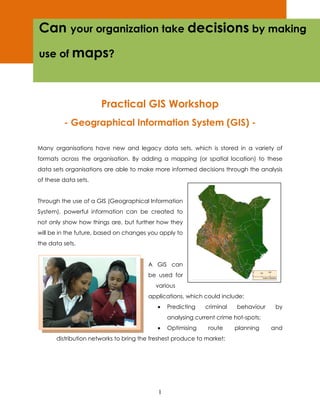
Through the use of a GIS (Geographical Information
System), powerful information can be created to
not only show how things are, but further how they
will be in the future, based on changes you apply to
the data sets.


                                       A GIS can
                                       be used for
                                          various
                                       applications, which could include:
                                           •   Predicting   criminal    behaviour    by
                                               analysing current crime hot-spots;
                                           •   Optimising    route     planning     and
      distribution networks to bring the freshest produce to market;


                                           1
•   Increase     revenue      within       Local
       Government by mapping outstanding
       payments     and    optimising     focussed
       revenue collection programmes;
   •   Assessment and planning of agricultural
       planting and harvesting to optimise soil
       characteristics and crop yield.


The objective of the workshop
The objective of the three-day workshop will be to guide attendees through a
systematic process in understanding:
   •   The information and knowledge environment organisations and business operate
                                              in;
                                          •   An      introduction    to   Geographical
                                              Information Systems (GIS);
                                          •   GIS data formats, software and concepts.
                                          •   GIS data analysis – database and spatial
                                              data analysis
                                          •   Practical, hands-on GIS problem solving, by
                                              making use of Free and Open Source GIS
                                              Software.


Each day will also end with a discussion session, where attendees can share their own
experience and comment on the topics covered that particular day. The workshop will
further culminate in a final day hands-on problem solving using local GIS data.


                                              2
Who should attend the workshop?
Delegates from organisations or businesses that already, or intend to, make use of GIS
technologies in their organisation or business. As the workshop will also make use of
practical GIS exercises, attendees are encouraged to have at least a basic level of
computer literacy.


The facilitator of the workshop will be Mr. Nico Elema, Managing Director, GIS Global
Image Consultants, South Africa (www.globalimage.co.za)


For further information about this course, please contact:


Mr. Nico Elema
GIS Global Image (PTY) Ltd
Tel: +27 21 880 1891
nico@cpt-globalimage.co.za


                                            3
PROPOSED PROGRAMME

                                                Day I:

                                                This session will focus on understanding what GIS is and how it can be
                                                used. Case studies and examples of successful implementations. The
Day I: Fundamentals of Mapping and Geographic


                                                session would also explore the other geo-technologies (map reading
                                                and analysis, remote sensing, GPS, digital cartography) which are
                                                related to GIS.

                                                Official opening and welcome

                                                Session I: Introduction to Geographical Information Systems (GIS)

                                                Content: The knowledge economy. The growing importance of GIS;
                                                What is GIS?; Characteristics of GIS; A holistic approach to GIS; 21st
                                                Century challenges; Why GIS is important to the concept of
                                                development; GIS in practice; The future of GIS
                                                              __________________________________________

                                                Session II: GIS Project management and understanding your
                                                organisation’s GIS needs.


                                                Content: What is Project Management? The importance of project
                                                management. The importance of understanding your organisation’s
                                                GIS needs. The importance of understanding different user needs, and
Information Systems


                                                how it relates to a successful GIS implementation.
                                                              ___________________________________________

                                                Session III: Data and data sources

                                                Content: The aim of this session is to discuss the importance of data;
                                                metadata and to further discuss the availability of GIS data in the
                                                Region.


                                                                               4
DAY II:

                                       This session should provide direct access to GIS software skills, by introducing
                                       an industry standard GIS package(s). By the end of this course the student is
                                       ready to begin applying the software to mapping and analyzing their
                                       environment. Due to licensing issues on proprietary software, the session will
                                       utilise open source GIS applications for demonstration.

                                       Session I: GIS software

                                       Content: What GIS Software is available to users of a GIS. Different users in the
                                       organisation and how their GIS software needs differ. The future of GIS
                                       software.
                                                       ___________________________________________

                                       Session II: Practical GIS Software skills
Day II: Introduction to GIS Software


                                       Content: Loading GIS data; GIS data capture techniques; map creation
                                       (changing map styles – map rendering);
                                                       ___________________________________________

                                       Session III: Practical GIS Software Skills (Continue)

                                       Content: GIS database analysis; GIS Spatial analysis (includes spatial data
                                       buffering); preparing maps for printing

                                                          ___________________________________________

                                       Session IV: Discussion

                                       Content: Relate issues in first three sessions to the work environment.
                                                        ___________________________________________


                                                                                   5
DAY III :
                                                  This session should be an exploration of various, more advanced GIS
                                                  techniques and concepts though an active learning project-based
                                                  approach. Students work with the instructor and each other to define,
                                                  propose, design, and execute a project that incorporates GIS skills and
                                                  knowledge. The project could be introduced to the class well in advance and
                                                  students start working in groups from the first day of the training.
Day III: GIS Applications - Project Development


                                                  Session I; II & III: Activity – Practical GIS application

                                                  Content: Participants are grouped in “Birds of a Feather” groupings and are
                                                  taken through the steps of developing a Geographical Information System
                                                  using their own experiences from their organizations. By the end of the activity,
                                                  the participants should have at least an outline of their GIS.

                                                                     ___________________________________________


                                                                                             6

Practical GIS workshop programme

  • 1.
    Can your organizationtake decisions by making use of maps? Practical GIS Workshop - Geographical Information System (GIS) - Many organisations have new and legacy data sets, which is stored in a variety of formats across the organisation. By adding a mapping (or spatial location) to these data sets organisations are able to make more informed decisions through the analysis of these data sets. Through the use of a GIS (Geographical Information System), powerful information can be created to not only show how things are, but further how they will be in the future, based on changes you apply to the data sets. A GIS can be used for various applications, which could include: • Predicting criminal behaviour by analysing current crime hot-spots; • Optimising route planning and distribution networks to bring the freshest produce to market; 1
  • 2.
    Increase revenue within Local Government by mapping outstanding payments and optimising focussed revenue collection programmes; • Assessment and planning of agricultural planting and harvesting to optimise soil characteristics and crop yield. The objective of the workshop The objective of the three-day workshop will be to guide attendees through a systematic process in understanding: • The information and knowledge environment organisations and business operate in; • An introduction to Geographical Information Systems (GIS); • GIS data formats, software and concepts. • GIS data analysis – database and spatial data analysis • Practical, hands-on GIS problem solving, by making use of Free and Open Source GIS Software. Each day will also end with a discussion session, where attendees can share their own experience and comment on the topics covered that particular day. The workshop will further culminate in a final day hands-on problem solving using local GIS data. 2
  • 3.
    Who should attendthe workshop? Delegates from organisations or businesses that already, or intend to, make use of GIS technologies in their organisation or business. As the workshop will also make use of practical GIS exercises, attendees are encouraged to have at least a basic level of computer literacy. The facilitator of the workshop will be Mr. Nico Elema, Managing Director, GIS Global Image Consultants, South Africa (www.globalimage.co.za) For further information about this course, please contact: Mr. Nico Elema GIS Global Image (PTY) Ltd Tel: +27 21 880 1891 nico@cpt-globalimage.co.za 3
  • 4.
    PROPOSED PROGRAMME Day I: This session will focus on understanding what GIS is and how it can be used. Case studies and examples of successful implementations. The Day I: Fundamentals of Mapping and Geographic session would also explore the other geo-technologies (map reading and analysis, remote sensing, GPS, digital cartography) which are related to GIS. Official opening and welcome Session I: Introduction to Geographical Information Systems (GIS) Content: The knowledge economy. The growing importance of GIS; What is GIS?; Characteristics of GIS; A holistic approach to GIS; 21st Century challenges; Why GIS is important to the concept of development; GIS in practice; The future of GIS __________________________________________ Session II: GIS Project management and understanding your organisation’s GIS needs. Content: What is Project Management? The importance of project management. The importance of understanding your organisation’s GIS needs. The importance of understanding different user needs, and Information Systems how it relates to a successful GIS implementation. ___________________________________________ Session III: Data and data sources Content: The aim of this session is to discuss the importance of data; metadata and to further discuss the availability of GIS data in the Region. 4
  • 5.
    DAY II: This session should provide direct access to GIS software skills, by introducing an industry standard GIS package(s). By the end of this course the student is ready to begin applying the software to mapping and analyzing their environment. Due to licensing issues on proprietary software, the session will utilise open source GIS applications for demonstration. Session I: GIS software Content: What GIS Software is available to users of a GIS. Different users in the organisation and how their GIS software needs differ. The future of GIS software. ___________________________________________ Session II: Practical GIS Software skills Day II: Introduction to GIS Software Content: Loading GIS data; GIS data capture techniques; map creation (changing map styles – map rendering); ___________________________________________ Session III: Practical GIS Software Skills (Continue) Content: GIS database analysis; GIS Spatial analysis (includes spatial data buffering); preparing maps for printing ___________________________________________ Session IV: Discussion Content: Relate issues in first three sessions to the work environment. ___________________________________________ 5
  • 6.
    DAY III : This session should be an exploration of various, more advanced GIS techniques and concepts though an active learning project-based approach. Students work with the instructor and each other to define, propose, design, and execute a project that incorporates GIS skills and knowledge. The project could be introduced to the class well in advance and students start working in groups from the first day of the training. Day III: GIS Applications - Project Development Session I; II & III: Activity – Practical GIS application Content: Participants are grouped in “Birds of a Feather” groupings and are taken through the steps of developing a Geographical Information System using their own experiences from their organizations. By the end of the activity, the participants should have at least an outline of their GIS. ___________________________________________ 6