Estimation Techniques inAgile &
Scrum
• Practical Approaches to Sizing Work
• Facilitator: [Your Name], Agile Coach
2.
Agenda
• 1. WhyEstimation Matters in Agile
• 2. Types of Estimation Techniques
• 3. Story Points vs. Time-Based Estimation
• 4. Popular Estimation Methods
• 5. Group Estimation Activity
• 6. Best Practices & Common Pitfalls
3.
Why Estimate?
• -Forecast velocity and plan sprints/releases
• - Help teams break down complex work
• - Improve prioritization and delivery planning
• - Enable predictability in delivery
4.
Estimation in Agile
•- Collaborative process
• - Focus is on relative effort, not precision
• - Helps build shared understanding of scope
• - Conducted during backlog refinement or
sprint planning
5.
Story Points vsTime-Based
Estimation
• Story Points:
• - Measures effort, complexity, and uncertainty
• - Abstract and relative
• - Less emotional attachment
• - Helps in team velocity tracking
• Time-Based:
• - Measures hours or days
• - Precise and absolute
6.
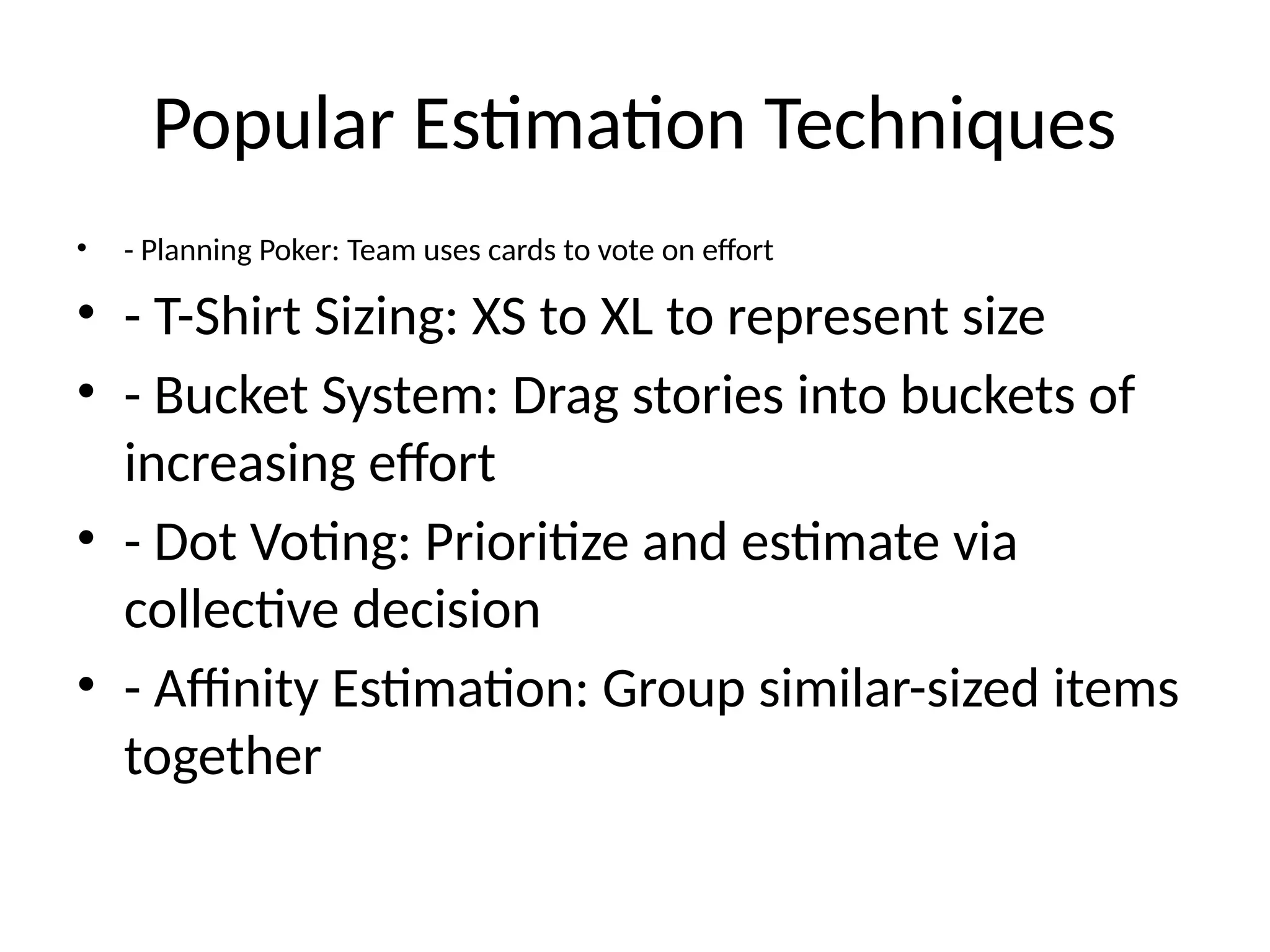
Popular Estimation Techniques
•- Planning Poker: Team uses cards to vote on effort
• - T-Shirt Sizing: XS to XL to represent size
• - Bucket System: Drag stories into buckets of
increasing effort
• - Dot Voting: Prioritize and estimate via
collective decision
• - Affinity Estimation: Group similar-sized items
together
7.
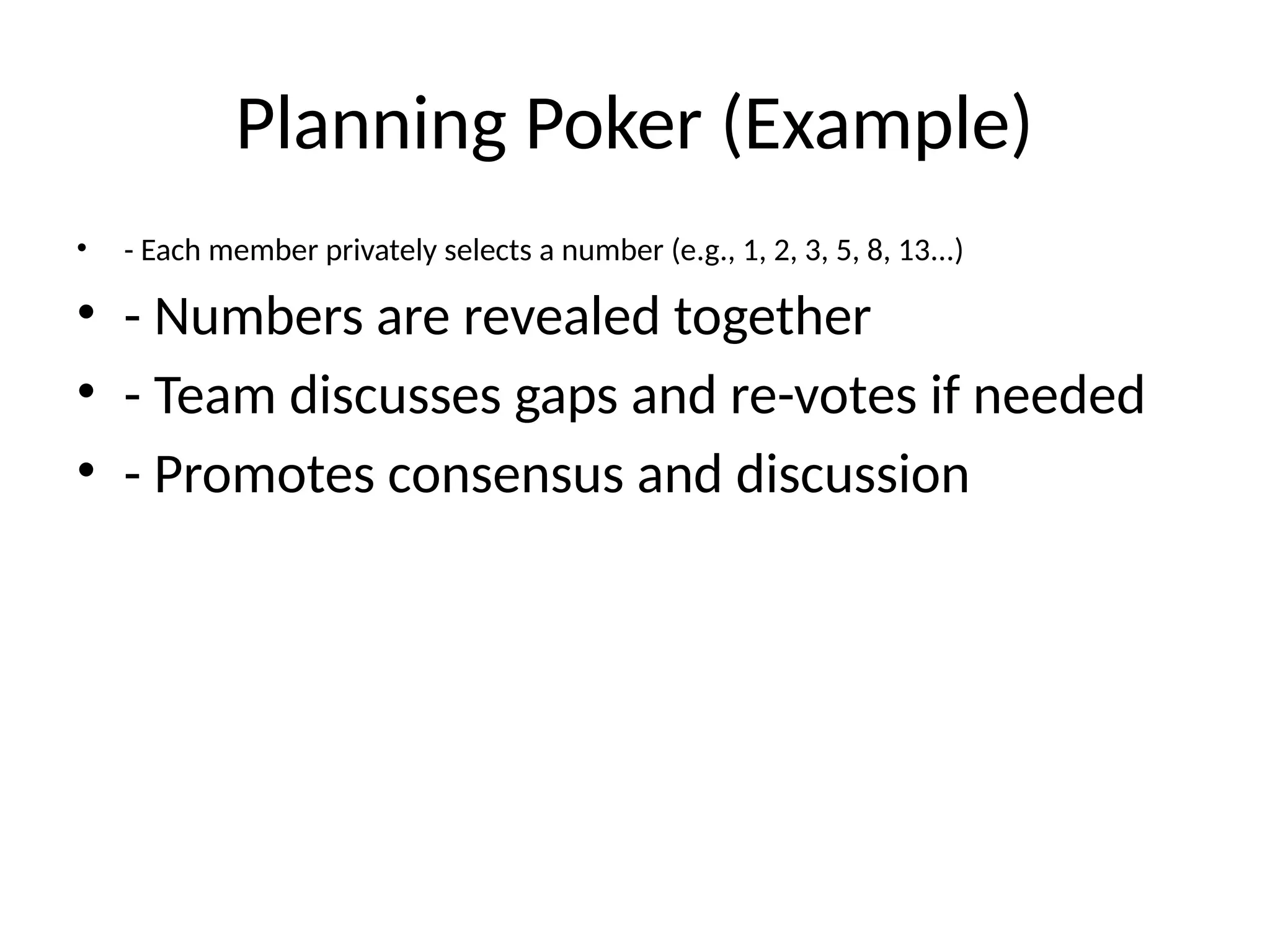
Planning Poker (Example)
•- Each member privately selects a number (e.g., 1, 2, 3, 5, 8, 13...)
• - Numbers are revealed together
• - Team discusses gaps and re-votes if needed
• - Promotes consensus and discussion
8.
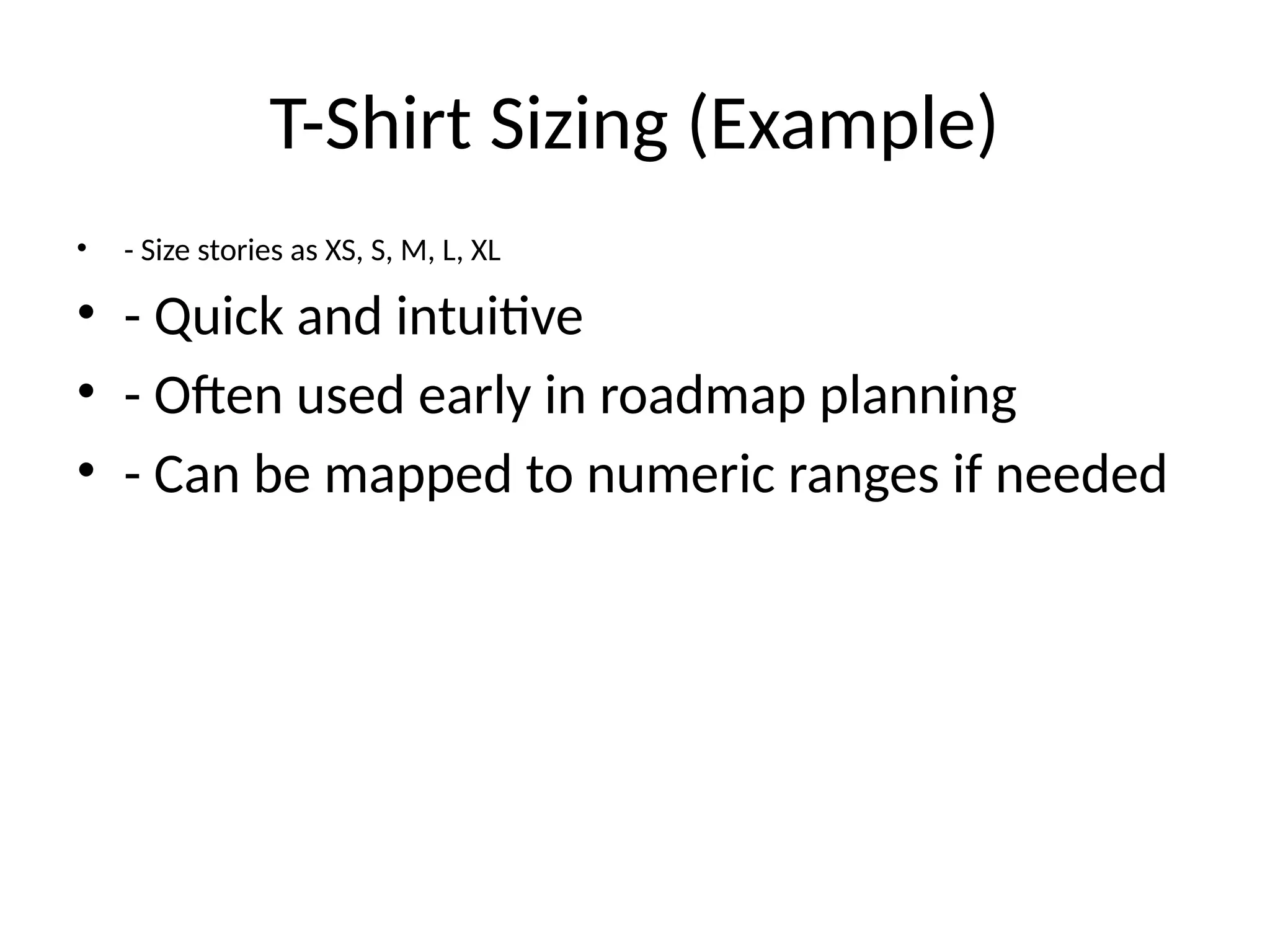
T-Shirt Sizing (Example)
•- Size stories as XS, S, M, L, XL
• - Quick and intuitive
• - Often used early in roadmap planning
• - Can be mapped to numeric ranges if needed
9.
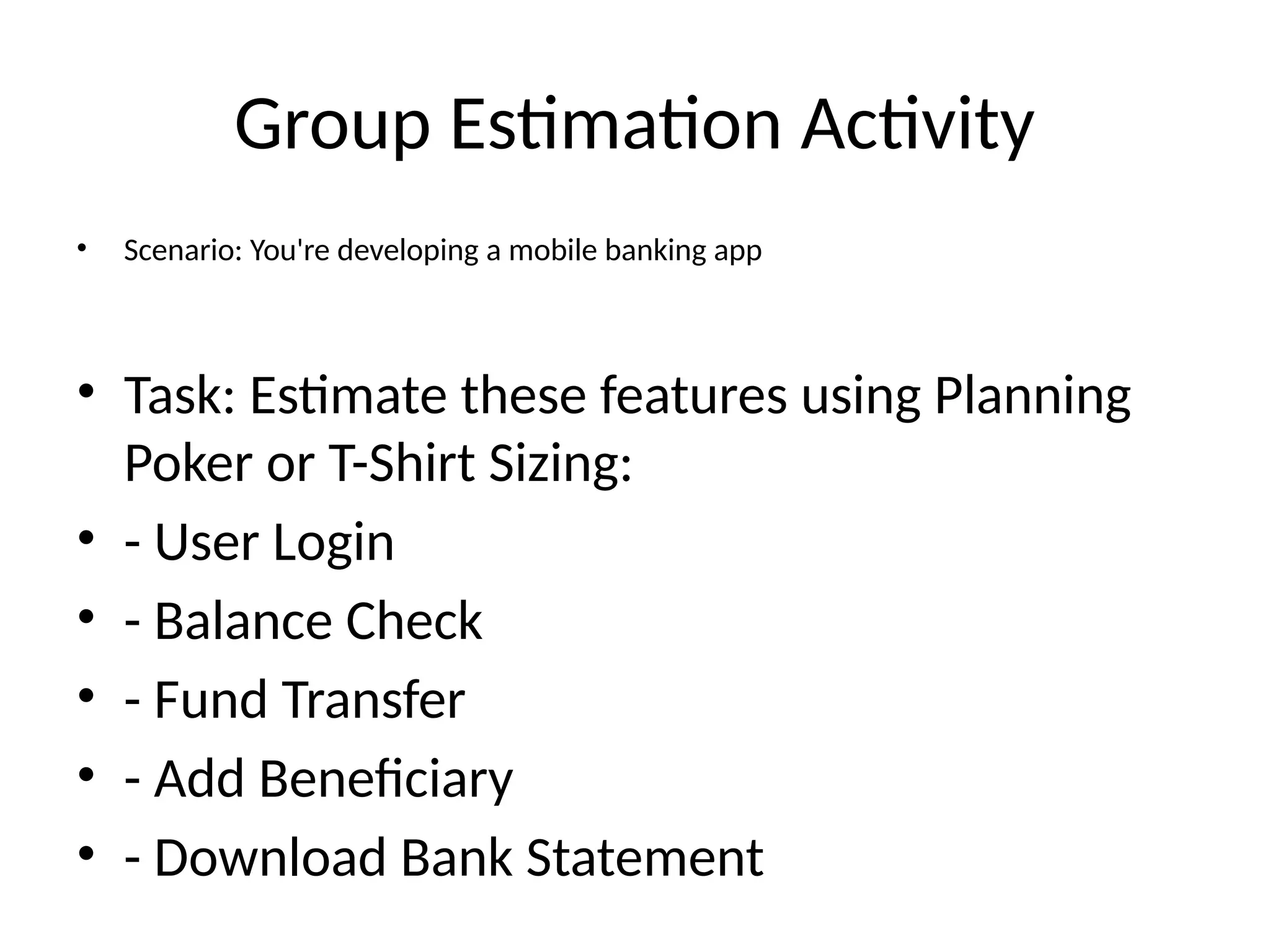
Group Estimation Activity
•Scenario: You're developing a mobile banking app
• Task: Estimate these features using Planning
Poker or T-Shirt Sizing:
• - User Login
• - Balance Check
• - Fund Transfer
• - Add Beneficiary
• - Download Bank Statement
10.
Activity Debrief
• Eachgroup shares:
• - One feature and its estimate
• - Which technique was used and why
• - Any challenges faced
11.
Common Pitfalls toAvoid
• - Converting story points to hours directly
• - Dominance in team discussions
• - Lack of clarity in story definition
• - Estimating without enough context
12.
Best Practices
• -Focus on relative estimation
• - Use team’s past data for better accuracy
• - Re-estimate if scope changes significantly
• - Encourage open dialogue during estimation
• - Keep it collaborative and fun!
13.
Wrap-up & Q&A
•- What are your key takeaways?
• - Which technique will you try next?
• - Questions?
![Estimation Techniques in Agile &
Scrum
• Practical Approaches to Sizing Work
• Facilitator: [Your Name], Agile Coach](https://image.slidesharecdn.com/estimationtechniquesagilescrumworkshop-250430055128-3030a03f/75/Estimation_Techniques_Agile_Scrum_Workshop-pptx-1-2048.jpg)


![CleanMyMac X v5.2.8 Crack for MacOS Full Version [Latest] pptx](https://cdn.slidesharecdn.com/ss_thumbnails/softwareoverview-251207194121-a81f0142-thumbnail.jpg?width=640&height=640&fit=bounds)


![Chapter4_Initiation_of_Sediment_Motion_v2[1].pptx](https://cdn.slidesharecdn.com/ss_thumbnails/chapter4initiationofsedimentmotionv21-251208223747-f94ef163-thumbnail.jpg?width=640&height=640&fit=bounds)
![Chapt_4[1].ppt very interseting and important](https://cdn.slidesharecdn.com/ss_thumbnails/chapt41-251208222956-7cf5e0fa-thumbnail.jpg?width=640&height=640&fit=bounds)
