Welcome
Professor: Aida Mohey Mohamed
Course Coordinator
Community Medicine & Public Health Department
University of Alexandria
aida_mohey@yahoo.com, Aida.Ali@alexmed.edu.eg
Questions
1. How will studying communication improve your
personal and professional relationships?
2. Discuss reasons why the study of
communication is essential?
Course overall objectives
By the end of this course, the student will be able to:
1. Communicate effectively at the interpersonal, group and public level
2. Interpret information for professional, non-professional and community audiences.
3. Mobilize individuals and communities by using appropriate media, and community resources
4. Use current technology to communicate effectively
Students will demonstrate proficiency of these skills by:
 Performing well on regular reading quizzes (formative & summative), mid-term and a final exam
 Taking part in class discussions and activities (case studies and role play)
 Designing effectively a poster to be used in public education
 Narratively making sense of health communication through oral presentation assignments
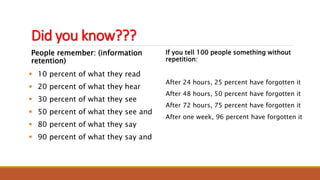
Did you know???
People remember: (information
retention)
 10 percent of what they read
 20 percent of what they hear
 30 percent of what they see
 50 percent of what they see and
 80 percent of what they say
 90 percent of what they say and
If you tell 100 people something without
repetition:
After 24 hours, 25 percent have forgotten it
After 48 hours, 50 percent have forgotten it
After 72 hours, 75 percent have forgotten it
After one week, 96 percent have forgotten it
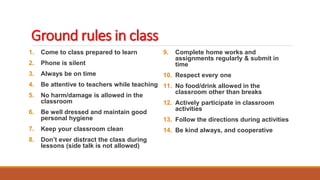
Ground rules in class
1. Come to class prepared to learn
2. Phone is silent
3. Always be on time
4. Be attentive to teachers while teaching
5. No harm/damage is allowed in the
classroom
6. Be well dressed and maintain good
personal hygiene
7. Keep your classroom clean
8. Don’t ever distract the class during
lessons (side talk is not allowed)
9. Complete home works and
assignments regularly & submit in
time
10. Respect every one
11. No food/drink allowed in the
classroom other than breaks
12. Actively participate in classroom
activities
13. Follow the directions during activities
14. Be kind always, and cooperative
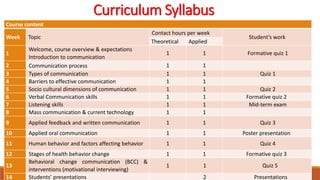
Curriculum Syllabus
Course content
Week Topic
Contact hours per week
Student’s work
Theoretical Applied
1
Welcome, course overview & expectations
Introduction to communication
1 1 Formative quiz 1
2 Communication process 1 1
3 Types of communication 1 1 Quiz 1
4 Barriers to effective communication 1 1
5 Socio cultural dimensions of communication 1 1 Quiz 2
6 Verbal Communication skills 1 1 Formative quiz 2
7 Listening skills 1 1 Mid-term exam
8 Mass communication & current technology 1 1
9 Applied feedback and written communication 1 1 Quiz 3
10 Applied oral communication 1 1 Poster presentation
11 Human behavior and factors affecting behavior 1 1 Quiz 4
12 Stages of health behavior change 1 1 Formative quiz 3
13
Behavioral change communication (BCC) &
interventions (motivational interviewing)
1 1 Quiz 5
14 Students’ presentations 2 Presentations
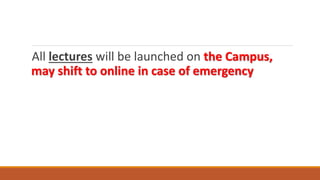
All lectures will be launched on the Campus,
may shift to online in case of emergency
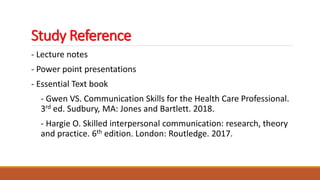
Study Reference
- Lecture notes
- Power point presentations
- Essential Text book
- Gwen VS. Communication Skills for the Health Care Professional.
3rd ed. Sudbury, MA: Jones and Bartlett. 2018.
- Hargie O. Skilled interpersonal communication: research, theory
and practice. 6th edition. London: Routledge. 2017.
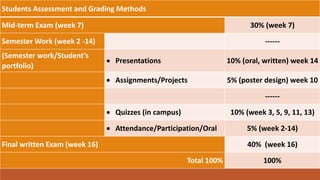
Students Assessment and Grading Methods
Mid-term Exam (week 7) 30% (week 7)
Semester Work (week 2 -14) ------
(Semester work/Student’s
portfolio)
 Presentations 10% (oral, written) week 14
 Assignments/Projects 5% (poster design) week 10
------
 Quizzes (in campus) 10% (week 3, 5, 9, 11, 13)
 Attendance/Participation/Oral 5% (week 2-14)
Final written Exam (week 16) 40% (week 16)
Total 100% 100%
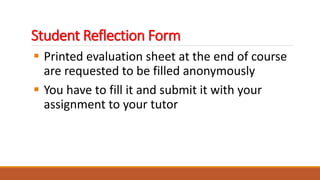
Student Reflection Form
 Printed evaluation sheet at the end of course
are requested to be filled anonymously
 You have to fill it and submit it with your
assignment to your tutor
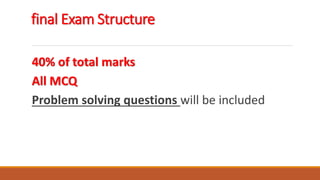
final Exam Structure
40% of total marks
All MCQ
Problem solving questions will be included
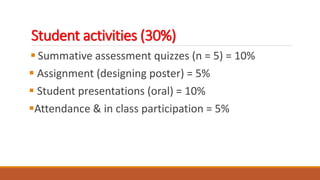
Student activities (30%)
 Summative assessment quizzes (n = 5) = 10%
 Assignment (designing poster) = 5%
 Student presentations (oral) = 10%
Attendance & in class participation = 5%
Thank You

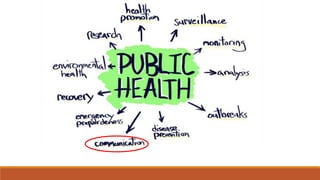
communication and behaviour change, sociocultural dimensions

  • 2.
    Welcome Professor: Aida MoheyMohamed Course Coordinator Community Medicine & Public Health Department University of Alexandria aida_mohey@yahoo.com, Aida.Ali@alexmed.edu.eg
  • 6.
    Questions 1. How willstudying communication improve your personal and professional relationships? 2. Discuss reasons why the study of communication is essential?
  • 7.
    Course overall objectives Bythe end of this course, the student will be able to: 1. Communicate effectively at the interpersonal, group and public level 2. Interpret information for professional, non-professional and community audiences. 3. Mobilize individuals and communities by using appropriate media, and community resources 4. Use current technology to communicate effectively Students will demonstrate proficiency of these skills by:  Performing well on regular reading quizzes (formative & summative), mid-term and a final exam  Taking part in class discussions and activities (case studies and role play)  Designing effectively a poster to be used in public education  Narratively making sense of health communication through oral presentation assignments
  • 8.
    Did you know??? Peopleremember: (information retention)  10 percent of what they read  20 percent of what they hear  30 percent of what they see  50 percent of what they see and  80 percent of what they say  90 percent of what they say and If you tell 100 people something without repetition: After 24 hours, 25 percent have forgotten it After 48 hours, 50 percent have forgotten it After 72 hours, 75 percent have forgotten it After one week, 96 percent have forgotten it
  • 9.
    Ground rules inclass 1. Come to class prepared to learn 2. Phone is silent 3. Always be on time 4. Be attentive to teachers while teaching 5. No harm/damage is allowed in the classroom 6. Be well dressed and maintain good personal hygiene 7. Keep your classroom clean 8. Don’t ever distract the class during lessons (side talk is not allowed) 9. Complete home works and assignments regularly & submit in time 10. Respect every one 11. No food/drink allowed in the classroom other than breaks 12. Actively participate in classroom activities 13. Follow the directions during activities 14. Be kind always, and cooperative
  • 10.
    Curriculum Syllabus Course content WeekTopic Contact hours per week Student’s work Theoretical Applied 1 Welcome, course overview & expectations Introduction to communication 1 1 Formative quiz 1 2 Communication process 1 1 3 Types of communication 1 1 Quiz 1 4 Barriers to effective communication 1 1 5 Socio cultural dimensions of communication 1 1 Quiz 2 6 Verbal Communication skills 1 1 Formative quiz 2 7 Listening skills 1 1 Mid-term exam 8 Mass communication & current technology 1 1 9 Applied feedback and written communication 1 1 Quiz 3 10 Applied oral communication 1 1 Poster presentation 11 Human behavior and factors affecting behavior 1 1 Quiz 4 12 Stages of health behavior change 1 1 Formative quiz 3 13 Behavioral change communication (BCC) & interventions (motivational interviewing) 1 1 Quiz 5 14 Students’ presentations 2 Presentations
  • 11.
    All lectures willbe launched on the Campus, may shift to online in case of emergency
  • 12.
    Study Reference - Lecturenotes - Power point presentations - Essential Text book - Gwen VS. Communication Skills for the Health Care Professional. 3rd ed. Sudbury, MA: Jones and Bartlett. 2018. - Hargie O. Skilled interpersonal communication: research, theory and practice. 6th edition. London: Routledge. 2017.
  • 13.
    Students Assessment andGrading Methods Mid-term Exam (week 7) 30% (week 7) Semester Work (week 2 -14) ------ (Semester work/Student’s portfolio)  Presentations 10% (oral, written) week 14  Assignments/Projects 5% (poster design) week 10 ------  Quizzes (in campus) 10% (week 3, 5, 9, 11, 13)  Attendance/Participation/Oral 5% (week 2-14) Final written Exam (week 16) 40% (week 16) Total 100% 100%
  • 14.
    Student Reflection Form Printed evaluation sheet at the end of course are requested to be filled anonymously  You have to fill it and submit it with your assignment to your tutor
  • 15.
    final Exam Structure 40%of total marks All MCQ Problem solving questions will be included
  • 16.
    Student activities (30%) Summative assessment quizzes (n = 5) = 10%  Assignment (designing poster) = 5%  Student presentations (oral) = 10% Attendance & in class participation = 5%
  • 17.