Online Marketing Company
            Find out more about Ajax Union:
           www.AjaxUnion.com
                Follow Us On Twitter:
          twitter.com/ajaxunion
                  Like On Facebook:
      www.facebook.com/ajaxunion
                Connect On Linkedin:
  www.linkedin.com/companies/ajax-union
                   Call Ajax Union:
                800-594-0444
Sarah Mogin – Vice President

                    Friend Sarah on Facebook:
              facebook.com/Sarah.Mogin

                      Follow Sarah on Twitter:
                      @SarahMogin

                  Connect With Sarah on Linkedin:
          http://www.linkedin.com/in/SarahMogin
PR & Reputation Management for
Small Business
Find out more about Ajax Union's products at:
www.ajaxunion.com
Agenda
• What is PR?
• Establishing Your Publicity Goals
• Press Releases
• Reputation Management
       • Dealing with Negative Buzz
       • Creating Positive Content
• Final Thoughts
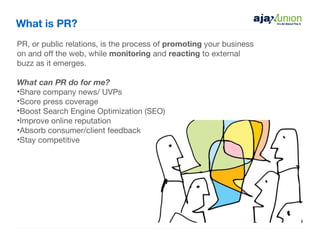
What is PR?
PR, or public relations, is the process of promoting your business
on and off the web, while monitoring and reacting to external
buzz as it emerges.

What can PR do for me?
•Share company news/ UVPs
•Score press coverage
•Boost Search Engine Optimization (SEO)
•Improve online reputation
•Absorb consumer/client feedback
•Stay competitive
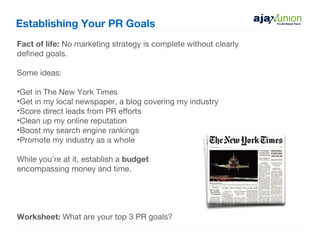
Establishing Your PR Goals
Fact of life: No marketing strategy is complete without clearly
defined goals.

Some ideas:

•Get in The New York Times
•Get in my local newspaper, a blog covering my industry
•Score direct leads from PR efforts
•Clean up my online reputation
•Boost my search engine rankings
•Promote my industry as a whole

While you’re at it, establish a budget
encompassing money and time.


Worksheet: What are your top 3 PR goals?
Press Releases
What is a press release?
20th Century: A document sent out to journalists with information
that can be easily adapted into an article.

21st Century: That, and a whole lot more.

Modern press releases:
•Can stand on their own
•Are LONGER (400 to 500 words)
         • End with general info
•Still need all the good stuff up front
•Do not need a boilerplate
•May need two versions
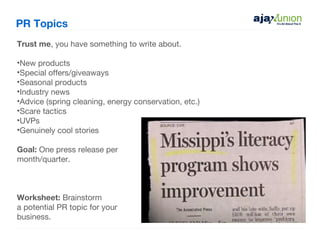
PR Topics
Trust me, you have something to write about.

•New products
•Special offers/giveaways
•Seasonal products
•Industry news
•Advice (spring cleaning, energy conservation, etc.)
•Scare tactics
•UVPs
•Genuinely cool stories

Goal: One press release per
month/quarter.


Worksheet: Brainstorm
a potential PR topic for your
business.
Headlines and First Lines
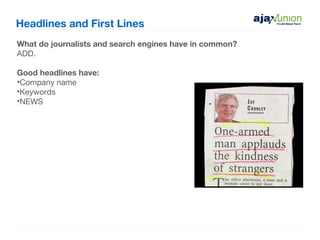
What do journalists and search engines have in common?
ADD.

Good headlines have:
•Company name
•Keywords
•NEWS
Headlines and First Lines
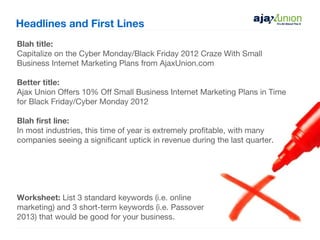
Blah title:
Capitalize on the Cyber Monday/Black Friday 2012 Craze With Small
Business Internet Marketing Plans from AjaxUnion.com

Better title:
Ajax Union Offers 10% Off Small Business Internet Marketing Plans in Time
for Black Friday/Cyber Monday 2012

Blah first line:
In most industries, this time of year is extremely profitable, with many
companies seeing a significant uptick in revenue during the last quarter.


Worksheet: List 3 standard keywords (i.e. online
marketing) and 3 short-term keywords (i.e. Passover
2013) that would be good for your business.
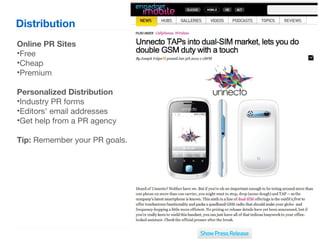
Distribution
Online PR Sites
•Free
•Cheap
•Premium

Personalized Distribution
•Industry PR forms
•Editors’ email addresses
•Get help from a PR agency

Tip: Remember your PR goals.
Reputation Management
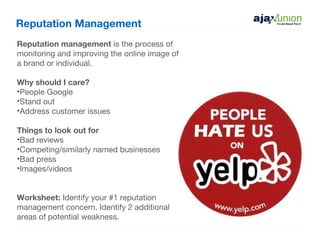
Reputation management is the process of
monitoring and improving the online image of
a brand or individual.

Why should I care?
•People Google
•Stand out
•Address customer issues

Things to look out for
•Bad reviews
•Competing/similarly named businesses
•Bad press
•Images/videos


Worksheet: Identify your #1 reputation
management concern. Identify 2 additional
areas of potential weakness.
Google
Yourself
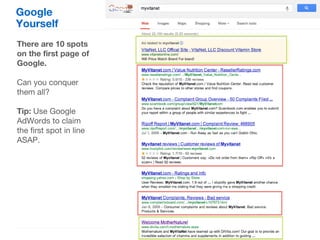
There are 10 spots
on the first page of
Google.

Can you conquer
them all?

Tip: Use Google
AdWords to claim
the first spot in line
ASAP.
Google
Yourself
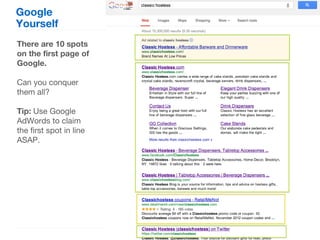
There are 10 spots
on the first page of
Google.

Can you conquer
them all?

Tip: Use Google
AdWords to claim
the first spot in line
ASAP.
The First Rule of Fight Club
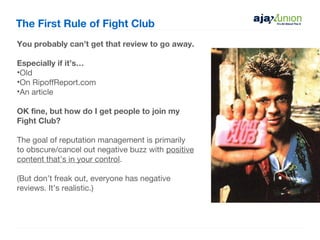
You probably can’t get that review to go away.

Especially if it’s…
•Old
•On RipoffReport.com
•An article

OK fine, but how do I get people to join my
Fight Club?

The goal of reputation management is primarily
to obscure/cancel out negative buzz with positive
content that’s in your control.

(But don’t freak out, everyone has negative
reviews. It’s realistic.)
Important Review Pages
Which review pages should I care about?

•What’s already showing up for your brand
on first 2-3 pages of Google
•Where your competitors are covered
•Google Local
•Yelp (but be careful)
•Industry (TripAdvisor)
•ResellerRatings
•Testimonials Page


Worksheet: List the top 3 review
pages/profiles relevant to your business.
Consumer Reviews
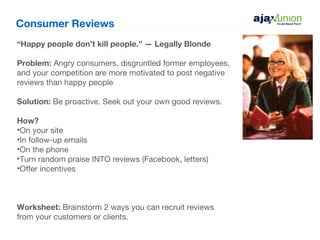
“Happy people don’t kill people.” — Legally Blonde

Problem: Angry consumers, disgruntled former employees,
and your competition are more motivated to post negative
reviews than happy people

Solution: Be proactive. Seek out your own good reviews.

How?
•On your site
•In follow-up emails
•On the phone
•Turn random praise INTO reviews (Facebook, letters)
•Offer incentives


Worksheet: Brainstorm 2 ways you can recruit reviews
from your customers or clients.
But back to Fight Club…
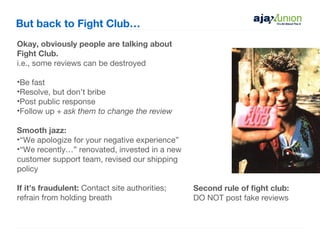
Okay, obviously people are talking about
Fight Club.
i.e., some reviews can be destroyed

•Be fast
•Resolve, but don’t bribe
•Post public response
•Follow up + ask them to change the review

Smooth jazz:
•“We apologize for your negative experience”
•“We recently…” renovated, invested in a new
customer support team, revised our shipping
policy

If it’s fraudulent: Contact site authorities;   Second rule of fight club:
refrain from holding breath                     DO NOT post fake reviews
Master of Your Domain
Expand your online presence with additional
profiles you control.

•Additional domain
        • AjaxUnionBlog.com
        • AjaxUnionReviews.com
•Facebook
•Twitter
•Multimedia content
        • Image Sharing
        • Videos

Time-tested trick: Google your more successful
competitors and friends
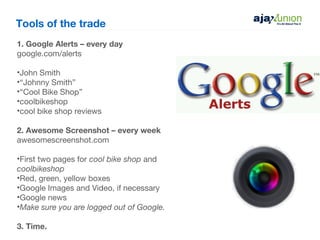
Tools of the trade
1. Google Alerts – every day
google.com/alerts

•John Smith
•“Johnny Smith”
•“Cool Bike Shop”
•coolbikeshop
•cool bike shop reviews

2. Awesome Screenshot – every week
awesomescreenshot.com

•First two pages for cool bike shop and
coolbikeshop
•Red, green, yellow boxes
•Google Images and Video, if necessary
•Google news
•Make sure you are logged out of Google.

3. Time.
Final Thoughts
•   Set Publicity Goals
•   Write a Press Release!
•   Google Yourself ASAP
•   Combat Negative Content with Positive Content
Request a Free Quote:
www.AjaxUnion.com
   Call Us Today:
    800-594-0444
Join Our Free Webinars!
www.AjaxUnion.com/webinar
   Try out RankZen today!
    www.RankZen.com

Pr strategies 2012 (3)

  • 1.
    Online Marketing Company Find out more about Ajax Union: www.AjaxUnion.com Follow Us On Twitter: twitter.com/ajaxunion Like On Facebook: www.facebook.com/ajaxunion Connect On Linkedin: www.linkedin.com/companies/ajax-union Call Ajax Union: 800-594-0444
  • 2.
    Sarah Mogin –Vice President Friend Sarah on Facebook: facebook.com/Sarah.Mogin Follow Sarah on Twitter: @SarahMogin Connect With Sarah on Linkedin: http://www.linkedin.com/in/SarahMogin
  • 3.
    PR & ReputationManagement for Small Business Find out more about Ajax Union's products at: www.ajaxunion.com
  • 4.
    Agenda • What isPR? • Establishing Your Publicity Goals • Press Releases • Reputation Management • Dealing with Negative Buzz • Creating Positive Content • Final Thoughts
  • 5.
    What is PR? PR,or public relations, is the process of promoting your business on and off the web, while monitoring and reacting to external buzz as it emerges. What can PR do for me? •Share company news/ UVPs •Score press coverage •Boost Search Engine Optimization (SEO) •Improve online reputation •Absorb consumer/client feedback •Stay competitive
  • 6.
    Establishing Your PRGoals Fact of life: No marketing strategy is complete without clearly defined goals. Some ideas: •Get in The New York Times •Get in my local newspaper, a blog covering my industry •Score direct leads from PR efforts •Clean up my online reputation •Boost my search engine rankings •Promote my industry as a whole While you’re at it, establish a budget encompassing money and time. Worksheet: What are your top 3 PR goals?
  • 7.
  • 8.
    What is apress release? 20th Century: A document sent out to journalists with information that can be easily adapted into an article. 21st Century: That, and a whole lot more. Modern press releases: •Can stand on their own •Are LONGER (400 to 500 words) • End with general info •Still need all the good stuff up front •Do not need a boilerplate •May need two versions
  • 9.
    PR Topics Trust me,you have something to write about. •New products •Special offers/giveaways •Seasonal products •Industry news •Advice (spring cleaning, energy conservation, etc.) •Scare tactics •UVPs •Genuinely cool stories Goal: One press release per month/quarter. Worksheet: Brainstorm a potential PR topic for your business.
  • 10.
    Headlines and FirstLines What do journalists and search engines have in common? ADD. Good headlines have: •Company name •Keywords •NEWS
  • 11.
    Headlines and FirstLines Blah title: Capitalize on the Cyber Monday/Black Friday 2012 Craze With Small Business Internet Marketing Plans from AjaxUnion.com Better title: Ajax Union Offers 10% Off Small Business Internet Marketing Plans in Time for Black Friday/Cyber Monday 2012 Blah first line: In most industries, this time of year is extremely profitable, with many companies seeing a significant uptick in revenue during the last quarter. Worksheet: List 3 standard keywords (i.e. online marketing) and 3 short-term keywords (i.e. Passover 2013) that would be good for your business.
  • 12.
    Distribution Online PR Sites •Free •Cheap •Premium PersonalizedDistribution •Industry PR forms •Editors’ email addresses •Get help from a PR agency Tip: Remember your PR goals.
  • 13.
  • 14.
    Reputation Management Reputation managementis the process of monitoring and improving the online image of a brand or individual. Why should I care? •People Google •Stand out •Address customer issues Things to look out for •Bad reviews •Competing/similarly named businesses •Bad press •Images/videos Worksheet: Identify your #1 reputation management concern. Identify 2 additional areas of potential weakness.
  • 15.
    Google Yourself There are 10spots on the first page of Google. Can you conquer them all? Tip: Use Google AdWords to claim the first spot in line ASAP.
  • 16.
    Google Yourself There are 10spots on the first page of Google. Can you conquer them all? Tip: Use Google AdWords to claim the first spot in line ASAP.
  • 17.
    The First Ruleof Fight Club You probably can’t get that review to go away. Especially if it’s… •Old •On RipoffReport.com •An article OK fine, but how do I get people to join my Fight Club? The goal of reputation management is primarily to obscure/cancel out negative buzz with positive content that’s in your control. (But don’t freak out, everyone has negative reviews. It’s realistic.)
  • 18.
    Important Review Pages Whichreview pages should I care about? •What’s already showing up for your brand on first 2-3 pages of Google •Where your competitors are covered •Google Local •Yelp (but be careful) •Industry (TripAdvisor) •ResellerRatings •Testimonials Page Worksheet: List the top 3 review pages/profiles relevant to your business.
  • 19.
    Consumer Reviews “Happy peopledon’t kill people.” — Legally Blonde Problem: Angry consumers, disgruntled former employees, and your competition are more motivated to post negative reviews than happy people Solution: Be proactive. Seek out your own good reviews. How? •On your site •In follow-up emails •On the phone •Turn random praise INTO reviews (Facebook, letters) •Offer incentives Worksheet: Brainstorm 2 ways you can recruit reviews from your customers or clients.
  • 20.
    But back toFight Club… Okay, obviously people are talking about Fight Club. i.e., some reviews can be destroyed •Be fast •Resolve, but don’t bribe •Post public response •Follow up + ask them to change the review Smooth jazz: •“We apologize for your negative experience” •“We recently…” renovated, invested in a new customer support team, revised our shipping policy If it’s fraudulent: Contact site authorities; Second rule of fight club: refrain from holding breath DO NOT post fake reviews
  • 21.
    Master of YourDomain Expand your online presence with additional profiles you control. •Additional domain • AjaxUnionBlog.com • AjaxUnionReviews.com •Facebook •Twitter •Multimedia content • Image Sharing • Videos Time-tested trick: Google your more successful competitors and friends
  • 22.
    Tools of thetrade 1. Google Alerts – every day google.com/alerts •John Smith •“Johnny Smith” •“Cool Bike Shop” •coolbikeshop •cool bike shop reviews 2. Awesome Screenshot – every week awesomescreenshot.com •First two pages for cool bike shop and coolbikeshop •Red, green, yellow boxes •Google Images and Video, if necessary •Google news •Make sure you are logged out of Google. 3. Time.
  • 23.
    Final Thoughts • Set Publicity Goals • Write a Press Release! • Google Yourself ASAP • Combat Negative Content with Positive Content
  • 24.
    Request a FreeQuote: www.AjaxUnion.com Call Us Today: 800-594-0444
  • 25.
    Join Our FreeWebinars! www.AjaxUnion.com/webinar Try out RankZen today! www.RankZen.com

Editor's Notes

  • #4 Hello. I’m Tierney Oberhammer, an online marketing specialist at Ajax Union. This networking event and blogging seminar is hosted by Ajax Union, and we hope you are having a great time and making connections. This short seminar is going to cover the basic of blogging. We will go over: What a blog is What a blog does Why you should have a blog How to maximize the success of your blog And how to track that success
  • #5 Let’s get started. A blog is a website like any other website. It has a URL and it is formatted using HTML Hypertext Markup Language, a standardized system for tagging text files to achieve font, color, graphic, and hyperlink effects on World Wide Web pages So, what’s the difference between websites and blog websites? Blogs get updated on a regular basis (or they should be) Regular websites don’t necessarily need to be updated. Blog stands for web-log – a blog is typically a log of something that is happening or something that you are doing Why should you blog? You have customers and potentials that want information. A blog is a great way to share with them and show that you are an expert in your field. It gives them a reason to trust you because you can show that you know what you are talking about. A blog is also an excellent way to generate links to your website – links are the foundation of SEO Does anybody know what SEO stands for? Does anybody know what SEO is? Your blog not only links to your site, but it links people to your site But generating worthwhile content, people will help do your linking for you. Also, the the purpose of a blog is the generation of fresh content. You ever heard the saying “Out of sight, out of mind?” Well, it holds true. If you want clients to remember you and use your products or services, you need to keep your website in their line of sight. Fresh content is key for SEO, too, especially now that Google has changed its algorithm to prioritize the freshest information. Google is catching up with Twitter on the importance of fresh content. Google has a special results section for blogs.
  • #6 Let’s get started. A blog is a website like any other website. It has a URL and it is formatted using HTML Hypertext Markup Language, a standardized system for tagging text files to achieve font, color, graphic, and hyperlink effects on World Wide Web pages So, what’s the difference between websites and blog websites? Blogs get updated on a regular basis (or they should be) Regular websites don’t necessarily need to be updated. Blog stands for web-log – a blog is typically a log of something that is happening or something that you are doing Why should you blog? You have customers and potentials that want information. A blog is a great way to share with them and show that you are an expert in your field. It gives them a reason to trust you because you can show that you know what you are talking about. A blog is also an excellent way to generate links to your website – links are the foundation of SEO Does anybody know what SEO stands for? Does anybody know what SEO is? Your blog not only links to your site, but it links people to your site But generating worthwhile content, people will help do your linking for you. Also, the the purpose of a blog is the generation of fresh content. You ever heard the saying “Out of sight, out of mind?” Well, it holds true. If you want clients to remember you and use your products or services, you need to keep your website in their line of sight. Fresh content is key for SEO, too, especially now that Google has changed its algorithm to prioritize the freshest information. Google is catching up with Twitter on the importance of fresh content. Google has a special results section for blogs.
  • #7 Let’s get started. A blog is a website like any other website. It has a URL and it is formatted using HTML Hypertext Markup Language, a standardized system for tagging text files to achieve font, color, graphic, and hyperlink effects on World Wide Web pages So, what’s the difference between websites and blog websites? Blogs get updated on a regular basis (or they should be) Regular websites don’t necessarily need to be updated. Blog stands for web-log – a blog is typically a log of something that is happening or something that you are doing Why should you blog? You have customers and potentials that want information. A blog is a great way to share with them and show that you are an expert in your field. It gives them a reason to trust you because you can show that you know what you are talking about. A blog is also an excellent way to generate links to your website – links are the foundation of SEO Does anybody know what SEO stands for? Does anybody know what SEO is? Your blog not only links to your site, but it links people to your site But generating worthwhile content, people will help do your linking for you. Also, the the purpose of a blog is the generation of fresh content. You ever heard the saying “Out of sight, out of mind?” Well, it holds true. If you want clients to remember you and use your products or services, you need to keep your website in their line of sight. Fresh content is key for SEO, too, especially now that Google has changed its algorithm to prioritize the freshest information. Google is catching up with Twitter on the importance of fresh content. Google has a special results section for blogs.
  • #8 Hello. I’m Tierney Oberhammer, an online marketing specialist at Ajax Union. This networking event and blogging seminar is hosted by Ajax Union, and we hope you are having a great time and making connections. This short seminar is going to cover the basic of blogging. We will go over: What a blog is What a blog does Why you should have a blog How to maximize the success of your blog And how to track that success
  • #9 Let’s get started. A blog is a website like any other website. It has a URL and it is formatted using HTML Hypertext Markup Language, a standardized system for tagging text files to achieve font, color, graphic, and hyperlink effects on World Wide Web pages So, what’s the difference between websites and blog websites? Blogs get updated on a regular basis (or they should be) Regular websites don’t necessarily need to be updated. Blog stands for web-log – a blog is typically a log of something that is happening or something that you are doing Why should you blog? You have customers and potentials that want information. A blog is a great way to share with them and show that you are an expert in your field. It gives them a reason to trust you because you can show that you know what you are talking about. A blog is also an excellent way to generate links to your website – links are the foundation of SEO Does anybody know what SEO stands for? Does anybody know what SEO is? Your blog not only links to your site, but it links people to your site But generating worthwhile content, people will help do your linking for you. Also, the the purpose of a blog is the generation of fresh content. You ever heard the saying “Out of sight, out of mind?” Well, it holds true. If you want clients to remember you and use your products or services, you need to keep your website in their line of sight. Fresh content is key for SEO, too, especially now that Google has changed its algorithm to prioritize the freshest information. Google is catching up with Twitter on the importance of fresh content. Google has a special results section for blogs.
  • #10 Let’s get started. A blog is a website like any other website. It has a URL and it is formatted using HTML Hypertext Markup Language, a standardized system for tagging text files to achieve font, color, graphic, and hyperlink effects on World Wide Web pages So, what’s the difference between websites and blog websites? Blogs get updated on a regular basis (or they should be) Regular websites don’t necessarily need to be updated. Blog stands for web-log – a blog is typically a log of something that is happening or something that you are doing Why should you blog? You have customers and potentials that want information. A blog is a great way to share with them and show that you are an expert in your field. It gives them a reason to trust you because you can show that you know what you are talking about. A blog is also an excellent way to generate links to your website – links are the foundation of SEO Does anybody know what SEO stands for? Does anybody know what SEO is? Your blog not only links to your site, but it links people to your site But generating worthwhile content, people will help do your linking for you. Also, the the purpose of a blog is the generation of fresh content. You ever heard the saying “Out of sight, out of mind?” Well, it holds true. If you want clients to remember you and use your products or services, you need to keep your website in their line of sight. Fresh content is key for SEO, too, especially now that Google has changed its algorithm to prioritize the freshest information. Google is catching up with Twitter on the importance of fresh content. Google has a special results section for blogs.
  • #11 Let’s get started. A blog is a website like any other website. It has a URL and it is formatted using HTML Hypertext Markup Language, a standardized system for tagging text files to achieve font, color, graphic, and hyperlink effects on World Wide Web pages So, what’s the difference between websites and blog websites? Blogs get updated on a regular basis (or they should be) Regular websites don’t necessarily need to be updated. Blog stands for web-log – a blog is typically a log of something that is happening or something that you are doing Why should you blog? You have customers and potentials that want information. A blog is a great way to share with them and show that you are an expert in your field. It gives them a reason to trust you because you can show that you know what you are talking about. A blog is also an excellent way to generate links to your website – links are the foundation of SEO Does anybody know what SEO stands for? Does anybody know what SEO is? Your blog not only links to your site, but it links people to your site But generating worthwhile content, people will help do your linking for you. Also, the the purpose of a blog is the generation of fresh content. You ever heard the saying “Out of sight, out of mind?” Well, it holds true. If you want clients to remember you and use your products or services, you need to keep your website in their line of sight. Fresh content is key for SEO, too, especially now that Google has changed its algorithm to prioritize the freshest information. Google is catching up with Twitter on the importance of fresh content. Google has a special results section for blogs.
  • #12 Let’s get started. A blog is a website like any other website. It has a URL and it is formatted using HTML Hypertext Markup Language, a standardized system for tagging text files to achieve font, color, graphic, and hyperlink effects on World Wide Web pages So, what’s the difference between websites and blog websites? Blogs get updated on a regular basis (or they should be) Regular websites don’t necessarily need to be updated. Blog stands for web-log – a blog is typically a log of something that is happening or something that you are doing Why should you blog? You have customers and potentials that want information. A blog is a great way to share with them and show that you are an expert in your field. It gives them a reason to trust you because you can show that you know what you are talking about. A blog is also an excellent way to generate links to your website – links are the foundation of SEO Does anybody know what SEO stands for? Does anybody know what SEO is? Your blog not only links to your site, but it links people to your site But generating worthwhile content, people will help do your linking for you. Also, the the purpose of a blog is the generation of fresh content. You ever heard the saying “Out of sight, out of mind?” Well, it holds true. If you want clients to remember you and use your products or services, you need to keep your website in their line of sight. Fresh content is key for SEO, too, especially now that Google has changed its algorithm to prioritize the freshest information. Google is catching up with Twitter on the importance of fresh content. Google has a special results section for blogs.
  • #13 Let’s get started. A blog is a website like any other website. It has a URL and it is formatted using HTML Hypertext Markup Language, a standardized system for tagging text files to achieve font, color, graphic, and hyperlink effects on World Wide Web pages So, what’s the difference between websites and blog websites? Blogs get updated on a regular basis (or they should be) Regular websites don’t necessarily need to be updated. Blog stands for web-log – a blog is typically a log of something that is happening or something that you are doing Why should you blog? You have customers and potentials that want information. A blog is a great way to share with them and show that you are an expert in your field. It gives them a reason to trust you because you can show that you know what you are talking about. A blog is also an excellent way to generate links to your website – links are the foundation of SEO Does anybody know what SEO stands for? Does anybody know what SEO is? Your blog not only links to your site, but it links people to your site But generating worthwhile content, people will help do your linking for you. Also, the the purpose of a blog is the generation of fresh content. You ever heard the saying “Out of sight, out of mind?” Well, it holds true. If you want clients to remember you and use your products or services, you need to keep your website in their line of sight. Fresh content is key for SEO, too, especially now that Google has changed its algorithm to prioritize the freshest information. Google is catching up with Twitter on the importance of fresh content. Google has a special results section for blogs.
  • #14 Hello. I’m Tierney Oberhammer, an online marketing specialist at Ajax Union. This networking event and blogging seminar is hosted by Ajax Union, and we hope you are having a great time and making connections. This short seminar is going to cover the basic of blogging. We will go over: What a blog is What a blog does Why you should have a blog How to maximize the success of your blog And how to track that success
  • #15 Let’s get started. A blog is a website like any other website. It has a URL and it is formatted using HTML Hypertext Markup Language, a standardized system for tagging text files to achieve font, color, graphic, and hyperlink effects on World Wide Web pages So, what’s the difference between websites and blog websites? Blogs get updated on a regular basis (or they should be) Regular websites don’t necessarily need to be updated. Blog stands for web-log – a blog is typically a log of something that is happening or something that you are doing Why should you blog? You have customers and potentials that want information. A blog is a great way to share with them and show that you are an expert in your field. It gives them a reason to trust you because you can show that you know what you are talking about. A blog is also an excellent way to generate links to your website – links are the foundation of SEO Does anybody know what SEO stands for? Does anybody know what SEO is? Your blog not only links to your site, but it links people to your site But generating worthwhile content, people will help do your linking for you. Also, the the purpose of a blog is the generation of fresh content. You ever heard the saying “Out of sight, out of mind?” Well, it holds true. If you want clients to remember you and use your products or services, you need to keep your website in their line of sight. Fresh content is key for SEO, too, especially now that Google has changed its algorithm to prioritize the freshest information. Google is catching up with Twitter on the importance of fresh content. Google has a special results section for blogs.
  • #16 Let’s get started. A blog is a website like any other website. It has a URL and it is formatted using HTML Hypertext Markup Language, a standardized system for tagging text files to achieve font, color, graphic, and hyperlink effects on World Wide Web pages So, what’s the difference between websites and blog websites? Blogs get updated on a regular basis (or they should be) Regular websites don’t necessarily need to be updated. Blog stands for web-log – a blog is typically a log of something that is happening or something that you are doing Why should you blog? You have customers and potentials that want information. A blog is a great way to share with them and show that you are an expert in your field. It gives them a reason to trust you because you can show that you know what you are talking about. A blog is also an excellent way to generate links to your website – links are the foundation of SEO Does anybody know what SEO stands for? Does anybody know what SEO is? Your blog not only links to your site, but it links people to your site But generating worthwhile content, people will help do your linking for you. Also, the the purpose of a blog is the generation of fresh content. You ever heard the saying “Out of sight, out of mind?” Well, it holds true. If you want clients to remember you and use your products or services, you need to keep your website in their line of sight. Fresh content is key for SEO, too, especially now that Google has changed its algorithm to prioritize the freshest information. Google is catching up with Twitter on the importance of fresh content. Google has a special results section for blogs.
  • #17 Let’s get started. A blog is a website like any other website. It has a URL and it is formatted using HTML Hypertext Markup Language, a standardized system for tagging text files to achieve font, color, graphic, and hyperlink effects on World Wide Web pages So, what’s the difference between websites and blog websites? Blogs get updated on a regular basis (or they should be) Regular websites don’t necessarily need to be updated. Blog stands for web-log – a blog is typically a log of something that is happening or something that you are doing Why should you blog? You have customers and potentials that want information. A blog is a great way to share with them and show that you are an expert in your field. It gives them a reason to trust you because you can show that you know what you are talking about. A blog is also an excellent way to generate links to your website – links are the foundation of SEO Does anybody know what SEO stands for? Does anybody know what SEO is? Your blog not only links to your site, but it links people to your site But generating worthwhile content, people will help do your linking for you. Also, the the purpose of a blog is the generation of fresh content. You ever heard the saying “Out of sight, out of mind?” Well, it holds true. If you want clients to remember you and use your products or services, you need to keep your website in their line of sight. Fresh content is key for SEO, too, especially now that Google has changed its algorithm to prioritize the freshest information. Google is catching up with Twitter on the importance of fresh content. Google has a special results section for blogs.
  • #18 Let’s get started. A blog is a website like any other website. It has a URL and it is formatted using HTML Hypertext Markup Language, a standardized system for tagging text files to achieve font, color, graphic, and hyperlink effects on World Wide Web pages So, what’s the difference between websites and blog websites? Blogs get updated on a regular basis (or they should be) Regular websites don’t necessarily need to be updated. Blog stands for web-log – a blog is typically a log of something that is happening or something that you are doing Why should you blog? You have customers and potentials that want information. A blog is a great way to share with them and show that you are an expert in your field. It gives them a reason to trust you because you can show that you know what you are talking about. A blog is also an excellent way to generate links to your website – links are the foundation of SEO Does anybody know what SEO stands for? Does anybody know what SEO is? Your blog not only links to your site, but it links people to your site But generating worthwhile content, people will help do your linking for you. Also, the the purpose of a blog is the generation of fresh content. You ever heard the saying “Out of sight, out of mind?” Well, it holds true. If you want clients to remember you and use your products or services, you need to keep your website in their line of sight. Fresh content is key for SEO, too, especially now that Google has changed its algorithm to prioritize the freshest information. Google is catching up with Twitter on the importance of fresh content. Google has a special results section for blogs.
  • #19 Let’s get started. A blog is a website like any other website. It has a URL and it is formatted using HTML Hypertext Markup Language, a standardized system for tagging text files to achieve font, color, graphic, and hyperlink effects on World Wide Web pages So, what’s the difference between websites and blog websites? Blogs get updated on a regular basis (or they should be) Regular websites don’t necessarily need to be updated. Blog stands for web-log – a blog is typically a log of something that is happening or something that you are doing Why should you blog? You have customers and potentials that want information. A blog is a great way to share with them and show that you are an expert in your field. It gives them a reason to trust you because you can show that you know what you are talking about. A blog is also an excellent way to generate links to your website – links are the foundation of SEO Does anybody know what SEO stands for? Does anybody know what SEO is? Your blog not only links to your site, but it links people to your site But generating worthwhile content, people will help do your linking for you. Also, the the purpose of a blog is the generation of fresh content. You ever heard the saying “Out of sight, out of mind?” Well, it holds true. If you want clients to remember you and use your products or services, you need to keep your website in their line of sight. Fresh content is key for SEO, too, especially now that Google has changed its algorithm to prioritize the freshest information. Google is catching up with Twitter on the importance of fresh content. Google has a special results section for blogs.
  • #20 Let’s get started. A blog is a website like any other website. It has a URL and it is formatted using HTML Hypertext Markup Language, a standardized system for tagging text files to achieve font, color, graphic, and hyperlink effects on World Wide Web pages So, what’s the difference between websites and blog websites? Blogs get updated on a regular basis (or they should be) Regular websites don’t necessarily need to be updated. Blog stands for web-log – a blog is typically a log of something that is happening or something that you are doing Why should you blog? You have customers and potentials that want information. A blog is a great way to share with them and show that you are an expert in your field. It gives them a reason to trust you because you can show that you know what you are talking about. A blog is also an excellent way to generate links to your website – links are the foundation of SEO Does anybody know what SEO stands for? Does anybody know what SEO is? Your blog not only links to your site, but it links people to your site But generating worthwhile content, people will help do your linking for you. Also, the the purpose of a blog is the generation of fresh content. You ever heard the saying “Out of sight, out of mind?” Well, it holds true. If you want clients to remember you and use your products or services, you need to keep your website in their line of sight. Fresh content is key for SEO, too, especially now that Google has changed its algorithm to prioritize the freshest information. Google is catching up with Twitter on the importance of fresh content. Google has a special results section for blogs.
  • #21 Let’s get started. A blog is a website like any other website. It has a URL and it is formatted using HTML Hypertext Markup Language, a standardized system for tagging text files to achieve font, color, graphic, and hyperlink effects on World Wide Web pages So, what’s the difference between websites and blog websites? Blogs get updated on a regular basis (or they should be) Regular websites don’t necessarily need to be updated. Blog stands for web-log – a blog is typically a log of something that is happening or something that you are doing Why should you blog? You have customers and potentials that want information. A blog is a great way to share with them and show that you are an expert in your field. It gives them a reason to trust you because you can show that you know what you are talking about. A blog is also an excellent way to generate links to your website – links are the foundation of SEO Does anybody know what SEO stands for? Does anybody know what SEO is? Your blog not only links to your site, but it links people to your site But generating worthwhile content, people will help do your linking for you. Also, the the purpose of a blog is the generation of fresh content. You ever heard the saying “Out of sight, out of mind?” Well, it holds true. If you want clients to remember you and use your products or services, you need to keep your website in their line of sight. Fresh content is key for SEO, too, especially now that Google has changed its algorithm to prioritize the freshest information. Google is catching up with Twitter on the importance of fresh content. Google has a special results section for blogs.
  • #22 Let’s get started. A blog is a website like any other website. It has a URL and it is formatted using HTML Hypertext Markup Language, a standardized system for tagging text files to achieve font, color, graphic, and hyperlink effects on World Wide Web pages So, what’s the difference between websites and blog websites? Blogs get updated on a regular basis (or they should be) Regular websites don’t necessarily need to be updated. Blog stands for web-log – a blog is typically a log of something that is happening or something that you are doing Why should you blog? You have customers and potentials that want information. A blog is a great way to share with them and show that you are an expert in your field. It gives them a reason to trust you because you can show that you know what you are talking about. A blog is also an excellent way to generate links to your website – links are the foundation of SEO Does anybody know what SEO stands for? Does anybody know what SEO is? Your blog not only links to your site, but it links people to your site But generating worthwhile content, people will help do your linking for you. Also, the the purpose of a blog is the generation of fresh content. You ever heard the saying “Out of sight, out of mind?” Well, it holds true. If you want clients to remember you and use your products or services, you need to keep your website in their line of sight. Fresh content is key for SEO, too, especially now that Google has changed its algorithm to prioritize the freshest information. Google is catching up with Twitter on the importance of fresh content. Google has a special results section for blogs.
  • #23 Let’s get started. A blog is a website like any other website. It has a URL and it is formatted using HTML Hypertext Markup Language, a standardized system for tagging text files to achieve font, color, graphic, and hyperlink effects on World Wide Web pages So, what’s the difference between websites and blog websites? Blogs get updated on a regular basis (or they should be) Regular websites don’t necessarily need to be updated. Blog stands for web-log – a blog is typically a log of something that is happening or something that you are doing Why should you blog? You have customers and potentials that want information. A blog is a great way to share with them and show that you are an expert in your field. It gives them a reason to trust you because you can show that you know what you are talking about. A blog is also an excellent way to generate links to your website – links are the foundation of SEO Does anybody know what SEO stands for? Does anybody know what SEO is? Your blog not only links to your site, but it links people to your site But generating worthwhile content, people will help do your linking for you. Also, the the purpose of a blog is the generation of fresh content. You ever heard the saying “Out of sight, out of mind?” Well, it holds true. If you want clients to remember you and use your products or services, you need to keep your website in their line of sight. Fresh content is key for SEO, too, especially now that Google has changed its algorithm to prioritize the freshest information. Google is catching up with Twitter on the importance of fresh content. Google has a special results section for blogs.