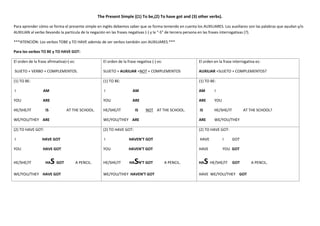
The Present Simple ((1) To be,(2) To have got and (3) other verbs). 
Para aprender cómo se forma el presente simple en inglés debemos saber que se forma teniendo en cuenta los AUXILIARES. Los auxiliares son las palabras que ayudan y/o 
AUXILIAN al verbo llevando la partícula de la negación en las frases negativas (-) y la “-S” de tercera persona en las frases interrogativas (?). 
***ATENCIÓN: Los verbos TOBE y TO HAVE además de ser verbos también son AUXILIARES.*** 
Para los verbos TO BE y TO HAVE GOT: 
El orden de la frase afirmativa(+) es: 
El orden de la frase negativa (-) es: 
El orden en la frase interrogativa es: 
SUJETO + VERBO + COMPLEMENTOS. 
SUJETO + AUXILIAR +NOT + COMPLEMENTOS 
AUXILIAR +SUJETO + COMPLEMENTOS? 
(1) TO BE: 
I AM 
YOU ARE 
HE/SHE/IT IS AT THE SCHOOL. 
WE/YOU/THEY ARE 
(1) TO BE: 
I AM 
YOU ARE 
HE/SHE/IT IS NOT AT THE SCHOOL. 
WE/YOU/THEY ARE 
(1) TO BE: 
AM I 
ARE YOU 
IS HE/SHE/IT AT THE SCHOOL? 
ARE WE/YOU/THEY 
(2) TO HAVE GOT: 
I HAVE GOT 
YOU HAVE GOT 
HE/SHE/IT HAS GOT A PENCIL. 
WE/YOU/THEY HAVE GOT 
(2) TO HAVE GOT: 
I HAVEN’T GOT 
YOU HAVEN’T GOT 
HE/SHE/IT HASN’T GOT A PENCIL. 
WE/YOU/THEY HAVEN’T GOT 
(2) TO HAVE GOT: 
HAVE I GOT 
HAVE YOU GOT 
HAS HE/SHE/IT GOT A PENCIL. 
HAVE WE/YOU/THEY GOT
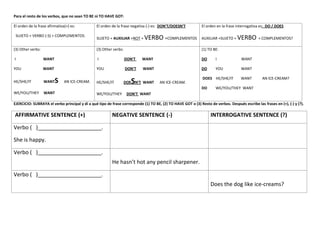
Para el resto de los verbos, que no sean TO BE ni TO HAVE GOT: 
El orden de la frase afirmativa(+) es: 
SUJETO + VERBO (-S) + COMPLEMENTOS. 
El orden de la frase negativa (-) es: DON’T/DOESN’T 
SUJETO + AUXILIAR +NOT + VERBO +COMPLEMENTOS 
El orden en la frase interrogativa es: DO / DOES 
AUXILIAR +SUJETO + VERBO + COMPLEMENTOS? 
(3) Other verbs: 
I WANT 
YOU WANT 
HE/SHE/IT WANTS AN ICE-CREAM. 
WE/YOU/THEY WANT 
(3) Other verbs: 
I DON’T WANT 
YOU DON’T WANT 
HE/SHE/IT DOESN’T WANT AN ICE-CREAM. 
WE/YOU/THEY DON’T WANT 
(1) TO BE: 
DO I WANT 
DO YOU WANT 
DOES HE/SHE/IT WANT AN ICE-CREAM? 
DO WE/YOU/THEY WANT 
EJERCICIO: SUBRAYA el verbo principal y di a qué tipo de frase corresponde (1) TO BE, (2) TO HAVE GOT o (3) Resto de verbos. Después escribe las frases en (+), (-) y (?). 
AFFIRMATIVE SENTENCE (+) NEGATIVE SENTENCE (-) INTERROGATIVE SENTENCE (?) 
Verbo ( )_____________________. 
She is happy. 
Verbo ( )_____________________. 
He hasn’t hot any pencil sharpener. 
Verbo ( )_____________________. 
Does the dog like ice-creams?
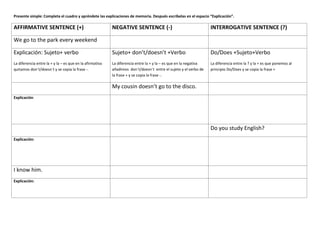
Presente simple: Completa el cuadro y apréndete las explicaciones de memoria. Después escríbelas en el espacio “Explicación”. 
AFFIRMATIVE SENTENCE (+) NEGATIVE SENTENCE (-) INTERROGATIVE SENTENCE (?) 
We go to the park every weekend 
Explicación: Sujeto+ verbo 
La diferencia entre la + y la – es que en la afirmativa 
quitamos don´t/doesn´t y se copia la frase -. 
Sujeto+ don’t/doesn’t +Verbo 
La diferencia entre la + y la – es que en la negativa 
añadimos don´t/doesn´t entre el sujeto y el verbo de 
la frase + y se copia la frase -. 
Do/Does +Sujeto+Verbo 
La diferencia entre la ? y la + es que ponemos al 
principio Do/Does y se copia la frase + 
My cousin doesn’t go to the disco. 
Explicación: 
Do you study English? 
Explicación: 
I know him. 
Explicación:
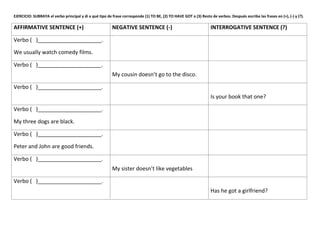
EJERCICIO: SUBRAYA el verbo principal y di a qué tipo de frase corresponde (1) TO BE, (2) TO HAVE GOT o (3) Resto de verbos. Después escribe las frases en (+), (-) y (?). 
AFFIRMATIVE SENTENCE (+) NEGATIVE SENTENCE (-) INTERROGATIVE SENTENCE (?) 
Verbo ( )_____________________. 
We usually watch comedy films. 
Verbo ( )_____________________. 
My cousin doesn’t go to the disco. 
Verbo ( )_____________________. 
Is your book that one? 
Verbo ( )_____________________. 
My three dogs are black. 
Verbo ( )_____________________. 
Peter and John are good friends. 
Verbo ( )_____________________. 
My sister doesn’t like vegetables 
Verbo ( )_____________________. 
Has he got a girlfriend?
Name: Date: 
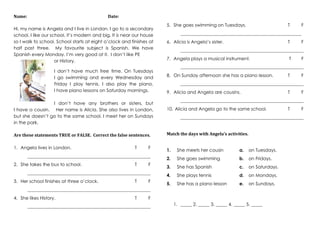
Hi, my name is Angela and I live in London. I go to a secondary 
school. I like our school, it’s modern and big. It is near our house 
so I walk to school. School starts at eight o’clock and finishes at 
half past three. My favourite subject is Spanish. We have 
Spanish every Monday. I’m very good at it. I don’t like PE 
or History. 
I don’t have much free time. On Tuesdays 
I go swimming and every Wednesday and 
Friday I play tennis. I also play the piano. 
I have piano lessons on Saturday mornings. 
I don’t have any brothers or sisters, but 
I have a cousin. Her name is Alicia. She also lives in London, 
but she doesn’t go to the same school. I meet her on Sundays 
in the park. 
Are these statements TRUE or FALSE. Correct the false sentences. 
1. Angela lives in London. T F 
______________________________________________________ 
2. She takes the bus to school. T F 
______________________________________________________ 
3. Her school finishes at three o’clock. T F 
______________________________________________________ 
4. She likes History. T F 
______________________________________________________ 
5. She goes swimming on Tuesdays. T F 
_____________________________________________________ 
6. Alicia is Angela’s sister. T F 
______________________________________________________ 
7. Angela plays a musical instrument. T F 
______________________________________________________ 
8. On Sunday afternoon she has a piano lesson. T F 
______________________________________________________ 
9. Alicia and Angela are cousins. T F 
______________________________________________________ 
10. Alicia and Angela go to the same school. T F 
______________________________________________________ 
Match the days with Angela’s activities. 
1. She meets her cousin a. on Tuesdays. 
2. She goes swimming b. on Fridays. 
3. She has Spanish c. on Saturdays. 
4. She plays tennis d. on Mondays. 
5. She has a piano lesson e. on Sundays. 
1. _____ 2. _____ 3. _____ 4. _____ 5. _____
Exercise: Fill in the blanks using the Present simple tense and underline the 
subject of the verb. 
Emily's Secret 
Emily is 8 years old. She ________(live) in a 
big house. She ________(have) a huge room. 
She ________ (have) many toys and she 
_____(have) a lot of friends. But Emily 
_________(not be) happy. She has a secret. 
She ____________ (not want) to tell anyone 
about her secret. She _______(feel) 
embarrassed. The problem is that if nobody 
_______(know) about it, there is no one that 
can help her. 
Emily ____________(not write) her homework. When there is an exam – 
she _________(get) sick. She _______________ (not tell) anyone, but the 
truth is she can't read and write. Emily ______________(not remember) the 
letters of the alphabet. 
One day, Emily's teacher finds out. She ______(see) that Emily can't write 
on the board. She __________(call) her after class and ________(ask) her 
to tell the truth. Emily says, "It is true. I ________(not know) how to read 
and write". The teacher ___________(listen) to her. She _________( want) 
to help Emily. She __________(tell) her, "That's ok. You can read and 
write if we ____________(practice) together". 
So Emily and her teacher __________(meet) every day after class. They 
____________ (practice) together. Emily ________(work) hard. Now she 
knows how to read and write! 
THE END
Reading comprehension 
1) How old is she? _________________________________________. 
2) Where does she live? ____________________________________. 
3) What does she have? ____________________________________. 
4) What’s Emily’s secret? _________________________________ 
________________________________________________________. 
5) Who helps Emily? 
_________________________________________________________.
Answers 
Emily's Secret 
Emily is 8 years old. She lives in a big house. She has a huge room. She has many toys 
and she has a lot of friends. But Emily is not 
happy. She has a secret. 
She doesn't want to tell anyone about her secret. 
She feels embarrassed. The problem is that if 
nobody knows about it, there is no one that can 
help her. 
Emily doesn't write her homework. When there 
is an exam – she gets sick. She doesn't tell 
anyone, but the truth is she can't read and write. 
Emily doesn't remember the letters of the 
alphabet. 
One day, Emily's teacher finds out. She sees that Emily can't write on the board. She 
calls her after class and asks her to tell the truth. Emily says, "It is true. I don't know 
how to read and write". The teacher listens to her. She wants to help Emily. She tells 
her, "That's ok. You can read and write if we practice together". 
So Emily and her teacher meet every day after class. They practice together. Emily 
works hard. Now she knows how to read and write! 
THE END 
Reading comprehension 
1) How old is she? She is 8 years old. 
2) Where does she live? She lives in a big house. 
3) What does she have? She has a secret. 
4) What’s Emily’s secret? 
Emily’s secret is that she doesn’t know how to read and write. 
Her secret is that she can’t read and write. 
5) Who help Emily? The teacher helps Emily.

Pr simple worksheet

  • 1.
    The Present Simple((1) To be,(2) To have got and (3) other verbs). Para aprender cómo se forma el presente simple en inglés debemos saber que se forma teniendo en cuenta los AUXILIARES. Los auxiliares son las palabras que ayudan y/o AUXILIAN al verbo llevando la partícula de la negación en las frases negativas (-) y la “-S” de tercera persona en las frases interrogativas (?). ***ATENCIÓN: Los verbos TOBE y TO HAVE además de ser verbos también son AUXILIARES.*** Para los verbos TO BE y TO HAVE GOT: El orden de la frase afirmativa(+) es: El orden de la frase negativa (-) es: El orden en la frase interrogativa es: SUJETO + VERBO + COMPLEMENTOS. SUJETO + AUXILIAR +NOT + COMPLEMENTOS AUXILIAR +SUJETO + COMPLEMENTOS? (1) TO BE: I AM YOU ARE HE/SHE/IT IS AT THE SCHOOL. WE/YOU/THEY ARE (1) TO BE: I AM YOU ARE HE/SHE/IT IS NOT AT THE SCHOOL. WE/YOU/THEY ARE (1) TO BE: AM I ARE YOU IS HE/SHE/IT AT THE SCHOOL? ARE WE/YOU/THEY (2) TO HAVE GOT: I HAVE GOT YOU HAVE GOT HE/SHE/IT HAS GOT A PENCIL. WE/YOU/THEY HAVE GOT (2) TO HAVE GOT: I HAVEN’T GOT YOU HAVEN’T GOT HE/SHE/IT HASN’T GOT A PENCIL. WE/YOU/THEY HAVEN’T GOT (2) TO HAVE GOT: HAVE I GOT HAVE YOU GOT HAS HE/SHE/IT GOT A PENCIL. HAVE WE/YOU/THEY GOT
  • 2.
    Para el restode los verbos, que no sean TO BE ni TO HAVE GOT: El orden de la frase afirmativa(+) es: SUJETO + VERBO (-S) + COMPLEMENTOS. El orden de la frase negativa (-) es: DON’T/DOESN’T SUJETO + AUXILIAR +NOT + VERBO +COMPLEMENTOS El orden en la frase interrogativa es: DO / DOES AUXILIAR +SUJETO + VERBO + COMPLEMENTOS? (3) Other verbs: I WANT YOU WANT HE/SHE/IT WANTS AN ICE-CREAM. WE/YOU/THEY WANT (3) Other verbs: I DON’T WANT YOU DON’T WANT HE/SHE/IT DOESN’T WANT AN ICE-CREAM. WE/YOU/THEY DON’T WANT (1) TO BE: DO I WANT DO YOU WANT DOES HE/SHE/IT WANT AN ICE-CREAM? DO WE/YOU/THEY WANT EJERCICIO: SUBRAYA el verbo principal y di a qué tipo de frase corresponde (1) TO BE, (2) TO HAVE GOT o (3) Resto de verbos. Después escribe las frases en (+), (-) y (?). AFFIRMATIVE SENTENCE (+) NEGATIVE SENTENCE (-) INTERROGATIVE SENTENCE (?) Verbo ( )_____________________. She is happy. Verbo ( )_____________________. He hasn’t hot any pencil sharpener. Verbo ( )_____________________. Does the dog like ice-creams?
  • 3.
    Presente simple: Completael cuadro y apréndete las explicaciones de memoria. Después escríbelas en el espacio “Explicación”. AFFIRMATIVE SENTENCE (+) NEGATIVE SENTENCE (-) INTERROGATIVE SENTENCE (?) We go to the park every weekend Explicación: Sujeto+ verbo La diferencia entre la + y la – es que en la afirmativa quitamos don´t/doesn´t y se copia la frase -. Sujeto+ don’t/doesn’t +Verbo La diferencia entre la + y la – es que en la negativa añadimos don´t/doesn´t entre el sujeto y el verbo de la frase + y se copia la frase -. Do/Does +Sujeto+Verbo La diferencia entre la ? y la + es que ponemos al principio Do/Does y se copia la frase + My cousin doesn’t go to the disco. Explicación: Do you study English? Explicación: I know him. Explicación:
  • 4.
    EJERCICIO: SUBRAYA elverbo principal y di a qué tipo de frase corresponde (1) TO BE, (2) TO HAVE GOT o (3) Resto de verbos. Después escribe las frases en (+), (-) y (?). AFFIRMATIVE SENTENCE (+) NEGATIVE SENTENCE (-) INTERROGATIVE SENTENCE (?) Verbo ( )_____________________. We usually watch comedy films. Verbo ( )_____________________. My cousin doesn’t go to the disco. Verbo ( )_____________________. Is your book that one? Verbo ( )_____________________. My three dogs are black. Verbo ( )_____________________. Peter and John are good friends. Verbo ( )_____________________. My sister doesn’t like vegetables Verbo ( )_____________________. Has he got a girlfriend?
  • 5.
    Name: Date: Hi,my name is Angela and I live in London. I go to a secondary school. I like our school, it’s modern and big. It is near our house so I walk to school. School starts at eight o’clock and finishes at half past three. My favourite subject is Spanish. We have Spanish every Monday. I’m very good at it. I don’t like PE or History. I don’t have much free time. On Tuesdays I go swimming and every Wednesday and Friday I play tennis. I also play the piano. I have piano lessons on Saturday mornings. I don’t have any brothers or sisters, but I have a cousin. Her name is Alicia. She also lives in London, but she doesn’t go to the same school. I meet her on Sundays in the park. Are these statements TRUE or FALSE. Correct the false sentences. 1. Angela lives in London. T F ______________________________________________________ 2. She takes the bus to school. T F ______________________________________________________ 3. Her school finishes at three o’clock. T F ______________________________________________________ 4. She likes History. T F ______________________________________________________ 5. She goes swimming on Tuesdays. T F _____________________________________________________ 6. Alicia is Angela’s sister. T F ______________________________________________________ 7. Angela plays a musical instrument. T F ______________________________________________________ 8. On Sunday afternoon she has a piano lesson. T F ______________________________________________________ 9. Alicia and Angela are cousins. T F ______________________________________________________ 10. Alicia and Angela go to the same school. T F ______________________________________________________ Match the days with Angela’s activities. 1. She meets her cousin a. on Tuesdays. 2. She goes swimming b. on Fridays. 3. She has Spanish c. on Saturdays. 4. She plays tennis d. on Mondays. 5. She has a piano lesson e. on Sundays. 1. _____ 2. _____ 3. _____ 4. _____ 5. _____
  • 6.
    Exercise: Fill inthe blanks using the Present simple tense and underline the subject of the verb. Emily's Secret Emily is 8 years old. She ________(live) in a big house. She ________(have) a huge room. She ________ (have) many toys and she _____(have) a lot of friends. But Emily _________(not be) happy. She has a secret. She ____________ (not want) to tell anyone about her secret. She _______(feel) embarrassed. The problem is that if nobody _______(know) about it, there is no one that can help her. Emily ____________(not write) her homework. When there is an exam – she _________(get) sick. She _______________ (not tell) anyone, but the truth is she can't read and write. Emily ______________(not remember) the letters of the alphabet. One day, Emily's teacher finds out. She ______(see) that Emily can't write on the board. She __________(call) her after class and ________(ask) her to tell the truth. Emily says, "It is true. I ________(not know) how to read and write". The teacher ___________(listen) to her. She _________( want) to help Emily. She __________(tell) her, "That's ok. You can read and write if we ____________(practice) together". So Emily and her teacher __________(meet) every day after class. They ____________ (practice) together. Emily ________(work) hard. Now she knows how to read and write! THE END
  • 7.
    Reading comprehension 1)How old is she? _________________________________________. 2) Where does she live? ____________________________________. 3) What does she have? ____________________________________. 4) What’s Emily’s secret? _________________________________ ________________________________________________________. 5) Who helps Emily? _________________________________________________________.
  • 8.
    Answers Emily's Secret Emily is 8 years old. She lives in a big house. She has a huge room. She has many toys and she has a lot of friends. But Emily is not happy. She has a secret. She doesn't want to tell anyone about her secret. She feels embarrassed. The problem is that if nobody knows about it, there is no one that can help her. Emily doesn't write her homework. When there is an exam – she gets sick. She doesn't tell anyone, but the truth is she can't read and write. Emily doesn't remember the letters of the alphabet. One day, Emily's teacher finds out. She sees that Emily can't write on the board. She calls her after class and asks her to tell the truth. Emily says, "It is true. I don't know how to read and write". The teacher listens to her. She wants to help Emily. She tells her, "That's ok. You can read and write if we practice together". So Emily and her teacher meet every day after class. They practice together. Emily works hard. Now she knows how to read and write! THE END Reading comprehension 1) How old is she? She is 8 years old. 2) Where does she live? She lives in a big house. 3) What does she have? She has a secret. 4) What’s Emily’s secret? Emily’s secret is that she doesn’t know how to read and write. Her secret is that she can’t read and write. 5) Who help Emily? The teacher helps Emily.