CAREER POINT UNIVERSITY
KOTA,RAJ.
Presentation on Absorption refrigeration System.
Submitted By:
Pradeep Kumar
UiD:K10695
B.Tech(ME.)
Sem. 6th
Submitted To:
Mr.Aditya Mishra Sir
Assist. Prof. ME. Dept.
CONTENTS:
●Introduction
●Principle of Operation
●Working Fluid for Vapor Absorption Refrigeration
System (VARS)
●Some Experimental Results for Different Fluid
●Various Designs of VARS
●Cost Analysis
●Conclusions
*
INTRODUCTION
●Electricity purchased from utility plant for VCRS can be
reduced.
●Another major difference is VCRS commonly used CFCs as
refrigerants or working fluid which is cause of ozone layer
depletion that will make VARS more prominent.
●VARS use natural refrigerants such as
NH3 and H2O.
●COP of VARS is much lower than the VCRS.
●Although VARS seem to be many advantages , VCRS still
dominate all market sectors.
●In order to promote the use of absorption system, further
development is required to improve performance and reduce
cost. *
PRINCIPLE OF OPERATION
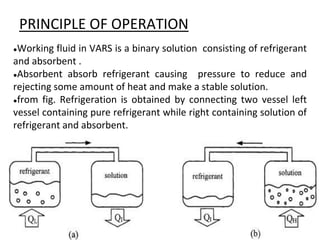
●Working fluid in VARS is a binary solution consisting of refrigerant
and absorbent .
●Absorbent absorb refrigerant causing pressure to reduce and
rejecting some amount of heat and make a stable solution.
●from fig. Refrigeration is obtained by connecting two vessel left
vessel containing pure refrigerant while right containing solution of
refrigerant and absorbent.
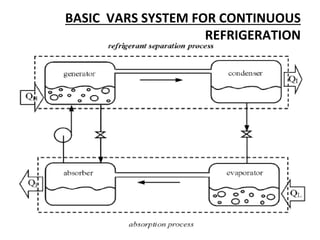
BASIC VARS SYSTEM FOR CONTINUOUS
REFRIGERATION
●Mechanical work is less in VARS compared to VCRS because
here pump is used instead of compressor.
●However, a large amount of heat is required so the solution
pump work is negligible compare to it.
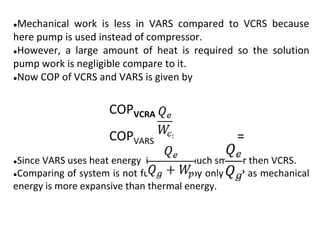
●Now COP of VCRS and VARS is given by
COPVCRA =
COPVARS = =
●Since VARS uses heat energy its COP is much smaller then VCRS.
●Comparing of system is not fully justify by only COP as mechanical
energy is more expansive than thermal energy.
Working Fluid for Vapor Absorption
Refrigeration System (VARS)
Properties of Working Fluid (Refrigerant –
Absorbent System):
1.Low viscosity to minimize pump work.
2.Low freezing point by which we can maintain the low
evaporator temperature.
3.Thermal stability.
4.Irreversible chemical reaction of all kinds, such as
decomposition, polymerization, corrosion, etc. Are to be avoided.
5.It must be completely miscible both in liquid as well as in
vapour as well as in vapour phase.
●In addition to above, two main thermodynamic requirements of
the mixture are.
Various Designs of VARS
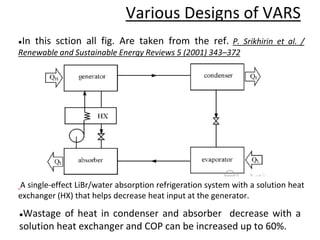
●Wastage of heat in condenser and absorber decrease with a
solution heat exchanger and COP can be increased up to 60%.
A single-effect LiBr/water absorption refrigeration system with a solution heat
exchanger (HX) that helps decrease heat input at the generator.
●In this sction all fig. Are taken from the ref. P. Srikhirin et al. /
Renewable and Sustainable Energy Reviews 5 (2001) 343–372
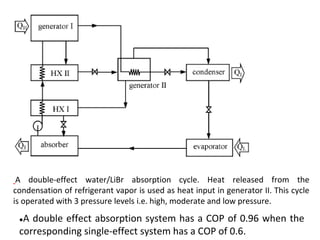
●A double effect absorption system has a COP of 0.96 when the
corresponding single-effect system has a COP of 0.6.
A double-effect water/LiBr absorption cycle. Heat released from the
condensation of refrigerant vapor is used as heat input in generator II. This cycle
is operated with 3 pressure levels i.e. high, moderate and low pressure.
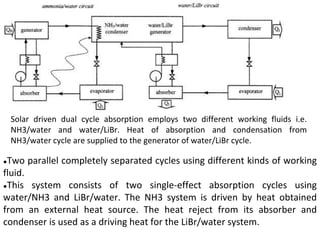
●Two parallel completely separated cycles using different kinds of working
fluid.
●This system consists of two single-effect absorption cycles using
water/NH3 and LiBr/water. The NH3 system is driven by heat obtained
from an external heat source. The heat reject from its absorber and
condenser is used as a driving heat for the LiBr/water system.
Solar driven dual cycle absorption employs two different working fluids i.e.
NH3/water and water/LiBr. Heat of absorption and condensation from
NH3/water cycle are supplied to the generator of water/LiBr cycle.
●An ejector is placed between a generator and a condenser of a
single-effect absorption system.
●LiBr/water is used as the working fluid. The ejector uses high-
pressure water vapor from the generator as the motive fluid.
A combined ejector/absorption proposed by Aphornratana and Eames [92], was
invented. High pressure refrigerant vapor from the generator enters the ejector as
motive fluid to carry the refrigerant vapor from the evaporator.
●For fig. 14 Experimental investigation showed that COP’s as high as
0.86 to 1.04 was found.
●This system must be operated with a high temperature heat source
(190 to 210°C) and acceptable surrounding temperature.
●As the generator temperature is high, the corrosion of construction
material may be problematic.
●This cycle is a combined cycle between a steam jet heat pump and
a single-effect absorption cycle.
A combined cycle proposed by Eames and Wu [93]. The highest solution circuit
temperature is maintained at about 80°C. So the corrosion problem is alleviated.
●A steam jet system is used as an internal heat pump, which
was used to recover rejected heat during the condensation of
the refrigerant vapor from a single-effect absorption cycle.
●The heat pump supplies heat to the generator of an absorption
system.
●The refrigerant vapor generated from the generator is
entrained by the steam ejector and is liquefied together with
the ejector’s motive steam by rejecting heat to the solution in
the generator.
●In this system the corrosion problem is eliminated as the
solution maximum temperature is maintained at 80°C.
●The driving heat (from an external source) is supplied to the
steam boiler only at temperatures around 200°C.
●The experimental COP of this system was found to be 1.03.
THANK YOU

Pptx

  • 1.
    CAREER POINT UNIVERSITY KOTA,RAJ. Presentationon Absorption refrigeration System. Submitted By: Pradeep Kumar UiD:K10695 B.Tech(ME.) Sem. 6th Submitted To: Mr.Aditya Mishra Sir Assist. Prof. ME. Dept.
  • 2.
    CONTENTS: ●Introduction ●Principle of Operation ●WorkingFluid for Vapor Absorption Refrigeration System (VARS) ●Some Experimental Results for Different Fluid ●Various Designs of VARS ●Cost Analysis ●Conclusions *
  • 3.
    INTRODUCTION ●Electricity purchased fromutility plant for VCRS can be reduced. ●Another major difference is VCRS commonly used CFCs as refrigerants or working fluid which is cause of ozone layer depletion that will make VARS more prominent. ●VARS use natural refrigerants such as NH3 and H2O. ●COP of VARS is much lower than the VCRS. ●Although VARS seem to be many advantages , VCRS still dominate all market sectors. ●In order to promote the use of absorption system, further development is required to improve performance and reduce cost. *
  • 4.
    PRINCIPLE OF OPERATION ●Workingfluid in VARS is a binary solution consisting of refrigerant and absorbent . ●Absorbent absorb refrigerant causing pressure to reduce and rejecting some amount of heat and make a stable solution. ●from fig. Refrigeration is obtained by connecting two vessel left vessel containing pure refrigerant while right containing solution of refrigerant and absorbent.
  • 5.
    BASIC VARS SYSTEMFOR CONTINUOUS REFRIGERATION
  • 6.
    ●Mechanical work isless in VARS compared to VCRS because here pump is used instead of compressor. ●However, a large amount of heat is required so the solution pump work is negligible compare to it. ●Now COP of VCRS and VARS is given by COPVCRA = COPVARS = = ●Since VARS uses heat energy its COP is much smaller then VCRS. ●Comparing of system is not fully justify by only COP as mechanical energy is more expansive than thermal energy.
  • 7.
    Working Fluid forVapor Absorption Refrigeration System (VARS) Properties of Working Fluid (Refrigerant – Absorbent System): 1.Low viscosity to minimize pump work. 2.Low freezing point by which we can maintain the low evaporator temperature. 3.Thermal stability. 4.Irreversible chemical reaction of all kinds, such as decomposition, polymerization, corrosion, etc. Are to be avoided. 5.It must be completely miscible both in liquid as well as in vapour as well as in vapour phase. ●In addition to above, two main thermodynamic requirements of the mixture are.
  • 8.
    Various Designs ofVARS ●Wastage of heat in condenser and absorber decrease with a solution heat exchanger and COP can be increased up to 60%. A single-effect LiBr/water absorption refrigeration system with a solution heat exchanger (HX) that helps decrease heat input at the generator. ●In this sction all fig. Are taken from the ref. P. Srikhirin et al. / Renewable and Sustainable Energy Reviews 5 (2001) 343–372
  • 9.
    ●A double effectabsorption system has a COP of 0.96 when the corresponding single-effect system has a COP of 0.6. A double-effect water/LiBr absorption cycle. Heat released from the condensation of refrigerant vapor is used as heat input in generator II. This cycle is operated with 3 pressure levels i.e. high, moderate and low pressure.
  • 10.
    ●Two parallel completelyseparated cycles using different kinds of working fluid. ●This system consists of two single-effect absorption cycles using water/NH3 and LiBr/water. The NH3 system is driven by heat obtained from an external heat source. The heat reject from its absorber and condenser is used as a driving heat for the LiBr/water system. Solar driven dual cycle absorption employs two different working fluids i.e. NH3/water and water/LiBr. Heat of absorption and condensation from NH3/water cycle are supplied to the generator of water/LiBr cycle.
  • 11.
    ●An ejector isplaced between a generator and a condenser of a single-effect absorption system. ●LiBr/water is used as the working fluid. The ejector uses high- pressure water vapor from the generator as the motive fluid. A combined ejector/absorption proposed by Aphornratana and Eames [92], was invented. High pressure refrigerant vapor from the generator enters the ejector as motive fluid to carry the refrigerant vapor from the evaporator.
  • 12.
    ●For fig. 14Experimental investigation showed that COP’s as high as 0.86 to 1.04 was found. ●This system must be operated with a high temperature heat source (190 to 210°C) and acceptable surrounding temperature. ●As the generator temperature is high, the corrosion of construction material may be problematic.
  • 13.
    ●This cycle isa combined cycle between a steam jet heat pump and a single-effect absorption cycle. A combined cycle proposed by Eames and Wu [93]. The highest solution circuit temperature is maintained at about 80°C. So the corrosion problem is alleviated.
  • 14.
    ●A steam jetsystem is used as an internal heat pump, which was used to recover rejected heat during the condensation of the refrigerant vapor from a single-effect absorption cycle. ●The heat pump supplies heat to the generator of an absorption system. ●The refrigerant vapor generated from the generator is entrained by the steam ejector and is liquefied together with the ejector’s motive steam by rejecting heat to the solution in the generator. ●In this system the corrosion problem is eliminated as the solution maximum temperature is maintained at 80°C. ●The driving heat (from an external source) is supplied to the steam boiler only at temperatures around 200°C. ●The experimental COP of this system was found to be 1.03.
  • 15.