English 4
EN4LR-III-2: Comprehend informational texts
Lesson Objectives: At the end of the lesson, the learners should be able to
1.note important information through outlining (topic, main idea, supporting
details): inductive organization (pyramid);
2. glean the writer’s purpose:
a. to recount;
b. to entertain;
c. to inform, explain, describe
3. identify text types according to the method of development and
organizational structure:
a. time order: chronology;
b. time order: procedural;
QUARTER 3 -
WEEK 5
English 4
4. draw conclusions and inferences from the text;
5. distinguish fact from opinion (statements of facts, opinions, and fact-based
statements of opinion);
6. produce a summary of a given text.
QUARTER 3 -
WEEK 5
EN4SW-III-5: Express ideas appropriately (age-appropriate, gender-
responsive, culture-sensitive) for one’s purpose, context, and target
audience.
Lesson Objectives: At the end of the lesson, the learners should be able to
1.recount/narrate an event or experience or describe a process in relation to a
given theme.
DAY 1
Quarter 3 - Week 5
LEARNING
OBJECTIVES
At the end of the lesson, the learners should
be able to note important information
through outlining (topic, main idea,
supporting details): inductive organization
(pyramid)
QUARTER 3
WEEK 5
CONTENT
FOCUS
Understanding Informational Texts
Historical Narrative (Time Order: Chronological)
• Comprehension and noting details (topic, main idea,
purpose, supporting details)
• Determining textual structure and method of
development: Inductive (pyramid)
• Distinguishing fact from opinion
• Drawing conclusions and inferences
• Summarizing the text
QUARTER 3
WEEK 5
Directions: In the space before
each number, draw a heart if the
given statement is true and a circle
if it is false.
Activating Prior Knowledge Pre-Lesson Proper
Lesson Purpose / Intention Pre-Lesson Proper
• What do you see in the picture?
What do you think is
happening?
• Where do you think this event
took place? Who do you think
were the people involved?
The teacher will introduce historical narratives/accounts as another
type of informational text. The teacher may say, “Are historical
accounts or narratives considered informational texts? If yes, why do
you think this is so? To help us answer this question, we will read
about a significant event in Philippine history.”
Lesson Language Practice Pre-Lesson Proper
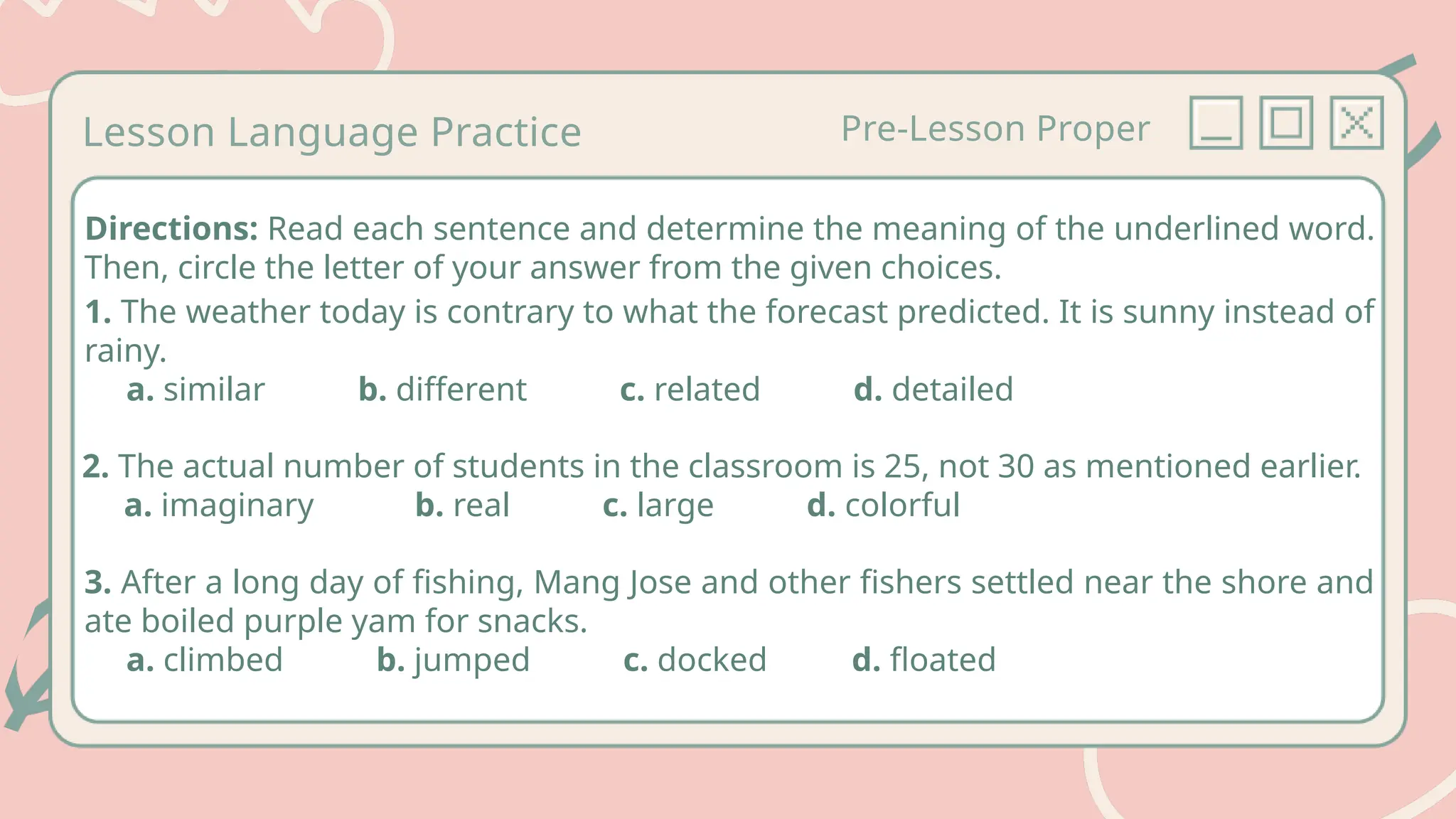
Directions: Read each sentence and determine the meaning of the underlined word.
Then, circle the letter of your answer from the given choices.
1. The weather today is contrary to what the forecast predicted. It is sunny instead of
rainy.
a. similar b. different c. related d. detailed
2. The actual number of students in the classroom is 25, not 30 as mentioned earlier.
a. imaginary b. real c. large d. colorful
3. After a long day of fishing, Mang Jose and other fishers settled near the shore and
ate boiled purple yam for snacks.
a. climbed b. jumped c. docked d. floated
Lesson Language Practice Pre-Lesson Proper
4. Invading the enemy’s territory, the army bravely marched towards the walled city.
a. protecting b. taking over c. destroying d. coming in
5. The group of scientists embarked on a thrilling expedition to study rare plants in
the Amazon rainforest.
a. argument b. journey c. discovery d. speed
6. The keen-eyed zookeeper spotted the missing deer trapped in the bushes near
the river and immediately rescued it.
a. saw b. ignored c. covered d. called
7. The cabin crew of the plane made sure that the passengers were safe during the
whole flight. They worked together to take care of the passengers.
a. captain b. team c. waiter d. server
Lesson Language Practice Pre-Lesson Proper
8. The tourist approached the tour guide and asked her for a map.
a. came near b. stayed away c. jumped off d. ran along
9. The young girl showed great courtesy by holding the door open for the elderly
lady.
a. rudeness b. shyness c. anger d. kindness
10. The fruit vendor displayed a variety of figs at his stall in the market. Figs have a
similar taste to strawberry.
a. a kind of leaf b. a kind of fruit c. a kind of bread d. a kind of flower
Reading the Key Idea / Stem Lesson Proper
The teacher will let learners read a historical
narrative about the arrival of Ferdinand
Magellan in Mactan. The following should be
provided beforehand to guide learners in
their reading of the text:
• What is the narrative about?
• What do you think is the purpose of the
writer?
• What specific details does the writer
share in this article? How are the details
organized?
Developing Understanding
of Key Idea / Stem
Lesson Proper
The teacher will then divide the class into
groups. Learners will work together in
accomplishing the following template:
Deepening Understanding
of Key Idea / Stem
Lesson Proper
What do we mean by Main Idea? Supporting Details?
A main idea is the main point a writer wants the reader to
come away with. Supporting details are the information,
facts, or points of discussion the writer gives to tell more
about this main idea.
• What is the main idea of the article?
• What are the supporting details in the article.
Making Generalizations and
Abstractions
Post-Lesson Proper
Directions for the narrative pyramid: Fill out
the narrative pyramid with the information
asked. Boxes beside the pyramid may be
used as extra space for writing.
1. List down the names or names of the
people the text talks about.
2. Write down two characteristics of each of
these people that the text talks about.
3. Describe the setting in three words.
4. Write down four important events that
happened.
5. Write down the main idea of the writer.
Evaluating Learning Post-Lesson Proper
Directions for the narrative timeline: Present
in a chronological manner the four important
events you identified earlier in the narrative
pyramid. You may refer to the sample
timeline in coming up with your own
narrative timeline.
Additional Activities for
Application or Remediation
Post-Lesson Proper
Read about writer’s purpose:
a. to recount;
b. to entertain;
c. to inform, explain, describe
(if possible)
DAY 2
Quarter 3 - Week 5
LEARNING
OBJECTIVES
At the end of the lesson, the learners
should be able to glean the writer’s
purpose:
a. to recount;
b. to entertain;
c. to inform, explain, describe
QUARTER 3
WEEK 5
CONTENT
FOCUS
Understanding Informational Texts
Historical Narrative (Time Order: Chronological)
• Comprehension and noting details (topic, main idea,
purpose, supporting details)
• Determining textual structure and method of
development: Inductive (pyramid)
• Distinguishing fact from opinion
• Drawing conclusions and inferences
• Summarizing the text
QUARTER 3
WEEK 5
Activity 1: “I’m good at something!”
The teacher will give the students a piece of paper. The teacher
will
ask the students to write a word or two that they think they are
really
good at. After writing, the teacher will ask some students to
share their
answer/s and try to answer this question:
1. Why do you think you’re good in that?
Activating Prior Knowledge Pre-Lesson Proper
Lesson Purpose / Intention Pre-Lesson Proper
Ananse: The Pot of Wisdom By: Adwoa Badoe
One day Ananse collected all the wisdom in the world and decided to keep it all
in a large pot for himself. Now he said,”I have all the wisdom of the world for
myself.” At least that was what he thought being such a greedy person. Kweku
Ananse then tied the pot of wisdom around his neck with a strong vine rope and
let the pot hang in front of him. But then he afraid that someone would find the
pot of wisdom and steal it. “What shall I do with my pot of wisdom?” He thought
and thought and at last he said,”I shall hide the pot on top of the tallest tree in
the forest.” So he searched the forest until he found the tallest tree which
happened to be the thorny silk cotton tree and brought the pot of wisdom to
the tree. While Ananse was trying to climb the thorny silk cotton tree his son
was watching him.
Lesson Purpose / Intention Pre-Lesson Proper
”Father?” he said, "What are you doing?" "Well" said Ananse, “I have in this clay pot
all the wisdom of the world and I am going to hang it on the top of the tallest tree
away from everybody. Then I will be the wisest in the whole wide world." "I have an
idea." said his son. "Why not hang the pot behind you instead of in front of you.
Then you will be able to climb the tree?” Well the sly one Ananse hung
the pot behind him and to his surprise; he was able to climb to the top
of the tree with his pot.
Finally Ananse sat on a branch of the tree holding the pot of wisdom. “I thought I
had all the wisdom in the world?” He thought to himself. “I thought I had it all in my
pot but my own son has wisdom not in my pot?” Then he made a statement that we
still use today. “No oneperson can have all the wisdom in the world.” On his way
down he dropped the pot and it smashed into many pieces and scatted all the
wisdom all over the world
Identify the writer’s purpose.
Lesson Purpose / Intention Pre-Lesson Proper
One day Ananse collected all the wisdom in the world and decided to keep it all in a large pot
for himself. Now he said,”I have all the wisdom of the world for myself.” At least that was
what he thought being such a greedy person. Kweku Ananse then tied the pot of wisdom
around his neck with a strong vine rope and let the pot hang in front of him. But then he was
afraid that someone would find the pot of wisdom and steal it. “What shall I do with my pot of
wisdom?” He thought and thought and at last he said,”I shall hide the pot on top of the tallest
tree in the forest.” So he searched the forest until he found the tallest tree which happened to
be the thorny silk cotton tree and brought the pot of wisdom to the tree. While Ananse was
trying to climb the thorny silk cotton tree his son was watching him. ”Father?” he said, "What
are you doing?" "Well" said Ananse, “I have in this clay pot all the wisdom of the world and I
am going to hang it on the top of the tallest tree away from everybody.
Lesson Purpose / Intention Pre-Lesson Proper
Then I will be the wisest in the whole wide world." "I have an idea." said his son. "Why not
hang the pot behind you instead of in front of you. Then you will be able to climb the tree?”
Well the sly one Ananse hung the pot behind him and to his surprise; he was able to climb to
the top
of the tree with his pot.
Finally Ananse sat on a branch of the tree holding the pot of wisdom. “I thought I had all the
wisdom in the world?” He thought to himself.
“I thought I had it all in my pot but my own son has wisdom not in my
pot?” Then he made a statement that we still use today. “No oneperson can have all the
wisdom in the world.” On his way down he dropped the pot and it smashed into many pieces
and scatted all the wisdom all over the world.
Lesson Language Practice Pre-Lesson Proper
The class will process their understanding of the story by answering
the following questions:
1. What do you think the story was all about (theme)?
2. What have you learned in the story?
3. How will it help you become a better person?
4. Why do you think the author wrote this story?
Reading the Key Idea / Stem Lesson Proper
AUTHOR’S PURPOSE
The teacher will discuss about the different types of purposes that
the authors have.
• An author’s purpose is his reason for or intent in writing.
• An author’s purpose may be to amuse the reader, to
recount/relate, to entertain or inform, explain, describe.
Developing Understanding
of Key Idea / Stem
Lesson Proper
a. To Recount
This purpose focuses on telling a story or sharing an experience, often in a
chronological order. It can include personal anecdotes or historical accounts.
The main goal is to provide a narrative that recounts events, feelings, and
reflections.
b. To Entertain
This purpose aims to engage the reader’s imagination or emotions through
humor, drama, or intrigue. Entertaining writing can include fiction, poetry, or
light-hearted essays. The primary goal is to provide enjoyment and
amusement, often through relatable characters, exciting plots, or witty
language
Developing Understanding
of Key Idea / Stem
Lesson Proper
c. To Inform, Explain, Describe
This purpose is about delivering information, clarifying concepts, or providing
detailed descriptions. It’s common in academic writing, articles, and
instructional texts. The goal is to educate the reader by explaining facts,
processes, or observations in a clear and straightforward manner.
Each purpose serves a different function and engages readers in unique
ways!
Deepening Understanding
of Key Idea/ Stem
Lesson Proper
Here are examples of passages for each writer's purpose:
a. To Recount
Passage:
"As I sat on the porch, sipping my coffee, I remembered that
summer day in 2015 when my family and I embarked on a road trip
across the country. We packed the car early in the morning,
excitement buzzing in the air. I can still hear my little brother asking,
'Are we there yet?' every twenty minutes. We visited national parks,
took countless photos, and shared stories that still make us laugh."
Deepening Understanding
of Key Idea/ Stem
Lesson Proper
b. To Entertain
Passage:
"It was a typical Tuesday until I discovered that my cat, Whiskers, had a
hidden talent for breakdancing. I was minding my own business, trying to
work, when I heard a thump followed by a curious meow. I looked over to
find him spinning on the kitchen floor, his furry paws flailing like a tiny
dancer. I couldn’t help but burst into laughter as he flipped over and
landed in a heap, looking utterly confused yet proud."
Deepening Understanding
of Key Idea/ Stem
Lesson Proper
c. To Inform, Explain, Describe Passage:
"Photosynthesis is the process by which green plants convert
sunlight into energy. During this process, chlorophyll in the leaves
captures sunlight, which is then used to convert carbon dioxide from
the air and water from the soil into glucose and oxygen. This not only
provides energy for the plant but also releases oxygen into the
atmosphere, which is essential for life on Earth."
Making Generalizations and
Abstractions
Post-Lesson Proper
Summary:
To recount focuses on storytelling and personal
experiences.
To entertain seeks to engage and amuse the
reader.
To inform, explain, describe is about educating
and clarifying concepts.
Evaluating Learning Post-Lesson Proper
Choose the option that best fits each statement:
1. A memoir detailing personal life experiences and lessons learned.
a. to recount
b. to entertain
c. to inform, explain, describe
2. A humorous short story about a day gone wrong at a family reunion.
a. to recount
b. to entertain
c. to inform, explain, describe
3. An article explaining how photosynthesis works in plants.
a. to recount
b. to entertain
c. to inform, explain,
Evaluating Learning Post-Lesson Proper
Choose the option that best fits each statement:
4. A diary entry reflecting on a recent trip and the emotions felt during it.
a. to recount
b. to entertain
c. to inform, explain, describe
5. A documentary script presenting the effects of climate change on wildlife.
a. to recount
b. to entertain
c. to inform, explain, describe
Additional Activities for
Application or Remediation
Post-Lesson Proper
The students will do an
advance study for the next
lesson.
(if possible)
DAY 3
Quarter 3 - Week 5
LEARNING
OBJECTIVES
At the end of the lesson, the learners
should be able to identify text types
according to the method of development
and organizational structure:
a. time order: chronology;
b. time order: procedural
QUARTER 3
WEEK 5
CONTENT
FOCUS
Understanding Informational Texts
Historical Narrative (Time Order: Chronological)
• Comprehension and noting details (topic, main idea,
purpose, supporting details)
• Determining textual structure and method of
development: Inductive (pyramid)
• Distinguishing fact from opinion
• Drawing conclusions and inferences
• Summarizing the text
QUARTER 3
WEEK 5
Identify the writer’s purpose.
Activating Prior Knowledge Pre-Lesson Proper
1. A personal letter describing a recent vacation and the fun activities enjoyed.
a. to recount
b. to entertain
c. to inform, explain, describe
2. A comic strip featuring a clumsy superhero trying to save the day but causing more chaos.
a. to recount
b. to entertain
c. to inform, explain, describe
3. An instructional guide on how to bake a chocolate cake, detailing each step and
ingredient.
a. to recount
b. to entertain
c. to inform, explain, describe
Lesson Purpose / Intention Pre-Lesson Proper
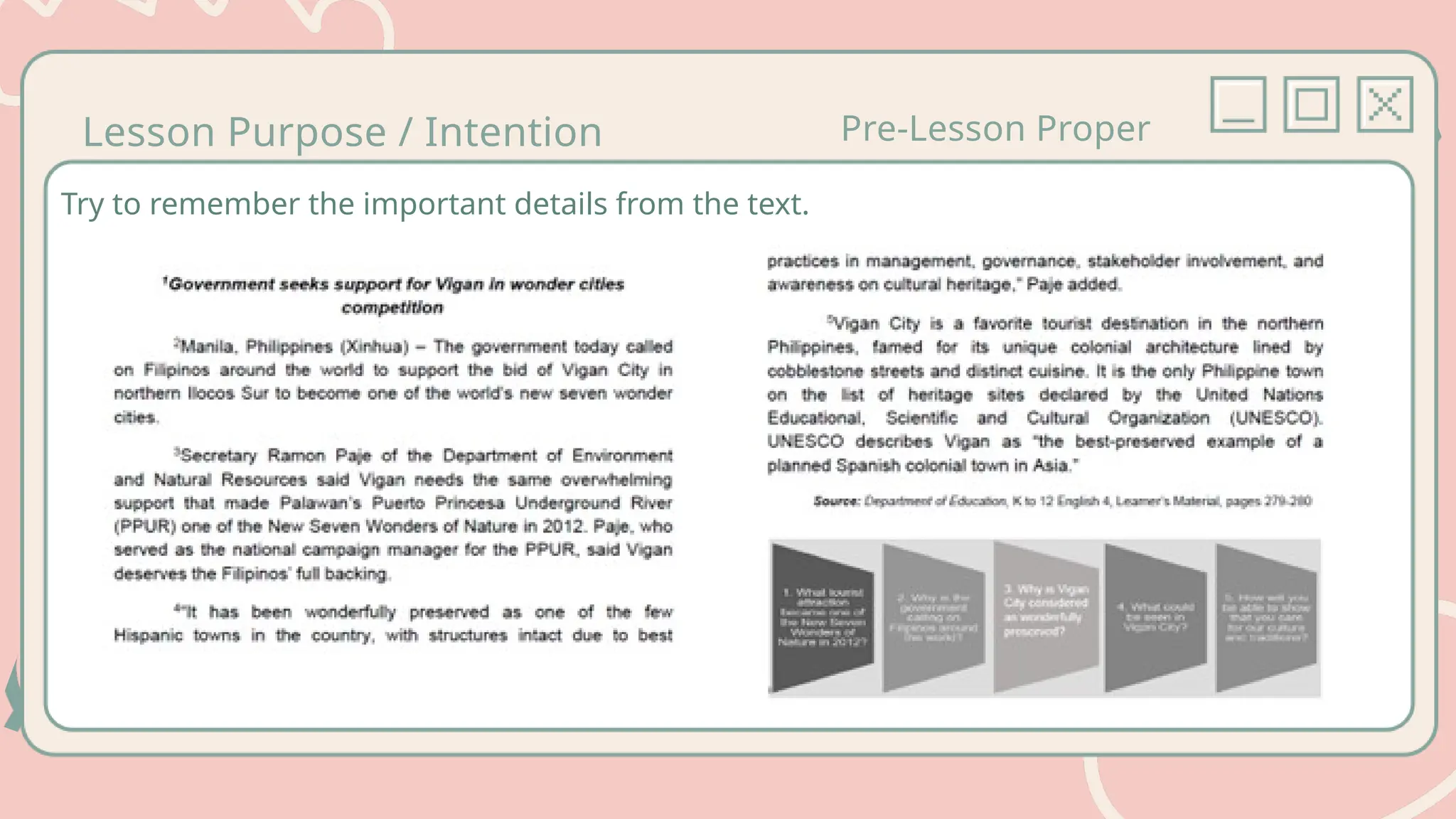
Try to remember the important details from the text.
Lesson Language Practice Pre-Lesson Proper
Read the paragraphs and answer the questions after each.
1. What does the text teach you?
2. What steps should you follow?
3. Were the directions clear? What words helped you know the correct steps to do?
Reading the Key Idea / Stem Lesson Proper
What is text-type?
Text-type refers to the classification and definition of the
way a text is written such as its structure, purpose, and
language features.
Developing Understanding
of Key Idea / Stem
Lesson Proper
A text type tells the procedure, directions, or steps on how to do something.
Examples:
1. recipe (steps in cooking)
2. steps in solving word problems
3. dance steps
4. creating crafts
5. going to places
It makes use of the signal words First, Next, Then, Finally.
This text type is called PROCEDURAL/SEQUENCE TEXT.
Developing Understanding
of Key Idea / Stem
Lesson Proper
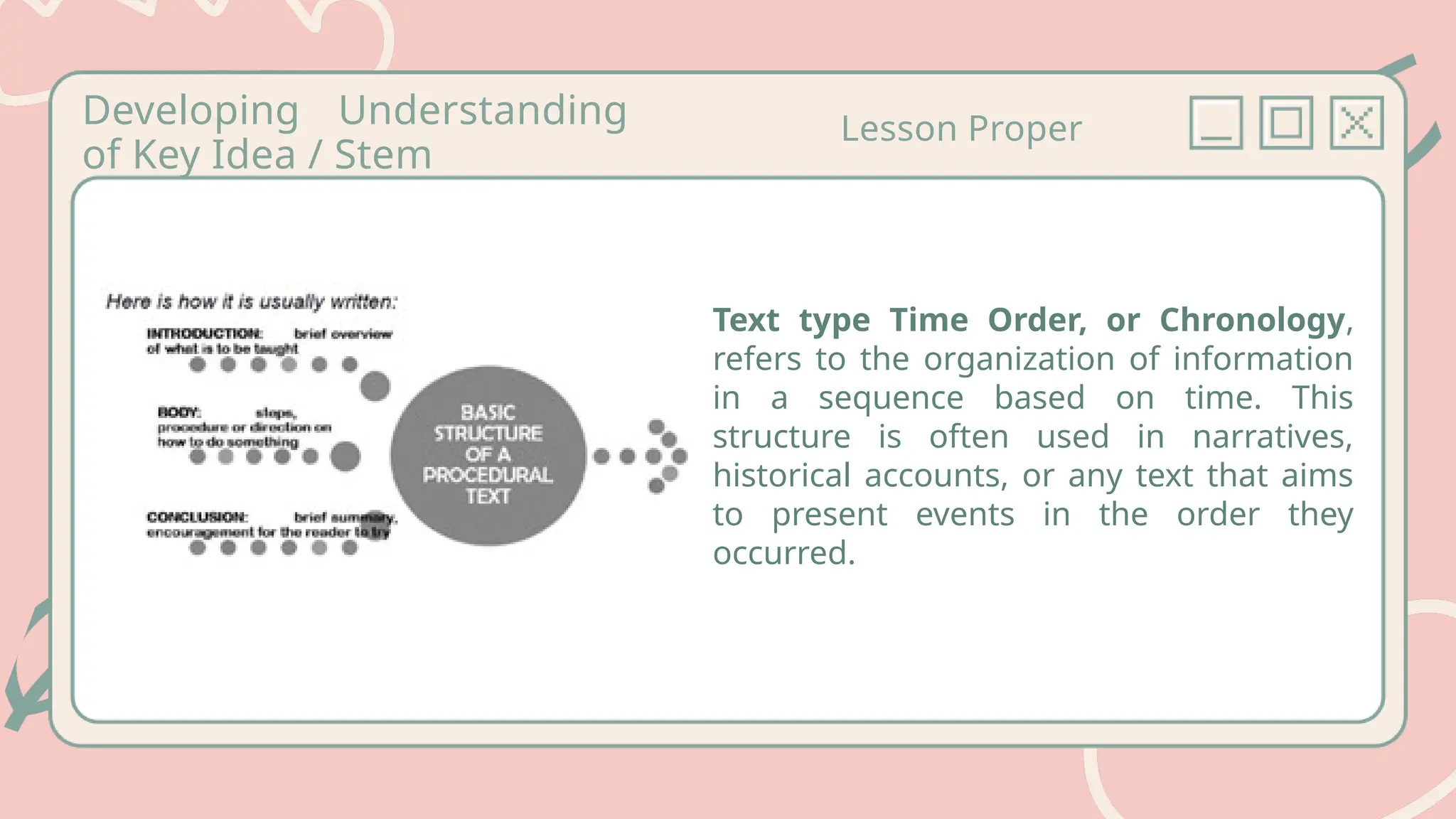
Text type Time Order, or Chronology,
refers to the organization of information
in a sequence based on time. This
structure is often used in narratives,
historical accounts, or any text that aims
to present events in the order they
occurred.
Deepening Understanding
of Key Idea / Stem
Lesson Proper
Here’s a simple example of a text organized in chronological order
A Day in the Life of a Student
• 7:00 AM - I wake up and get ready for school. After a quick breakfast, I grab my
backpack and head out the door.
• 8:00 AM - Classes begin. My first subject is math, where we learn about fractions.
• 9:00 AM - Next, we have English class. We read a chapter from a novel and
discuss the main characters
• 10:30 AM - After a short break, it’s time for science. Today, we conduct an
experiment on plant growth
• 12:00 PM - Lunch! I sit with my friends in the canteen, sharing stories and
enjoying our meals.
• 1:00 PM - The afternoon classes start with history. We learn about ancient
civilizations.
Deepening Understanding
of Key Idea / Stem
Lesson Proper
Example of Text Type: Time Order Procedural
• 2:30 PM - Finally, it’s time for art. I love expressing my creativity through painting.
• 3:30 PM - The school day ends, and I head home, ready to relax and do my
homework
To make a peanut butter and jelly sandwich, start by gathering your ingredients and
tools. You will need two slices of bread, peanut butter, jelly, a butter knife, and a
plate. Once you have everything ready, place one slice of bread on the plate. Use the
butter knife to scoop a generous amount of peanut butter and spread it evenly on
this slice. Next, take the second slice of bread and scoop some jelly, spreading it
evenly as well. After both slices are prepared, carefully place the peanut butter slice
on top of the jelly slice, ensuring that the spreads face each other. If you prefer, you
can then use the knife to cut the sandwich in half or into quarters. Finally, serve the
sandwich on the plate and enjoy your delicious creation!
Making Generalizations and
Abstractions
Post-Lesson Proper
What are the two Text Types we
have discussed? Explain each
text type.
Evaluating Learning Post-Lesson Proper
Quiz: Identify the Text Type
1. A recipe for chocolate chip cookies that lists ingredients and detailed steps to make
them.
Text Type:
2. A timeline detailing the major events of World War II in the order they occurred.
Text Type: ___
3. Instructions for assembling a piece of furniture with numbered steps.
Text Type: ___
Evaluating Learning Post-Lesson Proper
Quiz: Identify the Text Type
4. An article describing the life of a famous scientist, arranged in the order of significant
events in their life.
Text Type: ___
5. A guide on how to change a flat tire, outlining each step involved in the process.
Text Type: ___
Additional Activities for
Application or Remediation
Post-Lesson Proper
Research on examples of Text
Types
1. Chronology
2. Procedural
Share it on class, tomorrow.
(if possible)
DAY 4
Quarter 3 - Week 5
LEARNING
OBJECTIVES
At the end of the lesson, the learners
should be able to draw conclusions and
inferences from the text
QUARTER 3
WEEK 5
CONTENT
FOCUS
Understanding Informational Texts
Historical Narrative (Time Order: Chronological)
• Comprehension and noting details (topic, main idea,
purpose, supporting details)
• Determining textual structure and method of
development: Inductive (pyramid)
• Distinguishing fact from opinion
• Drawing conclusions and inferences
• Summarizing the text
QUARTER 3
WEEK 5
Activating Prior Knowledge Pre-Lesson Proper
Read the selection and choose the best possible ending.
Lesson Purpose / Intention Pre-Lesson Proper
What can you see in the picture? What are they doing?
Lesson Language Practice Pre-Lesson Proper
Read the short story below.
Lesson Language Practice Pre-Lesson Proper
Based on the story above, answer the questions below.
1. Who is the main character in the story?
a. mother b. Dalie c. father
2. Where did the story happen?
a. in the house b. at school c. in the forest
3. What was her mother doing in the kitchen?
a. washing the plates b. planting flowers c. packing food
4. Where are they going?
a. to the mall b. to the beach or resort c. to school
5. What are they celebrating?
a. wedding b. anniversary c. birthday
Reading the Key Idea / Stem Lesson Proper
In the story, for example, Maria’s mother told her to
wear her swim
suit. Based on experience, you would usually wear that
attire when you
go to the beach or a resort. Right?
That is making an inference leading to a conclusion.
Developing Understanding
of Key Idea / Stem
Lesson Proper
Think!
An inference is an idea you form in your mind when you see an event or read
a story. It is done by taking out clues from the story and relating it to what
you already know.
After making an inference, you can then draw a conclusion from it.
A conclusion is a statement you can form that would sum up the ideas and
information you gathered.
Deepening Understanding
of Key Idea / Stem
Lesson Proper
Activity 1
Read the following and encircle the letter that would likely be true
1. Margie woke up to her alarm. She took a bath and ate her breakfast. Then, she wore
her newly ironed uniform.
a. Margie is going to school.
b. Margie is dreaming about her mother.
c. Margie is getting ready to play with her brother.
2. Joshua got his favorite jersey. He filled his bottle with water and placed it in his bag.
He brought a towel and extra shirt, too. He took his basketball and went on.
a. He is going for a swim.
b. Joshua went to a basketball game.
c. He and his friends is going to have a walk.
Deepening Understanding
of Key Idea / Stem
Lesson Proper
Activity 1
3. The teacher went inside the classroom. He told the class to get a clean sheet of paper.
The class was so silent. Then, the teacher said “Pass your papers!”
a. They had a quiz.
b. The teacher scolded them.
c. The teacher discussed a new lesson.
4. Camille went to the kitchen. She heated the pan and put oil. Then, she grabbed the
marinated chicken from the refrigerator.
a. Camille is cooking rice.
b. Camille is cooking fried chicken.
c. Camille is cooking her mother’s favorite Afritada.
Deepening Understanding
of Key Idea / Stem
Lesson Proper
Activity 1
5. Erika wore her favorite pajamas. Then, she brushed her teeth. She turned off the
lights and laid down.
a. She went to sleep.
b. Erika prepared for work.
c. Erika played with her cat
Making Generalizations and
Abstractions
Post-Lesson Proper
Choose the best inference about each of the pictures below.
Encircle the letter of your answer.
Evaluating Learning Post-Lesson Proper
Direction: Read the selection and choose the statement that would probably be true using
your inference. Encircle the letter of the correct answer.
1. Nathan ate his breakfast. He wore his favorite shirt. He sat by the sofa facing the
television. Then, he heard a knock on the
door.
a. Nathan’s friend came to visit him.
b. He went to sleep.
c. Nathan slept on the sofa.
2. It was 6:00 O’clock in the morning when Alyssa heard a loud noise. She went to check on it
and found shattered glass on the floor. She saw her cat on top of the table beside the other
plates.
a. Her cat is eating breakfast.
b. Alyssa’s cat accidentally bumped into some of the plates and breaking it.
c. Alyssa went back to sleep.
Evaluating Learning Post-Lesson Proper
3. Mr. Jusayan got up early. He ate his breakfast and went to his car. In his workplace, he
wore a white coat with a stethoscope on his neck.
a. Mr. Jusayan likes to draw.
b. Mr. Jusayan is a doctor.
c. Mr. Jusayan is a teacher.
4. Ms. Sabijon went in a classroom. She told the class to get a clean sheet of paper. She
posted something on the board. After 30 minutes, Ms. Sabijon instructed “Pass your papers
in front.”
a. Ms. Sabijon is bored.
b. Ms. Sabijon took an exam.
c. Ms. Sabijon gave her pupils a quiz.
Evaluating Learning Post-Lesson Proper
5. Eliezer took a bath early. He got his drawing book, pencil and coloring materials. Then, he
went out to see the sunrise.
a. Eliezer ate his breakfast outside.
b. Eliezer went out to draw the sunrise.
c. Eliezer likes to sing in front of the sun.
Additional Activities for
Application or Remediation
Post-Lesson Proper
(if possible)
Direction: Based on your inference, complete the paragraphs below by filling in the
blank.
1. I wear a white coat. I check on patients so they may feel better. I am a ___________.
2. I listened to my teacher. I make sure to understand the lesson so that I can do well in
my exams. I am a ___________.
3. Every day I make sure that my pupils will enjoy learning. I prepare loads of activities
for them to enjoy and learn from. I am a _________.
4. I cook meals. I make sure that the food I make is delicious and presentable. I am a
________.
5. I take care of your teeth. I clean it with my tools. When needed, I provide you with a
toothbrush and a toothpaste. I am a
__________.
DAY 5
Quarter 3 - Week 5
LEARNING
OBJECTIVES
At the end of the lesson, the learners
should be able to distinguish fact from
opinion (statements of facts, opinions,
and fact-based statements of opinion);
produce a summary of a given text.
QUARTER 3
WEEK 5
Activating Prior Knowledge Pre-Lesson Proper
Read the story and write a reaction based on the guide questions provided.
A Ride on a Bus
Lea E. Basquinas
One day, Sandra and her mother, Aling Rosa, rode a bus to reach Sandra’s school. A mother
with four children was on the same bus.
“Excuse me, may I take a seat because I have four children with me,” said the mother to the
passengers.
“Mom, can I just sit on your lap?” asked Sandra to her mother.
“Well, can’t you see? The bus is already full,” replied one of the passengers.
Sandra pitied the mother because there was no one on the bus that would let her sit or any
of her children.
Activating Prior Knowledge Pre-Lesson Proper
“But why Sandra?” asked Aling Rosa. “I have already paid our fare,” she added.
“Look at them, Mama. I believe they might bump with each other and get hurt if they can’t
sit down,” explained Sandra. “In my opinion, the mother looks frail because of her age,” she
added.
1. Who are the characters in the story?
2. Describe each character.
3. What can you say about the story?
“Alright my daughter, sit on my lap so that she could sit beside us,” said Aling Rosa, as she
called the mother with four children.
The mother thanked Aling Rosa and Sandra.
Lesson Purpose / Intention Pre-Lesson Proper
Have you ever experienced attending a simple
thanksgiving party? When was that? How was
your experience?
Lesson Language Practice Pre-Lesson Proper
Read the story.
Simple Celebration
Lea E. Basquinas
“Hello, Kumareng Connie and Kumpareng Kardo. Good morning!” said Aling Myrna. “How are
your children?”
“Oh, hi there Mareng Myrna. Good morning too,” replied Aling Connie.
“Our children are okay. Ric is now in the army. Ana is now studying education and our
youngest Ada is in grade 4,” said Mang Kardo.
“Oh it’s nice to hear that,” said Aling Myrna. “Moises is now a fireman. Riza my daughter and
your daughter Anna are classmates. And our youngest Mark is in grade 4, one of the
classmates of Ada, your youngest,” added.
“Oh, yes! Anna and Riza are classmates and so are Mark and Ada. They are friends,” replied
Mang Kardo
Lesson Language Practice Pre-Lesson Proper
“I came here to invite your family personally, Mareng Connie,” said Aling Myrna. “There will be
a thanksgiving party in our house tomorrow evening, just a simple celebration because I am
promoted as supervisor of the LEBB Corporation,” she also added.
“Wow! Congratulations Mareng Myrna, that is women empowerment. We are so proud of
you,” greeted Aling Connie. “I believe you are really fit in that position.”
“That’s right, women empowerment. Congratulations Mareng Myrna. We will be there
together with the children of course,” uttered Mang Kardo. “It seems the children would love
to attend too.”
“Thank you, Mareng Connie and Pareng Kardo. I think my children will be glad to see you with
your children,” replied Aling Myrna. “I’ll go ahead now.”
Lesson Language Practice Pre-Lesson Proper
1. Who are the characters in the story?
2. What is the celebration in Aling Myrna’s house?
3. Why did Aling Myrna invite Aling Connie’s family?
4. What sentence expresses fact?
5. What sentence expresses an opinion
Reading the Key Idea / Stem Lesson Proper
What is a fact?
A fact is something that is true and supported by evidence.
What is an opinion?
An opinion is only a belief. It is also an expression of a person’s
feelings. Clue words like “think,” “believe,” “feel,” “probably,” or
“seems” signal an opinion.
Example: Perhaps only sons should be treated well.
Developing Understanding
of Key Idea / Stem
Lesson Proper
Read each sentence carefully. Write F if the sentence expresses fact and O if
the sentence expresses an opinion.
1. There will be a thanksgiving party at Aling Myrna’s house.
2. Aling Myrna was promoted as supervisor.
3. I believe you really fit in that position.
4. Riza my daughter and Anna your daughter are classmates.
5. I think my children will be glad to see you.
Deepening Understanding
of Key Idea / Stem
Lesson Proper
Your task is to write 3 sentences expressing facts and 3 sentences expressing
opinions. Write your answers in your answer sheets.
Fact:
1.
2.
3.
Opinion:
1.
2.
3.
Making Generalizations and
Abstractions
Post-Lesson Proper
What is a Fact?
What is an Opinion?
Evaluating Learning Post-Lesson Proper
Directions: Write F on the blank if the sentence expresses a fact and O if it expresses an
opinion. Write your answers on your answer sheet.
______ 1. Independence Day is celebrated in June.
______ 2. I believe honest children are loved by everyone.
______ 3. The Philippines is an archipelago.
______ 4. Bats are nocturnal animals.
______ 5. Perhaps children who misbehave need more attention.
_______6. We live in the best apartment in the city.
______ 7. I believe that summer is the best season.
______ 8. I think that spaghetti is a delicious meal.
______ 9. An Inquirer is a newspaper.
______ 10. Banana is a source of potassium
Additional Activities for
Application or Remediation
Post-Lesson Proper
(if possible)
Write 3 sentences that express fact. Then, convert
these sentences into opinions.

PPT_ENGLISH_G4_Q3_W5.pptx...............

  • 1.
    English 4 EN4LR-III-2: Comprehendinformational texts Lesson Objectives: At the end of the lesson, the learners should be able to 1.note important information through outlining (topic, main idea, supporting details): inductive organization (pyramid); 2. glean the writer’s purpose: a. to recount; b. to entertain; c. to inform, explain, describe 3. identify text types according to the method of development and organizational structure: a. time order: chronology; b. time order: procedural; QUARTER 3 - WEEK 5
  • 2.
    English 4 4. drawconclusions and inferences from the text; 5. distinguish fact from opinion (statements of facts, opinions, and fact-based statements of opinion); 6. produce a summary of a given text. QUARTER 3 - WEEK 5 EN4SW-III-5: Express ideas appropriately (age-appropriate, gender- responsive, culture-sensitive) for one’s purpose, context, and target audience. Lesson Objectives: At the end of the lesson, the learners should be able to 1.recount/narrate an event or experience or describe a process in relation to a given theme.
  • 3.
  • 4.
    LEARNING OBJECTIVES At the endof the lesson, the learners should be able to note important information through outlining (topic, main idea, supporting details): inductive organization (pyramid) QUARTER 3 WEEK 5
  • 5.
    CONTENT FOCUS Understanding Informational Texts HistoricalNarrative (Time Order: Chronological) • Comprehension and noting details (topic, main idea, purpose, supporting details) • Determining textual structure and method of development: Inductive (pyramid) • Distinguishing fact from opinion • Drawing conclusions and inferences • Summarizing the text QUARTER 3 WEEK 5
  • 6.
    Directions: In thespace before each number, draw a heart if the given statement is true and a circle if it is false. Activating Prior Knowledge Pre-Lesson Proper
  • 7.
    Lesson Purpose /Intention Pre-Lesson Proper • What do you see in the picture? What do you think is happening? • Where do you think this event took place? Who do you think were the people involved? The teacher will introduce historical narratives/accounts as another type of informational text. The teacher may say, “Are historical accounts or narratives considered informational texts? If yes, why do you think this is so? To help us answer this question, we will read about a significant event in Philippine history.”
  • 8.
    Lesson Language PracticePre-Lesson Proper Directions: Read each sentence and determine the meaning of the underlined word. Then, circle the letter of your answer from the given choices. 1. The weather today is contrary to what the forecast predicted. It is sunny instead of rainy. a. similar b. different c. related d. detailed 2. The actual number of students in the classroom is 25, not 30 as mentioned earlier. a. imaginary b. real c. large d. colorful 3. After a long day of fishing, Mang Jose and other fishers settled near the shore and ate boiled purple yam for snacks. a. climbed b. jumped c. docked d. floated
  • 9.
    Lesson Language PracticePre-Lesson Proper 4. Invading the enemy’s territory, the army bravely marched towards the walled city. a. protecting b. taking over c. destroying d. coming in 5. The group of scientists embarked on a thrilling expedition to study rare plants in the Amazon rainforest. a. argument b. journey c. discovery d. speed 6. The keen-eyed zookeeper spotted the missing deer trapped in the bushes near the river and immediately rescued it. a. saw b. ignored c. covered d. called 7. The cabin crew of the plane made sure that the passengers were safe during the whole flight. They worked together to take care of the passengers. a. captain b. team c. waiter d. server
  • 10.
    Lesson Language PracticePre-Lesson Proper 8. The tourist approached the tour guide and asked her for a map. a. came near b. stayed away c. jumped off d. ran along 9. The young girl showed great courtesy by holding the door open for the elderly lady. a. rudeness b. shyness c. anger d. kindness 10. The fruit vendor displayed a variety of figs at his stall in the market. Figs have a similar taste to strawberry. a. a kind of leaf b. a kind of fruit c. a kind of bread d. a kind of flower
  • 11.
    Reading the KeyIdea / Stem Lesson Proper The teacher will let learners read a historical narrative about the arrival of Ferdinand Magellan in Mactan. The following should be provided beforehand to guide learners in their reading of the text: • What is the narrative about? • What do you think is the purpose of the writer? • What specific details does the writer share in this article? How are the details organized?
  • 12.
    Developing Understanding of KeyIdea / Stem Lesson Proper The teacher will then divide the class into groups. Learners will work together in accomplishing the following template:
  • 13.
    Deepening Understanding of KeyIdea / Stem Lesson Proper What do we mean by Main Idea? Supporting Details? A main idea is the main point a writer wants the reader to come away with. Supporting details are the information, facts, or points of discussion the writer gives to tell more about this main idea. • What is the main idea of the article? • What are the supporting details in the article.
  • 14.
    Making Generalizations and Abstractions Post-LessonProper Directions for the narrative pyramid: Fill out the narrative pyramid with the information asked. Boxes beside the pyramid may be used as extra space for writing. 1. List down the names or names of the people the text talks about. 2. Write down two characteristics of each of these people that the text talks about. 3. Describe the setting in three words. 4. Write down four important events that happened. 5. Write down the main idea of the writer.
  • 15.
    Evaluating Learning Post-LessonProper Directions for the narrative timeline: Present in a chronological manner the four important events you identified earlier in the narrative pyramid. You may refer to the sample timeline in coming up with your own narrative timeline.
  • 16.
    Additional Activities for Applicationor Remediation Post-Lesson Proper Read about writer’s purpose: a. to recount; b. to entertain; c. to inform, explain, describe (if possible)
  • 17.
  • 18.
    LEARNING OBJECTIVES At the endof the lesson, the learners should be able to glean the writer’s purpose: a. to recount; b. to entertain; c. to inform, explain, describe QUARTER 3 WEEK 5
  • 19.
    CONTENT FOCUS Understanding Informational Texts HistoricalNarrative (Time Order: Chronological) • Comprehension and noting details (topic, main idea, purpose, supporting details) • Determining textual structure and method of development: Inductive (pyramid) • Distinguishing fact from opinion • Drawing conclusions and inferences • Summarizing the text QUARTER 3 WEEK 5
  • 20.
    Activity 1: “I’mgood at something!” The teacher will give the students a piece of paper. The teacher will ask the students to write a word or two that they think they are really good at. After writing, the teacher will ask some students to share their answer/s and try to answer this question: 1. Why do you think you’re good in that? Activating Prior Knowledge Pre-Lesson Proper
  • 21.
    Lesson Purpose /Intention Pre-Lesson Proper Ananse: The Pot of Wisdom By: Adwoa Badoe One day Ananse collected all the wisdom in the world and decided to keep it all in a large pot for himself. Now he said,”I have all the wisdom of the world for myself.” At least that was what he thought being such a greedy person. Kweku Ananse then tied the pot of wisdom around his neck with a strong vine rope and let the pot hang in front of him. But then he afraid that someone would find the pot of wisdom and steal it. “What shall I do with my pot of wisdom?” He thought and thought and at last he said,”I shall hide the pot on top of the tallest tree in the forest.” So he searched the forest until he found the tallest tree which happened to be the thorny silk cotton tree and brought the pot of wisdom to the tree. While Ananse was trying to climb the thorny silk cotton tree his son was watching him.
  • 22.
    Lesson Purpose /Intention Pre-Lesson Proper ”Father?” he said, "What are you doing?" "Well" said Ananse, “I have in this clay pot all the wisdom of the world and I am going to hang it on the top of the tallest tree away from everybody. Then I will be the wisest in the whole wide world." "I have an idea." said his son. "Why not hang the pot behind you instead of in front of you. Then you will be able to climb the tree?” Well the sly one Ananse hung the pot behind him and to his surprise; he was able to climb to the top of the tree with his pot. Finally Ananse sat on a branch of the tree holding the pot of wisdom. “I thought I had all the wisdom in the world?” He thought to himself. “I thought I had it all in my pot but my own son has wisdom not in my pot?” Then he made a statement that we still use today. “No oneperson can have all the wisdom in the world.” On his way down he dropped the pot and it smashed into many pieces and scatted all the wisdom all over the world
  • 23.
    Identify the writer’spurpose. Lesson Purpose / Intention Pre-Lesson Proper One day Ananse collected all the wisdom in the world and decided to keep it all in a large pot for himself. Now he said,”I have all the wisdom of the world for myself.” At least that was what he thought being such a greedy person. Kweku Ananse then tied the pot of wisdom around his neck with a strong vine rope and let the pot hang in front of him. But then he was afraid that someone would find the pot of wisdom and steal it. “What shall I do with my pot of wisdom?” He thought and thought and at last he said,”I shall hide the pot on top of the tallest tree in the forest.” So he searched the forest until he found the tallest tree which happened to be the thorny silk cotton tree and brought the pot of wisdom to the tree. While Ananse was trying to climb the thorny silk cotton tree his son was watching him. ”Father?” he said, "What are you doing?" "Well" said Ananse, “I have in this clay pot all the wisdom of the world and I am going to hang it on the top of the tallest tree away from everybody.
  • 24.
    Lesson Purpose /Intention Pre-Lesson Proper Then I will be the wisest in the whole wide world." "I have an idea." said his son. "Why not hang the pot behind you instead of in front of you. Then you will be able to climb the tree?” Well the sly one Ananse hung the pot behind him and to his surprise; he was able to climb to the top of the tree with his pot. Finally Ananse sat on a branch of the tree holding the pot of wisdom. “I thought I had all the wisdom in the world?” He thought to himself. “I thought I had it all in my pot but my own son has wisdom not in my pot?” Then he made a statement that we still use today. “No oneperson can have all the wisdom in the world.” On his way down he dropped the pot and it smashed into many pieces and scatted all the wisdom all over the world.
  • 25.
    Lesson Language PracticePre-Lesson Proper The class will process their understanding of the story by answering the following questions: 1. What do you think the story was all about (theme)? 2. What have you learned in the story? 3. How will it help you become a better person? 4. Why do you think the author wrote this story?
  • 26.
    Reading the KeyIdea / Stem Lesson Proper AUTHOR’S PURPOSE The teacher will discuss about the different types of purposes that the authors have. • An author’s purpose is his reason for or intent in writing. • An author’s purpose may be to amuse the reader, to recount/relate, to entertain or inform, explain, describe.
  • 27.
    Developing Understanding of KeyIdea / Stem Lesson Proper a. To Recount This purpose focuses on telling a story or sharing an experience, often in a chronological order. It can include personal anecdotes or historical accounts. The main goal is to provide a narrative that recounts events, feelings, and reflections. b. To Entertain This purpose aims to engage the reader’s imagination or emotions through humor, drama, or intrigue. Entertaining writing can include fiction, poetry, or light-hearted essays. The primary goal is to provide enjoyment and amusement, often through relatable characters, exciting plots, or witty language
  • 28.
    Developing Understanding of KeyIdea / Stem Lesson Proper c. To Inform, Explain, Describe This purpose is about delivering information, clarifying concepts, or providing detailed descriptions. It’s common in academic writing, articles, and instructional texts. The goal is to educate the reader by explaining facts, processes, or observations in a clear and straightforward manner. Each purpose serves a different function and engages readers in unique ways!
  • 29.
    Deepening Understanding of KeyIdea/ Stem Lesson Proper Here are examples of passages for each writer's purpose: a. To Recount Passage: "As I sat on the porch, sipping my coffee, I remembered that summer day in 2015 when my family and I embarked on a road trip across the country. We packed the car early in the morning, excitement buzzing in the air. I can still hear my little brother asking, 'Are we there yet?' every twenty minutes. We visited national parks, took countless photos, and shared stories that still make us laugh."
  • 30.
    Deepening Understanding of KeyIdea/ Stem Lesson Proper b. To Entertain Passage: "It was a typical Tuesday until I discovered that my cat, Whiskers, had a hidden talent for breakdancing. I was minding my own business, trying to work, when I heard a thump followed by a curious meow. I looked over to find him spinning on the kitchen floor, his furry paws flailing like a tiny dancer. I couldn’t help but burst into laughter as he flipped over and landed in a heap, looking utterly confused yet proud."
  • 31.
    Deepening Understanding of KeyIdea/ Stem Lesson Proper c. To Inform, Explain, Describe Passage: "Photosynthesis is the process by which green plants convert sunlight into energy. During this process, chlorophyll in the leaves captures sunlight, which is then used to convert carbon dioxide from the air and water from the soil into glucose and oxygen. This not only provides energy for the plant but also releases oxygen into the atmosphere, which is essential for life on Earth."
  • 32.
    Making Generalizations and Abstractions Post-LessonProper Summary: To recount focuses on storytelling and personal experiences. To entertain seeks to engage and amuse the reader. To inform, explain, describe is about educating and clarifying concepts.
  • 33.
    Evaluating Learning Post-LessonProper Choose the option that best fits each statement: 1. A memoir detailing personal life experiences and lessons learned. a. to recount b. to entertain c. to inform, explain, describe 2. A humorous short story about a day gone wrong at a family reunion. a. to recount b. to entertain c. to inform, explain, describe 3. An article explaining how photosynthesis works in plants. a. to recount b. to entertain c. to inform, explain,
  • 34.
    Evaluating Learning Post-LessonProper Choose the option that best fits each statement: 4. A diary entry reflecting on a recent trip and the emotions felt during it. a. to recount b. to entertain c. to inform, explain, describe 5. A documentary script presenting the effects of climate change on wildlife. a. to recount b. to entertain c. to inform, explain, describe
  • 35.
    Additional Activities for Applicationor Remediation Post-Lesson Proper The students will do an advance study for the next lesson. (if possible)
  • 36.
  • 37.
    LEARNING OBJECTIVES At the endof the lesson, the learners should be able to identify text types according to the method of development and organizational structure: a. time order: chronology; b. time order: procedural QUARTER 3 WEEK 5
  • 38.
    CONTENT FOCUS Understanding Informational Texts HistoricalNarrative (Time Order: Chronological) • Comprehension and noting details (topic, main idea, purpose, supporting details) • Determining textual structure and method of development: Inductive (pyramid) • Distinguishing fact from opinion • Drawing conclusions and inferences • Summarizing the text QUARTER 3 WEEK 5
  • 39.
    Identify the writer’spurpose. Activating Prior Knowledge Pre-Lesson Proper 1. A personal letter describing a recent vacation and the fun activities enjoyed. a. to recount b. to entertain c. to inform, explain, describe 2. A comic strip featuring a clumsy superhero trying to save the day but causing more chaos. a. to recount b. to entertain c. to inform, explain, describe 3. An instructional guide on how to bake a chocolate cake, detailing each step and ingredient. a. to recount b. to entertain c. to inform, explain, describe
  • 40.
    Lesson Purpose /Intention Pre-Lesson Proper Try to remember the important details from the text.
  • 41.
    Lesson Language PracticePre-Lesson Proper Read the paragraphs and answer the questions after each. 1. What does the text teach you? 2. What steps should you follow? 3. Were the directions clear? What words helped you know the correct steps to do?
  • 42.
    Reading the KeyIdea / Stem Lesson Proper What is text-type? Text-type refers to the classification and definition of the way a text is written such as its structure, purpose, and language features.
  • 43.
    Developing Understanding of KeyIdea / Stem Lesson Proper A text type tells the procedure, directions, or steps on how to do something. Examples: 1. recipe (steps in cooking) 2. steps in solving word problems 3. dance steps 4. creating crafts 5. going to places It makes use of the signal words First, Next, Then, Finally. This text type is called PROCEDURAL/SEQUENCE TEXT.
  • 44.
    Developing Understanding of KeyIdea / Stem Lesson Proper Text type Time Order, or Chronology, refers to the organization of information in a sequence based on time. This structure is often used in narratives, historical accounts, or any text that aims to present events in the order they occurred.
  • 45.
    Deepening Understanding of KeyIdea / Stem Lesson Proper Here’s a simple example of a text organized in chronological order A Day in the Life of a Student • 7:00 AM - I wake up and get ready for school. After a quick breakfast, I grab my backpack and head out the door. • 8:00 AM - Classes begin. My first subject is math, where we learn about fractions. • 9:00 AM - Next, we have English class. We read a chapter from a novel and discuss the main characters • 10:30 AM - After a short break, it’s time for science. Today, we conduct an experiment on plant growth • 12:00 PM - Lunch! I sit with my friends in the canteen, sharing stories and enjoying our meals. • 1:00 PM - The afternoon classes start with history. We learn about ancient civilizations.
  • 46.
    Deepening Understanding of KeyIdea / Stem Lesson Proper Example of Text Type: Time Order Procedural • 2:30 PM - Finally, it’s time for art. I love expressing my creativity through painting. • 3:30 PM - The school day ends, and I head home, ready to relax and do my homework To make a peanut butter and jelly sandwich, start by gathering your ingredients and tools. You will need two slices of bread, peanut butter, jelly, a butter knife, and a plate. Once you have everything ready, place one slice of bread on the plate. Use the butter knife to scoop a generous amount of peanut butter and spread it evenly on this slice. Next, take the second slice of bread and scoop some jelly, spreading it evenly as well. After both slices are prepared, carefully place the peanut butter slice on top of the jelly slice, ensuring that the spreads face each other. If you prefer, you can then use the knife to cut the sandwich in half or into quarters. Finally, serve the sandwich on the plate and enjoy your delicious creation!
  • 47.
    Making Generalizations and Abstractions Post-LessonProper What are the two Text Types we have discussed? Explain each text type.
  • 48.
    Evaluating Learning Post-LessonProper Quiz: Identify the Text Type 1. A recipe for chocolate chip cookies that lists ingredients and detailed steps to make them. Text Type: 2. A timeline detailing the major events of World War II in the order they occurred. Text Type: ___ 3. Instructions for assembling a piece of furniture with numbered steps. Text Type: ___
  • 49.
    Evaluating Learning Post-LessonProper Quiz: Identify the Text Type 4. An article describing the life of a famous scientist, arranged in the order of significant events in their life. Text Type: ___ 5. A guide on how to change a flat tire, outlining each step involved in the process. Text Type: ___
  • 50.
    Additional Activities for Applicationor Remediation Post-Lesson Proper Research on examples of Text Types 1. Chronology 2. Procedural Share it on class, tomorrow. (if possible)
  • 51.
  • 52.
    LEARNING OBJECTIVES At the endof the lesson, the learners should be able to draw conclusions and inferences from the text QUARTER 3 WEEK 5
  • 53.
    CONTENT FOCUS Understanding Informational Texts HistoricalNarrative (Time Order: Chronological) • Comprehension and noting details (topic, main idea, purpose, supporting details) • Determining textual structure and method of development: Inductive (pyramid) • Distinguishing fact from opinion • Drawing conclusions and inferences • Summarizing the text QUARTER 3 WEEK 5
  • 54.
    Activating Prior KnowledgePre-Lesson Proper Read the selection and choose the best possible ending.
  • 55.
    Lesson Purpose /Intention Pre-Lesson Proper What can you see in the picture? What are they doing?
  • 56.
    Lesson Language PracticePre-Lesson Proper Read the short story below.
  • 57.
    Lesson Language PracticePre-Lesson Proper Based on the story above, answer the questions below. 1. Who is the main character in the story? a. mother b. Dalie c. father 2. Where did the story happen? a. in the house b. at school c. in the forest 3. What was her mother doing in the kitchen? a. washing the plates b. planting flowers c. packing food 4. Where are they going? a. to the mall b. to the beach or resort c. to school 5. What are they celebrating? a. wedding b. anniversary c. birthday
  • 58.
    Reading the KeyIdea / Stem Lesson Proper In the story, for example, Maria’s mother told her to wear her swim suit. Based on experience, you would usually wear that attire when you go to the beach or a resort. Right? That is making an inference leading to a conclusion.
  • 59.
    Developing Understanding of KeyIdea / Stem Lesson Proper Think! An inference is an idea you form in your mind when you see an event or read a story. It is done by taking out clues from the story and relating it to what you already know. After making an inference, you can then draw a conclusion from it. A conclusion is a statement you can form that would sum up the ideas and information you gathered.
  • 60.
    Deepening Understanding of KeyIdea / Stem Lesson Proper Activity 1 Read the following and encircle the letter that would likely be true 1. Margie woke up to her alarm. She took a bath and ate her breakfast. Then, she wore her newly ironed uniform. a. Margie is going to school. b. Margie is dreaming about her mother. c. Margie is getting ready to play with her brother. 2. Joshua got his favorite jersey. He filled his bottle with water and placed it in his bag. He brought a towel and extra shirt, too. He took his basketball and went on. a. He is going for a swim. b. Joshua went to a basketball game. c. He and his friends is going to have a walk.
  • 61.
    Deepening Understanding of KeyIdea / Stem Lesson Proper Activity 1 3. The teacher went inside the classroom. He told the class to get a clean sheet of paper. The class was so silent. Then, the teacher said “Pass your papers!” a. They had a quiz. b. The teacher scolded them. c. The teacher discussed a new lesson. 4. Camille went to the kitchen. She heated the pan and put oil. Then, she grabbed the marinated chicken from the refrigerator. a. Camille is cooking rice. b. Camille is cooking fried chicken. c. Camille is cooking her mother’s favorite Afritada.
  • 62.
    Deepening Understanding of KeyIdea / Stem Lesson Proper Activity 1 5. Erika wore her favorite pajamas. Then, she brushed her teeth. She turned off the lights and laid down. a. She went to sleep. b. Erika prepared for work. c. Erika played with her cat
  • 63.
    Making Generalizations and Abstractions Post-LessonProper Choose the best inference about each of the pictures below. Encircle the letter of your answer.
  • 64.
    Evaluating Learning Post-LessonProper Direction: Read the selection and choose the statement that would probably be true using your inference. Encircle the letter of the correct answer. 1. Nathan ate his breakfast. He wore his favorite shirt. He sat by the sofa facing the television. Then, he heard a knock on the door. a. Nathan’s friend came to visit him. b. He went to sleep. c. Nathan slept on the sofa. 2. It was 6:00 O’clock in the morning when Alyssa heard a loud noise. She went to check on it and found shattered glass on the floor. She saw her cat on top of the table beside the other plates. a. Her cat is eating breakfast. b. Alyssa’s cat accidentally bumped into some of the plates and breaking it. c. Alyssa went back to sleep.
  • 65.
    Evaluating Learning Post-LessonProper 3. Mr. Jusayan got up early. He ate his breakfast and went to his car. In his workplace, he wore a white coat with a stethoscope on his neck. a. Mr. Jusayan likes to draw. b. Mr. Jusayan is a doctor. c. Mr. Jusayan is a teacher. 4. Ms. Sabijon went in a classroom. She told the class to get a clean sheet of paper. She posted something on the board. After 30 minutes, Ms. Sabijon instructed “Pass your papers in front.” a. Ms. Sabijon is bored. b. Ms. Sabijon took an exam. c. Ms. Sabijon gave her pupils a quiz.
  • 66.
    Evaluating Learning Post-LessonProper 5. Eliezer took a bath early. He got his drawing book, pencil and coloring materials. Then, he went out to see the sunrise. a. Eliezer ate his breakfast outside. b. Eliezer went out to draw the sunrise. c. Eliezer likes to sing in front of the sun.
  • 67.
    Additional Activities for Applicationor Remediation Post-Lesson Proper (if possible) Direction: Based on your inference, complete the paragraphs below by filling in the blank. 1. I wear a white coat. I check on patients so they may feel better. I am a ___________. 2. I listened to my teacher. I make sure to understand the lesson so that I can do well in my exams. I am a ___________. 3. Every day I make sure that my pupils will enjoy learning. I prepare loads of activities for them to enjoy and learn from. I am a _________. 4. I cook meals. I make sure that the food I make is delicious and presentable. I am a ________. 5. I take care of your teeth. I clean it with my tools. When needed, I provide you with a toothbrush and a toothpaste. I am a __________.
  • 68.
  • 69.
    LEARNING OBJECTIVES At the endof the lesson, the learners should be able to distinguish fact from opinion (statements of facts, opinions, and fact-based statements of opinion); produce a summary of a given text. QUARTER 3 WEEK 5
  • 70.
    Activating Prior KnowledgePre-Lesson Proper Read the story and write a reaction based on the guide questions provided. A Ride on a Bus Lea E. Basquinas One day, Sandra and her mother, Aling Rosa, rode a bus to reach Sandra’s school. A mother with four children was on the same bus. “Excuse me, may I take a seat because I have four children with me,” said the mother to the passengers. “Mom, can I just sit on your lap?” asked Sandra to her mother. “Well, can’t you see? The bus is already full,” replied one of the passengers. Sandra pitied the mother because there was no one on the bus that would let her sit or any of her children.
  • 71.
    Activating Prior KnowledgePre-Lesson Proper “But why Sandra?” asked Aling Rosa. “I have already paid our fare,” she added. “Look at them, Mama. I believe they might bump with each other and get hurt if they can’t sit down,” explained Sandra. “In my opinion, the mother looks frail because of her age,” she added. 1. Who are the characters in the story? 2. Describe each character. 3. What can you say about the story? “Alright my daughter, sit on my lap so that she could sit beside us,” said Aling Rosa, as she called the mother with four children. The mother thanked Aling Rosa and Sandra.
  • 72.
    Lesson Purpose /Intention Pre-Lesson Proper Have you ever experienced attending a simple thanksgiving party? When was that? How was your experience?
  • 73.
    Lesson Language PracticePre-Lesson Proper Read the story. Simple Celebration Lea E. Basquinas “Hello, Kumareng Connie and Kumpareng Kardo. Good morning!” said Aling Myrna. “How are your children?” “Oh, hi there Mareng Myrna. Good morning too,” replied Aling Connie. “Our children are okay. Ric is now in the army. Ana is now studying education and our youngest Ada is in grade 4,” said Mang Kardo. “Oh it’s nice to hear that,” said Aling Myrna. “Moises is now a fireman. Riza my daughter and your daughter Anna are classmates. And our youngest Mark is in grade 4, one of the classmates of Ada, your youngest,” added. “Oh, yes! Anna and Riza are classmates and so are Mark and Ada. They are friends,” replied Mang Kardo
  • 74.
    Lesson Language PracticePre-Lesson Proper “I came here to invite your family personally, Mareng Connie,” said Aling Myrna. “There will be a thanksgiving party in our house tomorrow evening, just a simple celebration because I am promoted as supervisor of the LEBB Corporation,” she also added. “Wow! Congratulations Mareng Myrna, that is women empowerment. We are so proud of you,” greeted Aling Connie. “I believe you are really fit in that position.” “That’s right, women empowerment. Congratulations Mareng Myrna. We will be there together with the children of course,” uttered Mang Kardo. “It seems the children would love to attend too.” “Thank you, Mareng Connie and Pareng Kardo. I think my children will be glad to see you with your children,” replied Aling Myrna. “I’ll go ahead now.”
  • 75.
    Lesson Language PracticePre-Lesson Proper 1. Who are the characters in the story? 2. What is the celebration in Aling Myrna’s house? 3. Why did Aling Myrna invite Aling Connie’s family? 4. What sentence expresses fact? 5. What sentence expresses an opinion
  • 76.
    Reading the KeyIdea / Stem Lesson Proper What is a fact? A fact is something that is true and supported by evidence. What is an opinion? An opinion is only a belief. It is also an expression of a person’s feelings. Clue words like “think,” “believe,” “feel,” “probably,” or “seems” signal an opinion. Example: Perhaps only sons should be treated well.
  • 77.
    Developing Understanding of KeyIdea / Stem Lesson Proper Read each sentence carefully. Write F if the sentence expresses fact and O if the sentence expresses an opinion. 1. There will be a thanksgiving party at Aling Myrna’s house. 2. Aling Myrna was promoted as supervisor. 3. I believe you really fit in that position. 4. Riza my daughter and Anna your daughter are classmates. 5. I think my children will be glad to see you.
  • 78.
    Deepening Understanding of KeyIdea / Stem Lesson Proper Your task is to write 3 sentences expressing facts and 3 sentences expressing opinions. Write your answers in your answer sheets. Fact: 1. 2. 3. Opinion: 1. 2. 3.
  • 79.
    Making Generalizations and Abstractions Post-LessonProper What is a Fact? What is an Opinion?
  • 80.
    Evaluating Learning Post-LessonProper Directions: Write F on the blank if the sentence expresses a fact and O if it expresses an opinion. Write your answers on your answer sheet. ______ 1. Independence Day is celebrated in June. ______ 2. I believe honest children are loved by everyone. ______ 3. The Philippines is an archipelago. ______ 4. Bats are nocturnal animals. ______ 5. Perhaps children who misbehave need more attention. _______6. We live in the best apartment in the city. ______ 7. I believe that summer is the best season. ______ 8. I think that spaghetti is a delicious meal. ______ 9. An Inquirer is a newspaper. ______ 10. Banana is a source of potassium
  • 81.
    Additional Activities for Applicationor Remediation Post-Lesson Proper (if possible) Write 3 sentences that express fact. Then, convert these sentences into opinions.