Promoting Comprehension
of Text Within the
Common Core State
Standards
Sharon Vaughn, iLit author, University of Texas
Content Area Intervention
This model of instruction was designed to help teachers
develop teaching routines for enhancing instructional
capacity and reading for understanding.
Lesson
Cycle
Comprehension
Canopy
Essential Words
& Warm Ups
Critical Reading
Team Based
Learning:
Comprehension
Checks
Team Based
Learning:
Knowledge
Application
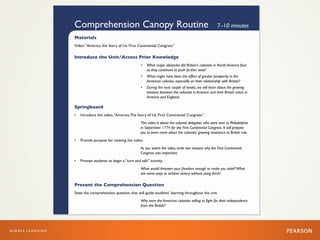
Comprehension Canopy
Comprehension Question
Why were the American colonists willing to fight for their independence
from the British?
Springboards are used to
motivate students and tie
future learning to past
experiences and concepts
A Purposeful “issue question”
guides student reading and
thinking
Essential Words: Introduction
Domain-specific concepts are identified and integrated into
instruction
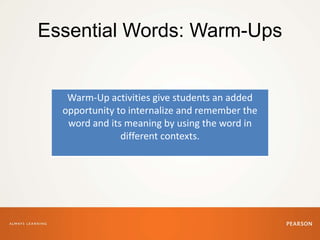
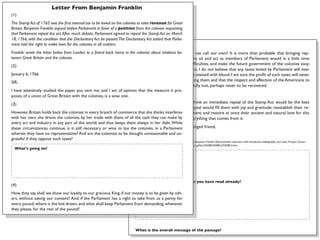
Essential Words: Warm-Ups
Warm-Up activities give students an added
opportunity to internalize and remember the
word and its meaning by using the word in
different contexts.
Critical Reading of Text
Informational text reading throughout the unit
is a teacher-guided process in which student
learning is scaffolded through different
grouping structures
• To facilitate comprehension of informational text
• To provide text support for addressing the
comprehension question
• To provide connections to essential words
• To prepare students for academic discourse during
team-based learning knowledge application
Team Based Learning
Adapted from a university-level practice that provides
opportunities for:
• Individual and group accountability
• Text-based discussion
• Immediate feedback
TBL Comprehension Checks TBL Knowledge Application
Multiple choice
5-10 questions
Designed to encourage discussion
Reading and/or writing team
activity
Students apply knowledge in one of
five purposes for academic
discourse
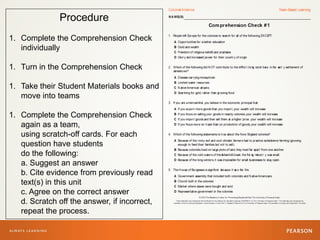
Procedure
1. Complete the Comprehension Check
individually
1. Turn in the Comprehension Check
1. Take their Student Materials books and
move into teams
1. Complete the Comprehension Check
again as a team,
using scratch-off cards. For each
question have students
do the following:
a. Suggest an answer
b. Cite evidence from previously read
text(s) in this unit
c. Agree on the correct answer
d. Scratch off the answer, if incorrect,
repeat the process.
Sample Inference InstructionFollow along as the teacher reads this paragraph. Try to picture the scene in your head.
Where does it take place? Who is talking?
1. What do you think this paragraph is about?
2. Does this take place in the past or in the present?
3. How do you know?
4. What is an "immigrant"?
5. What does "havoc" mean?
"Immigrant families were crowded everywhere, along with boxes and barrels of supplies.
Everything smelled badly. Everywhere you turned, you bumped into someone or fell over a bundle.
It was pure havoc. One or another of the boys was bawling most of the time, especially George. It
took a lot of impatience for me to hit a child, but one night I had had it. In anger, I got up, struck a
match, and lit the kerosene lamp on the wall. My eyes focused on the ceiling quite accidentally and
I saw a mass of crawlers squirming and creeping into crevices. I examined George's body and found
bedbugs crawling about, his body covered with red blotches, and then I knew why he was crying…"
(Hoobbler, p. 101)
Essential Words
• Daily instruction of
overarching concepts.
• Simplified definitions, visuals,
sentence use, think-pair-share
question.
Word Study and
Fluency
• Build reading speed, accuracy
and expression.
• Begins with word reading and
moves to sentence, paragraph,
and whole passages.
• Individualized materials and
instruction based on student
need.
Vocabulary Close Reading
In 1867, a boy found a large, glassy
stone near Kimberley. When it proved to be
a _______________________, fortune
hunters came from all around the world.
From that unexpected beginning, both gold
and diamonds became a major source of
revenue for South Africa.
Text: Close Reading Vocabulary
All around the world, fall is a time to
harvest. It is the result of many months of
work. In spring before anything is planted,
the fields are bare. Farmers plant their
seeds. As the little plants grow, the
farmers care for them. They water them
during the sweltering heat of summer.
They pull weeds and protect the plants
from bugs.
17
Close Text Reading: Teaching
Vocabulary
1. Select text at sentence level for
younger students or less proficient
readers and paragraph level for more
proficient readers. (See Slide 3)
2. Underline key vocabulary words.
3. Make text available to students.
4. Read text aloud together (teachers and
students)
Cont.
5. Ask students to work in pairs or small
groups and to read the text multiple times
using the text as a source for determining
the meaning of the underline word.
6. Students then report out their
understanding of work meaning to class as a
whole.
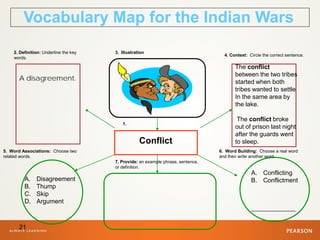
Vocabulary Maps
Components
1. Word Recognition
2. Definitions
3. Illustrations
4. Context
5. Vocabulary Associations
6. Vocabulary Building
7. Application
20
21
3. Illustration
4. Context: Circle the correct sentence.
6. Word Building: Choose a real word
and then write another word.
7. Provide: an example phrase, sentence,
or definition.
5. Word Associations: Choose two
related words.
1.
Conflict
A. Disagreement
B. Thump
C. Skip
D. Argument
A. Conflicting
B. Conflictment
_______________
The conflict
between the two tribes
started when both
tribes wanted to settle
In the same area by
the lake.
The conflict broke
out of prison last night
after the guards went
to sleep.
A disagreement.
2. Definition: Underline the key
words.
Vocabulary Map for the Indian Wars
Vocabulary and
Comprehension
Vocabulary Development
Teacher checks
student
knowledge with a
survey
Vocabulary Development
Students use
context sentences
and mixed media
to determine the
meaning of the
word.
Vocabulary Development
Embedded notes
reinforce
strategies and
support the
teacher if
students struggle
to respond.
Vocabulary Development
While reading
aloud a whole-
class text, the
teacher models
how to
determine the
meaning of the
vocabulary word.
Vocabulary Development
Students define
the terms in their
own words.
Answers are
recorded in the
student journal.
Reading Comprehension
Teacher
introduces
comprehension
strategy.
Reading Comprehension
Teacher reads
aloud a grade-
level anchor text
while the class
follows along.
The Stop icon
indicates a Think
Aloud…
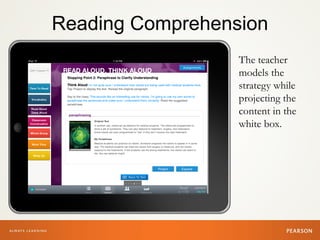
Reading Comprehension
The teacher
models the
strategy while
projecting the
content in the
white box.
Reading Comprehension
Students apply
the skills on a
nonfiction text at
their reading
level. Students
will also write a
summary of the
text.
Learn more at
redefiningliteracy.com
Q & A

August 22, 2013, Pearson iLit Presentation on Common Core

  • 1.
    Promoting Comprehension of TextWithin the Common Core State Standards Sharon Vaughn, iLit author, University of Texas
  • 2.
    Content Area Intervention Thismodel of instruction was designed to help teachers develop teaching routines for enhancing instructional capacity and reading for understanding. Lesson Cycle Comprehension Canopy Essential Words & Warm Ups Critical Reading Team Based Learning: Comprehension Checks Team Based Learning: Knowledge Application
  • 3.
    Comprehension Canopy Comprehension Question Whywere the American colonists willing to fight for their independence from the British? Springboards are used to motivate students and tie future learning to past experiences and concepts A Purposeful “issue question” guides student reading and thinking
  • 5.
    Essential Words: Introduction Domain-specificconcepts are identified and integrated into instruction
  • 6.
    Essential Words: Warm-Ups Warm-Upactivities give students an added opportunity to internalize and remember the word and its meaning by using the word in different contexts.
  • 8.
    Critical Reading ofText Informational text reading throughout the unit is a teacher-guided process in which student learning is scaffolded through different grouping structures • To facilitate comprehension of informational text • To provide text support for addressing the comprehension question • To provide connections to essential words • To prepare students for academic discourse during team-based learning knowledge application
  • 10.
    Team Based Learning Adaptedfrom a university-level practice that provides opportunities for: • Individual and group accountability • Text-based discussion • Immediate feedback TBL Comprehension Checks TBL Knowledge Application Multiple choice 5-10 questions Designed to encourage discussion Reading and/or writing team activity Students apply knowledge in one of five purposes for academic discourse
  • 11.
    Procedure 1. Complete theComprehension Check individually 1. Turn in the Comprehension Check 1. Take their Student Materials books and move into teams 1. Complete the Comprehension Check again as a team, using scratch-off cards. For each question have students do the following: a. Suggest an answer b. Cite evidence from previously read text(s) in this unit c. Agree on the correct answer d. Scratch off the answer, if incorrect, repeat the process.
  • 14.
    Sample Inference InstructionFollowalong as the teacher reads this paragraph. Try to picture the scene in your head. Where does it take place? Who is talking? 1. What do you think this paragraph is about? 2. Does this take place in the past or in the present? 3. How do you know? 4. What is an "immigrant"? 5. What does "havoc" mean? "Immigrant families were crowded everywhere, along with boxes and barrels of supplies. Everything smelled badly. Everywhere you turned, you bumped into someone or fell over a bundle. It was pure havoc. One or another of the boys was bawling most of the time, especially George. It took a lot of impatience for me to hit a child, but one night I had had it. In anger, I got up, struck a match, and lit the kerosene lamp on the wall. My eyes focused on the ceiling quite accidentally and I saw a mass of crawlers squirming and creeping into crevices. I examined George's body and found bedbugs crawling about, his body covered with red blotches, and then I knew why he was crying…" (Hoobbler, p. 101)
  • 15.
    Essential Words • Dailyinstruction of overarching concepts. • Simplified definitions, visuals, sentence use, think-pair-share question. Word Study and Fluency • Build reading speed, accuracy and expression. • Begins with word reading and moves to sentence, paragraph, and whole passages. • Individualized materials and instruction based on student need.
  • 16.
    Vocabulary Close Reading In1867, a boy found a large, glassy stone near Kimberley. When it proved to be a _______________________, fortune hunters came from all around the world. From that unexpected beginning, both gold and diamonds became a major source of revenue for South Africa.
  • 17.
    Text: Close ReadingVocabulary All around the world, fall is a time to harvest. It is the result of many months of work. In spring before anything is planted, the fields are bare. Farmers plant their seeds. As the little plants grow, the farmers care for them. They water them during the sweltering heat of summer. They pull weeds and protect the plants from bugs. 17
  • 18.
    Close Text Reading:Teaching Vocabulary 1. Select text at sentence level for younger students or less proficient readers and paragraph level for more proficient readers. (See Slide 3) 2. Underline key vocabulary words. 3. Make text available to students. 4. Read text aloud together (teachers and students)
  • 19.
    Cont. 5. Ask studentsto work in pairs or small groups and to read the text multiple times using the text as a source for determining the meaning of the underline word. 6. Students then report out their understanding of work meaning to class as a whole.
  • 20.
    Vocabulary Maps Components 1. WordRecognition 2. Definitions 3. Illustrations 4. Context 5. Vocabulary Associations 6. Vocabulary Building 7. Application 20
  • 21.
    21 3. Illustration 4. Context:Circle the correct sentence. 6. Word Building: Choose a real word and then write another word. 7. Provide: an example phrase, sentence, or definition. 5. Word Associations: Choose two related words. 1. Conflict A. Disagreement B. Thump C. Skip D. Argument A. Conflicting B. Conflictment _______________ The conflict between the two tribes started when both tribes wanted to settle In the same area by the lake. The conflict broke out of prison last night after the guards went to sleep. A disagreement. 2. Definition: Underline the key words. Vocabulary Map for the Indian Wars
  • 22.
  • 23.
  • 24.
    Vocabulary Development Students use contextsentences and mixed media to determine the meaning of the word.
  • 25.
    Vocabulary Development Embedded notes reinforce strategiesand support the teacher if students struggle to respond.
  • 26.
    Vocabulary Development While reading alouda whole- class text, the teacher models how to determine the meaning of the vocabulary word.
  • 27.
    Vocabulary Development Students define theterms in their own words. Answers are recorded in the student journal.
  • 28.
  • 29.
    Reading Comprehension Teacher reads alouda grade- level anchor text while the class follows along. The Stop icon indicates a Think Aloud…
  • 30.
    Reading Comprehension The teacher modelsthe strategy while projecting the content in the white box.
  • 31.
    Reading Comprehension Students apply theskills on a nonfiction text at their reading level. Students will also write a summary of the text.
  • 32.
  • 33.